
2009 AMC 12B 真题
计时
1:15:00
1.
Jane 在五天工作周的每天早上都会买一个 美分的松饼或一个 美分的贝果。她这一周的总花费正好是整数美元。她买了多少个贝果?
Each morning of her five-day workweek, Jane bought either a -cent muffin or a -cent bagel. Her total cost for the week was a whole number of dollars. How many bagels did she buy?
小提示:
她一共买了 件东西,所以松饼和贝果的数量之和为 。
She buys items total, so muffins and bagels together number
大提示:
总价 美分必须是 的倍数;把这个总价对 取模。
The total cents must be a multiple of reduce the cost modulo
解答:
若她买了 个贝果,则买了 个松饼,总价为 美分。要使总价为整数美元,它必须是 的倍数,于是 ,即 。因为 ,只有 可行,此时总价为 美分,即 。
所以正确答案是 B。
With bagels she buys muffins, costing cents. For a whole number of dollars this must be a multiple of Thus or Since only works, giving cents
Thus, the correct answer is B.
2.
油漆工 Paula 原本有刚好够刷 间同样大小房间的油漆。不幸的是,在去工作的路上,有三罐油漆从卡车上掉了下来,所以她只剩下够刷 间房间的油漆。她刷这 间房间用了多少罐油漆?
Paula the painter had just enough paint for identically sized rooms. Unfortunately, on the way to work, three cans of paint fell off her truck, so she had only enough paint for rooms. How many cans of paint did she use for the rooms?
答案:C
小提示:
丢失的 罐油漆对应她少刷的 间房间。
The lost cans account for the rooms she can no longer paint
大提示:
油漆罐数与房间数的比是 。
The ratio of cans to rooms is
解答:
丢失 罐使她少刷 间房间,所以 罐油漆能刷 间房间,每间房需要 罐。
刷 间房间需要 罐。
所以正确答案是 C。
Losing cans cost her rooms, so cans paint rooms and each room needs of a can.
For rooms she used cans.
Thus, the correct answer is C.
3.
比 少百分之二十的数,比哪个数多三分之一?
Twenty percent less than is one-third more than what number?
4.
一个长方形院子里有两个花坛,形状是全等的等腰直角三角形。院子的其余部分是如图所示的梯形。梯形的两条平行边长度分别为 米和 米。花坛占整个院子的几分之几?

A rectangular yard contains two flower beds in the shape of congruent isosceles right triangles. The remainder of the yard has a trapezoidal shape, as shown. The parallel sides of the trapezoid have lengths and meters. What fraction of the yard is occupied by the flower beds?
小提示:
两个三角形的直角边等于两条平行边长度差的一半。
The two triangle legs equal half the difference of the parallel sides
大提示:
每个等腰直角三角形的直角边长为 。
Each isosceles right triangle has legs
解答:
两条平行边相差 ,所以每个三角形的直角边为 ,面积为 。两个花坛总面积为 。
长方形尺寸为 乘 ,面积为 ,花坛所占比例为 。
所以正确答案是 C。
The parallel sides differ by so each triangle has legs and area The two beds total
The rectangle measures by so its area is and the fraction occupied is
Thus, the correct answer is C.
5.
Kiana 有两个年长的双胞胎哥哥。他们三个人年龄的乘积是 。他们三个人年龄的和是多少?
Kiana has two older twin brothers. The product of their three ages is What is the sum of their three ages?
小提示:
,所以每个人的年龄都是 的幂。
so every age is a power of
大提示:
若每个双胞胎哥哥都是 岁,则 乘以 Kiana 的年龄等于 ,且 Kiana 更小。
If each twin is years old, then times Kiana’s age is and Kiana is younger
解答:
因为 ,每个年龄都是 的幂。双胞胎年龄相同,设为 ,则 Kiana 的年龄为 。
取 时,Kiana 的年龄是 ,比双胞胎小。(若双胞胎年龄更小,Kiana 就会更大,这是不允许的。)年龄和为 。
所以正确答案是 D。
Since each age is a power of The twins share an age so Kiana’s age is
Taking gives Kiana who is younger than the twins. (Smaller twins would make Kiana older, which is not allowed.) The sum is
Thus, the correct answer is D.
6.
通过插入括号,可以使表达式 取得若干个值。可以得到多少个不同的值?
By inserting parentheses, it is possible to give the expression several values. How many different values can be obtained?
小提示:
结果取决于加法相对于两个乘法在什么时候进行。
The result depends on when the addition is performed relative to the two multiplications
大提示:
系统列出不同的分组方式;有些加括号方式会得到相同的值。
Enumerate the distinct groupings; several parenthesizations collapse to the same value
解答:
真正不同的分组给出
这些分组给出 、、、。
这四个值互不相同,所以可以得到 个值。
所以正确答案是 C。
The genuinely different groupings give
and
These are all distinct, so values can be obtained.
Thus, the correct answer is C.
7.
某一年中,汽油价格在一月上涨 ,二月下跌 ,三月上涨 ,四月下跌 。四月底的汽油价格与一月初相同。四舍五入到最接近的整数, 是多少?
In a certain year the price of gasoline rose by during January, fell by during February, rose by during March, and fell by during April. The price of gasoline at the end of April was the same as it had been at the beginning of January. To the nearest integer, what is
答案:B
小提示:
将连续的倍率 、 和 相乘。
Multiply the successive factors and
大提示:
三个月后价格变为起始价格的 倍,所以四月必须抵消这个倍率。
After three months the price is times the start, so April must undo that factor
解答:
一月至三月后,价格变为原价的 倍。
要回到原价,四月必须乘以 ,也就是下降 。四舍五入后,。
所以正确答案是 B。
After January through March the price is times the original.
To return to the original, April must multiply by a decrease of To the nearest integer,
Thus, the correct answer is B.
8.
当一个桶装满三分之二的水时,桶和水共重 千克。当桶装满一半的水时,总重量为 千克。用 和 表示,当桶装满水时的总重量是多少千克?
When a bucket is two-thirds full of water, the bucket and water weigh kilograms. When the bucket is one-half full of water the total weight is kilograms. In terms of and what is the total weight in kilograms when the bucket is full of water?
小提示:
设空桶重 ,满桶水的水重 ,则 ,。
Let the empty bucket weigh and a full load of water weigh so and
大提示:
将两个方程相减求出 ,再计算 。
Subtract the two equations to find then compute
解答:
设 为空桶重量, 为满桶水的水重。则 ,且 。
两式相减得 ,所以 ,且 。满桶总重量为 。
所以正确答案是 E。
Let be the bucket’s weight and the weight of a full bucket of water. Then and
Subtracting gives so and The full weight is
Thus, the correct answer is E.
9.
三角形 的顶点为 、 和 ,其中 在直线 上。 的面积是多少?
Triangle has vertices and where is on the line What is the area of
小提示:
直线 是 ,它与 平行。
Line is which is parallel to
大提示:
因为 在一条与 平行的直线上移动,面积固定;选一个方便的 。
Since slides along a line parallel to the area is fixed; pick a convenient
解答:
直线 的方程是 ,它与 平行,所以面积与 在该直线上的具体位置无关。
取 。此时底边 在 -轴上,高为 ,面积为 。
所以正确答案是 A。
Line has equation which is parallel to so the area is independent of where lies on that line.
Take Then the base lies on the -axis with height giving area
Thus, the correct answer is A.
10.
一个特殊的 小时制电子钟显示一天中的小时和分钟。不幸的是,每当它本应显示数字 时,都会错误地显示成 。例如,下午 时,钟会错误显示为下午 。一天中有多少比例的时间,这个钟显示的是正确时间?
A particular -hour digital clock displays the hour and minute of a day. Unfortunately, whenever it is supposed to display a it mistakenly displays a For example, when it is pm the clock incorrectly shows pm. What fraction of the day will the clock show the correct time?
小提示:
小时显示正确,除非小时中含有 ,也就是 点。
The hour is shown correctly unless it contains a namely hours
大提示:
分钟只有在两个数字都不是 时才正确;数出 个分钟中错误的分钟数。
A minute is correct only when neither of its digits is a ; count the bad minutes out of
解答:
含有数字 的小时是 ,所以 个小时中有 个小时显示正确,比例为 。
若分钟的某一位是 ,则分钟显示错误:十位为一给出 ( 分钟),个位为一额外给出 ( 分钟),共 分钟。因此分钟正确的比例为 。
因此一天中的正确显示比例为 。
所以正确答案是 A。
The hours containing a are so of the hours display correctly, a fraction
A minute is wrong if either digit is : the tens digit gives ( minutes), and the ones digit adds ( more), in all. So of minutes are correct.
The fraction of the day is
Thus, the correct answer is A.
11.
星期一,Millie 把一夸脱鸟食倒入喂鸟器,其中 是小米。此后每天她都再加入一夸脱同样混合比例的鸟食,而且不取出剩下的鸟食。每天鸟只吃掉喂鸟器中小米的 ,但会吃掉所有其他种子。在星期几,Millie 刚放入鸟食后,鸟会发现喂鸟器中超过一半的种子是小米?
On Monday, Millie puts a quart of seeds, of which are millet, into a bird feeder. On each successive day she adds another quart of the same mix of seeds without removing any seeds that are left. Each day the birds eat only of the millet in the feeder, but they eat all of the other seeds. On which day, just after Millie has placed the seeds, will the birds find that more than half the seeds in the feeder are millet?
星期二
Tuesday
星期三
Wednesday
星期四
Thursday
星期五
Friday
星期六
Saturday
小提示:
每天早上,之前小米的 留下,又加入 夸脱新的小米;其他种子总是 夸脱。
Each morning of the previous millet remains and quart of new millet is added, while the other seeds always total quart
大提示:
天后小米量为 夸脱;要求它超过 。
After days the millet is quart; require this to exceed
解答:
每天鸟留下小米的 ,而 Millie 又加入 夸脱新小米,所以 天后小米量为 夸脱。
非小米种子总量始终是 夸脱,所以小米超过一半等价于 ,即 。
因为 ,而 ,所以首次发生在第 天,也就是星期五。
所以正确答案是 D。
Each day the birds leave of the millet and Millie adds quart of new millet, so after days the millet is quart.
The non-millet seeds always total quart, so millet exceeds half when that is,
Since and this first happens on day which is Friday.
Thus, the correct answer is D.
12.
一个实数等比数列的第五项和第八项分别是 和 。首项是多少?
The fifth and eighth terms of a geometric sequence of real numbers are and respectively. What is the first term?
13.
三角形 满足 、,且到 的高长为 。 的两个可能值之和是多少?
Triangle has and and the altitude to has length What is the sum of the two possible values of
小提示:
高的垂足会分割 ;在两个直角三角形中使用勾股定理。
The foot of the altitude splits ; use the Pythagorean theorem in the two right triangles
大提示:
两段垂足距离为 和 ; 是它们的和或差。
The foot distances are and ; is their sum or difference
解答:
设 为从 作高所得的垂足。则 ,。
若 在 与 之间,则 ;若三角形为钝角三角形,则 。两值之和为 。
所以正确答案是 D。
Let be the foot of the altitude from Then and
If lies between and then ; if the triangle is obtuse, The sum is
Thus, the correct answer is D.
14.
如图,五个单位正方形放在坐标平面上,左下角在原点。斜线从 延伸到 ,把整个区域分成面积相等的两部分。 是多少?
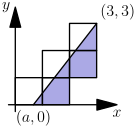
Five unit squares are arranged in the coordinate plane as shown, with the lower left corner at the origin. The slanted line, extending from to divides the entire region into two regions of equal area. What is
小提示:
总面积是 ,所以每部分面积必须是 。
The total area is so each region must be
大提示:
直线右下方的区域是一个底为 、高为 的三角形,再减去一个单位正方形。
The region on the lower-right side of the line is a triangle of base and height minus one unit square
解答:
五个正方形总面积为 ,所以每部分面积必须为 。
从 到 的直线与坐标轴围成一个底为 、高为 的三角形。直线右下方的区域是这个三角形去掉一个单位正方形,所以 得 ,从而 。
所以正确答案是 C。
The five squares have total area so each region must have area
The line from to together with the axes bounds a triangle of base and height ; the region on the lower-right side of the line is this triangle with one unit square removed. Setting gives so
Thus, the correct answer is C.
15.
假设 。下面是五个关于 的方程。哪个方程的解 最大?
Assume Below are five equations for Which equation has the largest solution
小提示:
解出每个方程得 ;底数越小, 越大。
Solving each gives ; a smaller base makes larger
大提示:
比较 在 时的大小,找出最小者。
Compare the values for and find the smallest
解答:
每个方程都给出 ,所以正数 越小,解越大。
当 时,有 ,并且因为 ,还有 。又因为 ,所以 。因此五个量中 最小,方程 (B) 的解最大。
所以正确答案是 B。
Each equation gives which is largest when the positive quantity is smallest.
For we have and because Also so Thus is the smallest of the five quantities, and equation (B) has the largest solution.
Thus, the correct answer is B.
16.
梯形 满足 、、、。比值 为 。 是多少?
Trapezoid has and The ratio is What is
小提示:
过 作平行于 的直线,与 交于 ;则 。
Draw the line through parallel to meeting at ; then
大提示:
证明 平分 ,再在 中使用角平分线定理。
Show bisects then apply the angle bisector theorem in
解答:
过 作平行于 的直线,与 交于 ,于是 是平行四边形,且 。于是 ,又因为 ,所以 平分 。
在 中由角平分线定理,,所以
所以正确答案是 B。
Draw the line through parallel to meeting at so is a parallelogram with Then and since segment bisects
By the angle bisector theorem in so
Thus, the correct answer is B.
17.
立方体的每个面上都画有一条窄条纹,从一条边的中点连到其对边的中点。每个面上选择哪一对对边是随机且相互独立的。出现一条连续条纹环绕立方体一周的概率是多少?
Each face of a cube is given a single narrow stripe painted from the center of one edge to the center of its opposite edge. The choice of the edge pairing is made at random and independently for each face. What is the probability that there is a continuous stripe encircling the cube?
小提示:
每个面的条纹有 个方向,所以共有 种等可能配置。
Each face’s stripe has orientations, giving equally likely configurations
大提示:
环绕条纹会沿着 对相对面中的某一对绕行;数出能形成环的配置。
An encircling stripe runs around one of pairs of opposite faces; count the configurations forming a loop
解答:
个面中的每个面都有 个等可能的条纹方向,所以共有 种配置。
环绕条纹沿着 对相对面中的某一对绕行。固定这样一条带,条纹经过的四个面必须对齐,概率为 ,其余两个面任意。 条可能的带互不重叠,所以概率为 。
所以正确答案是 B。
Each of the faces has equally likely stripe orientations, for configurations.
An encircling stripe runs around one of the pairs of opposite faces. Fixing such a band, the four faces it passes through must be aligned, with probability while the two remaining faces are free. The possible bands are disjoint events, so the probability is
Thus, the correct answer is B.
18.
Rachel 和 Robert 在圆形跑道上跑步。Rachel 逆时针跑,每 秒跑完一圈;Robert 顺时针跑,每 秒跑完一圈。两人同时从起点出发。开始跑步后 分钟到 分钟之间的某个随机时刻,一位站在跑道内的摄影师拍了一张照片,照片显示以起跑线为中心的四分之一圈跑道。两人都在照片中的概率是多少?
Rachel and Robert run on a circular track. Rachel runs counterclockwise and completes a lap every seconds, and Robert runs clockwise and completes a lap every seconds. Both start from the start line at the same time. At some random time between minutes and minutes after they begin to run, a photographer standing inside the track takes a picture that shows one-fourth of the track, centered on the starting line. What is the probability that both Rachel and Robert are in the picture?
小提示:
照片覆盖起点两侧各 圈的弧;找出在第 分钟内每位跑者位于这段弧内的时间。
The picture spans lap on each side of the start; find when each runner is within that arc during the th minute
大提示:
Rachel 在 秒内入镜,Robert 在 秒内入镜;取重叠长度再除以 秒。
Rachel is in view for s and Robert for s; take the overlap over s
解答:
照片覆盖距离起点不超过 圈的弧。在 秒时,Rachel 已跑 圈,距离起点还差 秒;四分之一圈对应 秒,所以她在 秒到 秒之间入镜,这是第 分钟内的时间。
在 秒时,Robert 距离起跑线 秒;四分之一圈需要 秒,所以他在 到 秒之间入镜。两人都入镜的时间是 到 秒,长度为 秒,占 秒的比例为 。
所以正确答案是 C。
The picture covers the arc within lap of the start on each side. At s Rachel has run laps, s short of the line; a quarter lap takes her s, so she is in view between s and s of the th minute.
At s Robert is s from the line; a quarter lap takes s, so he is in view between and s. Both appear between and s, a window of s out of giving probability
Thus, the correct answer is C.
19.
对每个正整数 ,令 。所有为质数的 的值之和是多少?
For each positive integer let What is the sum of all values of that are prime numbers?
小提示:
改写成平方差: 。
Rewrite as a difference of squares:
大提示:
将它因式分解;若乘积为质数,则较小因子必须等于 。
Factor it; for the product to be prime, the smaller factor must equal
解答:
写成
要使 为质数,较小因子必须为 。解 得 ,所以 或 。
此时 ,,二者都是质数,和为 。
所以正确答案是 E。
Write
For to be prime the smaller factor must be : solving gives so or
Then and are both prime, summing to
Thus, the correct answer is E.
20.
一个凸多面体 有顶点 ,,,,并有 条边。用平面 ,,, 切割该多面体,使得平面 只切过与顶点 相接的那些边。此外,没有两个平面在 的内部或表面相交。这些切割产生了 个棱锥和一个新的多面体 。 有多少条边?
A convex polyhedron has vertices and edges. The polyhedron is cut by planes in such a way that plane cuts only those edges that meet at vertex In addition, no two planes intersect inside or on The cuts produce pyramids and a new polyhedron How many edges does have?
小提示:
每条原来的边都在靠近两个端点处各被切一次,产生新的顶点。
Each original edge is cut once near each of its two endpoints, creating new vertices
大提示:
计算新产生的边(每个边端点对应一条)以及每条原边保留下来的中间部分。
Count the new edges (one per edge-endpoint) plus the surviving middle portion of each original edge
解答:
条边中的每一条都在靠近两个端点处各被切一次,所以 有 个顶点。
在顶点 处的切割会形成一个小多边形,其边数等于 的度数。对所有顶点求和得到 ,即所有边端点的总数。每条原边的中间部分也保留下来,又增加 条边。因此 有 条边。
所以正确答案是 C。
Each of the edges is cut once near each endpoint, so has vertices.
The cut at vertex creates a small polygon whose number of edges equals the degree of ; summed over all vertices this is the total number of edge-endpoints. The middle portion of each original edge also survives, adding edges. So has edges.
Thus, the correct answer is C.
21.
十名女性坐在一排 个座位上。所有 人都起身,然后重新坐满这 个座位,每个人坐在自己原来的座位或与原座位相邻的座位上。她们有多少种重新入座方式?
Ten women sit in seats in a line. All of the get up and then reseat themselves using all seats, each sitting in the seat she was in before or a seat next to the one she occupied before. In how many ways can the women be reseated?
小提示:
设 表示 名女性的合法重新入座数;考虑最右边女性的选择。
Let count the valid reseatings of women; consider the rightmost woman’s choice
大提示:
若她不动,剩下 种;若她向左移动,则必须与左邻座交换,剩下 种,所以 。
If she stays she leaves ways; if she moves left a swap is forced, leaving — so
解答:
设 为 名女性的合法重新入座方式数。最右边的女性要么留在原座位,此时其余人有 种方式;要么与左边的邻座交换(这是填满最右端座位的唯一其他方式),此时剩下 种方式。
因此 ,且 、,得到斐波那契数列 。所以 。
所以正确答案是 A。
Let be the number of valid reseatings of women. The rightmost woman either keeps her seat, leaving ways for the rest, or swaps with her left neighbor — the only other way to fill the end seat — leaving ways.
Thus with and giving the Fibonacci values So
Thus, the correct answer is A.
22.
平行四边形 的面积为 。顶点 在 ,其余顶点都在第一象限。顶点 和 分别是在直线 和 上的格点,其中 是整数。这样的平行四边形有多少个?
Parallelogram has area Vertex is at and all other vertices are in the first quadrant. Vertices and are lattice points on the lines and for some integer respectively. How many such parallelograms are there?
小提示:
设 、,平行四边形面积为 。
With and the area of the parallelogram is
大提示:
需要 ;数出分成三个正整数的有序因式分解数。
You need ; count ordered factorizations into three positive integers
解答:
设 、,其中 为正整数且 。面积条件给出 。
每个平行四边形对应一个正整数有序三元组 ,其乘积为 。六个因子 在三个位置中的分配数为 ,因子 也有 种分配,所以共有 个。
所以正确答案是 C。
Let and with positive integers and The area is
Each parallelogram corresponds to an ordered triple of positive integers with product The six ’s distribute among the three factors in ways, and likewise the six ’s in ways, giving
Thus, the correct answer is C.
23.
复平面中的区域 定义为
从 中均匀随机选取一个复数 。 也在 中的概率是多少?
A region in the complex plane is defined by
A complex number is chosen uniformly at random from What is the probability that is also in
小提示:
相乘后实部为 ,虚部为 ;两者都必须落在 中。
Multiplying gives real part and imaginary part ; both must lie in
大提示:
条件是 和 ;求 中满足这些条件的面积。
These conditions are and ; find the area of satisfying them
解答:
展开得 。实部和虚部都落在 中,当且仅当 且 。
在正方形 (面积 )内,不满足条件的区域只出现在四个角。靠近 的地方,直线 切去一个直角三角形,两条直角边均为 ,面积为 。
四个角共去掉 ,剩余面积为 ,概率为 。
所以正确答案是 D。
Expanding, Both parts lie in iff and
Within the square (area ) these fail only in four corner triangles. Near the line cuts off a right triangle with legs area
The four corners remove leaving The probability is
Thus, the correct answer is D.
24.
在 中,有多少个 的值满足 ?
注:函数 和 表示反三角函数。
For how many values of in is
Note: The functions and denote inverse trigonometric functions.
小提示:
在 ,而左边的值在 中,所以任何解都需满足 。
On and the left side lies in so any solution needs
大提示:
因为 在 上一一对应,方程在 上化为 。
Since is one-to-one on the equation reduces to on
解答:
在 。因为 的值域是 ,任何解都必须满足 ,此时方程化为 。
方程 成立,当且仅当 对某个整数 成立。
第一族给出 ,在区间中贡献 和 。第二族给出 ,贡献 和 。因此在 中共有 个解。
所以正确答案是 B。
On Since takes values in any solution requires where the equation becomes
The equation holds exactly when for some integer
The first family gives contributing and The second gives contributing and Hence there are solutions in
Thus, the correct answer is B.
25.
集合 由满足 且 的整数坐标点 组成。有多少个边长至少为 的正方形,其四个顶点都在 中?
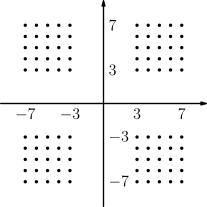
The set is defined by the points with integer coordinates, and How many squares of side at least have their four vertices in
小提示:
分成四个 方块,每个象限一个;边长 的正方形恰好从每个方块取一个顶点。
splits into four blocks, one per quadrant; a side- square takes exactly one vertex from each block
大提示:
将四个方块平移叠到同一个 网格 上;每个有效正方形会对应到 中的一个点或 中的一个正方形。
Slide the four blocks together onto a single grid each valid square maps to a point of or a square in
解答:
由四个 方块 组成,每个象限一个。任何边长 的正方形在每个方块中恰好使用一个顶点,因为同一方块中的两点距离小于 ,而不同方块中的点之间距离至少为 。
将每个方块按 向内平移,可把它们叠合成同一个 网格 (即满足 的那些点)。每个这样的正方形要么对应 中的一个点,要么对应 中的一个正方形。所以所求个数等于 的点数,加上 倍的以 中的点为顶点的正方形个数。
该网格中与坐标轴平行的正方形共有 个。对于倾斜的正方形,设它的一条边水平移动 个单位、竖直移动 个单位,其中 且 。对每个有序数对 ,有 种放置方式。 对应的个数分别为 ,于是倾斜的正方形有 个,正方形总共有 个。因此所求的个数为 。
所以正确答案是 E。
consists of four blocks one in each quadrant. Any square of side uses exactly one vertex in each block, since two points in one block are less than apart while points in different blocks are at least apart.
Sliding each block inward by superimposes them on one grid (points with ). Each such square maps to either a single point of or a square in So the count equals the number of points of plus times the number of squares with vertices in
The grid has axis-parallel squares. For a tilted square, let one side move units horizontally and units vertically, where and For each ordered pair there are placements. The totals for are respectively, giving tilted squares and squares altogether. Therefore the required count is
Thus, the correct answer is E.