
Problemas del 2007 AIME II
¡Desplázate hacia abajo y presiona Iniciar para intentar el examen! O ve al PDF imprimible, la clave de respuestas, o las soluciones profesionales preparadas por LIVE by Po-Shen Loh.
Todos los problemas se usan con el permiso legal oficial de la Mathematical Association of America (MAA).
O salta directamente a un solo problema con su solución: 1 · 2 · 3 · 4 · 5 · 6 · 7 · 8 · 9 · 10 · 11 · 12 · 13 · 14 · 15
¿Quieres aprender de forma profesional con clases interactivas en video?
Con tiempo
3:00:00
1.
Una organización matemática está produciendo un conjunto de matrículas conmemorativas. Cada matrícula contiene una secuencia de cinco caracteres elegidos entre las cuatro letras de AIME y los cuatro dígitos de Ningún carácter puede aparecer en una secuencia más veces de las que aparece entre las cuatro letras de AIME o los cuatro dígitos de Un conjunto de matrículas en el que cada secuencia posible aparece exactamente una vez contiene matrículas. ¿Cuánto vale ?
A mathematical organization is producing a set of commemorative license plates. Each plate contains a sequence of five characters chosen from the four letters in AIME and the four digits in No character may appear in a sequence more times than it appears among the four letters in AIME or the four digits in A set of plates in which each possible sequence appears exactly once contains license plates. Find
Respuesta: 372
Pista pequeña:
Divide en casos según cuántos usa la secuencia; cualquier otro carácter puede aparecer a lo sumo una vez.
Split into cases by how many ’s the sequence uses; every other character can appear at most once
Pista grande:
Con dos , colócalos de maneras y llena tres posiciones con los otros seis caracteres.
With two ’s, place them in ways and fill three spots from the six other characters
Solución:
Los caracteres disponibles son los siete símbolos distintos A, I, M, E, donde puede usarse hasta dos veces y cada uno de los demás a lo sumo una vez. Las secuencias que usan a lo sumo un constan de cinco caracteres distintos elegidos entre los siete, en orden:
Secuencias con dos : elige las dos posiciones para los de maneras, y luego llena las tres posiciones restantes con caracteres distintos de los otros seis de maneras, dando secuencias.
Por lo tanto y
The available characters are the seven distinct symbols A, I, M, E, where may be used up to twice and every other character at most once. Sequences using at most one consist of five distinct characters chosen from the seven, in order:
Sequences with two ’s: choose the two positions for the ’s in ways, then fill the remaining three positions with distinct characters from the other six in ways, for sequences.
Thus and
2.
¿Cuántas ternas ordenadas hay tales que y son enteros positivos, es divisor de es divisor de y ?
Find the number of ordered triples where and are positive integers, is a factor of is a factor of and
Respuesta: 200
Pista pequeña:
Como divide tanto a como a debe dividir a .
Since divides both and it must divide
Pista grande:
Escribe y entonces que tiene soluciones positivas.
Write and then which has positive solutions
Solución:
Como divide a y a divide a Escribe y con entonces así que Para y positivos necesitamos por lo que
Para cada tal la ecuación tiene soluciones ordenadas positivas. Sumando,
Since divides and it divides Write and with then so For positive and we need so
For each such the equation has ordered positive solutions. Summing,
3.
El cuadrado tiene lado y los puntos y son exteriores al cuadrado tales que y ¿Cuánto vale ?
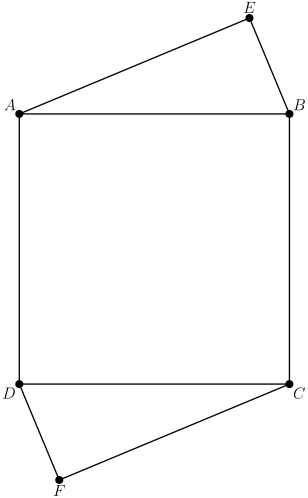
Square has side length and points and are exterior to the square such that and Find
Respuesta: 578
Pista pequeña:
Como los ángulos y son rectos.
Since angles and are right angles
Pista grande:
Prolonga más allá de y más allá de hasta que se corten en y busca triángulos rectángulos congruentes con .
Extend beyond and beyond to meet at and look for right triangles congruent to
Solución:
Como los triángulos y son rectángulos en y y son congruentes (lados ). Prolonga más allá de y más allá de hasta que las dos rectas se corten en
Entonces Estos dos ángulos suman así que y el triángulo es congruente con (ángulos iguales e hipotenusa ). Por lo tanto y
Por lo tanto y con un ángulo recto entre ellos en así que
Since triangles and are right-angled at and and they are congruent (sides ). Extend beyond and beyond until the two lines meet at
Then These two angles sum to so and triangle is congruent to (equal angles and hypotenuse ). Hence and
Therefore and with a right angle between them at so
4.
Los trabajadores de una fábrica producen componentes y artefactos. Para cada producto, el tiempo de producción es constante e idéntico para todos los trabajadores, pero no necesariamente igual para los dos productos. En una hora, trabajadores pueden producir componentes y artefactos. En dos horas, trabajadores pueden producir componentes y artefactos. En tres horas, trabajadores pueden producir componentes y artefactos. ¿Cuánto vale ?
The workers in a factory produce widgets and whoosits. For each product, production time is constant and identical for all workers, but not necessarily equal for the two products. In one hour, workers can produce widgets and whoosits. In two hours, workers can produce widgets and whoosits. In three hours, workers can produce widgets and whoosits. Find
Respuesta: 450
Pista pequeña:
Sean y las horas-trabajador necesarias para producir un componente y un artefacto; cada situación da una ecuación lineal.
Let and be the worker-hours needed for one widget and one whoosit; each scenario gives one linear equation
Pista grande:
Los dos primeros escenarios dan y el tercero aporta horas-trabajador en total.
The first two scenarios give and the third supplies worker-hours in total
Solución:
Sean y las horas-trabajador necesarias para producir un componente y un artefacto. Las tres situaciones aportan y horas-trabajador, así que
Las dos primeras ecuaciones se simplifican a y dando y Sustituyendo en la tercera, así que y
Let and be the worker-hours required to make one widget and one whoosit. The three scenarios supply and worker-hours, so
The first two equations simplify to and giving and Substituting into the third, so and
5.
La gráfica de la ecuación se dibuja en papel cuadriculado, donde cada cuadrito representa una unidad en cada dirección. ¿Cuántos de los cuadritos por del papel tienen su interior completamente por debajo de la gráfica y completamente en el primer cuadrante?
The graph of the equation is drawn on graph paper with each square representing one unit in each direction. How many of the by graph paper squares have interiors lying entirely below the graph and entirely in the first quadrant?
Respuesta: 888
Pista pequeña:
El segmento va de a cuenta cuántos cuadritos unitarios atraviesa en el rectángulo de cuadritos.
The segment runs from to count how many unit squares it cuts through in the rectangle of squares
Pista grande:
Como el segmento no toca ningún punto reticular interior, así que atraviesa cuadritos; la simetría reparte por igual los cuadritos no tocados.
Since the segment hits no interior lattice point, so it crosses squares; symmetry splits the untouched squares evenly
Solución:
La recta corta a los ejes en y así que todos los cuadritos que cumplen la condición están dentro del rectángulo que contiene cuadritos unitarios. Como el segmento no pasa por ningún punto reticular interior; cruza rectas verticales interiores y rectas horizontales interiores, entrando en un cuadrito nuevo en cada cruce, así que pasa por el interior de cuadritos.
Los otros cuadritos quedan completamente por encima o completamente por debajo del segmento. El punto medio del segmento es el centro del rectángulo, así que rotar alrededor de él intercambia los dos grupos. Por lo tanto exactamente la mitad de ellos, están por debajo de la gráfica.
The line meets the axes at and so all qualifying squares lie inside the rectangle, which contains unit squares. Because the segment passes through no interior lattice point; it crosses interior vertical lines and interior horizontal lines, entering a new square at each crossing, so it passes through the interiors of squares.
The other squares lie entirely above or entirely below the segment. The segment’s midpoint is the center of the rectangle, so rotating by about it swaps the two groups. Hence exactly half of them, lie below the graph.
6.
Un entero se llama de paridad monótona si su representación decimal cumple cuando es impar, y cuando es par. ¿Cuántos enteros de cuatro dígitos de paridad monótona hay?
An integer is called parity-monotonic if its decimal representation satisfies if is odd, and if is even. How many four-digit parity-monotonic integers are there?
Respuesta: 640
Pista pequeña:
Construye el número de derecha a izquierda, contando cuántos dígitos pueden preceder inmediatamente a un dígito dado.
Build the number from right to left, counting how many digits may immediately precede a given digit
Pista grande:
Para cada dígito exactamente dígitos pueden precederlo: los dígitos impares menores que junto con los dígitos pares mayores que El dígito nunca cumple.
For every digit exactly digits can precede it: the odd digits below together with the even digits above The digit never qualifies.
Solución:
Un dígito puede preceder inmediatamente a exactamente cuando es impar y menor que o par y mayor que Revisando cada de a esto siempre permite exactamente dígitos: por ejemplo, admite admite admite (Aumentar en cambia opciones impares por pares, manteniendo el total en ) Nótese que nunca es un predecesor permitido, ya que es par pero no supera a ningún dígito.
Así que elige el último dígito de maneras, y luego cada uno de de maneras; el dígito inicial es automáticamente distinto de cero. El total es
A digit may immediately precede exactly when is odd and less than or even and greater than Checking each from to this always allows exactly digits: for example, allows allows allows (Raising by trades odd choices for even ones, keeping the total at ) Note that is never an allowed predecessor, since is even but exceeds no digit.
So choose the last digit in ways, then each of in ways; the leading digit is automatically nonzero. The count is
7.
Dado un número real sea el mayor entero menor o igual que Para cierto entero hay exactamente enteros positivos tales que y divide a para todo tal que ¿Cuál es el valor máximo de para ?
Given a real number let denote the greatest integer less than or equal to For a certain integer there are exactly positive integers such that and divides for all such that Find the maximum value of for
Respuesta: 553
Pista pequeña:
significa cuenta los múltiplos de en ese rango.
means count the multiples of in that range
Pista grande:
Hay de esos múltiplos, así que resuelve y luego toma el mayor múltiplo.
There are such multiples, so solve then take the largest multiple
Solución:
La condición significa Los múltiplos de en este rango son así que hay exactamente de ellos.
Poner da El máximo de es
The condition means The multiples of in this range are so there are exactly of them.
Setting gives The maximum of is
8.
Una hoja rectangular de papel mide unidades por unidades. Se dibujan varias líneas paralelas a los bordes del papel. Un rectángulo determinado por las intersecciones de algunas de estas líneas se llama básico si (i) los cuatro lados del rectángulo son segmentos de líneas dibujadas, y (ii) ningún segmento de línea dibujada queda dentro del rectángulo.
Dado que la longitud total de todas las líneas dibujadas es exactamente unidades, sea el máximo número posible de rectángulos básicos determinados. ¿Cuál es el residuo cuando se divide entre ?
A rectangular piece of paper measures units by units. Several lines are drawn parallel to the edges of the paper. A rectangle determined by the intersections of some of these lines is called basic if (i) all four sides of the rectangle are segments of drawn line segments, and (ii) no segments of drawn lines lie inside the rectangle.
Given that the total length of all lines drawn is exactly units, let be the maximum possible number of basic rectangles determined. Find the remainder when is divided by
Respuesta: 896
Pista pequeña:
Con líneas dibujadas de longitud y de longitud obtenemos y los pares adyacentes forman rectángulos básicos.
With drawn lines of length and of length we get and adjacent pairs form basic rectangles
Pista grande:
Maximiza sujeto a toma que satisfaga y que esté lo más cerca posible del vértice .
Maximize over take satisfying and as close as possible to the vertex
Solución:
Supón que de las líneas dibujadas tienen longitud y tienen longitud de modo que Un rectángulo básico está limitado por dos líneas adyacentes en cada dirección, así que las líneas determinan rectángulos básicos. Poniendo y debemos maximizar sujeto a
Como función de el producto es una parábola hacia abajo con vértice en Para que sea entero necesitamos es decir Los candidatos más cercanos son (que da y producto ) y (que da y producto ).
Así que y el residuo al dividir entre es
Suppose of the drawn lines have length and have length so A basic rectangle is bounded by two adjacent lines in each direction, so the lines determine basic rectangles. Setting and we must maximize subject to
As a function of the product is a downward parabola with vertex at For to be an integer we need i.e. The nearest candidates are (giving and product ) and (giving and product ).
So and the remainder upon division by is
9.
Se da el rectángulo con y Los puntos y están sobre y respectivamente, tales que La circunferencia inscrita del triángulo es tangente a en el punto y la circunferencia inscrita del triángulo es tangente a en el punto ¿Cuánto vale ?
Rectangle is given with and Points and lie on and respectively, such that The inscribed circle of triangle is tangent to at point and the inscribed circle of triangle is tangent to at point Find
Respuesta: 259
Pista pequeña:
Calcula y con el teorema de Pitágoras; los triángulos y resultan congruentes.
Compute and with the Pythagorean theorem; triangles and turn out congruent
Pista grande:
El punto de tangencia divide según las longitudes de las tangentes: y donde es el semiperímetro común. Entonces
The tangency point splits by tangent lengths: and where is the common semiperimeter. Then
Solución:
Coloca de modo que y Entonces y En particular los triángulos y son congruentes, con semiperímetro común
En cualquier triángulo, la distancia de un vértice a los puntos de tangencia de la circunferencia inscrita sobre sus dos lados es el semiperímetro menos el lado opuesto. En el triángulo en el triángulo
Por lo tanto
Place so and Then and In particular triangles and are congruent, with common semiperimeter
In any triangle, the distance from a vertex to the incircle’s tangency points on its two sides is the semiperimeter minus the opposite side. In triangle in triangle
Therefore
10.
Sea un conjunto con seis elementos. Sea el conjunto de todos los subconjuntos de Los subconjuntos y de no necesariamente distintos, se eligen de forma independiente y al azar de La probabilidad de que esté contenido en al menos uno de los conjuntos y es donde y son enteros positivos, es primo, y y son primos entre sí. ¿Cuánto vale ? (El conjunto es el conjunto de todos los elementos de que no están en )
Let be a set with six elements. Let be the set of all subsets of Subsets and of not necessarily distinct, are chosen independently and at random from The probability that is contained in at least one of or is where and are positive integers, is prime, and and are relatively prime. Find (The set is the set of all elements of which are not in )
Respuesta: 710
Pista pequeña:
Separa según y cuenta los conjuntos con o solo el conjunto vacío cumple ambas condiciones.
Condition on and count the sets with or only the empty set satisfies both
Pista grande:
Suma sobre la expresión usando .
Sum over the expression using
Solución:
Fija con Hay subconjuntos y subconjuntos y solo el conjunto vacío se cuenta dos veces, así que elecciones de tienen éxito. Como hay conjuntos de tamaño y elecciones para cada uno de y la probabilidad es usando
Esto se simplifica a Como es impar, tomamos y
Fix with There are subsets and subsets and only the empty set is counted twice, so choices of succeed. Since there are sets of size and choices for each of and the probability is using
This simplifies to Since is odd, we take and
11.
Dos tubos cilíndricos largos de la misma longitud pero distinto diámetro están paralelos entre sí sobre una superficie plana. El tubo más grande tiene radio y rueda por la superficie hacia el tubo más pequeño, que tiene radio Rueda por encima del tubo más pequeño y sigue rodando por la superficie plana hasta que se detiene apoyado en el mismo punto de su circunferencia por el que empezó, habiendo dado una vuelta completa. Si el tubo más pequeño nunca se mueve, y la rodadura ocurre sin deslizamiento, el tubo más grande termina a una distancia de donde empezó. La distancia puede expresarse en la forma donde y son enteros y no es divisible por el cuadrado de ningún primo. ¿Cuánto vale ?
Two long cylindrical tubes of the same length but different diameters lie parallel to each other on a flat surface. The larger tube has radius and rolls along the surface toward the smaller tube, which has radius It rolls over the smaller tube and continues rolling along the flat surface until it comes to rest on the same point of its circumference as it started, having made one complete revolution. If the smaller tube never moves, and the rolling occurs with no slipping, the larger tube ends up a distance from where it starts. The distance can be expressed in the form where and are integers and is not divisible by the square of any prime. Find
Respuesta: 179
Pista pequeña:
Cuando los tubos se tocan mientras ambos descansan en el suelo, el segmento que une sus centros tiene longitud y componente vertical .
When the tubes touch while both rest on the ground, the segment joining their centers has length and vertical component
Pista grande:
El giro total es al cruzar el tubo pequeño, el giro del tubo grande es la suma del barrido de de su centro y la contribución angular del arco de contacto; el resto es rodadura sobre suelo plano.
Total turning is while crossing the small tube, the big tube’s rotation equals the center’s sweep plus the angular contribution from the contact arc; the rest is flat rolling
Solución:
Cuando el tubo que rueda toca a la vez el suelo y el tubo pequeño, el segmento entre los centros tiene longitud y componente vertical así que forma un ángulo de con la horizontal. Mientras el tubo grande rueda por encima del pequeño, su centro se desplaza a lo largo de un arco de radio alrededor del centro del tubo pequeño, desde por encima de la horizontal en un lado hasta en el otro: un barrido de que hace avanzar el centro horizontalmente en
Durante ese barrido, el arco de contacto sobre el tubo pequeño equivale a de la circunferencia del tubo grande, y el propio barrido también hace girar al tubo grande así que cruzar el tubo pequeño hace girar al tubo grande en total. Para completar exactamente una vuelta, los de giro restantes ocurren rodando sobre suelo plano, donde el centro avanza la distancia rodada
Por lo tanto y
When the rolling tube touches both the ground and the small tube, the segment between centers has length and vertical component so it makes a angle with the horizontal. As the big tube rolls over the small one, its center swings along an arc of radius about the small tube’s center, from above the horizontal on one side to on the other: a sweep of advancing the center horizontally by
During that sweep, the contact arc on the small tube is worth of the big tube’s circumference, and the sweep itself also rotates the big tube by so crossing the small tube turns the big tube by in all. To complete exactly one revolution, the remaining of turning happens rolling on flat ground, where the center advances the rolled distance
Hence and
12.
La sucesión geométrica creciente consta enteramente de potencias enteras de Dado que y ¿cuánto vale ?
The increasing geometric sequence consists entirely of integral powers of Given that and find
Respuesta: 91
Pista pequeña:
Escribe con enteros y la condición de la suma de logaritmos da .
Write with integers and the log-sum condition gives
Pista grande:
La suma está estrictamente entre y así que su logaritmo en base determina .
The sum lies strictly between and so its base- log pins down
Solución:
Cada término es una potencia de y la razón es un cociente de potencias de así que para enteros y con ya que la sucesión es creciente. La primera condición da es decir
Para la segunda condición, es el término más grande, y así que está estrictamente entre y Las cotas dadas obligan entonces a
Restando de se obtiene luego Por lo tanto
Every term is a power of and the ratio is a quotient of powers of so for integers and with since the sequence increases. The first condition gives i.e.
For the second condition, is the largest term, and so lies strictly between and The given bounds then force
Subtracting from yields then Therefore
13.
Un arreglo triangular de cuadrados tiene un cuadrado en la primera fila, dos en la segunda y, en general, cuadrados en la -ésima fila para Con la excepción de la fila inferior, cada cuadrado descansa sobre dos cuadrados de la fila inmediatamente inferior, como se ilustra en la figura. En cada cuadrado de la undécima fila se coloca un o un . Luego se colocan números en los demás cuadrados, siendo la entrada de cada cuadrado la suma de las entradas de los dos cuadrados debajo de él. ¿Para cuántas distribuciones iniciales de y en la fila inferior el número del cuadrado superior es múltiplo de ?
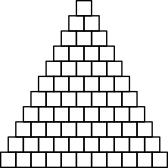
A triangular array of squares has one square in the first row, two in the second, and, in general, squares in the th row for With the exception of the bottom row, each square rests on two squares in the row immediately below, as illustrated in the figure. In each square of the eleventh row, a or a is placed. Numbers are then placed into the other squares, with the entry for each square being the sum of the entries in the two squares below it. For how many initial distributions of ’s and ’s in the bottom row is the number in the top square a multiple of
Respuesta: 640
Pista pequeña:
Cada entrada se propaga hacia arriba como el triángulo de Pascal: para las entradas inferiores el cuadrado superior es .
Each entry feeds upward like Pascal’s triangle: for bottom entries the top square is
Pista grande:
Módulo salvo para el coeficiente se anula, así que solo importa .
Modulo except for the coefficient vanishes, so only matters
Solución:
Etiqueta las entradas de la fila inferior como Como cada cuadrado es la suma de los dos que tiene debajo, las contribuciones se acumulan con los pesos del triángulo de Pascal: el cuadrado superior es igual a
Módulo la comprobación directa (o el teorema de Lucas con ) muestra que para mientras que y Así que el cuadrado superior es múltiplo de exactamente cuando
Como estas cuatro entradas son o su suma solo es divisible por cuando vale o o bien las cuatro son (una manera) o bien exactamente tres son (cuatro maneras), dando opciones. Las siete entradas restantes son libres, así que el total es
Label the bottom-row entries Since each square is the sum of the two below it, the contributions accumulate with Pascal’s-triangle weights: the top square equals
Modulo direct checking (or Lucas’ theorem with ) shows that for while and So the top square is a multiple of exactly when
Because the four entries are or their sum is divisible by only when it is or either all four are (one way) or exactly three are (four ways), for choices. The remaining seven entries are free, so the count is
14.
Sea un polinomio con coeficientes reales tal que y para todo ¿Cuánto vale ?
Let be a polynomial with real coefficients such that and for all Find
Respuesta: 676
Pista pequeña:
Si es una raíz, también lo es compara los coeficientes principales para ver que es mónico.
If is a root, so is compare leading coefficients to see is monic
Pista grande:
Ninguna raíz puede tener (los módulos crecerían sin fin, o el producto de las raíces no podría ser ); entonces obliga a .
No root can have (moduli would grow forever, or the root product couldn’t be ); then forces
Solución:
Los valores dados descartan que el polinomio sea constante. Si tiene grado y coeficiente principal los coeficientes principales de los dos lados de son y así que La ecuación también muestra que siempre que es una raíz, también es una raíz.
Si alguna raíz tuviera entonces e iterando se producirían infinitas raíces distintas, lo cual es imposible. Como es mónico con el producto de las raíces tiene módulo así que ninguna raíz puede tener módulo menor que tampoco: toda raíz satisface Entonces también debe tener módulo así que Escribiendo obtenemos que se simplifica a así que
Así, toda raíz es y los coeficientes reales las emparejan: La condición da así que
The given values rule out a constant polynomial. If has degree and leading coefficient the leading coefficients of the two sides of are and so The equation also shows that whenever is a root, is a root as well.
If some root had then and iterating would produce infinitely many distinct roots — impossible. Since is monic with the product of the roots has modulus so no root can have modulus less than either: every root satisfies Then must also have modulus so Writing we get which simplifies to so
Thus every root is and real coefficients pair them up: The condition gives so
15.
Se dibujan cuatro circunferencias y con el mismo radio en el interior del triángulo de modo que es tangente a los lados y a y a y y es tangente externamente a y Si los lados del triángulo son y el radio de puede representarse en la forma donde y son enteros positivos primos entre sí. ¿Cuánto vale ?
Four circles and with the same radius are drawn in the interior of triangle such that is tangent to sides and to and to and and is externally tangent to and If the sides of triangle are and the radius of can be represented in the form where and are relatively prime positive integers. Find
Respuesta: 389
Pista pequeña:
Los centros de están sobre las bisectrices de los ángulos, formando un triángulo semejante a reducido hacia el incentro por el factor .
The centers of lie on the angle bisectors, forming a triangle similar to shrunk toward the incenter by factor
Pista grande:
El centro de equidista de esos tres centros, así que es igual al circunradio del triángulo reducido, a saber .
The center of is equidistant from those three centers, so equals the circumradius of the shrunken triangle, namely
Solución:
Sea el radio común, y sean los centros de Cada uno está a distancia de dos lados del triángulo, así que cada uno está sobre una bisectriz de ángulo, y los lados del triángulo son paralelos a los de a distancia Por lo tanto es la imagen de bajo la homotecia centrada en el incentro con razón donde es el inradio; en particular su circunradio es donde es el circunradio de
El centro de está a distancia de cada uno de (circunferencias iguales tangentes externamente), así que es el circuncentro de y Para el triángulo --, y la fórmula de Herón da el área así que y
Entonces da así que Como no comparte factor con la respuesta es
Let be the common radius, and let be the centers of Each is at distance from two sides of the triangle, so each lies on an angle bisector, and the sides of triangle are parallel to those of at distance Hence is the image of under the homothety centered at the incenter with ratio where is the inradius; in particular its circumradius is where is the circumradius of
The center of is at distance from each of (externally tangent equal circles), so it is the circumcenter of and For the -- triangle, and Heron’s formula gives area so and
Then gives so Since shares no factor with the answer is