Problemas del 2003 AIME I

¡Desplázate hacia abajo y presiona Iniciar para intentar el examen! O ve al PDF imprimible, la clave de respuestas, o las soluciones profesionales preparadas por LIVE by Po-Shen Loh.

Todos los problemas se usan con el permiso legal oficial de la Mathematical Association of America (MAA).

O salta directamente a un solo problema con su solución: 1 · 2 · 3 · 4 · 5 · 6 · 7 · 8 · 9 · 10 · 11 · 12 · 13 · 14 · 15

¿Quieres aprender de forma profesional con clases interactivas en video?

Aprende con LIVE

Con tiempo

3:00:00

1.

Dado que ((3!)!)!3!=kn!,\frac{((3!)!)!}{3!} = k \cdot n!, donde kk y nn son enteros positivos y nn es lo más grande posible, halla k+n.k + n.

Given that ((3!)!)!3!=kn!,\frac{((3!)!)!}{3!} = k \cdot n!, where kk and nn are positive integers and nn is as large as possible, find k+n.k + n.

Respuesta: 839
Conceptos:factorialacotación a casos límite
Nivel de dificultad: 1670
Pista pequeña:

Calcula los factoriales interiores: 3!=6,3! = 6, así que la expresión es 720!6\frac{720!}{6}.

Compute the inner factorials: 3!=6,3! = 6, so the expression is 720!6\frac{720!}{6}

Pista grande:

Escribe 720!=720719!720! = 720 \cdot 719! y observa que n=720n = 720 haría que kn!k \cdot n! fuera demasiado grande.

Write 720!=720719!720! = 720 \cdot 719! and note that n=720n = 720 would make kn!k \cdot n! too large

Solución:

Como 3!=63! = 6 y 6!=720,6! = 720, la expresión es ((3!)!)!3!=720!6=720719!6=120719!. \begin{aligned} \frac{((3!)!)!}{3!} &= \frac{720!}{6} \\ &= \frac{720 \cdot 719!}{6} \\ &= 120 \cdot 719!. \end{aligned}

Si nn fuera 720720 o más, entonces kn!720!,k \cdot n! \ge 720!, lo que supera 720!6.\frac{720!}{6}. Así que el mayor valor posible de nn es 719,719, que se logra con k=120,k = 120, y k+n=120+719=839.k + n = 120 + 719 = 839.

Since 3!=63! = 6 and 6!=720,6! = 720, the expression is ((3!)!)!3!=720!6=720719!6=120719!. \begin{aligned} \frac{((3!)!)!}{3!} &= \frac{720!}{6} \\ &= \frac{720 \cdot 719!}{6} \\ &= 120 \cdot 719!. \end{aligned}

If nn were 720720 or more, then kn!720!,k \cdot n! \ge 720!, which exceeds 720!6.\frac{720!}{6}. So the largest possible value of nn is 719,719, achieved with k=120,k = 120, and k+n=120+719=839.k + n = 120 + 719 = 839.

2.

En un plano se dibujan cien circunferencias concéntricas con radios 1,1, 2,2, 3,3, ,\ldots, 100100. El interior de la circunferencia de radio 11 se pinta de rojo, y cada región limitada por circunferencias consecutivas se pinta de rojo o de verde, de modo que dos regiones adyacentes no tengan el mismo color. La razón entre el área total de las regiones verdes y el área del círculo de radio 100100 puede expresarse como mn,\frac{m}{n}, donde mm y nn son enteros positivos primos entre sí. Halla m+n.m + n.

One hundred concentric circles with radii 1,1, 2,2, 3,3, ,\ldots, 100100 are drawn in a plane. The interior of the circle of radius 11 is colored red, and each region bounded by consecutive circles is colored either red or green, with no two adjacent regions the same color. The ratio of the total area of the green regions to the area of the circle of radius 100100 can be expressed as mn,\frac{m}{n}, where mm and nn are relatively prime positive integers. Find m+n.m + n.

Respuesta: 301
Nivel de dificultad: 1790
Pista pequeña:

Los colores se alternan, así que las regiones verdes son los anillos entre los radios 11 y 2,2, 33 y 4,4, y así sucesivamente.

The colors alternate, so the green regions are the annuli between radii 11 and 2,2, 33 and 4,4, and so on

Pista grande:

Por diferencia de cuadrados, las áreas verdes suman π(1+2+3++100)\pi\,(1 + 2 + 3 + \cdots + 100).

By difference of squares, the green areas total π(1+2+3++100)\pi\,(1 + 2 + 3 + \cdots + 100)

Solución:

Las regiones se alternan rojo, verde, rojo, verde, \ldots desde el centro hacia afuera, así que las regiones verdes son los anillos entre los radios 11 y 2,2, entre 33 y 4,4, y así hasta el anillo entre 9999 y 100.100. Su área total es π[(2212)+(4232)++(1002992)]=π[(2+1)+(4+3)++(100+99)], \begin{aligned} &\scriptsize \pi\left[(2^2 - 1^2) + (4^2 - 3^2) + \cdots + (100^2 - 99^2)\right] \\ &\scriptsize = \pi\left[(2 + 1) + (4 + 3) + \cdots + (100 + 99)\right], \end{aligned} que es π(1+2++100)=5050π.\pi\,(1 + 2 + \cdots + 100) = 5050\pi.

La razón buscada es 5050π1002π=101200,\frac{5050\pi}{100^2 \pi} = \frac{101}{200}, así que m+n=101+200=301.m + n = 101 + 200 = 301.

The regions alternate red, green, red, green, \ldots from the center outward, so the green regions are the annuli between radii 11 and 2,2, between 33 and 4,4, and so on up to the annulus between 9999 and 100.100. Their total area is π[(2212)+(4232)++(1002992)]=π[(2+1)+(4+3)++(100+99)], \begin{aligned} &\scriptsize \pi\left[(2^2 - 1^2) + (4^2 - 3^2) + \cdots + (100^2 - 99^2)\right] \\ &\scriptsize = \pi\left[(2 + 1) + (4 + 3) + \cdots + (100 + 99)\right], \end{aligned} which is π(1+2++100)=5050π.\pi\,(1 + 2 + \cdots + 100) = 5050\pi.

The desired ratio is 5050π1002π=101200,\frac{5050\pi}{100^2 \pi} = \frac{101}{200}, so m+n=101+200=301.m + n = 101 + 200 = 301.

3.

Sea el conjunto S={8,5,1,13,34,3,21,2}.\mathcal{S} = \{8, 5, 1, 13, 34, 3, 21, 2\}. Susan hace una lista de la siguiente manera: para cada subconjunto de dos elementos de S,\mathcal{S}, escribe en su lista el mayor de los dos elementos del subconjunto. Halla la suma de los números de la lista.

Let the set S={8,5,1,13,34,3,21,2}.\mathcal{S} = \{8, 5, 1, 13, 34, 3, 21, 2\}. Susan makes a list as follows: for each two-element subset of S,\mathcal{S}, she writes on her list the greater of the set’s two elements. Find the sum of the numbers on the list.

Respuesta: 484
Nivel de dificultad: 1840
Pista pequeña:

Cada elemento se escribe en la lista una vez por cada elemento menor del conjunto.

Each element is written on the list once for every smaller element in the set

Pista grande:

Ordena el conjunto como 1,2,3,5,8,13,21,341, 2, 3, 5, 8, 13, 21, 34 y multiplica cada elemento por la cantidad de elementos menores.

Sort the set as 1,2,3,5,8,13,21,341, 2, 3, 5, 8, 13, 21, 34 and multiply each element by the count of smaller elements

Solución:

Un elemento xx es el elemento mayor de un subconjunto de dos elementos exactamente una vez por cada elemento menor del conjunto, así que xx contribuye a la suma una vez por cada elemento por debajo de él. Ordenando el conjunto como 1,2,3,5,8,13,21,34,1, 2, 3, 5, 8, 13, 21, 34, la suma de la lista es 0(1)+1(2)+2(3)+3(5)+4(8)+5(13)+6(21)+7(34)=2+6+15+32+65+126+238=484. \begin{aligned} &0(1) + 1(2) + 2(3) + 3(5) \\ &\quad {}+ 4(8) + 5(13) + 6(21) \\ &\quad {}+ 7(34) \\ &= 2 + 6 + 15 + 32 \\ &\quad {}+ 65 + 126 + 238 = 484. \end{aligned}

An element xx is the greater element of a two-element subset exactly once for each smaller element of the set, so xx contributes to the sum once per element below it. Sorting the set as 1,2,3,5,8,13,21,34,1, 2, 3, 5, 8, 13, 21, 34, the sum of the list is 0(1)+1(2)+2(3)+3(5)+4(8)+5(13)+6(21)+7(34)=2+6+15+32+65+126+238=484. \begin{aligned} &0(1) + 1(2) + 2(3) + 3(5) \\ &\quad {}+ 4(8) + 5(13) + 6(21) \\ &\quad {}+ 7(34) \\ &= 2 + 6 + 15 + 32 \\ &\quad {}+ 65 + 126 + 238 = 484. \end{aligned}

4.

Dado que log10sinx+log10cosx=1\log_{10} \sin x + \log_{10} \cos x = -1 y que log10(sinx+cosx)\log_{10}(\sin x + \cos x) =12(log10n1),= \frac{1}{2}(\log_{10} n - 1), halla n.n.

Given that log10sinx+log10cosx=1\log_{10} \sin x + \log_{10} \cos x = -1 and that log10(sinx+cosx)\log_{10}(\sin x + \cos x) =12(log10n1),= \frac{1}{2}(\log_{10} n - 1), find n.n.

Respuesta: 12
Nivel de dificultad: 1990
Pista pequeña:

Suma los logaritmos: la primera ecuación da sinxcosx=110\sin x \cos x = \frac{1}{10}.

Add the logarithms: the first equation gives sinxcosx=110\sin x \cos x = \frac{1}{10}

Pista grande:

Eleva al cuadrado sinx+cosx\sin x + \cos x y usa sin2x+cos2x=1\sin^2 x + \cos^2 x = 1 para evaluarlo.

Square sinx+cosx\sin x + \cos x and use sin2x+cos2x=1\sin^2 x + \cos^2 x = 1 to evaluate it

Solución:

La primera ecuación dice log10(sinxcosx)=1,\log_{10}(\sin x \cos x) = -1, así que sinxcosx=110.\sin x \cos x = \frac{1}{10}. Entonces (sinx+cosx)2=sin2x+cos2x+2sinxcosx=1+210=1210. \begin{aligned} (\sin x + \cos x)^2 &= \sin^2 x + \cos^2 x \\ &\quad {}+ 2 \sin x \cos x \\ &= 1 + \frac{2}{10} = \frac{12}{10}. \end{aligned}

Tomando logaritmos, 2log10(sinx+cosx)2\log_{10}(\sin x + \cos x) =log101210= \log_{10} \frac{12}{10} =log10121,= \log_{10} 12 - 1, así que log10(sinx+cosx)\log_{10}(\sin x + \cos x) =12(log10121)= \frac{1}{2}(\log_{10} 12 - 1) y n=12.n = 12.

The first equation says log10(sinxcosx)=1,\log_{10}(\sin x \cos x) = -1, so sinxcosx=110.\sin x \cos x = \frac{1}{10}. Then (sinx+cosx)2=sin2x+cos2x+2sinxcosx=1+210=1210. \begin{aligned} (\sin x + \cos x)^2 &= \sin^2 x + \cos^2 x \\ &\quad {}+ 2 \sin x \cos x \\ &= 1 + \frac{2}{10} = \frac{12}{10}. \end{aligned}

Taking logarithms, 2log10(sinx+cosx)2\log_{10}(\sin x + \cos x) =log101210= \log_{10} \frac{12}{10} =log10121,= \log_{10} 12 - 1, so log10(sinx+cosx)\log_{10}(\sin x + \cos x) =12(log10121)= \frac{1}{2}(\log_{10} 12 - 1) and n=12.n = 12.

5.

Considera el conjunto de puntos que están dentro de un paralelepípedo rectangular (caja) de 33 por 44 por 55 unidades, o a una distancia no mayor que una unidad de él. Dado que el volumen de este conjunto es m+nπp,\frac{m + n\pi}{p}, donde m,m, n,n, y pp son enteros positivos, y nn y pp son primos entre sí, halla m+n+p.m + n + p.

Consider the set of points that are inside or within one unit of a rectangular parallelepiped (box) that measures 33 by 44 by 55 units. Given that the volume of this set is m+nπp,\frac{m + n\pi}{p}, where m,m, n,n, and pp are positive integers, and nn and pp are relatively prime, find m+n+p.m + n + p.

Respuesta: 505
Nivel de dificultad: 2210
Pista pequeña:

La región es la caja más losas sobre cada cara, cuartos de cilindro a lo largo de cada arista, y octantes de esfera en cada vértice.

The region is the box plus slabs over each face, quarter-cylinders along each edge, and sphere octants at each corner

Pista grande:

Los doce cuartos de cilindro forman tres cilindros completos con alturas 3,3, 4,4, 5,5, y los ocho octantes forman una esfera unitaria.

The twelve quarter-cylinders form three full cylinders with heights 3,3, 4,4, 5,5, and the eight octants form one unit sphere

Solución:

La región consta de la caja misma, seis losas de grosor 11 que se proyectan hacia afuera desde las caras, cuartos de cilindro de radio 11 a lo largo de las doce aristas, y octavos de esfera de radio 11 en los ocho vértices. La caja tiene volumen 345=60,3 \cdot 4 \cdot 5 = 60, y las losas suman 2(34+35+45)=94.2(3 \cdot 4 + 3 \cdot 5 + 4 \cdot 5) = 94.

Los cuatro cuartos de cilindro a lo largo de las aristas paralelas a cada dimensión se combinan en un cilindro completo, así que los cilindros suman π12(3+4+5)=12π.\pi \cdot 1^2 (3 + 4 + 5) = 12\pi. Los ocho octantes se combinan en una esfera unitaria de volumen 4π3.\frac{4\pi}{3}.

El volumen total es 60+94+12π+4π3=154+40π3=462+40π3, \begin{aligned} &60 + 94 + 12\pi \\ &\quad {}+ \frac{4\pi}{3} = 154 + \frac{40\pi}{3} \\ &= \frac{462 + 40\pi}{3}, \end{aligned} así que m+n+pm + n + p =462+40+3= 462 + 40 + 3 =505.= 505.

The region consists of the box itself, six slabs of thickness 11 projecting outward from the faces, quarter-cylinders of radius 11 along the twelve edges, and eighth-spheres of radius 11 at the eight corners. The box has volume 345=60,3 \cdot 4 \cdot 5 = 60, and the slabs total 2(34+35+45)=94.2(3 \cdot 4 + 3 \cdot 5 + 4 \cdot 5) = 94.

The four quarter-cylinders along edges parallel to each dimension combine into a full cylinder, so the cylinders total π12(3+4+5)=12π.\pi \cdot 1^2 (3 + 4 + 5) = 12\pi. The eight octants combine into one unit sphere of volume 4π3.\frac{4\pi}{3}.

The total volume is 60+94+12π+4π3=154+40π3=462+40π3, \begin{aligned} &60 + 94 + 12\pi \\ &\quad {}+ \frac{4\pi}{3} = 154 + \frac{40\pi}{3} \\ &= \frac{462 + 40\pi}{3}, \end{aligned} so m+n+pm + n + p =462+40+3= 462 + 40 + 3 =505.= 505.

6.

La suma de las áreas de todos los triángulos cuyos vértices son también vértices de un cubo de 11 por 11 por 11 es m+n+p,m + \sqrt{n} + \sqrt{p}, donde m,m, n,n, y pp son enteros. Halla m+n+p.m + n + p.

The sum of the areas of all triangles whose vertices are also vertices of a 11 by 11 by 11 cube is m+n+p,m + \sqrt{n} + \sqrt{p}, where m,m, n,n, and pp are integers. Find m+n+p.m + n + p.

Respuesta: 348
Nivel de dificultad: 2370
Pista pequeña:

Cada lado es una arista del cubo, una diagonal de cara de longitud 2,\sqrt{2}, o una diagonal espacial de longitud 3;\sqrt{3}; clasifica los (83)=56\binom{8}{3} = 56 triángulos.

Each side is a cube edge, a face diagonal of length 2,\sqrt{2}, or a space diagonal of length 3;\sqrt{3}; classify the (83)=56\binom{8}{3} = 56 triangles

Pista grande:

Los tres tipos son arista-arista-diagonal de cara, tres diagonales de cara, y arista-diagonal de cara-diagonal espacial; hay 24,24, 8,8, y 2424 de ellos.

The three types are edge-edge-face diagonal, three face diagonals, and edge-face diagonal-space diagonal; there are 24,24, 8,8, and 2424 of them

Solución:

Cada lado de un triángulo así es una arista del cubo, una diagonal de cara de longitud 2,\sqrt{2}, o una diagonal espacial de longitud 3.\sqrt{3}. Solo aparecen tres formas. Un triángulo de dos aristas adyacentes y una diagonal de cara es rectángulo con área 12;\frac{1}{2}; hay 44 por cara, o 24.24. Un triángulo de tres diagonales de cara es equilátero con área 32;\frac{\sqrt{3}}{2}; cada uno queda determinado por los tres vértices adyacentes a uno de los 88 vértices del cubo, así que hay 8.8. Un triángulo de una arista, una diagonal de cara y una diagonal espacial es rectángulo con catetos 11 y 2,\sqrt{2}, así que su área es 22;\frac{\sqrt{2}}{2}; cada una de las 44 diagonales espaciales forma uno con cada uno de los 66 vértices fuera de esa diagonal, así que hay 24.24. (En efecto 24+8+24=(83)=56.24 + 8 + 24 = \binom{8}{3} = 56.)

El área total es 2412+832+2422=12+43+122=12+48+288, \begin{aligned} &24 \cdot \frac{1}{2} + 8 \cdot \frac{\sqrt{3}}{2} + 24 \cdot \frac{\sqrt{2}}{2} \\ &= 12 + 4\sqrt{3} + 12\sqrt{2} \\ &= 12 + \sqrt{48} + \sqrt{288}, \end{aligned} así que m+n+pm + n + p =12+48+288= 12 + 48 + 288 =348.= 348.

Every side of such a triangle is a cube edge, a face diagonal of length 2,\sqrt{2}, or a space diagonal of length 3.\sqrt{3}. Only three shapes occur. A triangle of two adjacent edges and a face diagonal is right with area 12;\frac{1}{2}; there are 44 per face, or 24.24. A triangle of three face diagonals is equilateral with area 32;\frac{\sqrt{3}}{2}; each is determined by the three vertices adjacent to one of the 88 cube vertices, so there are 8.8. A triangle of an edge, a face diagonal, and a space diagonal is right with legs 11 and 2,\sqrt{2}, so its area is 22;\frac{\sqrt{2}}{2}; each of the 44 space diagonals forms one with each of the 66 vertices off that diagonal, so there are 24.24. (Indeed 24+8+24=(83)=56.24 + 8 + 24 = \binom{8}{3} = 56.)

The total area is 2412+832+2422=12+43+122=12+48+288, \begin{aligned} &24 \cdot \frac{1}{2} + 8 \cdot \frac{\sqrt{3}}{2} + 24 \cdot \frac{\sqrt{2}}{2} \\ &= 12 + 4\sqrt{3} + 12\sqrt{2} \\ &= 12 + \sqrt{48} + \sqrt{288}, \end{aligned} so m+n+pm + n + p =12+48+288= 12 + 48 + 288 =348.= 348.

7.

El punto BB está en AC\overline{AC} con AB=9AB = 9 y BC=21.BC = 21. El punto DD no está en AC\overline{AC} de modo que AD=CD,AD = CD, y ADAD y BDBD son enteros. Sea ss la suma de todos los perímetros posibles del ACD.\triangle ACD. Halla s.s.

Point BB is on AC\overline{AC} with AB=9AB = 9 and BC=21.BC = 21. Point DD is not on AC\overline{AC} so that AD=CD,AD = CD, and ADAD and BDBD are integers. Let ss be the sum of all possible perimeters of ACD.\triangle ACD. Find s.s.

Respuesta: 380
Nivel de dificultad: 2270
Pista pequeña:

El pie de la perpendicular desde DD hacia AC\overline{AC} es el punto medio de AC,\overline{AC}, que está a 66 unidades de BB.

The foot of the perpendicular from DD to AC\overline{AC} is the midpoint of AC,\overline{AC}, which is 66 units from BB

Pista grande:

Con AD=aAD = a y BD=b,BD = b, los dos triángulos rectángulos dan a2b2=15262=189;a^2 - b^2 = 15^2 - 6^2 = 189; factorízalo.

With AD=aAD = a and BD=b,BD = b, the two right triangles give a2b2=15262=189;a^2 - b^2 = 15^2 - 6^2 = 189; factor it

Solución:

Sean AD=CD=aAD = CD = a y BD=b,BD = b, y sea EE el pie de la perpendicular desde DD hacia AC.\overline{AC}. Como AD=CD,AD = CD, el punto EE es el punto medio de AC,\overline{AC}, así que AE=15AE = 15 y BE=159=6.BE = 15 - 9 = 6. Los triángulos rectángulos DEADEA y DEBDEB comparten el cateto DE,DE, así que a2152=DE2=b262,a^2 - 15^2 = DE^2 = b^2 - 6^2, es decir, (a+b)(ab)=189.(a+b)(a-b) = 189.

Las factorizaciones 189=1891189 = 189 \cdot 1 =633= 63 \cdot 3 =277=219= 27 \cdot 7 = 21 \cdot 9 dan (a,b)=(95,94),(a, b) = (95, 94), (33,30),(33, 30), (17,10),(17, 10), y (15,6).(15, 6). La última se descarta: b=6b = 6 pondría a DD sobre AC.\overline{AC}. Cada par válido da un triángulo con perímetro 2a+30.2a + 30.

Por lo tanto s=(190+30)s = (190 + 30) +(66+30)+ (66 + 30) +(34+30)+ (34 + 30) =220+96+64= 220 + 96 + 64 =380.= 380.

Let AD=CD=aAD = CD = a and BD=b,BD = b, and let EE be the foot of the perpendicular from DD to AC.\overline{AC}. Since AD=CD,AD = CD, point EE is the midpoint of AC,\overline{AC}, so AE=15AE = 15 and BE=159=6.BE = 15 - 9 = 6. The right triangles DEADEA and DEBDEB share leg DE,DE, so a2152=DE2=b262,a^2 - 15^2 = DE^2 = b^2 - 6^2, that is (a+b)(ab)=189.(a+b)(a-b) = 189.

The factorizations 189=1891189 = 189 \cdot 1 =633= 63 \cdot 3 =277=219= 27 \cdot 7 = 21 \cdot 9 give (a,b)=(95,94),(a, b) = (95, 94), (33,30),(33, 30), (17,10),(17, 10), and (15,6).(15, 6). The last is rejected: b=6b = 6 would put DD on AC.\overline{AC}. Each valid pair gives a triangle with perimeter 2a+30.2a + 30.

Therefore s=(190+30)s = (190 + 30) +(66+30)+ (66 + 30) +(34+30)+ (34 + 30) =220+96+64= 220 + 96 + 64 =380.= 380.

8.

En una sucesión creciente de cuatro enteros positivos, los primeros tres términos forman una progresión aritmética, los últimos tres términos forman una progresión geométrica, y el primer y el cuarto término difieren en 30.30. Halla la suma de los cuatro términos.

In an increasing sequence of four positive integers, the first three terms form an arithmetic progression, the last three terms form a geometric progression, and the first and fourth terms differ by 30.30. Find the sum of the four terms.

Respuesta: 129
Nivel de dificultad: 2210
Pista pequeña:

Escribe los términos como a,a, a+d,a + d, a+2d,a + 2d, y a+30a + 30.

Write the terms as a,a, a+d,a + d, a+2d,a + 2d, and a+30a + 30

Pista grande:

La condición geométrica se convierte en 3a(10d)=2d(2d15),3a(10 - d) = 2d(2d - 15), así que 10d10 - d y 2d152d - 15 deben tener el mismo signo.

The geometric condition becomes 3a(10d)=2d(2d15),3a(10 - d) = 2d(2d - 15), so 10d10 - d and 2d152d - 15 must have the same sign

Solución:

Escribe los términos como a,a, a+d,a + d, a+2d,a + 2d, y a+30,a + 30, donde aa y dd son enteros positivos. La condición geométrica sobre los últimos tres términos dice (a+30)(a+d)=(a+2d)2.(a + 30)(a + d) = (a + 2d)^2. Desarrollando ambos lados y simplificando, 30a+30d=3ad+4d2,30a + 30d = 3ad + 4d^2, es decir, 3a(10d)=2d(2d15).3a(10 - d) = 2d(2d - 15).

Como a,d>0,a, d \gt 0, los factores 10d10 - d y 2d152d - 15 deben tener el mismo signo, lo que obliga a 7.5<d<10,7.5 \lt d \lt 10, así que d=8d = 8 o d=9.d = 9. Para d=8,d = 8, obtenemos 6a=16,6a = 16, que no tiene solución entera. Para d=9,d = 9, obtenemos 3a=54,3a = 54, así que a=18.a = 18.

La sucesión es 18,27,36,4818, 27, 36, 48 (en efecto 27,36,4827, 36, 48 tiene razón 43\frac{4}{3}), y la suma es 18+27+36+48=129.18 + 27 + 36 + 48 = 129.

Write the terms as a,a, a+d,a + d, a+2d,a + 2d, and a+30,a + 30, where aa and dd are positive integers. The geometric condition on the last three terms says (a+30)(a+d)=(a+2d)2.(a + 30)(a + d) = (a + 2d)^2. Expanding both sides and simplifying, 30a+30d=3ad+4d2,30a + 30d = 3ad + 4d^2, that is 3a(10d)=2d(2d15).3a(10 - d) = 2d(2d - 15).

Since a,d>0,a, d \gt 0, the factors 10d10 - d and 2d152d - 15 must have the same sign, forcing 7.5<d<10,7.5 \lt d \lt 10, so d=8d = 8 or d=9.d = 9. For d=8,d = 8, we get 6a=16,6a = 16, which has no integer solution. For d=9,d = 9, we get 3a=54,3a = 54, so a=18.a = 18.

The sequence is 18,27,36,4818, 27, 36, 48 (indeed 27,36,4827, 36, 48 has ratio 43\frac{4}{3}), and the sum is 18+27+36+48=129.18 + 27 + 36 + 48 = 129.

9.

Un entero entre 10001000 y 9999,9999, inclusive, se llama equilibrado si la suma de sus dos dígitos más a la izquierda es igual a la suma de sus dos dígitos más a la derecha. ¿Cuántos enteros equilibrados hay?

An integer between 10001000 and 9999,9999, inclusive, is called balanced if the sum of its two leftmost digits equals the sum of its two rightmost digits. How many balanced integers are there?

Respuesta: 615
Nivel de dificultad: 2430
Pista pequeña:

Agrupa por la suma común de cada par de dígitos s;s; cuenta por separado los pares de la izquierda (primer dígito no nulo) y los pares de la derecha.

Group by the common digit-pair sum s;s; count leftmost pairs (first digit nonzero) and rightmost pairs separately

Pista grande:

Para s9s \le 9 las cuentas son ss y s+1;s + 1; para s10s \ge 10 ambas valen 19s.19 - s. Suma los productos.

For s9s \le 9 the counts are ss and s+1;s + 1; for s10s \ge 10 both equal 19s.19 - s. Sum the products.

Solución:

Agrupa los enteros equilibrados por la suma común ss de cada par de dígitos, donde 1s18.1 \le s \le 18. Para s9,s \le 9, el par de la izquierda (primer dígito al menos 11) puede formarse de ss maneras y el par de la derecha de s+1s + 1 maneras. Para s10,s \ge 10, ambos dígitos de cada par deben ser al menos s9,s - 9, lo que da 19s19 - s maneras para cada par.

La cuenta total es s=19s(s+1)+s=1018(19s)2=s=19(s2+s)+k=19k2=2285+45=615. \begin{aligned} &\sum_{s=1}^{9} s(s+1) + \sum_{s=10}^{18} (19 - s)^2 \\ &= \sum_{s=1}^{9} (s^2 + s) + \sum_{k=1}^{9} k^2 \\ &= 2 \cdot 285 + 45 = 615. \end{aligned}

Group the balanced integers by the common sum ss of each digit pair, where 1s18.1 \le s \le 18. For s9,s \le 9, the leftmost pair (first digit at least 11) can be formed in ss ways and the rightmost pair in s+1s + 1 ways. For s10,s \ge 10, both digits of each pair must be at least s9,s - 9, giving 19s19 - s ways for each pair.

The total count is s=19s(s+1)+s=1018(19s)2=s=19(s2+s)+k=19k2=2285+45=615. \begin{aligned} &\sum_{s=1}^{9} s(s+1) + \sum_{s=10}^{18} (19 - s)^2 \\ &= \sum_{s=1}^{9} (s^2 + s) + \sum_{k=1}^{9} k^2 \\ &= 2 \cdot 285 + 45 = 615. \end{aligned}

10.

El triángulo ABCABC es isósceles con AC=BCAC = BC y ACB=106.\angle ACB = 106^\circ. El punto MM está en el interior del triángulo de modo que MAC=7\angle MAC = 7^\circ y MCA=23.\angle MCA = 23^\circ. Halla el número de grados de CMB.\angle CMB.

Triangle ABCABC is isosceles with AC=BCAC = BC and ACB=106.\angle ACB = 106^\circ. Point MM is in the interior of the triangle so that MAC=7\angle MAC = 7^\circ and MCA=23.\angle MCA = 23^\circ. Find the number of degrees in CMB.\angle CMB.

Respuesta: 83
Nivel de dificultad: 2920
Pista pequeña:

Los ángulos de la base son 37.37^\circ. En el triángulo AMC,AMC, la ley de los senos con AC=1AC = 1 da CM=2sin7.CM = 2\sin 7^\circ.

The base angles are 37.37^\circ. In triangle AMC,AMC, the Law of Sines with AC=1AC = 1 gives CM=2sin7.CM = 2\sin 7^\circ.

Pista grande:

Aplica la ley de los cosenos en el triángulo BMC,BMC, usando el hecho de que el coseno de MCB\angle MCB es igual a sin7,\sin 7^\circ, para demostrar que MB=CBMB = CB.

Apply the Law of Cosines in triangle BMC,BMC, using the fact that the cosine of MCB\angle MCB equals sin7,\sin 7^\circ, to show MB=CBMB = CB

Solución:

Supón que AC=BC=1.AC = BC = 1. En el triángulo AMC,AMC, los ángulos en AA y CC son 77^\circ y 23,23^\circ, así que AMC=150,\angle AMC = 150^\circ, y la ley de los senos da CM=sin7sin150=2sin7.CM = \frac{\sin 7^\circ}{\sin 150^\circ} = 2\sin 7^\circ.

Además MCB=10623=83,\angle MCB = 106^\circ - 23^\circ = 83^\circ, cuyo coseno es sin7.\sin 7^\circ. La ley de los cosenos en el triángulo BMCBMC da entonces MB2=CM2+CB22CMCBcos83=4sin27+14sin27=1. \begin{aligned} MB^2 &= CM^2 + CB^2 \\ &\quad {}- 2 \cdot CM \cdot CB \cos 83^\circ \\ &= 4\sin^2 7^\circ + 1 \\ &\quad {}- 4\sin^2 7^\circ = 1. \end{aligned}

Así que MB=1=CB,MB = 1 = CB, lo que hace que el triángulo BMCBMC sea isósceles con CMB=MCB=83.\angle CMB = \angle MCB = 83^\circ. La respuesta es 83.83.

Assume AC=BC=1.AC = BC = 1. In triangle AMC,AMC, the angles at AA and CC are 77^\circ and 23,23^\circ, so AMC=150,\angle AMC = 150^\circ, and the Law of Sines gives CM=sin7sin150=2sin7.CM = \frac{\sin 7^\circ}{\sin 150^\circ} = 2\sin 7^\circ.

Also MCB=10623=83,\angle MCB = 106^\circ - 23^\circ = 83^\circ, whose cosine is sin7.\sin 7^\circ. The Law of Cosines in triangle BMCBMC then gives MB2=CM2+CB22CMCBcos83=4sin27+14sin27=1. \begin{aligned} MB^2 &= CM^2 + CB^2 \\ &\quad {}- 2 \cdot CM \cdot CB \cos 83^\circ \\ &= 4\sin^2 7^\circ + 1 \\ &\quad {}- 4\sin^2 7^\circ = 1. \end{aligned}

So MB=1=CB,MB = 1 = CB, making triangle BMCBMC isosceles with CMB=MCB=83.\angle CMB = \angle MCB = 83^\circ. The answer is 83.83.

11.

Se elige un ángulo xx al azar del intervalo 0<x<90.0^\circ \lt x \lt 90^\circ. Sea pp la probabilidad de que los números sin2x,\sin^2 x, cos2x,\cos^2 x, y sinxcosx\sin x \cos x no sean las longitudes de los lados de un triángulo. Dado que p=dn,p = \frac{d}{n}, donde dd es el número de grados de arctanm\arctan m y mm y nn son enteros positivos con m+n<1000,m + n \lt 1000, halla m+n.m + n.

An angle xx is chosen at random from the interval 0<x<90.0^\circ \lt x \lt 90^\circ. Let pp be the probability that the numbers sin2x,\sin^2 x, cos2x,\cos^2 x, and sinxcosx\sin x \cos x are not the lengths of the sides of a triangle. Given that p=dn,p = \frac{d}{n}, where dd is the number of degrees in arctanm\arctan m and mm and nn are positive integers with m+n<1000,m + n \lt 1000, find m+n.m + n.

Respuesta: 92
Nivel de dificultad: 2710
Pista pequeña:

Para 0<x450^\circ \lt x \le 45^\circ el mayor de los tres números es cos2x,\cos^2 x, así que solo una desigualdad triangular puede fallar.

For 0<x450^\circ \lt x \le 45^\circ the largest of the three numbers is cos2x,\cos^2 x, so only one triangle inequality can fail

Pista grande:

cos2xsin2x+sinxcosx\cos^2 x \ge \sin^2 x + \sin x \cos x se transforma, mediante las fórmulas de ángulo doble, en tan2x2\tan 2x \le 2.

cos2xsin2x+sinxcosx\cos^2 x \ge \sin^2 x + \sin x \cos x rearranges via double angles to tan2x2\tan 2x \le 2

Solución:

Reemplazar xx por 90x90^\circ - x intercambia sinx\sin x y cosx,\cos x, así que la probabilidad de fallo en (45,90)(45^\circ, 90^\circ) coincide con la de (0,45),(0^\circ, 45^\circ), y basta considerar 0<x45.0^\circ \lt x \le 45^\circ. Allí cos2xsinxcosxsin2x,\cos^2 x \ge \sin x \cos x \ge \sin^2 x, así que los tres números no forman un triángulo exactamente cuando cos2xsin2x+sinxcosx.\cos^2 x \ge \sin^2 x + \sin x \cos x.

Como cos2xsin2x=cos2x\cos^2 x - \sin^2 x = \cos 2x y sinxcosx=12sin2x,\sin x \cos x = \frac{1}{2}\sin 2x, esto dice cos2x12sin2x,\cos 2x \ge \frac{1}{2} \sin 2x, es decir tan2x2.\tan 2x \le 2. Como la tangente crece en este rango, eso ocurre exactamente para x12arctan2.x \le \frac{1}{2}\arctan 2.

Por lo tanto, p=12arctan245=arctan290,p = \frac{\frac{1}{2}\arctan 2}{45^\circ} = \frac{\arctan 2}{90^\circ}, así que m=2m = 2 y n=90,n = 90, con m+n=92<1000,m + n = 92 \lt 1000, y la respuesta es 92.92.

Replacing xx by 90x90^\circ - x swaps sinx\sin x and cosx,\cos x, so the failure probability on (45,90)(45^\circ, 90^\circ) matches that on (0,45),(0^\circ, 45^\circ), and it suffices to consider 0<x45.0^\circ \lt x \le 45^\circ. There cos2xsinxcosxsin2x,\cos^2 x \ge \sin x \cos x \ge \sin^2 x, so the three numbers fail to form a triangle exactly when cos2xsin2x+sinxcosx.\cos^2 x \ge \sin^2 x + \sin x \cos x.

Since cos2xsin2x=cos2x\cos^2 x - \sin^2 x = \cos 2x and sinxcosx=12sin2x,\sin x \cos x = \frac{1}{2}\sin 2x, this says cos2x12sin2x,\cos 2x \ge \frac{1}{2} \sin 2x, i.e. tan2x2.\tan 2x \le 2. Because tangent increases on this range, that happens exactly for x12arctan2.x \le \frac{1}{2}\arctan 2.

Therefore p=12arctan245=arctan290,p = \frac{\frac{1}{2}\arctan 2}{45^\circ} = \frac{\arctan 2}{90^\circ}, so m=2m = 2 and n=90,n = 90, with m+n=92<1000,m + n = 92 \lt 1000, and the answer is 92.92.

12.

En el cuadrilátero convexo ABCD,ABCD, AC,\angle A \cong \angle C, AB=CD=180,AB = CD = 180, y ADBC.AD \ne BC. El perímetro de ABCDABCD es 640.640. Halla 1000cosA.\lfloor 1000 \cos A \rfloor. (La notación x\lfloor x \rfloor significa el mayor entero que es menor o igual que x.x.)

In convex quadrilateral ABCD,ABCD, AC,\angle A \cong \angle C, AB=CD=180,AB = CD = 180, and ADBC.AD \ne BC. The perimeter of ABCDABCD is 640.640. Find 1000cosA.\lfloor 1000 \cos A \rfloor. (The notation x\lfloor x \rfloor means the greatest integer that is less than or equal to x.x.)

Respuesta: 777
Nivel de dificultad: 2560
Pista pequeña:

Calcula BD2BD^2 por la ley de los cosenos en los triángulos ABDABD y CDB,CDB, e iguala los resultados.

Compute BD2BD^2 by the Law of Cosines in triangles ABDABD and CDB,CDB, and set the results equal

Pista grande:

Como ADBC,AD \ne BC, dividir entre ADBCAD - BC deja cosA=AD+BC360,\cos A = \frac{AD + BC}{360}, y AD+BC=640360AD + BC = 640 - 360.

Because ADBC,AD \ne BC, dividing by ADBCAD - BC leaves cosA=AD+BC360,\cos A = \frac{AD + BC}{360}, and AD+BC=640360AD + BC = 640 - 360

Solución:

Sean A=C=α,\angle A = \angle C = \alpha, AD=x,AD = x, y BC=y.BC = y. Aplicando la ley de los cosenos a la diagonal BDBD en los triángulos ABDABD y CDB,CDB, BD2=x2+18022180xcosα=y2+18022180ycosα. \begin{aligned} BD^2 &= x^2 + 180^2 \\ &\quad {}- 2 \cdot 180x\cos\alpha \\ &= y^2 + 180^2 \\ &\quad {}- 2 \cdot 180y\cos\alpha. \end{aligned}

Reordenando se obtiene x2y2=2180(xy)cosα,x^2 - y^2 = 2 \cdot 180(x - y)\cos\alpha, y como xyx \ne y podemos dividir entre xy:x - y: cosα=x+y360=6402180360=280360=79. \begin{aligned} \cos\alpha &= \frac{x + y}{360} \\ &= \frac{640 - 2 \cdot 180}{360} \\ &= \frac{280}{360} = \frac{7}{9}. \end{aligned}

Entonces 1000cosA=70009=777.7,1000\cos A = \frac{7000}{9} = 777.7\ldots, así que 1000cosA=777.\lfloor 1000\cos A \rfloor = 777.

Let A=C=α,\angle A = \angle C = \alpha, AD=x,AD = x, and BC=y.BC = y. Applying the Law of Cosines to diagonal BDBD in triangles ABDABD and CDB,CDB, BD2=x2+18022180xcosα=y2+18022180ycosα. \begin{aligned} BD^2 &= x^2 + 180^2 \\ &\quad {}- 2 \cdot 180x\cos\alpha \\ &= y^2 + 180^2 \\ &\quad {}- 2 \cdot 180y\cos\alpha. \end{aligned}

Rearranging gives x2y2=2180(xy)cosα,x^2 - y^2 = 2 \cdot 180(x - y)\cos\alpha, and since xyx \ne y we may divide by xy:x - y: cosα=x+y360=6402180360=280360=79. \begin{aligned} \cos\alpha &= \frac{x + y}{360} \\ &= \frac{640 - 2 \cdot 180}{360} \\ &= \frac{280}{360} = \frac{7}{9}. \end{aligned}

Then 1000cosA=70009=777.7,1000\cos A = \frac{7000}{9} = 777.7\ldots, so 1000cosA=777.\lfloor 1000\cos A \rfloor = 777.

13.

Sea NN la cantidad de enteros positivos menores o iguales que 20032003 cuya representación en base 22 tiene más dígitos 11 que dígitos 00. Halla el residuo de dividir NN entre 1000.1000.

Let NN be the number of positive integers that are less than or equal to 20032003 and whose base-22 representation has more 11’s than 00’s. Find the remainder when NN is divided by 1000.1000.

Respuesta: 155
Nivel de dificultad: 2920
Pista pequeña:

Todo entero así tiene a lo sumo 1111 dígitos binarios; para los números de (d+1)(d+1) dígitos, cuenta según la cantidad de dígitos 11 usando la fila dd del triángulo de Pascal.

Every such integer has at most 1111 binary digits; for (d+1)(d+1)-digit numbers, count by the number of 11’s using row dd of Pascal’s triangle

Pista grande:

Las filas 00 a 1010 contribuyen 2047+3512\frac{2047 + 351}{2} números por simetría; luego descarta los enteros que califican de 20042004 a 2047.2047.

Rows 00 through 1010 contribute 2047+3512\frac{2047 + 351}{2} numbers by symmetry; then discard the qualifying integers from 20042004 to 2047.2047.

Solución:

Como 2003<211=2048,2003 \lt 2^{11} = 2048, todo entero en cuestión tiene a lo sumo 1111 dígitos binarios. Un número binario de (d+1)(d+1) dígitos empieza con 1,1, y elegir kk dígitos 11 más entre los dd dígitos restantes da (dk)\binom{d}{k} números con k+1k + 1 unos; los dígitos 11 superan a los dígitos 00 exactamente cuando kd2.k \ge \frac{d}{2}. Así que la cuenta sobre todos los números hasta 20472047 es el total de las entradas en el centro o a la derecha del centro de las filas 00 a 1010 del triángulo de Pascal.

Esas filas suman 1+2++210=2047,1 + 2 + \cdots + 2^{10} = 2047, y las entradas centrales suman i=05(2ii)\sum_{i=0}^{5}\binom{2i}{i} =1+2+6+20+70+252= 1 + 2 + 6 + 20 + 70 + 252 =351,= 351, así que por simetría la cuenta es 2047+3512=1199.\frac{2047 + 351}{2} = 1199.

Los 4444 enteros de 20042004 a 20472047 superan todos 1984=111110000002,1984 = 11111000000_2, así que cada uno tiene el prefijo 1111111111 más al menos un 1,1, por lo que tiene al menos seis dígitos 11 entre once dígitos; los 4444 fueron contados. Por lo tanto N=119944=1155,N = 1199 - 44 = 1155, cuyo residuo al dividir entre 10001000 es 155.155.

Since 2003<211=2048,2003 \lt 2^{11} = 2048, every integer in question has at most 1111 binary digits. A (d+1)(d+1)-digit binary number starts with 1,1, and choosing kk more 11’s among the remaining dd digits gives (dk)\binom{d}{k} numbers with k+1k + 1 ones; the 11’s outnumber the 00’s exactly when kd2.k \ge \frac{d}{2}. So the count over all numbers up to 20472047 is the total of the entries on or to the right of the center of rows 00 through 1010 of Pascal’s triangle.

Those rows sum to 1+2++210=2047,1 + 2 + \cdots + 2^{10} = 2047, and the central entries sum to i=05(2ii)\sum_{i=0}^{5}\binom{2i}{i} =1+2+6+20+70+252= 1 + 2 + 6 + 20 + 70 + 252 =351,= 351, so by symmetry the count is 2047+3512=1199.\frac{2047 + 351}{2} = 1199.

The 4444 integers from 20042004 to 20472047 all exceed 1984=111110000002,1984 = 11111000000_2, so each has the prefix 1111111111 plus at least one more 1,1, hence at least six 11’s among eleven digits — all 4444 were counted. Therefore N=119944=1155,N = 1199 - 44 = 1155, whose remainder upon division by 10001000 is 155.155.

14.

La representación decimal de mn,\frac{m}{n}, donde mm y nn son enteros positivos primos entre sí y m<n,m \lt n, contiene los dígitos 2,2, 5,5, y 11 de forma consecutiva, y en ese orden. Halla el menor valor de nn para el cual esto es posible.

The decimal representation of mn,\frac{m}{n}, where mm and nn are relatively prime positive integers and m<n,m \lt n, contains the digits 2,2, 5,5, and 11 consecutively, and in that order. Find the smallest value of nn for which this is possible.

Respuesta: 127
Nivel de dificultad: 3270
Pista pequeña:

Muestra que basta con que 251251 aparezca inmediatamente después del punto decimal, así que 2511000mn<2521000\frac{251}{1000} \le \frac{m}{n} \lt \frac{252}{1000}.

Show it suffices for 251251 to appear immediately after the decimal point, so 2511000mn<2521000\frac{251}{1000} \le \frac{m}{n} \lt \frac{252}{1000}

Pista grande:

Usa las fracciones vecinas 14<32127<63250:\frac14 \lt \frac{32}{127} \lt \frac{63}{250}: cada par adyacente tiene diferencia cruzada 1,1, lo que da una cota inferior para los denominadores de las fracciones que quedan entre ellas.

Use the neighboring fractions 14<32127<63250:\frac14 \lt \frac{32}{127} \lt \frac{63}{250}: each adjacent pair has cross-difference 1,1, which bounds the denominators between them

Solución:

Basta con hacer que 251251 aparezca inmediatamente después del punto decimal. En efecto, si mn=0.A251\frac{m}{n} = 0.A251\ldots, donde AA es un bloque de k1k \ge 1 dígitos, entonces 10kmnA=0.25110^k \frac{m}{n} - A = 0.251\ldots es una fracción entre 00 y 11 cuyo denominador reducido no supera n.n. Así que buscamos el menor nn para el cual existe un mm que satisface 2511000mn<2521000,\frac{251}{1000} \le \frac{m}{n} \lt \frac{252}{1000}, es decir, 01000m251n<n.0 \le 1000m - 251n \lt n.

La fracción 32127\frac{32}{127} pertenece a este intervalo porque 2511000<32127<63250=2521000. \frac{251}{1000} \lt \frac{32}{127} \lt \frac{63}{250} = \frac{252}{1000}. Falta demostrar que ningún denominador menor funciona. Usamos el siguiente hecho elemental: si ab<uv<cd\frac{a}{b} \lt \frac{u}{v} \lt \frac{c}{d} y bcad=1,bc-ad=1, entonces v=b(cvdu)+d(buav)b+d, \begin{aligned} v &= b(cv-du)+d(bu-av) \\ &\ge b+d, \end{aligned} porque las dos expresiones entre paréntesis son enteros positivos.

Ahora 4321127=14\cdot32-1\cdot127=1 y 1276332250=1.127\cdot63-32\cdot250=1. Por lo tanto, toda fracción estrictamente entre 14\frac14 y 32127\frac{32}{127} tiene denominador al menos 4+127=131,4+127=131, mientras que toda fracción estrictamente entre 32127\frac{32}{127} y 63250\frac{63}{250} tiene denominador al menos 127+250=377.127+250=377. Como el intervalo buscado está contenido en (14,63250)\left(\frac14,\frac{63}{250}\right) y contiene 32127,\frac{32}{127}, ninguna fracción del intervalo tiene denominador menor que 127.127.

El menor valor posible de nn es 127.127.

It suffices to make 251251 appear immediately after the decimal point: if mn=0.A251\frac{m}{n} = 0.A251\ldots with AA a block of k1k \ge 1 digits, then 10kmnA=0.25110^k \frac{m}{n} - A = 0.251\ldots is a fraction between 00 and 11 whose reduced denominator is at most n.n. So we need the smallest nn admitting an mm with 2511000mn<2521000,\frac{251}{1000} \le \frac{m}{n} \lt \frac{252}{1000}, that is 01000m251n<n.0 \le 1000m - 251n \lt n.

The fraction 32127\frac{32}{127} lies in this interval because 2511000<32127<63250=2521000. \frac{251}{1000} \lt \frac{32}{127} \lt \frac{63}{250} = \frac{252}{1000}. It remains to prove that no smaller denominator works. We use the following elementary fact: if ab<uv<cd\frac{a}{b} \lt \frac{u}{v} \lt \frac{c}{d} and bcad=1,bc-ad=1, then v=b(cvdu)+d(buav)b+d, \begin{aligned} v &= b(cv-du)+d(bu-av) \\ &\ge b+d, \end{aligned} because both parenthesized quantities are positive integers.

Now 4321127=14\cdot32-1\cdot127=1 and 1276332250=1.127\cdot63-32\cdot250=1. Therefore every fraction strictly between 14\frac14 and 32127\frac{32}{127} has denominator at least 4+127=131,4+127=131, while every fraction strictly between 32127\frac{32}{127} and 63250\frac{63}{250} has denominator at least 127+250=377.127+250=377. Since our target interval lies inside (14,63250)\left(\frac14,\frac{63}{250}\right) and contains 32127,\frac{32}{127}, no fraction in it has denominator below 127.127.

The smallest possible value of nn is 127.127.

15.

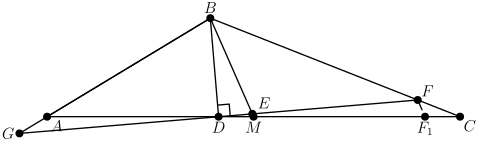
En el ABC,\triangle ABC, AB=360,AB = 360, BC=507,BC = 507, y CA=780.CA = 780. Sea MM el punto medio de CA,\overline{CA}, y sea DD el punto sobre CA\overline{CA} tal que BD\overline{BD} biseca el ángulo ABC.ABC. Sea FF el punto sobre BC\overline{BC} tal que DFBD.\overline{DF} \perp \overline{BD}. Supón que DF\overline{DF} corta a BM\overline{BM} en E.E. La razón DE:EFDE : EF puede escribirse en la forma mn,\frac{m}{n}, donde mm y nn son enteros positivos primos entre sí. Halla m+n.m + n.

In ABC,\triangle ABC, AB=360,AB = 360, BC=507,BC = 507, and CA=780.CA = 780. Let MM be the midpoint of CA,\overline{CA}, and let DD be the point on CA\overline{CA} such that BD\overline{BD} bisects angle ABC.ABC. Let FF be the point on BC\overline{BC} such that DFBD.\overline{DF} \perp \overline{BD}. Suppose that DF\overline{DF} meets BM\overline{BM} at E.E. The ratio DE:EFDE : EF can be written in the form mn,\frac{m}{n}, where mm and nn are relatively prime positive integers. Find m+n.m + n.

Respuesta: 289
Nivel de dificultad: 3370
Pista pequeña:

Extiende FD\overline{FD} más allá de DD hasta cortar el rayo BABA en G.G. En el triángulo BGF,BGF, BD\overline{BD} es a la vez una altura y una bisectriz, así que BG=BF.BG = BF.

Extend FD\overline{FD} past DD to hit ray BABA at G.G. In triangle BGF,BGF, BD\overline{BD} is both an altitude and an angle bisector, so BG=BF.BG = BF.

Pista grande:

Toma F1F_1 sobre AC\overline{AC} con FF1BM;\overline{FF_1} \parallel \overline{BM}; entonces DE:EF=DM:MF1DE : EF = DM : MF_1 por triángulos semejantes.

Take F1F_1 on AC\overline{AC} with FF1BM;\overline{FF_1} \parallel \overline{BM}; then DE:EF=DM:MF1DE : EF = DM : MF_1 by similar triangles

Solución:

Escribe c=AB=360,c = AB = 360, a=BC=507,a = BC = 507, b=CA=780.b = CA = 780. Extiende FD\overline{FD} más allá de DD hasta cortar el rayo BABA más allá de AA en G.G. En el triángulo BGF,BGF, el segmento BD\overline{BD} es a la vez una bisectriz y una altura, así que BG=BF=t.BG = BF = t. La bisectriz también da CDDA=ac,\frac{CD}{DA} = \frac{a}{c}, así que el teorema de Menelao para la recta GDFGDF que cruza el triángulo ABCABC dice AGGBBFFCCDDA=tcttatac=1, \begin{aligned} &\frac{AG}{GB} \cdot \frac{BF}{FC} \cdot \frac{CD}{DA} \\ &= \frac{t - c}{t} \cdot \frac{t}{a - t} \cdot \frac{a}{c} = 1, \end{aligned} por lo que t=2aca+c.t = \frac{2ac}{a + c}.

Ahora sea F1F_1 el punto sobre AC\overline{AC} con FF1BM.\overline{FF_1} \parallel \overline{BM}. Como EE está sobre BM,\overline{BM}, tenemos EMFF1,\overline{EM} \parallel \overline{FF_1}, así que los triángulos DEMDEM y DFF1DFF_1 son semejantes y DEEF=DMMF1.\frac{DE}{EF} = \frac{DM}{MF_1}. La razón de la bisectriz da AD=bca+c,AD = \frac{bc}{a + c}, así que DM=b2bca+c=b(ac)2(a+c).DM = \frac{b}{2} - \frac{bc}{a+c} = \frac{b(a - c)}{2(a + c)}. También CF=at=a(ac)a+c,CF = a - t = \frac{a(a - c)}{a + c}, así que CF1=CMCFCB=b2aca+cCF_1 = CM \cdot \frac{CF}{CB} = \frac{b}{2} \cdot \frac{a - c}{a + c} y MF1=b2(1aca+c)=bca+c.MF_1 = \frac{b}{2}\left(1 - \frac{a - c}{a + c}\right) = \frac{bc}{a + c}.

Por lo tanto, DEEF=DMMF1=ac2c=147720=49240, \begin{aligned} \frac{DE}{EF} &= \frac{DM}{MF_1} = \frac{a - c}{2c} \\ &= \frac{147}{720} = \frac{49}{240}, \end{aligned} y m+n=49+240=289.m + n = 49 + 240 = 289.

Write c=AB=360,c = AB = 360, a=BC=507,a = BC = 507, b=CA=780.b = CA = 780. Extend FD\overline{FD} beyond DD to meet ray BABA beyond AA at G.G. In triangle BGF,BGF, segment BD\overline{BD} is both an angle bisector and an altitude, so BG=BF=t.BG = BF = t. The bisector also gives CDDA=ac,\frac{CD}{DA} = \frac{a}{c}, so Menelaus’ theorem for line GDFGDF crossing triangle ABCABC says AGGBBFFCCDDA=tcttatac=1, \begin{aligned} &\frac{AG}{GB} \cdot \frac{BF}{FC} \cdot \frac{CD}{DA} \\ &= \frac{t - c}{t} \cdot \frac{t}{a - t} \cdot \frac{a}{c} = 1, \end{aligned} so t=2aca+c.t = \frac{2ac}{a + c}.

Now let F1F_1 be the point on AC\overline{AC} with FF1BM.\overline{FF_1} \parallel \overline{BM}. Since EE lies on BM,\overline{BM}, we have EMFF1,\overline{EM} \parallel \overline{FF_1}, so triangles DEMDEM and DFF1DFF_1 are similar and DEEF=DMMF1.\frac{DE}{EF} = \frac{DM}{MF_1}. The bisector ratio gives AD=bca+c,AD = \frac{bc}{a + c}, so DM=b2bca+c=b(ac)2(a+c).DM = \frac{b}{2} - \frac{bc}{a+c} = \frac{b(a - c)}{2(a + c)}. Also CF=at=a(ac)a+c,CF = a - t = \frac{a(a - c)}{a + c}, so CF1=CMCFCB=b2aca+cCF_1 = CM \cdot \frac{CF}{CB} = \frac{b}{2} \cdot \frac{a - c}{a + c} and MF1=b2(1aca+c)=bca+c.MF_1 = \frac{b}{2}\left(1 - \frac{a - c}{a + c}\right) = \frac{bc}{a + c}.

Therefore DEEF=DMMF1=ac2c=147720=49240, \begin{aligned} \frac{DE}{EF} &= \frac{DM}{MF_1} = \frac{a - c}{2c} \\ &= \frac{147}{720} = \frac{49}{240}, \end{aligned} and m+n=49+240=289.m + n = 49 + 240 = 289.