
Problemas del 1995 AIME
¡Desplázate hacia abajo y presiona Iniciar para intentar el examen! O ve al PDF imprimible, la clave de respuestas, o las soluciones profesionales preparadas por LIVE by Po-Shen Loh.
Todos los problemas se usan con el permiso legal oficial de la Mathematical Association of America (MAA).
O salta directamente a un solo problema con su solución: 1 · 2 · 3 · 4 · 5 · 6 · 7 · 8 · 9 · 10 · 11 · 12 · 13 · 14 · 15
¿Quieres aprender de forma profesional con clases interactivas en video?
Con tiempo
3:00:00
1.
El cuadrado mide Para los lados del cuadrado miden la mitad que los del cuadrado dos lados adyacentes de son mediatrices de dos lados adyacentes de y los otros dos lados de son mediatrices de dos lados adyacentes de El área total encerrada por al menos uno de puede escribirse como donde y son enteros positivos coprimos. Halla
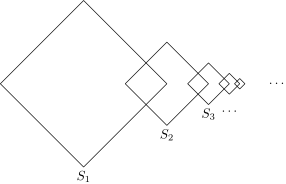
Square is For the lengths of the sides of square are half the lengths of the sides of square two adjacent sides of square are perpendicular bisectors of two adjacent sides of square and the other two sides of square are the perpendicular bisectors of two adjacent sides of square The total area enclosed by at least one of can be written in the form where and are relatively prime positive integers. Find
Respuesta: 255
Pista pequeña:
Cada cuadrado tiene la cuarta parte del área del cuadrado anterior
Each square has one fourth the area of the preceding square
Pista grande:
Dos cuadrados consecutivos se superponen en la cuarta parte del menor, y los interiores de cuadrados no consecutivos no se superponen
Adjacent squares overlap in one fourth of the smaller square, and nonadjacent interiors do not overlap
Solución:
La suma de las áreas de los cinco cuadrados es La disposición mediante mediatrices hace que la superposición de cada par consecutivo sea la cuarta parte del cuadrado menor. Estas cuatro superposiciones son disjuntas y tienen área total Por lo tanto, la unión tiene área y
The sum of the five square areas is The perpendicular-bisector placement makes the overlap of each adjacent pair one fourth of the smaller square. These four overlaps are disjoint and have total area Thus the union has area and
2.
Halla las tres últimas cifras del producto de las raíces positivas de
Find the last three digits of the product of the positive roots of
Respuesta: 25
Pista pequeña:
Define de modo que
Set so
Pista grande:
Compara los exponentes de y luego usa la suma de los dos valores de
Compare exponents of , then use the sum of the two values of
Solución:
Sea de modo que La ecuación se convierte en y por tanto Los dos valores de tienen suma así que el producto de las raíces positivas correspondientes es Como sus tres últimas cifras son La respuesta AIME pedida es
Put so The equation becomes and hence The two values of have sum so the product of the corresponding positive roots is Since its last three digits are The requested AIME answer is
3.
Partiendo de un objeto se mueve en el plano cartesiano mediante pasos de longitud uno. Cada paso va a la izquierda, a la derecha, hacia arriba o hacia abajo, con las cuatro opciones igualmente probables. Sea la probabilidad de que el objeto llegue a en seis pasos o menos. Dado que puede escribirse como donde y son enteros positivos coprimos, halla
Starting at an object moves in the coordinate plane via a sequence of steps, each of length one. Each step is left, right, up, or down, all four equally likely. Let be the probability that the object reaches in six or fewer steps. Given that can be written in the form where and are relatively prime positive integers, find
Respuesta: 67
Pista pequeña:
El objetivo puede alcanzarse por primera vez únicamente después de o pasos
The target can first be reached only after or steps
Pista grande:
De los caminos de seis pasos que terminan en el objetivo, resta los que ya llegaron en el paso
From the six-step paths ending at the target, subtract those that already arrived at step
Solución:
Hay caminos de cuatro pasos hasta Hay caminos de seis pasos que terminan allí: el par opuesto adicional consiste en un paso a la izquierda y otro a la derecha, o en uno hacia abajo y otro hacia arriba. De ellos, alcanzan por primera vez el objetivo en el paso y luego hacen un regreso de dos pasos. Por lo tanto, Así,
There are four-step paths to There are six-step paths ending there: the extra opposite pair is either left-right or down-up. Of these, first reach the target at step and then make a two-step return. Therefore Thus
4.
Dos círculos de radios y son tangentes exteriormente entre sí y tangentes interiormente a un círculo de radio El círculo de radio tiene una cuerda que es tangente exterior común a los otros dos círculos. Halla el cuadrado de la longitud de esta cuerda.
Circles of radius and are externally tangent to each other and are internally tangent to a circle of radius The circle of radius has a chord that is a common external tangent of the other two circles. Find the square of the length of this chord.
Respuesta: 224
Pista pequeña:
Los tres centros son colineales porque sus distancias por pares son y
The three circle centers are collinear because their pairwise distances are and
Pista grande:
Usa las distancias dirigidas desde los dos centros menores hasta la tangente común para hallar su distancia al centro mayor
Use signed distances from the two smaller centers to the common tangent to find its distance from the large center
Solución:
Coloca el centro del círculo de radio en el origen y los centros menores en y Escribe la tangente exterior común como donde es un vector normal unitario. Sus distancias dirigidas a los dos centros difieren en por lo que y Usar la distancia desde da Así, la cuerda está a unidades del centro mayor y el cuadrado de su longitud es
Put the radius- circle at the origin and the smaller centers at and Write the common external tangent as where is a unit normal. Its signed distances from the two centers differ by so and Using the distance from gives Thus the chord lies units from the large center, and its squared length is
5.
Para ciertos valores reales de y la ecuación tiene cuatro raíces no reales. El producto de dos de ellas es y la suma de las otras dos es donde Halla
For certain real values of and the equation has four non-real roots. The product of two of these roots is and the sum of the other two roots is where Find
Respuesta: 51
Pista pequeña:
Como el polinomio tiene coeficientes reales, sus raíces no reales aparecen en pares conjugados
Because the polynomial has real coefficients, its non-real roots occur in conjugate pairs
Pista grande:
Agrupa los seis productos por pares en los productos internos de los dos grupos y los cuatro productos cruzados
Group the six pairwise products into the products within the two groups and the four cross-products
Solución:
Sean las dos primeras raíces y Como no es real, no son conjugadas, así que las otras raíces son y Por consiguiente, y Por las fórmulas de Vieta,
Let the first two roots be and Since is not real, they are not conjugates, so the other roots are and Hence and By Vieta’s formulas,
6.
Sea ¿Cuántos divisores enteros positivos de son menores que pero no dividen a ?
Let How many positive integer divisors of are less than but do not divide
Respuesta: 589
Pista pequeña:
Empareja cada divisor de con
Pair each divisor of with
Pista grande:
Entre los divisores menores que , resta los que ya dividen a
Among the divisors below , subtract those that already divide
Solución:
El número tiene divisores. Emparejar con deja solo a sin pareja, así que divisores están por debajo de El número tiene divisores, de los cuales están por debajo de Por lo tanto, la cantidad pedida es
The number has divisors. Pairing with leaves only unpaired, so divisors lie below The number has divisors, of which are below Therefore the requested count is
7.
Dado que y donde y son enteros positivos y y son coprimos, halla
Given that and where and are positive integers with and relatively prime, find
Respuesta: 27
Pista pequeña:
Define y expresa en términos de
Set and express in terms of
Pista grande:
Los dos productos dados se convierten en la mitad de un cuadrado perfecto en
Both given products become half of a perfect square in
Solución:
Sea Como La elección de signo compatible da Por tanto, Así,
Let Since The feasible sign gives Therefore Thus
8.
¿Para cuántos pares ordenados de enteros positivos con son enteros tanto como ?
For how many ordered pairs of positive integers with are both and integers?
Respuesta: 85
Pista pequeña:
Escribe y reduce módulo
Write and reduce modulo
Pista grande:
El cociente debe tener la forma ; cuenta los valores positivos posibles de
The quotient must have the form ; count the possible positive values of
Solución:
Escribe Módulo tenemos así que es divisible por exactamente cuando Como escribe con La cota se convierte en Solo contribuyen lo que da
Write Modulo we have so is divisible by exactly when Since write with The bound becomes Only contribute, giving
9.
El triángulo es isósceles, con y altura Supón que hay un punto sobre con y Entonces el perímetro de puede escribirse en la forma donde y son enteros. Halla
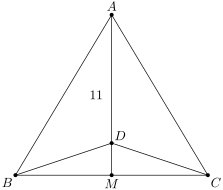
Triangle is isosceles, with and altitude Suppose that there is a point on with and Then the perimeter of may be written in the form where and are integers. Find
Respuesta: 616
Pista pequeña:
Sea y sea la mitad del ángulo del vértice
Let and let half the apex angle be
Pista grande:
Usa y la fórmula del ángulo triple para la tangente
Use and the triple-angle formula for tangent
Solución:
Sean y de modo que Como la simetría da mientras que Por tanto, Sea Entonces por lo que y Así, y con lo cual el perímetro es Por consiguiente,
Let and so Because symmetry gives while Hence Put Then so and Thus and making the perimeter Therefore
10.
¿Cuál es el mayor entero positivo que no es la suma de un múltiplo entero positivo de y un entero compuesto positivo?
What is the largest positive integer that is not the sum of a positive integral multiple of and a positive composite integer?
Respuesta: 215
Pista pequeña:
Para cada residuo módulo , halla el menor entero compuesto positivo de esa clase
For each residue modulo , find the smallest positive composite integer in that residue
Pista grande:
Una vez que un número de una clase residual es representable, todo número unidades mayor de esa clase también lo es
Once one number in a residue class is representable, every number larger in that class is representable
Solución:
Un número de la clase residual es representable cuando excede al menor compuesto positivo de esa clase en un múltiplo positivo de Si el residuo es compuesto, él mismo aporta ese primer valor. Para los residuos restantes, unos primeros compuestos adecuados son La mayor entrada es y y son todos primos. Por lo tanto, no es representable, mientras que todo entero mayor sí lo es.
A number in residue class is representable once it exceeds the first positive composite in that class by a positive multiple of Composite residues themselves supply that first value. For the remaining residues, suitable first composites are The largest entry is and and are all prime. Hence is not representable, while every larger integer is.
11.
Un prisma rectangular recto (es decir, un paralelepípedo rectangular) tiene aristas de longitudes enteras con Un plano paralelo a una cara de corta a en dos prismas, uno de los cuales es semejante a y ambos tienen volumen no nulo. Dado que ¿para cuántas ternas ordenadas existe tal plano?
A right rectangular prism (i.e., a rectangular parallelepiped) has sides of integral length with A plane parallel to one of the faces of cuts into two prisms, one of which is similar to and both of which have nonzero volume. Given that for how many ordered triples does such a plane exist?
Respuesta: 40
Pista pequeña:
Ordena las tres aristas del prisma menor y compáralas en orden con y
Sort the three side lengths of the smaller prism and compare them in order with and
Pista grande:
Las dos dimensiones que no cambian obligan a que
The two unchanged dimensions force
Solución:
Sean las aristas ordenadas del prisma menor semejante. Este comparte dos longitudes con y sus tres aristas ordenadas son menores que las correspondientes de La única correspondencia posible es y La semejanza da entonces así que Recíprocamente, cada par de factores produce un corte no degenerado. Como su cuadrado tiene divisores. Al excluir el par central y tomar un divisor de cada par restante se obtiene
Let the similar smaller prism have sorted sides It shares two side lengths with and all three of its sorted sides are smaller than the corresponding sides of The only possible matching is and Similarity then gives so Conversely every factor pair gives a nondegenerate cut. Since its square has divisors. Excluding the central pair and taking one divisor from each remaining pair gives
12.
La pirámide tiene base cuadrada aristas congruentes y y Sea la medida del ángulo diedro formado por las caras y Dado que donde y son enteros, halla
Pyramid has square base congruent edges and and Let be the measure of the dihedral angle formed by faces and Given that where and are integers, find
Respuesta: 5
Pista pequeña:
Coloca los vértices del cuadrado en y el vértice de la pirámide en
Place the square’s vertices at and the apex at
Pista grande:
Halla a partir de y luego toma el suplemento del ángulo entre normales adecuadas a las caras
Find from then take the supplement of the angle between suitable face normals
Solución:
Toma los vértices adyacentes de la base y A partir de Se pueden tomar como normales a las dos caras y El coseno de su ángulo agudo es El ángulo diedro interior es su suplemento, así que Por lo tanto,
Take adjacent base vertices and From Normals to the two faces may be taken as and Their acute angle has cosine The interior dihedral angle is its supplement, so Thus
13.
Sea el entero más cercano a Halla
Let be the integer closest to Find
Respuesta: 400
Pista pequeña:
Cuenta los enteros para los cuales
Count the integers for which
Pista grande:
El número de apariciones de se simplifica a
The number of occurrences of simplifies to
Solución:
Para el número de enteros positivos para los cuales es Para estos representan valores, y su contribución a la suma pedida es Los valores restantes tienen y aportan El total es
For the number of positive integers for which is For these account for values, and their contribution to the requested sum is The remaining values have contributing The total is
14.
En un círculo de radio dos cuerdas de longitud se cortan en un punto cuya distancia al centro es Las dos cuerdas dividen el interior del círculo en cuatro regiones. Dos de ellas están limitadas por segmentos de longitudes distintas, y el área de cualquiera puede expresarse de manera única como donde y son enteros positivos y no es divisible por el cuadrado de ningún primo. Halla
In a circle of radius two chords of length intersect at a point whose distance from the center is The two chords divide the interior of the circle into four regions. Two of these regions are bordered by segments of unequal lengths, and the area of either of them can be expressed uniquely in the form where and are positive integers and is not divisible by the square of any prime. Find
Respuesta: 378
Pista pequeña:
Cada cuerda está a del centro; determina las dos direcciones posibles de una recta que pase por el punto de intersección
Each chord is from the center, so determine the two possible line directions through the intersection point
Pista grande:
Los segmentos desiguales de las cuerdas miden y y sus extremos subtienden en el centro
The unequal chord segments have lengths and and their endpoints subtend at the center
Solución:
Coloca el centro en y la intersección en Una cuerda de longitud está a de así que una recta por que contenga tal cuerda forma un ángulo de o con Resolver sobre cualquiera de las dos rectas da segmentos de longitudes y
Para cualquiera de las regiones limitadas por segmentos desiguales, los dos extremos del arco subtienden en Su área es el sector menos más Por tanto,
Put the center at and the intersection at A length- chord is from so a line through containing such a chord makes angle or with Solving along either line gives segment lengths and
For either region bordered by unequal segments, the two arc endpoints subtend at Its area is the sector minus plus Hence
15.
Sea la probabilidad de que, al lanzar repetidamente una moneda equilibrada, aparezca una racha de caras antes que una racha de cruces. Dado que puede escribirse como donde y son enteros positivos coprimos, halla
Let be the probability that, in the process of repeatedly flipping a fair coin, one will encounter a run of heads before one encounters a run of tails. Given that can be written in the form where and are relatively prime positive integers, find
Respuesta: 37
Pista pequeña:
Usa estados para y caras consecutivas y otro estado para una sola cruz final
Use states for and consecutive heads and one separate state for a single trailing tail
Pista grande:
Expresa la probabilidad de éxito de cada estado de racha de caras en términos del estado con una cruz final
Express every head-run state’s success probability in terms of the trailing-tail state
Solución:
Sea la probabilidad de éxito con caras consecutivas y sin una cruz final, y sea la probabilidad después de una cruz. Entonces Al trabajar hacia atrás se obtiene Como resulta y Por lo tanto, así que
Let be the success probability with consecutive heads and no trailing tail, and let be the probability after one tail. Then Working backward gives Since we get and Therefore so