
Problemas del 1994 AIME
¡Desplázate hacia abajo y presiona Iniciar para intentar el examen! O ve al PDF imprimible, la clave de respuestas, o las soluciones profesionales preparadas por LIVE by Po-Shen Loh.
Todos los problemas se usan con el permiso legal oficial de la Mathematical Association of America (MAA).
O salta directamente a un solo problema con su solución: 1 · 2 · 3 · 4 · 5 · 6 · 7 · 8 · 9 · 10 · 11 · 12 · 13 · 14 · 15
¿Quieres aprender de forma profesional con clases interactivas en video?
Con tiempo
3:00:00
1.
La sucesión creciente consta de los múltiplos positivos de que son una unidad menores que un cuadrado perfecto. ¿Cuál es el residuo cuando el término de la sucesión se divide entre ?
The increasing sequence consists of those positive multiples of that are one less than a perfect square. What is the remainder when the th term of the sequence is divided by
Respuesta: 63
Pista pequeña:
El número es divisible por exactamente cuando no es divisible por
A number is divisible by exactly when is not divisible by
Pista grande:
Agrupa de dos en dos los valores admisibles de y luego reduce el cuadrado requerido módulo
Index the eligible values of in pairs, then reduce the required square modulo
Solución:
Los términos son para los enteros que no son divisibles por En cada bloque de tres valores consecutivos de hay dos admisibles. El término corresponde a Como
The terms are for integers not divisible by In each block of three consecutive ’s there are two eligible values. The th corresponds to Since
2.
Un círculo cuyo diámetro mide es tangente interiormente en a un círculo de radio Se construye el cuadrado con y sobre el círculo mayor, tangente en al círculo menor y el círculo menor fuera de La longitud de puede escribirse en la forma donde y son enteros. Halla
A circle with diameter of length is internally tangent at to a circle of radius Square is constructed with and on the larger circle, tangent at to the smaller circle, and the smaller circle outside The length of can be written in the form where and are integers. Find
Respuesta: 312
Pista pequeña:
Coloca el círculo grande en el origen y sitúa y sobre un diámetro
Place the large circle at the origin and put and on a diameter
Pista grande:
Si el lado del cuadrado mide , su lado-cuerda está a una distancia del centro del círculo grande
If the square’s side is , its chord side lies at distance from the large circle’s center
Solución:
Coloca el círculo grande en el origen con y Sea el lado del cuadrado. Como el círculo menor está fuera del cuadrado, se encuentra sobre y la cuerda paralela se encuentra sobre La fórmula para una cuerda del círculo de radio da Al elevar al cuadrado se obtiene de modo que Por lo tanto,
Put the large circle at the origin with and Let the square’s side be Because the smaller circle is outside the square, lies on and the parallel chord lies on A chord of the radius- circle then gives Squaring yields so Thus
3.
La función tiene la propiedad de que, para todo número real Si ¿cuál es el residuo al dividir entre ?
The function has the property that, for each real number If what is the remainder when is divided by
Respuesta: 561
Pista pequeña:
Primero usa para hallar
First use to find
Pista grande:
Elimina los términos alternados deduciendo una recurrencia de a
Eliminate alternating terms by deriving a recurrence from to
Solución:
Primero, Al avanzar dos pasos se obtiene Por lo tanto, El residuo pedido es
First Subtracting through two steps gives Therefore The requested remainder is
4.
Halla el entero positivo para el cual (Para un número real es el mayor entero que no excede a )
Find the positive integer for which (For real is the greatest integer not exceeding )
Respuesta: 312
Pista pequeña:
Agrupa los enteros que tienen el mismo valor de
Group integers having the same value of
Pista grande:
Calcula la suma hasta ; a partir de ahí, cada nuevo término aporta inicialmente
Compute the sum through , after which every new term initially contributes
Solución:
Para el sumando es Por lo tanto, la suma hasta es La diferencia es así que incluimos enteros más a partir de Por consiguiente,
For the summand is Thus the sum through is The remaining is so we include more integers beginning with Hence
5.
Dado un entero positivo sea el producto de las cifras no nulas de (Si tiene una sola cifra, entonces es igual a esa cifra). Sea ¿Cuál es el mayor factor primo de ?
Given a positive integer let be the product of the nonzero digits of (If has only one digit, then is equal to that digit.) Let What is the largest prime factor of
Respuesta: 103
Pista pequeña:
Escribe con tres cifras cada número desde hasta y haz que una cifra cero aporte un factor de
Write every number from through using three digits and let a zero digit contribute a factor of
Pista grande:
La suma se factoriza por posiciones decimales; recuerda quitar la contribución de
The sum factors by digit position; remember to remove the contribution of
Solución:
Para una posición decimal, la suma de sus factores efectivos es donde el primer representa la cifra Por lo tanto, la suma desde hasta es Al quitar la contribución artificial de se obtiene Como el mayor factor primo es
For one digit position, the sum of its effective factors is where the first represents digit Thus the sum over through is Removing the artificial contribution from gives Since the largest prime factor is
6.
Para se dibujan en el plano cartesiano las gráficas de las ecuaciones Estas rectas dividen parte del plano en triángulos equiláteros de lado ¿Cuántos de esos triángulos se forman?
The graphs of the equations are drawn in the coordinate plane for These lines cut part of the plane into equilateral triangles of side How many such triangles are formed?
Respuesta: 660
Pista pequeña:
Indexa una recta de cada familia mediante en
Index one line from each family by in
Pista grande:
Una celda triangular mínima aparece exactamente cuando o
A smallest triangular cell occurs precisely when or
Solución:
Una celda triangular unitaria queda determinada por índices que satisfacen Para el signo más, Hay pares ordenados cuya suma es así que esta orientación aporta Por simetría, la otra orientación también aporta para un total de
A unit triangular cell is determined by indices satisfying For the plus sign, There are ordered pairs with sum so this orientation contributes By symmetry the other orientation also contributes for a total of
7.
Para ciertos pares ordenados de números reales, el sistema de ecuaciones tiene al menos una solución, y cada solución es un par ordenado de enteros. ¿Cuántos pares ordenados hay?
For certain ordered pairs of real numbers, the system of equations has at least one solution, and each solution is an ordered pair of integers. How many such ordered pairs are there?
Respuesta: 72
Pista pequeña:
Enumera todos los puntos enteros de
List all integer points on
Pista grande:
Cuenta tanto las cuerdas que pasan por dos puntos enteros no antipodales como las tangentes en un solo punto entero
Count both chords through two non-antipodal lattice points and tangents at one lattice point
Solución:
El círculo tiene los puntos enteros obtenidos de y Una secante que satisface la condición queda determinada por dos puntos enteros no antipodales cualesquiera. Esto da rectas; se excluyen los pares antipodales porque su recta pasa por el origen y no puede tener ecuación También hay tangentes, una en cada punto entero. Cada recta tiene una normalización única así que el total es
The circle has the lattice points obtained from and A secant satisfying the condition is determined by any two non-antipodal lattice points. This gives lines; antipodal pairs are excluded because their line passes through the origin and cannot have equation There are also tangents, one at each lattice point. Each line has a unique normalization so the total is
8.
Los puntos y son los vértices de un triángulo equilátero. Halla el valor de
The points and are the vertices of an equilateral triangle. Find the value of
Respuesta: 315
Pista pequeña:
El vector es una rotación de por o por
The vector is a rotation of through or
Pista grande:
Usa primero la segunda coordenada de la rotación y luego calcula la primera
Use the second coordinate of the rotation first, then compute the first coordinate
Solución:
Para una rotación de de donde La primera coordenada es entonces La orientación opuesta cambia ambos signos y deja invariante el producto. Por lo tanto,
For a rotation, so The first coordinate is then The opposite orientation changes both signs and leaves the product unchanged. Hence
9.
Se juega un solitario de la siguiente manera. Se colocan en una bolsa seis pares distintos de fichas iguales. El jugador extrae fichas al azar, una por una, y las conserva, excepto que un par de fichas iguales se aparta tan pronto como aparece en su mano. El juego termina si el jugador llega a tener tres fichas sin que haya dos iguales; de lo contrario, continúa sacando hasta vaciar la bolsa. La probabilidad de vaciar la bolsa es donde y son enteros positivos coprimos. Halla
A solitaire game is played as follows. Six distinct pairs of matched tiles are placed in a bag. The player randomly draws tiles one at a time from the bag and retains them, except that matching tiles are put aside as soon as they appear in the player’s hand. The game ends if the player ever holds three tiles, no two of which match; otherwise the drawing continues until the bag is empty. The probability that the bag will be emptied is where and are relatively prime positive integers. Find
Respuesta: 394
Pista pequeña:
Registra el número de pares aún no vistos y el número de fichas sin pareja que se tienen en la mano
Track the number of unseen pairs and the number of unmatched tiles currently held
Pista grande:
Desde el estado , la ficha siguiente empareja una de las fichas en la mano o abre uno de los pares aún no vistos
From state , the next tile either matches one of the held tiles or opens one of the unseen pairs
Solución:
Sea la probabilidad de éxito cuando quedan pares aún no vistos y se tienen fichas sin pareja. Entre las fichas restantes, cierran un par abierto y abren un nuevo par; este último caso produce una derrota cuando Por tanto, donde se omite el segundo término cuando y Al evaluar esta recurrencia de tres estados se obtiene para Por consiguiente, y
Let be the chance of success with unseen pairs and unmatched tiles held. Among remaining tiles, close an open pair and open a new pair; the latter move fails when Thus omitting the second term when with Evaluating this three-state recursion gives for Hence and
10.
En el triángulo el ángulo es recto y la altura desde corta a en Las longitudes de los lados de son enteras, y donde y son enteros positivos coprimos. Halla
In triangle angle is a right angle and the altitude from meets at The lengths of the sides of are integers, and where and are relatively prime positive integers. Find
Respuesta: 450
Pista pequeña:
Usa la semejanza para escribir
Use similarity to write
Pista grande:
Expresa en su mínima expresión y usa la factorización prima de
Express in lowest terms and use the prime factorization of
Solución:
Escribe en su mínima expresión, con y La semejanza da Por lo tanto, es divisible por si escribimos , obtenemos La posibilidad no puede ser un cateto de un triángulo rectángulo entero no degenerado, así que Si llamamos al otro cateto de la terna primitiva, entonces lo que da y Por consiguiente,
Write in lowest terms, with and Similarity gives Hence is divisible by writing gives The possibility cannot be a leg of a nondegenerate integer right triangle, so Writing the other leg of the primitive triple as we have giving and Therefore
11.
Noventa y cuatro ladrillos, cada uno de dimensiones se apilan uno encima de otro para formar una torre de ladrillos de altura. Cada ladrillo puede orientarse para aportar o a la altura total. ¿Cuántas alturas diferentes se pueden obtener usando los ladrillos?
Ninety-four bricks, each measuring are to be stacked one on top of another to form a tower bricks tall. Each brick can be oriented so it contributes or to the total height of the tower. How many different tower heights can be achieved using all of the bricks?
Respuesta: 465
Pista pequeña:
Comienza con todos los ladrillos aportando pulgadas y cuenta los incrementos posibles
Start with all bricks contributing inches and count possible increments
Pista grande:
Si ladrillos aportan pulgadas, los incrementos restantes forman un intervalo de paridad fija a medida que varía el número de ladrillos de pulgadas
If bricks contribute inches, the remaining increments form a parity interval as the number of -inch bricks varies
Solución:
Si ladrillos usan la altura y usan la altura el total es donde y Para un fijo, el valor avanza de dos en dos desde hasta Los intervalos con par cubren todos los valores pares de desde hasta además de y solo faltan y Los intervalos con impar cubren todos los valores impares de desde hasta además de y y solo faltan y Por lo tanto, hay alturas distintas.
If bricks use height and use height the total is where and For fixed the value runs by twos from to The even- intervals cover every even from through as well as missing only and The odd- intervals cover every odd from through as well as and missing only and Thus there are distinct heights.
12.
Un campo rectangular cercado mide metros por metros. Una investigadora agrícola dispone de metros de cerca para dividir interiormente el campo en parcelas de prueba cuadradas y congruentes. Hay que dividir todo el campo y los lados de los cuadrados deben ser paralelos a sus bordes. ¿Cuál es el mayor número de parcelas cuadradas en que puede dividirse el campo usando todos o algunos de los metros de cerca?
A fenced, rectangular field measures meters by meters. An agricultural researcher has meters of fence that can be used for internal fencing to partition the field into congruent, square test plots. The entire field must be partitioned, and the sides of the squares must be parallel to the edges of the field. What is the largest number of square test plots into which the field can be partitioned using all or some of the meters of fence?
Respuesta: 702
Pista pequeña:
Si hay filas y columnas, la igualdad de los lados de los cuadrados obliga a que
If there are rows and columns, equality of square side lengths forces
Pista grande:
Escribe y , y luego calcula únicamente la longitud de la cerca interior
Write and , then calculate only the internal fence length
Solución:
Sea la cuadrícula de filas y columnas, de modo que cada cuadrado tiene lado Las cercas verticales y horizontales interiores tienen longitud total Exigir que esto no supere da Con el número de parcelas es
Let the grid have rows and columns, so each square has side The internal vertical and horizontal fences have total length Requiring this to be at most gives With the number of plots is
13.
La ecuación tiene raíces complejas donde la barra indica conjugación compleja. Halla el valor de
The equation has complex roots where the bar denotes complex conjugation. Find the value of
Respuesta: 850
Pista pequeña:
Define donde
Set where
Pista grande:
Expresa en términos de y suma sobre los cinco pares conjugados
Express in terms of and sum over the five conjugate pairs
Solución:
Sea de modo que y Como Sumar un valor por cada uno de los cinco pares conjugados da menos veces la suma de las diez raíces de que es El valor pedido es
Let so and Since Summing one value for each of the five conjugate pairs gives minus times the sum of all ten roots of which is The requested value is
14.
Un rayo de luz incide en en el punto con ángulo de incidencia y se refleja con el mismo ángulo, como se muestra. El rayo continúa su trayectoria y se refleja en los segmentos y según la regla de que el ángulo de incidencia es igual al de reflexión. Dado que y determina cuántas veces rebotará el rayo en los dos segmentos. Incluye en la cuenta la primera reflexión en
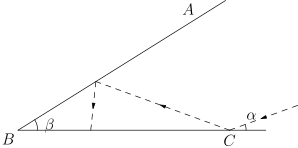
A beam of light strikes at point with angle of incidence and reflects with an equal angle of reflection as shown. The light beam continues its path, reflecting off line segments and according to the rule: angle of incidence equals angle of reflection. Given that and determine the number of times the light beam will bounce off the two line segments. Include the first reflection at in your count.
Respuesta: 71
Pista pequeña:
Despliega cada reflexión reflejando la siguiente copia del ángulo formado por los dos segmentos en vez de reflejar el rayo
Unfold each reflection by reflecting the next copy of the two-segment angle instead of reflecting the beam
Pista grande:
Después de reflexiones posteriores a la primera, la semirrecta límite correspondiente ha girado
After reflections beyond the first one, the relevant boundary ray has turned through
Solución:
Despliega la trayectoria en cada rebote, de modo que el rayo se convierte en una recta que cruza copias reflejadas sucesivas del ángulo en Después de reflexiones posteriores a la inicial en la siguiente semirrecta límite forma un ángulo con la original. Al usar el cruce permanece sobre los segmentos finitos exactamente mientras Por lo tanto, así que hay reflexiones más. Al incluir la primera reflexión en , se obtienen
Unfold the path at each bounce, so the beam becomes one straight line crossing successive reflected copies of the angle at After reflections beyond the initial reflection at the next boundary ray makes angle with the original one. Using the crossing remains on the finite segments exactly while Therefore so there are further reflections. Including the first reflection at gives
15.
Dado un punto en una hoja triangular considera los pliegues que se forman al doblar y sobre Llamemos a punto de plegado de si estos pliegues, que son tres salvo cuando es uno de los vértices, no se cortan. Supón que y Entonces el área del conjunto de todos los puntos de plegado de puede escribirse como donde y son enteros positivos y no es divisible por el cuadrado de ningún primo. ¿Cuál es ?
Given a point on a triangular piece of paper consider the creases that are formed in the paper when and are folded onto Let us call a fold point of if these creases, which number three unless is one of the vertices, do not intersect. Suppose that and Then the area of the set of all fold points of can be written in the form where and are positive integers and is not divisible by the square of any prime. What is
Respuesta: 597
Pista pequeña:
Dos pliegues se cortan en el circuncentro del triángulo formado por y los dos vértices correspondientes
Two fold creases meet at the circumcenter of the triangle formed by and the corresponding two vertices
Pista grande:
El lugar geométrico de los puntos de plegado es la intersección de los discos con diámetros y
The fold-point locus is the intersection of the disks with diameters and
Solución:
Los pliegues correspondientes a dos vértices se cortan en el circuncentro del triángulo formado con Esta intersección queda fuera del papel exactamente cuando el ángulo en es obtuso, de modo que el lugar de los puntos de plegado es la intersección de los tres discos de diámetros y El disco de diámetro contiene todo el triángulo rectángulo, por lo que queda la intersección de los discos de diámetros y .
Aquí Los dos radios relevantes son y y su lente consta de segmentos circulares con ángulos centrales y Su área es Por tanto, es igual a
The creases for two vertices meet at the circumcenter of the triangle formed with This intersection lies off the paper exactly when the angle at is obtuse, so the fold-point locus is the intersection of the three diameter disks for and The disk contains the entire right triangle, leaving the intersection of the and disks.
Here The two relevant radii are and and their lens consists of circular segments with central angles and Its area is Thus equals