
2018 AIME II 第 4 题
先试着解答 2018 AIME II 第 4 题,然后核对你的答案与精心整理的解答,解答来自 LIVE by Po-Shen Loh。你也可以参加完整限时模拟考试、查看全部 2018 AIME II 解答,或核对答案。
所有题目均经美国数学协会(MAA)官方合法授权使用。
4.
在等角八边形 中,,且 。自交八边形 围成六个不重叠的三角形区域。设 为 围成的面积,也就是这六个三角形区域的总面积。若 ,其中 与 是互质正整数,求 。
In equiangular octagon and The self-intersecting octagon encloses six non-overlapping triangular regions. Let be the area enclosed by that is, the total area of the six triangular regions. Then where and are relatively prime positive integers. Find
小提示:
把八边形放在网格上:长度为 的边是单位正方形的对角线,因此八个顶点都可以是格点
Place the octagon on a grid: the sides are diagonals of unit squares, so all eight vertices are lattice points
大提示:
路径 有 旋转对称性;求线段 与 和线段 以及彼此的交点
The path has a rotational symmetry; find where segments and cross segment and each other
解答:
因为所有内角都是 ,且长度为 的边是单位正方形的对角线,所以八边形可放在格点上:、、、、、、、。路径 绕 作 旋转后不变。设 与 分别为 、 与 的交点,并设 。线段 的斜率为 ,所以 ,由对称性得 且 。
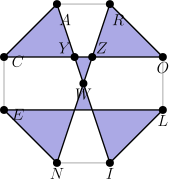
六个封闭区域包括四个全等的角部三角形(如 )和两个全等的小三角形(如 )。三角形 的底 ,高为 ,所以面积为 。三角形 的底 ,高为 ,所以面积为 。因此 所以 。
Since the interior angles are all and the sides are diagonals of unit squares, the octagon fits on a lattice: The path is carried to itself by the rotation about Let and be the points where and cross and let Segment has slope so and by symmetry and
The six enclosed regions are the four congruent corner triangles like and the two small congruent triangles like Triangle has base and height so its area is Triangle has base and height so its area is Therefore and
其他年份的第 4 题
1983 AIME · 1984 AIME · 1985 AIME · 1986 AIME · 1987 AIME · 1988 AIME · 1989 AIME · 1990 AIME · 1991 AIME · 1992 AIME · 1993 AIME · 1994 AIME · 1995 AIME · 1996 AIME · 1997 AIME · 1998 AIME · 1999 AIME · 2000 AIME I · 2000 AIME II · 2001 AIME I · 2001 AIME II · 2002 AIME I · 2002 AIME II · 2003 AIME I · 2003 AIME II · 2004 AIME I · 2004 AIME II · 2005 AIME I · 2005 AIME II · 2006 AIME I · 2006 AIME II · 2007 AIME I · 2007 AIME II · 2008 AIME I · 2008 AIME II · 2009 AIME I · 2009 AIME II · 2010 AIME I · 2010 AIME II · 2011 AIME I · 2011 AIME II · 2012 AIME I · 2012 AIME II · 2013 AIME I · 2013 AIME II · 2014 AIME I · 2014 AIME II · 2015 AIME I · 2015 AIME II · 2016 AIME I · 2016 AIME II · 2017 AIME I · 2017 AIME II · 2018 AIME I · 2019 AIME I · 2019 AIME II · 2020 AIME I · 2020 AIME II · 2021 AIME I · 2021 AIME II · 2022 AIME I · 2022 AIME II · 2023 AIME I · 2023 AIME II · 2024 AIME I · 2024 AIME II · 2025 AIME I · 2025 AIME II · 2026 AIME I · 2026 AIME II