
2018 AIME II 详解
向下滚动即可查看来自 LIVE by Po-Shen Loh 的精心整理的解答,打印PDF 解答,查看答案,或参加完整限时模拟考试。
所有题目均经美国数学协会(MAA)官方合法授权使用。
1.
点 、、 按此顺序位于一条直路上,且 到 的距离为 米。Ina 的速度是 Eve 的两倍,Paul 的速度是 Ina 的两倍。三名跑者同时开始跑步:Ina 从 出发跑向 ,Paul 从 出发跑向 ,Eve 从 出发跑向 。当 Paul 遇到 Eve 时,他转身跑向 。Paul 和 Ina 同时到达 。求 到 的距离。
Points and lie in that order along a straight path where the distance from to is meters. Ina runs twice as fast as Eve, and Paul runs twice as fast as Ina. The three runners start running at the same time with Ina starting at and running toward Paul starting at and running toward and Eve starting at and running toward When Paul meets Eve, he turns around and runs toward Paul and Ina both arrive at at the same time. Find the number of meters from to
小提示:
设 。Paul 和 Eve 共同跑完从 到 的间隔,所以 Paul 在转身前跑了其中的
Let Paul and Eve together cover the gap from to so Paul runs of it before turning around
大提示:
当 Paul 回到 时,他已经跑了 ,而同一段时间内速度为他一半的 Ina 跑了
When Paul is back at he has run and in that same time Ina, at half his speed, has run
解答:
设 ,则 ,设 Eve 的速度为 ,则 Ina 的速度为 ,Paul 的速度为 。Paul 和 Eve 分别从 与 相向而跑,所以他们一起跑完相距 米的路段,其中 Paul 跑了 。然后 Paul 沿原路跑回 ,所以当他到达 时,他总共跑了 米。
Ina 同时到达 ,她跑了 米。因为 Paul 的速度是 Ina 的两倍,所以这段时间内 Paul 跑了 米。因此 得 ,所以 。
Let so and let Eve’s speed be so Ina runs at and Paul at Paul and Eve start at and running toward each other, so together they cover the meters between them, with Paul covering of it. Paul then retraces that distance back to so when he reaches he has run meters in total.
Ina reaches at the same moment, having run meters. Since Paul runs twice as fast as Ina, he has run meters in that time. Therefore which gives so
2.
设 、、,对 ,递归定义 为 除以 的余数。求 。
Let and and for define recursively to be the remainder when is divided by Find
小提示:
逐项计算;每一项只依赖前三项,所以一旦某个连续三项的三元组重复,数列就开始周期重复
Compute terms one at a time; each term depends only on the previous three, so once a triple of consecutive terms repeats, the sequence is periodic
大提示:
这个数列的周期为 ,所以把指标 、、 对 取余
The sequence repeats with period so reduce the indices modulo
解答:
逐项计算得 因为 ,且每一项只由前三项决定,所以数列以 为周期。
因此 、、,乘积为 。
Computing successive terms gives Since and each term depends only on the previous three, the sequence is periodic with period
Therefore and so the product is
3.
求所有满足以下条件的正整数 的和: 进制整数 是完全平方数,且 进制整数 是完全立方数。
Find the sum of all positive integers such that the base- integer is a perfect square and the base- integer is a perfect cube.
小提示:
条件说明 是完全平方数,并且 是完全立方数
The conditions say is a perfect square and is a perfect cube
大提示:
是奇数且小于 ,所以只需要检查少数几个奇数立方数
is odd and less than so only a handful of odd cubes need to be checked
解答:
条件说明 是完全平方数,并且 是完全立方数。由于 是奇数,且 使 ,这个立方数只能是 、、、、、,给出 、、、、、。
对这些正候选值, 分别为 、、、、,其中只有 (对应 )和 (对应 )是完全平方数。所求和为 。
The conditions say is a perfect square and is a perfect cube. Since is odd and forces the cube must be one of giving
The corresponding values of for the positive candidates are and only (for ) and (for ) are perfect squares. The requested sum is
4.
在等角八边形 中,,且 。自交八边形 围成六个不重叠的三角形区域。设 为 围成的面积,也就是这六个三角形区域的总面积。若 ,其中 与 是互质正整数,求 。
In equiangular octagon and The self-intersecting octagon encloses six non-overlapping triangular regions. Let be the area enclosed by that is, the total area of the six triangular regions. Then where and are relatively prime positive integers. Find
小提示:
把八边形放在网格上:长度为 的边是单位正方形的对角线,因此八个顶点都可以是格点
Place the octagon on a grid: the sides are diagonals of unit squares, so all eight vertices are lattice points
大提示:
路径 有 旋转对称性;求线段 与 和线段 以及彼此的交点
The path has a rotational symmetry; find where segments and cross segment and each other
解答:
因为所有内角都是 ,且长度为 的边是单位正方形的对角线,所以八边形可放在格点上:、、、、、、、。路径 绕 作 旋转后不变。设 与 分别为 、 与 的交点,并设 。线段 的斜率为 ,所以 ,由对称性得 且 。
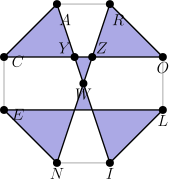
六个封闭区域包括四个全等的角部三角形(如 )和两个全等的小三角形(如 )。三角形 的底 ,高为 ,所以面积为 。三角形 的底 ,高为 ,所以面积为 。因此 所以 。
Since the interior angles are all and the sides are diagonals of unit squares, the octagon fits on a lattice: The path is carried to itself by the rotation about Let and be the points where and cross and let Segment has slope so and by symmetry and
The six enclosed regions are the four congruent corner triangles like and the two small congruent triangles like Triangle has base and height so its area is Triangle has base and height so its area is Therefore and
5.
设 、、 为复数,满足 、、,其中 。那么存在实数 与 ,使得 。求 。
Suppose that and are complex numbers such that and where Then there are real numbers and such that Find
小提示:
将三个方程相乘,以求出
Multiply all three equations together to find
大提示:
,且 在复数中是完全平方;然后用 分别除以给定的乘积
and is a perfect square in the complex numbers; then divide by each given product
解答:
将三个方程相乘,得到 因为 ,所以 。
用 分别除以给定的乘积,得 且符号一致。因此 ,所以 ,从而 。
Multiplying the three equations gives Since we get
Dividing by each given product yields with matching signs. Hence so and
6.
从区间 中随机均匀选取一个实数 。多项式 的根全为实数的概率可写成 ,其中 与 是互质正整数。求 。
A real number is chosen randomly and uniformly from the interval The probability that the roots of the polynomial are all real can be written in the form where and are relatively prime positive integers. Find
小提示:
寻找对所有 都成立的根: 与 始终都是根
Look for roots that work for every both and are always roots
大提示:
提出因式 后,二次式 有实根恰好当
After factoring out the quadratic has real roots exactly when
解答:
按是否含有 分组:所以该多项式分解为 。
四个根全为实数,恰好当二次因式有实根,即 ,也就是 或 。在 中被排除的区间 长度为 ,整个区间长度为 ,所以概率为 。所求和为 。
Group the terms by whether they involve so the polynomial factors as
All four roots are real exactly when the quadratic factor has real roots, i.e. when which means or The excluded interval has length inside which has length so the probability is The requested sum is
7.
三角形 的边长为 、、。点 ,,,, 位于线段 上,且对 ,,,,点 位于 与 之间。点 ,,,, 位于线段 上,且对 ,,,,点 位于 与 之间。此外,每条线段 ,,,,,都平行于 。这些线段把三角形分成 个区域,其中有 个梯形和 个三角形。所有 个区域面积相等。求线段 ,,,, 中长度为有理数的线段数。
Triangle has side lengths and Points are on segment with between and for and points are on segment with between and for Furthermore, each segment is parallel to The segments cut the triangle into regions, consisting of trapezoids and triangle. Each of the regions has the same area. Find the number of segments that have rational length.
小提示:
各区域面积相等,所以三角形 的面积是整个三角形的 ,长度按面积比的平方根缩放
The regions have equal areas, so triangle has area of the whole, and lengths scale as the square root of the area ratio
大提示:
,它为有理数恰好当 是完全平方数
which is rational exactly when is a perfect square
解答:
因为 个区域面积相等,三角形 (前 个区域的并集)的面积是三角形 的 。每个三角形 都与 相似,长度按面积比的平方根缩放,所以
这为有理数恰好当 是完全平方数,也就是当且仅当 ,其中 为正整数。条件 给出 ,所以 。共有 条这样的线段。
Since the regions have equal areas, triangle (the union of the first regions) has area of triangle Each triangle is similar to and lengths scale as the square root of areas, so
This is rational exactly when is a perfect square, which happens exactly when for a positive integer The condition gives so There are such segments.
8.
一只青蛙位于坐标平面的原点。从点 出发,青蛙可以跳到 、、 或 中任一点。求青蛙从 出发并最终到达 的不同跳跃序列个数。
A frog is positioned at the origin in the coordinate plane. From the point the frog can jump to any of the points or Find the number of distinct sequences of jumps in which the frog begins at and ends at
小提示:
向右的跳跃由若干 与 组成且总和为 ,所以作为多重集合只能是 、,或 ,向上的跳跃同理
The rightward jumps are s and s summing to so as a multiset they are or and likewise for the upward jumps
大提示:
对每一对多重集合,所有跳跃的排列数是一个多项式系数;把九种情况相加
For each pair of multisets, the number of ways to order all the jumps is a multinomial coefficient; add up the nine cases
解答:
水平跳跃是若干长度为 或 的步长,总和为 ,所以作为多重集合只能是 、,或 ,竖直跳跃也一样。对任意一对多重集合,所有跳跃的任意排列都是有效序列,排列数就是合并后多重集合的多项式系数。
九种情况给出 其中 、、 各出现两次。
总数为 。
The horizontal jumps are steps of or summing to so as a multiset they are or and the same holds for the vertical jumps. For any choice of the two multisets, every ordering of all the jumps is a valid sequence, and the number of orderings is the multinomial coefficient of the combined multiset.
The nine cases give The values and each occur twice.
The total is
9.
八边形 的边长满足 ,且 。它由一个 矩形的四个角各切去一个 -- 三角形形成,其中边 位于矩形的一条短边上,如图所示。设 为 的中点,并作线段 、、、、、,把八边形分成 个三角形。求以这 个三角形的重心为顶点的凸多边形面积。
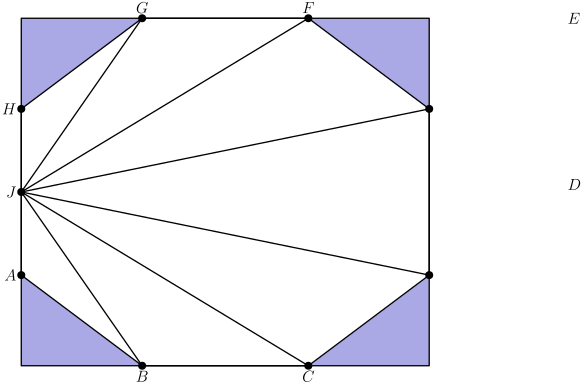
Octagon with side lengths and is formed by removing four -- triangles from the corners of a rectangle with side on a short side of the rectangle, as shown. Let be the midpoint of and partition the octagon into triangles by drawing segments and Find the area of the convex polygon whose vertices are the centroids of these triangles.
小提示:
每个三角形都有共同顶点 ,所以每个重心都位于从 到对边中点的线段上,且位于这条线段的三分之二处
Every triangle has vertex so each centroid lies two-thirds of the way from to the midpoint of the opposite side
大提示:
重心七边形是那些中点组成的七边形以 为中心、按 倍缩放所得,所以它的面积是中点七边形面积的
The centroid heptagon is the heptagon of those midpoints dilated by about so its area is of the midpoint heptagon’s area
解答:
这 个三角形都以 为一个顶点。三角形 的重心位于从 到 中点的线段上,且位于这条线段的三分之二处。因此,重心七边形是由 的中点构成的七边形 以 为中心、按 的比例缩放所得的图形,其面积为 。
放置矩形,使 、、、、、、、,所以 。这些中点为 、、、、、、。在 、、 处的竖直截段长度分别为 、、,将 分成两个高为 的梯形和一个高为 的三角形:
所求面积为 。
Each of the triangles has as a vertex, and the centroid of a triangle lies on the segment from to the midpoint of two-thirds of the way out. So the centroid heptagon is the image of the heptagon formed by the midpoints of under a dilation centered at with ratio and its area is
Place the rectangle with so The midpoints are The vertical segments at and have lengths and cutting into two trapezoids of height and a triangle of height
The requested area is
10.
求从 映到 的函数 的个数,使得对 中所有 都有 。
Find the number of functions from to that satisfy for all in
小提示:
这个条件说明 的每个值都是 的不动点。按元素需要经过多少次 才到达不动点来分类
The condition says every value of is a fixed point of Classify elements by how many applications of they need to reach a fixed point.
大提示:
若有 个不动点,又有 个其他元素直接映到这些不动点,则剩下的 个元素必须映到这 个元素;用二项式系数按情况计数
With fixed points and further elements mapping straight to them, the remaining elements must map to those count each case with binomial coefficients
解答:
对 反复应用 可知,该条件等价于对每个 , 都是 的不动点。因此元素分层排列:先是一个非空的 个不动点集合,然后是 个映到不动点、但本身不是不动点的元素,剩下的 个元素每个都必须映到这 个中间层元素之一。
对给定的 与 有 种方式选不动点, 种方式选中间层, 种方式把中间层映到不动点,剩余元素有 种映法。把 对所有有效的 、 求和,再加上 的恒等函数情形,得到
Applying to repeatedly shows the condition means that is a fixed point of for every So the elements organize into levels: a nonempty set of fixed points, then elements whose image is a fixed point (but which are not fixed), and the remaining elements, each of which must map to one of the middle elements.
For given and there are choices of fixed points, choices of the middle level, maps from the middle level to the fixed points, and maps for the rest. Summing over the valid pairs (all plus the identity case ) gives
11.
求 ,,,,, 的排列个数,使得对每个满足 的 ,排列的前 项中至少有一项大于 。
Find the number of permutations of such that for each with at least one of the first terms of the permutation is greater than
小提示:
条件失败恰好发生在某个长度 的前缀是 的一个排列时
The condition fails exactly when some prefix of length is a permutation of
大提示:
令 表示 的排列中没有更短的这种前缀的个数;因为每个排列都有唯一的最短这种前缀,所以
Let count permutations of with no shorter such prefix; then since every permutation has a unique shortest one
解答:
条件失败恰好当存在某个 ,使前 项是 的一个排列。对 的一个排列,令 为前缀恰好是 的最小长度(全长 总是可行),并令 为这个最小的 等于 的排列数。我们要求的是 。
每个 的排列都唯一分解为长度 的最小前缀(有 种选择),后接剩余 个数的任意排列,所以 从 开始,得到 、、、,并且
The condition fails exactly when the first terms are a permutation of for some For a permutation of let be the smallest length for which the prefix is (the full length always works), and let be the number of permutations whose smallest such is We want
Every permutation of decomposes uniquely as a minimal prefix of length ( choices) followed by any arrangement of the remaining values, so Starting from this gives and
12.
设 为凸四边形,且 、、。假设 的对角线交于点 ,并且三角形 与 的面积之和等于三角形 与 的面积之和。求四边形 的面积。
Let be a convex quadrilateral with and Assume that the diagonals of intersect at point and that the sum of the areas of triangles and equals the sum of the areas of triangles and Find the area of quadrilateral
小提示:
将每个三角形的面积写成其两条边段长度之积的一半再乘以 ,其中 是 处的一个角;面积条件可分解为
Write each triangle’s area as one-half the product of its two side segments and where is an angle at the area condition factors as
大提示:
取 ,并在以 为顶点的四个三角形中都使用余弦定理;利用 处的角互补,成对相加和相减
Take and apply the law of cosines to all four triangles at add and subtract in pairs, using that the angles at are supplementary
解答:
设 、、、,并设 。由于 ,等面积条件 化简为 。由对称性,不妨设 。
在三角形 与 中用余弦定理(它们在 处的角互补),得到 和 ,所以 ,且 。同理,三角形 与 给出 和 。相除得 ,而相减得 ;于是 、、,并且 ,所以 。
总面积为
Let and let Since the equal-area condition simplifies to By symmetry assume
The law of cosines in triangles and (whose angles at are supplementary) gives and so and Similarly triangles and give and Dividing, while subtracting gives hence and so
The total area is
13.
Misha 掷一枚标准且公平的六面骰子,直到她在连续三次掷骰中按顺序掷出 -- 为止。她掷骰次数为奇数的概率为 ,其中 与 是互质正整数。求 。
Misha rolls a standard, fair six-sided die until she rolls -- in that order on three consecutive rolls. The probability that she will roll the die an odd number of times is where and are relatively prime positive integers. Find
小提示:
令 、、 分别为从全新状态、已经掷出一个 、已经掷出 - 后最终总掷骰次数为奇数的概率;按下一次掷骰分类
Let be the probabilities of finishing in an odd total number of rolls starting fresh, starting after a and starting after - condition on the next roll
大提示:
一次无关掷骰会翻转奇偶性,所以会出现 、 这样的项;例如
A stray roll flips parity, so terms like and appear; for example
解答:
令 为总掷骰次数为奇数的概率;令 为已经先掷出一个 时这个概率,令 为已经先掷出 - 时这个概率(每种情况下都从已经掷出的骰数开始计数)。按下一次掷骰分类,并注意当计数重新开始时,已经用掉的掷骰次数会翻转所需奇偶性。从全新状态开始:若掷出 ,转到状态 ;否则用掉一次掷骰,之后需要偶数次续程。已有一个 时:若再掷出 ,说明第一次掷骰作废,需要 型的偶数次续程;若掷出 ,转到 ;否则浪费前两次掷骰。已有 - 时:若掷出 ,以 次掷骰结束(奇数);若掷出 ,带着浪费的两次掷骰重回 状态;否则浪费三次掷骰。因此
第一个方程给出 ;把第三个方程代入第二个方程得 ,所以 ,从而 ,。因为 是质数,所以 。
Let be the probability that the total number of rolls is odd; let be that probability given that the first roll is a and given that the first two rolls are - (in each case counting all rolls). Condition on the next roll, noting that whenever the count restarts, the rolls already used flip the required parity. Starting fresh: a leads to state anything else uses one roll, after which an even continuation is needed. After a another means the first roll is wasted, needing an even continuation of the -type; a leads to anything else wastes both rolls. After - a finishes in rolls (odd); a restarts at the -state with two wasted rolls; anything else wastes all three. Thus
The first equation gives substituting the third into the second yields so giving and Since is prime,
14.
三角形 的内切圆 与 相切于 。设 为 与 的另一个交点。点 与 分别位于 与 上,使得 在 处与 相切。已知 、、,且 ,其中 与 是互质正整数。求 。
The incircle of triangle is tangent to at Let be the other intersection of with Points and lie on and respectively, so that is tangent to at Assume that and where and are relatively prime positive integers. Find
小提示:
设内切圆与 相切于 与 相切于 。在 与 处用切线-弦定角可得 ;在三角形 与 中使用正弦定理
Let the incircle touch at and at Tangent-chord angles at and show use the law of sines in triangles and
大提示:
是 与 的调和平均数:,类似地 ,且
is the harmonic mean of and and likewise with
解答:
设 与 相切于 与 相切于 ,并设 、。切线 与弦 所成的角等于切线 与弦 所成的角,所以 ,再由对顶角得 。在三角形 中用正弦定理得 ,又由切线长相等 ,所以 。在三角形 中,由于 ,同理 ,且 ,于是 。
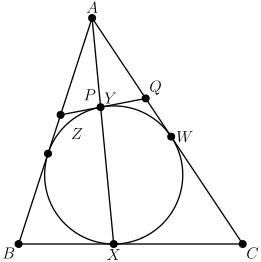
将两个关系相加,得 。由于 、,得到 ,因此 。在边 上作同样论证(在三角形 与 中使用 ),得 。又因为从 引出的两条切线等长,。因此 所以 ,。
Let touch at and at and set and The tangent-chord angle between and chord equals the one between and so and vertical angles give In triangle the law of sines gives and by equal tangents so In triangle since similarly and gives
Adding the two relations, so with and we get hence The identical argument on side (using in triangles and ) gives and by equal tangents from Therefore so and
15.
求从 映到整数集的函数 的个数,使得 、,并且 对 中所有 与 都成立。
Find the number of functions from to the integers such that and for all and in
小提示:
相邻函数值之差的绝对值为 、,或 ,且六个差的总和为 ;证明至多有一个差为负
Consecutive values differ by or in absolute value and the six differences sum to show at most one difference can be negative
大提示:
分三种情况处理:没有下降;下降发生在端点;下降发生在内部,此时它被迫是 ,且两侧都是
Handle three cases: no decrease; a decrease at either end; an interior decrease, which is forced to be flanked by two s
解答:
设 ,所以每个 ,且 。若有 个差为负,则总和最多为 ,所以 。若没有差为负,则满足 、 的解(其中 分别计数 、、 的个数)为 、、、。所有这些排列都满足任意两点条件,给出
若 ,则 且 ,迫使 且 ;剩余四个差为正且和为 ,给出 个函数,而 的情况对称:两端合计 个。最后,若对某个 有 ,则条件 与 迫使 且 。另外三个差为正且和为 ,可以是两个 和一个 ,或一个 和两个 ,每种各有 种顺序:所以这 个位置中每个都有 种方式,共 个函数。
总数为 。
Let so each and If of the differences were negative, the sum would be at most so If no difference is negative, the solutions of (with counting s, s, s) are and all such orderings satisfy every pair condition, giving
If then with forces and the remaining four differences are positive and sum to giving functions, and the case is symmetric: in all. Finally, if for some the pair conditions and force and The other three differences are positive and sum to achievable as two s and a or a and two s, each in orders: ways for each of the positions, or functions.
The total is