
Problemas del 2004 AIME II
¡Desplázate hacia abajo y presiona Iniciar para intentar el examen! O ve al PDF imprimible, la clave de respuestas, o las soluciones profesionales preparadas por LIVE by Po-Shen Loh.
Todos los problemas se usan con el permiso legal oficial de la Mathematical Association of America (MAA).
O salta directamente a un solo problema con su solución: 1 · 2 · 3 · 4 · 5 · 6 · 7 · 8 · 9 · 10 · 11 · 12 · 13 · 14 · 15
¿Quieres aprender de forma profesional con clases interactivas en video?
Con tiempo
3:00:00
1.
Una cuerda de un círculo es perpendicular a un radio en el punto medio de dicho radio. La razón entre el área de la mayor de las dos regiones en que la cuerda divide el círculo y el área de la menor puede expresarse en la forma donde y son enteros positivos, y son primos entre sí, y ni ni es divisible por el cuadrado de ningún primo. Halla el residuo cuando el producto se divide entre
A chord of a circle is perpendicular to a radius at the midpoint of the radius. The ratio of the area of the larger of the two regions into which the chord divides the circle to the smaller can be expressed in the form where and are positive integers, and are relatively prime, and neither nor is divisible by the square of any prime. Find the remainder when the product is divided by
Respuesta: 592
Pista pequeña:
Toma el radio igual a la cuerda queda entonces a distancia del centro, así que subtiende un ángulo central de .
Take the radius to be the chord then lies at distance from the center, so it subtends a central angle
Pista grande:
La región menor es un tercio del disco menos un triángulo de área la mayor es dos tercios del disco más ese triángulo.
The smaller region is a third of the disk minus a triangle of area the larger is two-thirds of the disk plus that triangle
Solución:
Escala de modo que el radio sea La cuerda queda a distancia del centro, así que cada radio hacia un extremo de la cuerda forma un ángulo de con el radio que la cuerda biseca, y los dos radios a los extremos forman un ángulo central de El triángulo isósceles que recortan tiene área y todo el disco tiene área
La región menor es el sector de menos el triángulo, y la región mayor es el resto, La razón es que tiene la forma requerida con
El producto es cuyo residuo al dividir entre es
Scale so the radius is The chord lies at distance from the center, so each radius to an endpoint of the chord makes a angle with the bisected radius, and the two endpoint radii form a central angle of The isosceles triangle they cut off has area and the whole disk has area
The smaller region is the sector minus the triangle, and the larger region is the rest, The ratio is which has the required form with
The product is whose remainder upon division by is
2.
Un frasco tiene caramelos rojos y caramelos azules. Terry toma dos caramelos al azar, y luego Mary toma dos de los caramelos restantes al azar. Dado que la probabilidad de que obtengan la misma combinación de colores, sin importar el orden, es donde y son enteros positivos primos entre sí, halla
A jar has red candies and blue candies. Terry picks two candies at random, then Mary picks two of the remaining candies at random. Given that the probability that they get the same color combination, irrespective of order, is where and are relatively prime positive integers, find
Respuesta: 441
Pista pequeña:
Coinciden solo si ambos sacan dos rojos, ambos sacan dos azules, o ambos sacan un caramelo de cada color.
They match only if both draw two reds, both draw two blues, or both draw one candy of each color
Pista grande:
Mary saca de lo que Terry dejó: para que ambos saquen dos rojos, la probabilidad es .
Mary draws from what Terry left: for two reds each, the probability is
Solución:
Las combinaciones coinciden exactamente cuando ambos sacan dos rojos, ambos sacan dos azules, o ambos sacan un caramelo de cada color. La probabilidad de que Terry saque dos rojos es tras lo cual quedan rojos y azules, así que Mary saca dos rojos con probabilidad Ese caso tiene probabilidad y por simetría el caso en que ambos sacan dos azules también tiene probabilidad
Para extracciones mixtas, Terry tiene éxito con probabilidad dejando de cada color, y Mary con probabilidad lo que da
El total es Como y la fracción está en su forma más simple, y
The combinations match exactly when both draw two reds, both draw two blues, or both draw one candy of each color. The probability that Terry draws two reds is after which reds and blues remain, so Mary draws two reds with probability That case has probability and by symmetry two blues each is also
For mixed draws, Terry succeeds with probability leaving of each color, and Mary with probability for
The total is Since and the fraction is in lowest terms, and
3.
Un bloque rectangular sólido se forma pegando cara con cara cubos congruentes de cm de arista. Cuando el bloque se observa de modo que tres de sus caras son visibles, exactamente de los cubos de cm de arista no pueden verse. Halla el menor valor posible de
A solid rectangular block is formed by gluing together congruent -cm cubes face to face. When the block is viewed so that three of its faces are visible, exactly of the -cm cubes cannot be seen. Find the smallest possible value of
Respuesta: 384
Pista pequeña:
Los cubos no vistos son exactamente los que no tocan ninguna de las tres caras visibles: forman un bloque .
The unseen cubes are exactly those behind the three visible faces: they form a block
Pista grande:
Factoriza como producto de tres enteros positivos de todas las maneras posibles y compara los volúmenes resultantes.
Factor as a product of three positive integers in every possible way and compare the resulting volumes
Solución:
Sea el bloque de dimensiones Un cubo queda oculto exactamente cuando no toca ninguna de las tres caras visibles, así que los cubos ocultos forman un bloque , lo que da
Las maneras de escribir como producto de tres enteros positivos son y que dan los bloques y con volúmenes y
El menor es
Let the block measure A cube is hidden exactly when it touches none of the three visible faces, so the hidden cubes form a block, giving
The ways to write as a product of three positive integers are and giving blocks and with volumes and
The smallest is
4.
¿Cuántos enteros positivos menores que tienen a lo sumo dos dígitos diferentes?
How many positive integers less than have at most two different digits?
Respuesta: 927
Pista pequeña:
Todo número de uno o dos dígitos cumple; cuenta los números de y de dígitos según qué posiciones contienen cada uno de los dos dígitos.
Every number with one or two digits qualifies; count - and -digit numbers by which positions hold which of two digit values
Pista grande:
Un número de dígitos con dígito inicial y otro dígito tiene patrones, cada uno realizable de maneras; suma los números cuyas cifras son todas iguales.
A -digit number with leading digit and second value has patterns, each in ways; add the numbers whose digits are all equal
Solución:
Todos los enteros positivos menores que cumplen. Un número de dígitos que cumple tiene todas sus cifras iguales ( posibilidades) o usa un dígito inicial junto con un segundo valor en algunas de las dos últimas posiciones: patrones, cada uno realizado de maneras ( opciones para luego para ), lo que da números.
De manera similar, un número de dígitos que cumple tiene todas sus cifras iguales ( posibilidades) o tiene apareciendo en un subconjunto no vacío de las tres últimas posiciones: patrones, cada uno realizable de maneras, lo que da números.
El total es
All positive integers below qualify. A qualifying -digit number is either a number whose digits are all equal ( of them) or uses a leading digit together with a second value in some of the last two positions: patterns, each realized in ways ( choices for then for ), for numbers.
Similarly a qualifying -digit number has all its digits equal ( possibilities) or has appearing in a nonempty subset of the last three positions: patterns, each in ways, for numbers.
The total is
5.
Para completar un trabajo grande se contrataron trabajadores, justo los suficientes para terminar el trabajo a tiempo. Todos los trabajadores permanecieron en el trabajo mientras se realizaba el primer cuarto de la obra, así que el primer cuarto de la obra se completó a tiempo. Luego se despidió a trabajadores, de modo que el segundo cuarto de la obra se completó con retraso. Luego se despidió a otros trabajadores, de modo que el tercer cuarto de la obra se completó con aún más retraso. Dado que todos los trabajadores trabajan al mismo ritmo, ¿cuál es el mínimo número de trabajadores adicionales, además de los trabajadores que aún quedan al final del tercer cuarto, que deben contratarse después de haberse completado tres cuartos de la obra para que el proyecto entero pueda completarse a tiempo o antes?
In order to complete a large job, workers were hired, just enough to complete the job on schedule. All the workers stayed on the job while the first quarter of the work was done, so the first quarter of the work was completed on schedule. Then workers were laid off, so the second quarter of the work was completed behind schedule. Then an additional workers were laid off, so the third quarter of the work was completed still further behind schedule. Given that all workers work at the same rate, what is the minimum number of additional workers, beyond the workers still on the job at the end of the third quarter, that must be hired after three-quarters of the work has been completed so that the entire project can be completed on schedule or before?
Respuesta: 766
Pista pequeña:
Elige la unidad de tiempo de modo que todo el trabajo esté programado para unidades; el primer cuarto toma entonces exactamente unidad.
Choose the time unit so the whole job is scheduled for units; the first quarter then takes exactly unit
Pista grande:
Los primeros tres cuartos toman unidades, dejando de unidad para el último cuarto.
The first three quarters take units, leaving of a unit for the final quarter
Solución:
Mide el tiempo de modo que trabajadores completen un cuarto del trabajo en unidad; el programa permite unidades en total. Con trabajadores el segundo cuarto toma unidades, y con trabajadores el tercer cuarto toma unidades. El tiempo usado hasta ahora es dejando de unidad para el último cuarto.
El último cuarto requiere unidades-trabajador de labor, así que la fuerza laboral debe satisfacer es decir por lo que se necesitan al menos trabajadores.
Como permanecen en el trabajo, deben contratarse al menos trabajadores adicionales.
Measure time so that workers complete a quarter of the job in unit; the schedule allows units in all. With workers the second quarter takes units, and with workers the third quarter takes units. The time used so far is leaving of a unit for the last quarter.
The last quarter requires worker-units of labor, so the workforce must satisfy that is so at least workers are needed.
Since remain on the job, at least additional workers must be hired.
6.
Tres monos astutos reparten un montón de plátanos. El primer mono toma algunos plátanos del montón, se queda con tres cuartos de ellos, y reparte el resto por igual entre los otros dos. El segundo mono toma algunos plátanos del montón, se queda con un cuarto de ellos, y reparte el resto por igual entre los otros dos. El tercer mono toma los plátanos restantes del montón, se queda con la doceava parte de ellos, y reparte el resto por igual entre los otros dos. Dado que cada mono recibe un número entero de plátanos cada vez que se reparten los plátanos, y que las cantidades de plátanos que el primer, segundo y tercer mono tienen al final del proceso están en la razón ¿cuál es el mínimo total posible para el número de plátanos?
Three clever monkeys divide a pile of bananas. The first monkey takes some bananas from the pile, keeps three-fourths of them, and divides the rest equally between the other two. The second monkey takes some bananas from the pile, keeps one-fourth of them, and divides the rest equally between the other two. The third monkey takes the remaining bananas from the pile, keeps one-twelfth of them, and divides the rest equally between the other two. Given that each monkey receives a whole number of bananas whenever the bananas are divided, and the numbers of bananas the first, second, and third monkeys have at the end of the process are in the ratio what is the least possible total for the number of bananas?
Respuesta: 408
Pista pequeña:
Supón que los monos toman y plátanos, de modo que todas las cantidades que conservan y reparten sean enteras.
Let the monkeys take and bananas, so every keep-and-split is automatically a whole number
Pista grande:
Las condiciones dan dos ecuaciones lineales que se reducen a quedando determinado después; toma los menores enteros positivos.
The conditions give two linear equations that reduce to with then determined; take the smallest positive integers
Solución:
Supón que el primer mono toma plátanos, quedándose con y dando a cada uno de los otros; el segundo toma quedándose con y dando a cada uno; el tercero toma quedándose con y dando a cada uno. Todas las cantidades que conservan o reparten son enteras exactamente cuando son enteros positivos. Las cantidades finales son y
La razón dice que la primera cantidad es el triple de la tercera y la segunda es el doble de la tercera: Sustituyendo en la primera ecuación da así que Por tanto y para un entero positivo y entonces
El total es mínimo cuando la respuesta es
Say the first monkey takes bananas, keeping and giving to each of the others; the second takes keeping and giving to each; the third takes keeping and giving to each. All divisions are whole numbers exactly when are positive integers. The final amounts are and
The ratio says the first amount is triple the third and the second is double the third: Substituting into the first equation gives so Thus and for a positive integer and then
The total is least when the answer is
7.
es una hoja rectangular de papel que se ha doblado de modo que la esquina coincide con el punto sobre el borde El pliegue es donde está sobre y está sobre Se dan las dimensiones y El perímetro del rectángulo es donde y son enteros positivos primos entre sí. Halla
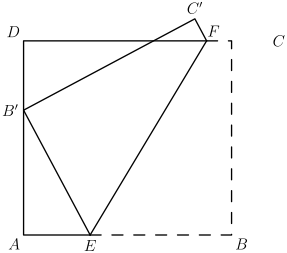
is a rectangular sheet of paper that has been folded so that corner is matched with point on edge The crease is where is on and is on The dimensions and are given. The perimeter of rectangle is where and are relatively prime positive integers. Find
Respuesta: 293
Pista pequeña:
El doblez conserva distancias, así que el triángulo rectángulo da y .
Folding preserves distances, so right triangle gives and
Pista grande:
Todo punto del pliegue equidista de y así que usa la pendiente de para ubicar sobre .
Every point of the crease is equidistant from and so use the slope of to locate on
Solución:
El doblez refleja hacia a través del pliegue, así que En el triángulo rectángulo y Coloca
Los puntos del pliegue equidistan de y así que es perpendicular a Como tiene pendiente el pliegue que pasa por tiene pendiente y corta a la recta (a altura ) en La condición da así que
El perímetro es así que
Folding reflects to across the crease, so In right triangle and Place
Points on the crease are equidistant from and so is perpendicular to Since has slope the crease through has slope and it meets the line (at height ) at The condition gives so
The perimeter is so
8.
¿Cuántos divisores enteros positivos de tienen exactamente divisores positivos?
How many positive integer divisors of are divisible by exactly positive integers?
Respuesta: 54
Pista pequeña:
Como un divisor de tiene exactamente divisores.
Since a divisor of has exactly divisors
Pista grande:
Cuenta las ternas ordenadas con producto primo por primo: reparte entre tres factores de maneras, y cada uno de y de maneras.
Count ordered triples with product prime by prime: split among three factors in ways, and each of and in ways
Solución:
Como tenemos así que sus divisores son con y Tal tiene divisores, así que necesitamos
Toda terna ordenada de enteros positivos con producto produce exponentes admisibles, ya que cada factor es a lo sumo Contando primo por primo: el exponente del primo se reparte entre los tres factores de maneras por estrellas y barras, y cada uno de los primos y va a uno de los factores.
El conteo es
Since we have so its divisors are with and Such an has divisors, so we need
Every ordered triple of positive integers with product yields admissible exponents, since each factor is at most Counting prime by prime: the exponent of the prime is split among the three factors in ways by stars and bars, and each of the primes and goes to one of the factors.
The count is
9.
Una sucesión de enteros positivos con y se forma de modo que los primeros tres términos están en progresión geométrica, los términos segundo, tercero y cuarto están en progresión aritmética y, en general, para todo los términos y están en progresión geométrica, y los términos y están en progresión aritmética. Sea el mayor término de esta sucesión que es menor que Halla
A sequence of positive integers with and is formed so that the first three terms are in geometric progression, the second, third, and fourth terms are in arithmetic progression, and, in general, for all the terms and are in geometric progression, and the terms and are in arithmetic progression. Let be the greatest term in this sequence that is less than Find
Respuesta: 973
Pista pequeña:
Sea cada condición de progresión fuerza el siguiente término, dando y .
Let each progression condition forces the next term, giving and
Pista grande:
Entonces fuerza así que los términos de índice impar son y los de índice par son .
Then forces so odd-indexed terms are and even-indexed terms are
Solución:
Sea La condición geométrica da la condición aritmética da luego y así sucesivamente: por inducción En particular y así que Al desarrollar da que se factoriza como así que
Con obtenemos así que y la sucesión es creciente. Como mientras que el mayor término por debajo de es
Por lo tanto
Let The geometric condition gives the arithmetic condition gives then and so on: inductively In particular and so Expanding gives which factors as so
With we get so and the sequence is increasing. Since while the greatest term below is
Therefore
10.
Sea el conjunto de enteros entre y cuyas expansiones binarias tienen exactamente dos dígitos . Si se elige un número al azar de la probabilidad de que sea divisible por es donde y son enteros positivos primos entre sí. Halla
Let be the set of integers between and whose binary expansions have exactly two ’s. If a number is chosen at random from the probability that it is divisible by is where and are relatively prime positive integers. Find
Respuesta: 913
Pista pequeña:
Los elementos de son con así que la divisibilidad por depende solo de .
Elements of are with so divisibility by depends only on
Pista grande:
Las potencias de se repiten módulo con periodo y exactamente cuando cuenta los pares con cada una de esas diferencias.
Powers of repeat mod with period and exactly when count the pairs with each such difference
Solución:
El conjunto consta de los números con Como es coprimo con tenemos divisible por exactamente cuando Las potencias de módulo recorren con periodo así que exactamente cuando
Para cada diferencia hay pares, así que el número de múltiplos de en es
La probabilidad es y como mientras que está en su forma más simple. Por tanto
The set consists of the numbers with Since is coprime to we have divisible by exactly when The powers of modulo cycle through with period so exactly when
For each difference there are pairs, so the number of multiples of in is
The probability is and since while it is in lowest terms. Thus
11.
Un cono circular recto tiene una base de radio y altura Una mosca parte de un punto en la superficie del cono cuya distancia al vértice del cono es y se arrastra a lo largo de la superficie del cono hasta un punto en el lado exactamente opuesto del cono cuya distancia al vértice es Halla la menor distancia que la mosca pudo haber recorrido.
A right circular cone has a base with radius and height A fly starts at a point on the surface of the cone whose distance from the vertex of the cone is and crawls along the surface of the cone to a point on the exact opposite side of the cone whose distance from the vertex is Find the least distance that the fly could have crawled.
Respuesta: 625
Pista pequeña:
La generatriz mide desenrolla el cono en un sector circular de radio .
The slant height is unroll the cone into a circular sector of radius
Pista grande:
El ángulo central del sector es así que los puntos exactamente opuestos están separados por un ángulo de en el sector; aplica la ley de los cosenos.
The sector’s central angle is so exactly opposite points are apart in the sector; apply the law of cosines
Solución:
La generatriz mide Cortar el cono a lo largo de la generatriz que pasa por el punto de partida y desenrollarlo da un sector de radio cuyo arco tiene la circunferencia de la base como un círculo completo de radio tiene circunferencia el ángulo central es Un punto en el lado exactamente opuesto del cono está a mitad de la vuelta, por lo que en el sector desenrollado las dos direcciones forman un ángulo de
El recorrido más corto es el segmento recto entre los dos puntos, a radios y con un ángulo de entre ellos. Por la ley de los cosenos,
Por tanto
The slant height is Cutting the cone along the ruling through the starting point and unrolling gives a sector of radius whose arc has the base circumference since a full circle of radius has circumference the central angle is A point on the exact opposite side of the cone is halfway around, which in the unrolled sector is away.
The shortest crawl is the straight segment between the two points, at radii and with a angle between them. By the law of cosines,
Thus
12.
Sea un trapecio isósceles, cuyas dimensiones son y Traza círculos de radio centrados en y y círculos de radio centrados en y Un círculo contenido dentro del trapecio es tangente a estos cuatro círculos. Su radio es donde y son enteros positivos, no es divisible por el cuadrado de ningún primo, y y son primos entre sí. Halla
Let be an isosceles trapezoid, whose dimensions are and Draw circles of radius centered at and and circles of radius centered at and A circle contained within the trapezoid is tangent to all four of these circles. Its radius is where and are positive integers, is not divisible by the square of any prime, and and are relatively prime. Find
Respuesta: 134
Pista pequeña:
La altura del trapecio es Centra el círculo interior en el eje de simetría; la tangencia significa que su centro está a distancia de y y a distancia de y
The trapezoid’s height is Center the inner circle on the axis of symmetry; tangency means its center is at distance from and and from and
Pista grande:
El centro está por encima de y por debajo de y esas dos alturas suman .
The center lies above and below and those two heights add to
Solución:
Al bajar perpendiculares desde y se ve que cada lado de longitud abarca un desplazamiento horizontal de así que la altura del trapecio es Por simetría, el centro del círculo interior está sobre el eje vertical que pasa por los puntos medios de y de Si su radio es la tangencia externa da y así que con y
Como pasar un radical al otro lado y elevar al cuadrado da y elevar al cuadrado de nuevo produce es decir
La raíz positiva es así que
Dropping perpendiculars from and shows each leg of length spans a horizontal offset of so the height of the trapezoid is By symmetry the inner circle’s center lies on the vertical axis through the midpoints of and of If its radius is external tangency gives and so with and
Since moving one radical across and squaring gives and squaring again yields that is
The positive root is so
13.
Sea un pentágono convexo con y Dado que la razón entre el área del triángulo y el área del triángulo es donde y son enteros positivos primos entre sí, halla
Let be a convex pentagon with and Given that the ratio between the area of triangle and the area of triangle is where and are relatively prime positive integers, find
Respuesta: 484
Pista pequeña:
La ley de los cosenos en el triángulo da Sea la intersección de y entonces es un paralelogramo.
The law of cosines in triangle gives Let be the intersection of and then is a parallelogram
Pista grande:
Los triángulos y son semejantes en razón así que expresa todas las distancias a las rectas paralelas y en función de la distancia de a .
Triangles and are similar in ratio so measure every distance to the parallel lines and in terms of the distance from to
Solución:
Por la ley de los cosenos, así que Sea la intersección de y Como y el cuadrilátero es un paralelogramo, así que está a la misma distancia de la recta que en el lado opuesto, donde
Como los triángulos y son semejantes con razón así que la distancia de a la recta es con en el lado de opuesto a Por tanto la distancia de a la recta es lo que da
Por tanto que está en su forma más simple ya que La respuesta es
By the law of cosines, so Let be the intersection of and Since and quadrilateral is a parallelogram, so lies at the same distance from line as on the opposite side, where
Since triangles and are similar with ratio so the distance from to line is with on the far side of from The distance from to line is therefore giving
Thus which is in lowest terms since The answer is
14.
Considera una cadena formada por cifras , en la que se insertan signos para producir una expresión aritmética. Por ejemplo, podría obtenerse de ocho cifras de esta manera. ¿Para cuántos valores de es posible insertar signos de modo que la expresión resultante tenga valor ?
Consider a string of ’s, into which signs are inserted to produce an arithmetic expression. For example, could be obtained from eight ’s in this way. For how many values of is it possible to insert signs so that the resulting expression has value
Respuesta: 108
Pista pequeña:
Divide todo entre necesitas copias de de y de con y .
Divide everything by you need copies of of and of with and
Pista grande:
Restar muestra determina exactamente qué valores puede alcanzar cuando .
Subtracting shows determine exactly which values can reach when
Solución:
Dividir entre convierte los sumandos en o (ningún sumando más largo cabe, ya que ) y el objetivo en Si cuentan los sumandos de cada tamaño, entonces y Restar da así que los posibles corresponden exactamente a los valores alcanzables de
Las restricciones son y (entonces se sigue). Para el valor recorre los intervalos y (cuando solo cabe). Su unión es todo entero desde hasta junto con solo es inalcanzable.
Así que toma valores, y toma valores.
Dividing by turns the summands into or (no summand with four or more digits fits, since ) and the target into If count the summands of each size, then and Subtracting gives so the possible correspond exactly to the attainable values of
The constraints are and (then follows). For the value ranges over the intervals and (when only fits). Their union is every integer from to together with only is unattainable.
So takes values, and takes values.
15.
Una tira larga y delgada de papel tiene unidades de longitud, unidad de ancho, y está dividida en cuadrados unitarios. El papel se dobla por la mitad repetidamente. En el primer doblez, el extremo derecho del papel se dobla para coincidir con el extremo izquierdo y quedar encima de él. El resultado es una tira de por de doble grosor. Luego, el extremo derecho de esta tira se dobla para coincidir con el extremo izquierdo y quedar encima de él, resultando en una tira de por de grosor cuádruple. Este proceso se repite veces más. Después del último doblez, la tira se ha convertido en una pila de cuadrados unitarios. ¿Cuántos de estos cuadrados quedan debajo del que originalmente ocupaba la posición contando desde la izquierda?
A long thin strip of paper is units in length, unit in width, and is divided into unit squares. The paper is folded in half repeatedly. For the first fold, the right end of the paper is folded over to coincide with and lie on top of the left end. The result is a by strip of double thickness. Next, the right end of this strip is folded over to coincide with and lie on top of the left end, resulting in a by strip of quadruple thickness. This process is repeated more times. After the last fold, the strip has become a stack of unit squares. How many of these squares lie below the square that was originally the nd square counting from the left?
Respuesta: 593
Pista pequeña:
Rastrea la posición del cuadrado contada desde el extremo izquierdo y desde el fondo de la pila; un doblez deja ambas sin cambio para los cuadrados de la mitad izquierda.
Track the square’s position counted from the left end and from the bottom of the stack; a fold leaves both unchanged for squares in the left half
Pista grande:
Para un cuadrado de la mitad derecha, la nueva posición desde la izquierda es la antigua posición desde la derecha, y la nueva posición desde arriba es la antigua posición desde el fondo.
For a square in the right half, the new position from the left is the old position from the right, and the new position from the top is the old position from the bottom
Solución:
Después de dobleces la tira mide cuadrados de largo y capas de grosor, así que las posiciones desde la izquierda y desde la derecha satisfacen y las posiciones desde el fondo y desde arriba satisfacen Cuando la mitad derecha se dobla sobre la izquierda, un cuadrado de la mitad izquierda conserva su y mientras que un cuadrado de la mitad derecha se voltea: su nuevo es su antiguo y su nuevo es su antiguo
El cuadrado número empieza en Aplicando la regla a lo largo de los diez dobleces da Por ejemplo, en el cuarto doblez la tira tiene longitud y así que el nuevo es y el nuevo es el antiguo haciendo
En la pila final de cuadrados, este cuadrado ocupa la posición contando desde el fondo, así que cuadrados quedan debajo de él.
After folds the strip is squares long and layers thick, so the positions from the left and from the right satisfy and the positions from the bottom and from the top satisfy When the right half is folded over onto the left, a square in the left half keeps its and while a square in the right half is flipped: its new is its old and its new is its old
The nd square starts at Applying the rule through the ten folds gives For example, at the fourth fold the strip has length and so the new is and the new is the old making
In the final stack of squares, this square sits at height from the bottom, so squares lie below it.