
2022 AMC 12B 真题
计时
1:15:00
1.
对所有实数 和 ,定义 为 。求下式的值:
Define to be for all real numbers and What is the value of
2.
在菱形 中,点 在 上,使得 ,,且 。求 的面积。(注:图不按比例绘制。)
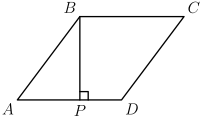
In rhombus point lies on segment so that and What is the area of (Note: the figure is not drawn to scale.)
3.
数列 ,,, 的前十项中,有多少项是质数?
How many of the first ten numbers of the sequence are prime numbers?
小提示:
尝试把每一项分解成两个都大于 的整数的乘积。
Look for a factorization of each term into two integers both greater than
大提示:
尝试将每项写成循环单位数与形如 的数之积,例如 。
Try writing a term as a repunit times a number of the form for example
解答:
第 项由 个一、一个 ,再接 个一组成。它可分解为循环单位数与形如 的数之积。例如 一般地,第 项等于 。
对每个 ,两个因子都大于 ,所以每一项都是合数。前十项中没有质数。
所以正确答案是 A。
The th term consists of ones, then a then ones. It factors as a repunit times a number of the form and in general the th term equals
For every both factors exceed so every term is composite. None of the ten numbers is prime.
Thus, the correct answer is A.
4.
有多少个常数 ,使多项式 有两个不同的整数根?
For how many values of the constant will the polynomial have two distinct integer roots?
小提示:
若根为 和 ,则 ,且 。
If the roots are and then and
大提示:
计数乘积为 且两个整数不同的无序因子对,包括负因子对。
Count the ordered-independent factor pairs of with two distinct integers, including negatives
解答:
若整数根为 和 ,则 ,且 。两个不同的根必须同号,所以列出 的因子对,并要求 。
正因子对为 ,负因子对为 、、、。因为要求两根不同,排除 。
这 个因子对各给出一个不同的 值。
所以正确答案是 B。
If the roots are integers and then and Distinct roots must have the same sign, so we list factor pairs of with
The positive pairs are and the negative pairs are The pair is excluded since the roots must be distinct.
Each of these pairs gives a different value of
Thus, the correct answer is B.
5.
点 绕点 逆时针旋转 。新位置的坐标是什么?
The point is rotated counterclockwise about the point What are the coordinates of its new position?
小提示:
先平移使旋转中心为原点,旋转后再平移回去。
Translate so the center of rotation is the origin, rotate, then translate back
大提示:
逆时针 旋转把 变为 。
A counterclockwise rotation sends to
解答:
相对于旋转中心 ,该点的坐标为 。
逆时针 旋转将 变为 ,所以 变为 。
平移回去得 。
所以正确答案是 B。
Relative to the center the point is at
A counterclockwise rotation sends to so becomes
Translating back gives
Thus, the correct answer is B.
6.
考虑下列 个集合,每个集合有 个元素:
其中有多少个集合恰好含有两个 的倍数?
Consider the following sets of elements each:
How many of these sets contain exactly two multiples of
小提示:
一个含 个连续整数的区间含有一个或两个 的倍数。
A block of consecutive integers contains either one or two multiples of
大提示:
先数 中 的倍数总数,再设有 个区间含两个、 个区间含一个。
Count the total multiples of in then let blocks have two and have one
解答:
从 到 中有 个 的倍数。由于 ,每个长度为 的连续整数区间含有一个或两个 的倍数。
设有 个区间含两个倍数,其余 个区间各含一个,则 ,所以 。
所以正确答案是 B。
Among to there are multiples of Because each block of consecutive integers contains one or two multiples of
If blocks contain two and the remaining contain one, then so
Thus, the correct answer is B.
7.
Camila 写下五个正整数。这些整数的唯一众数比它们的中位数大 ,而中位数比它们的算术平均数大 。众数的最小可能值是多少?
Camila writes down five positive integers. The unique mode of these integers is greater than their median, and the median is greater than their arithmetic mean. What is the least possible value for the mode?
小提示:
众数大于中位数,所以它只能出现在两个最大的数中。
The mode exceeds the median, so it can only appear among the two largest numbers
大提示:
设中位数为 ;为了有唯一众数,两个最大数都必须等于 ,且总和为 。
Let the median be for a unique mode the two largest must both equal and the sum is
解答:
将五个数按递增排列,设中位数为 。众数为 ,所以它只能出现在两个最大数中;要成为唯一众数,这两个数必须都等于 。
平均数为 ,所以五个数之和为 。除去两个 和中位数 ,两个最小数之和为 。
两个最小数是不同的正整数,所以 ,得 。当 时, 满足条件,因此最小众数为 。
所以正确答案是 D。
List the numbers in increasing order with median The mode is so it can only occur among the two largest entries; for it to be the unique mode, both of them must equal
The mean is so the total is With the two largest equal to and the median the two smallest sum to
The two smallest are distinct positive integers, so giving With the list works, so the least mode is
Thus, the correct answer is D.
8.
方程 在坐标平面中的图像是什么?
What is the graph of in the coordinate plane?
两条相交抛物线
two intersecting parabolas
两条不相交抛物线
two nonintersecting parabolas
两个相交圆
two intersecting circles
一个圆和一条双曲线
a circle and a hyperbola
一个圆和两条抛物线
a circle and two parabolas
小提示:
移项得到 。
Move everything to one side to get
大提示:
作为平方差分解,得到两个单独的方程。
Factor as a difference of squares, giving two separate equations
解答:
整理得 ,即 。作平方差分解,得
因此或者 ,这是一条双曲线;或者 ,这是一个圆。
所以正确答案是 D。
Rearranging, so This factors as
Thus either which is a hyperbola, or which is a circle.
Thus, the correct answer is D.
9.
数列 ,,, 是正整数的严格递增等差数列,且 求 的最小可能值。
The sequence is a strictly increasing arithmetic sequence of positive integers such that What is the minimum possible value of
小提示:
两边除以 得到 。
Divide both sides by to get
大提示:
求出 后,写成 ,并让公差 尽可能大。
After finding write and make the common difference as large as possible
解答:
两边除以 ,得 。因此 ,并且 ,其中 。当 时,左边严格递增,而 满足方程,所以唯一解是 。
设公差 ,则 ,并且 。要使 最小,就要使 尽可能大。因为 ,最大选择为 (此时 )。
于是 。
因此,正确答案是 B。
Dividing by we need Thus and where The left side is strictly increasing for and works, so uniquely
With common difference we have and To minimize we maximize since the largest choice is (giving ).
Then
Thus, the correct answer is B.
10.
正六边形 的边长为 。设 为 的中点, 为 的中点。四边形 的周长是多少?
Regular hexagon has side length Let be the midpoint of and let be the midpoint of What is the perimeter of
小提示:
将正六边形放在坐标系中,并把中心设为原点。
Place the hexagon on coordinates with its center at the origin
大提示:
由对称性, 的四条边相等;用距离公式算一条边。
By symmetry all four sides of are equal; compute one distance with the distance formula
解答:
将中心置于原点,取 ,,,,,。
则 ,。由对称性,四边形 的四条边相等,并且
所以周长为 。
所以正确答案是 D。
Place the hexagon with center at the origin:
Then and By symmetry all four sides of are equal, and
The perimeter is
Thus, the correct answer is D.
11.
令 其中 。 是多少?
Let where What is
小提示:
这两个底数是本原三次单位根 和 。
The two bases are the primitive cube roots of unity, and
大提示:
由 ,把指数 对 取模。
Then reduce the exponent modulo
解答:
两个底数是本原三次单位根 及其共轭 。因此 。
由于 是 的倍数,,所以 。
所以正确答案是 E。
The two bases are the primitive cube roots of unity, and its conjugate So
Since is a multiple of so
Thus, the correct answer is E.
12.
Kayla 掷四个公平 面骰。至少有一个掷出的数大于 ,且至少有两个掷出的数大于 的概率是多少?
Kayla rolls four fair -sided dice. What is the probability that at least one of the numbers Kayla rolls is greater than and at least two of the numbers she rolls are greater than
小提示:
把每个骰子分为低档 、中档 和高档 ,每类概率都是 。
Sort each die into low mid or high each with probability
大提示:
需要至少一个高骰,且至少两个骰子不是低骰;在 个类别模式中数出符合条件的模式。
You need at least one high die and at least two dice that are not low; count the good category patterns out of
解答:
将每个骰子分类为低档 、中档 或高档 ;每类概率都是 ,所以 个类别模式等可能。
需要至少一个高骰,即骰面大于 ,并且至少两个骰面大于 ,也就是中档或高档。两个坏事件分别是没有高骰,以及至多一个非低档骰。
没有高骰的模式有 个,至多一个非低骰的模式有 个,两种坏条件同时发生的模式有 个。由容斥,可行模式数为 。
概率为 。
所以正确答案是 D。
Sort each die into low mid or high each has probability so the category patterns are equally likely.
We need at least one high die (a number greater than ) and at least two dice that are greater than (mid or high). The two bad events are having no high die and having at most one non-low die.
There are patterns of the first kind, of the second kind, and in their intersection. By inclusion-exclusion the count of good patterns is
The probability is
Thus, the correct answer is D.
13.
下图显示一个边长为 和 的长方形,以及一个边长为 的正方形。正方形的三个顶点如图所示,分别位于长方形的三条不同边上。正方形和长方形内部重叠区域的面积是多少?
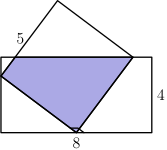
The diagram below shows a rectangle with side lengths and and a square with side length Three vertices of the square lie on three different sides of the rectangle, as shown. What is the area of the region inside both the square and the rectangle?
小提示:
建立坐标系;正方形的倾斜会在角落形成 -- 直角三角形。
Set up coordinates; the tilt of the square makes -- right triangles at the corners
大提示:
除了一个伸出上边界的三角形,整个正方形都在长方形内;从 中减去该三角形面积。
The whole square lies inside the rectangle except one triangle sticking out past the top edge; subtract that triangle from
解答:
将长方形放在 。利用 -- 直角三角形,倾斜正方形的顶点可取为 、、 和 。
除了伸出顶边 的三角形外,整个正方形都在长方形内。该三角形的顶点为 、 和 ,面积为
重叠区域的面积为 。
所以正确答案是 D。
Place the rectangle as The tilted square, using the -- right triangles, has vertices and
The entire square lies inside the rectangle except for the triangle poking above the top edge That triangle has vertices and with area
The region inside both is
Thus, the correct answer is D.
14.
抛物线 与 -轴交于点 、,与 -轴交于点 。求 。
The graph of intersects the -axis at points and and the -axis at point What is
小提示:
因式分解以求截距: 和 在 -轴上, 在 -轴上。
Factor to find the intercepts: and on the -axis, on the -axis
大提示:
对向量 和 ,使用 。
With vectors and use
解答:
因式分解得 ,所以 ,,且 -截距为 。
于是 ,。利用叉积和点积,
所以正确答案是 E。
Factoring, so and and the -intercept is
Then and Using the cross and dot products,
Thus, the correct answer is E.
15.
下列数中有一个不能被任何小于 的质数整除。是哪一个?
One of the following numbers is not divisible by any prime number less than Which is it?
小提示:
五个数都是奇数,所以只需测试 和 的整除性。
All five numbers are odd, so test divisibility only by and
大提示:
使用 模 的循环;例如 为偶数时 。
Use the cycles of modulo for example when is even
解答:
所有选项都是奇数,所以只需检查质数 。
选项 A 中,,所以 能被 整除。选项 B 中,,所以 能被 整除。选项 D 中,,所以 能被 整除。选项 E 对 取模时,。
对于 ,它对三取模时 ,对五取模时 ;而且由 和 可得它对七取模时 。因此它不能被任何小于 的质数整除。
所以正确答案是 C。
Every option is odd, so only the primes need checking.
Option A: so is divisible by Option B: so is divisible by Option D: so is divisible by Option E: modulo
For it is and (since and ) So it is not divisible by any prime below
Thus, the correct answer is C.
16.
设 和 为正实数,并满足
以及
的最大可能值是多少?
Suppose and are positive real numbers such that
and
What is the greatest possible value of
小提示:
令 、;对两个方程取 。
Let and take of both equations
大提示:
得到 和 ;合并得到关于 的二次方程。
You get and combine to form a quadratic in
解答:
令 、。对第一个方程取 ,由 得 ,即 。
对第二个方程取 得到 ,所以 。代入前式得 ,也就是 ,即 。
解得 ,因此 的最大可能值为 。
所以正确答案是 C。
Let and Taking of gives i.e.
Taking of the second equation gives so Substituting, so i.e.
Thus and the greatest value of is
Thus, the correct answer is C.
17.
有多少个 的 - 数组,使得四行的和以某种顺序为 ,, 和 ,而四列的和也以某种顺序为 ,, 和 ?例如,数组 满足条件。
How many arrays whose entries are s and s are there such that the row sums (the sum of the entries in each row) are and in some order, and the column sums (the sum of the entries in each column) are also and in some order? For example, the array satisfies the condition.
小提示:
和为 的行全是 ,和为 的列也全是 。
The row of sum is all s and the column of sum is all s
大提示:
删除和为 的列;剩下的 数组行和为 ,列和为 。
Delete the sum- column; the remaining array has row sums and column sums
解答:
行和为 的行全是 ,列和为 的列也全是 。将行和 分配给四行有 种方式,选择哪一列的和为 有 种方式。
删除该列后,剩下的 数组的行和为 ,列和必须为 。全零行和全一行已确定;行和为 和 的两行有 种排法,使列和按某种顺序成为 。
因此总数为 。
所以正确答案是 D。
The row with sum is all s and the column with sum is all s. There are ways to assign the row sums to the four rows, and choices for which column has sum
Delete that column. The remaining array has row sums and must have column sums The all-zero and all-one rows are forced; the rows of reduced sum and can be placed in ways to produce column sums in some order.
The total is
Thus, the correct answer is D.
18.
网格中的每个小方格或填充或为空,并且至多有八个相邻方格,相邻指共边或共顶点。网格按如下规则变换:
任一填充方格若有两个或三个填充邻居,则保持填充。任一空方格若恰有三个填充邻居,则变为填充。其他所有方格保持为空或变为空。
下图给出一个变换示例。
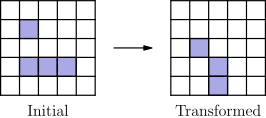
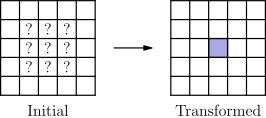
假设 网格有一圈空方格包围一个 子网格。有多少种初始构型会在一次变换后得到只有中心一个填充方格的网格?(旋转或反射得到的构型视为不同。)
Each square in a grid is either filled or empty, and has up to eight adjacent neighboring squares, where neighboring squares share either a side or a corner. The grid is transformed by the following rules:
Any filled square with two or three filled neighbors remains filled. Any empty square with exactly three filled neighbors becomes a filled square. All other squares remain empty or become empty.
A sample transformation is shown in the figure below.
Suppose the grid has a border of empty squares surrounding a subgrid. How many initial configurations will lead to a transformed grid consisting of a single filled square in the center after a single transformation? (Rotations and reflections of the same configuration are considered different.)
小提示:
只有内部 子网格可以被填充;中心若原为空,则需恰有 个填充邻居,若原已填充,则需有 或 个填充邻居。
Only the inner can be filled; the center becoming filled needs exactly filled neighbors (if it was empty) or - (if it was filled)
大提示:
关键限制是没有边界方格获得恰好三个填充邻居;检查可知每个有效构型恰有三个填充格。
The binding constraint is that no border square gains exactly three filled neighbors; check that every valid configuration has exactly three filled cells
解答:
只有内部 子网格可以初始填充。要使中心在变换后填充,若它原为空,则需恰有 个填充邻居;若它原已填充,则需有 或 个填充邻居。
其他所有方格在变换后都必须为空。关键限制是任何边界方格都不能恰好获得三个填充邻居,这就排除了把 子网格某条外边上的三格全部填充的情况。
若中心初始为空,则它的 个邻居中必须恰有 个被填充。在正方形的对称下检查这些三元组,只剩四种类型。以中心为 建立环坐标,代表元为 它们的对称轨道大小依次为 ,共给出 种构型。
若中心初始已填充,同样的邻居检查只留下两种构型,其中另外两个填充格是一对相对的角邻居。因此总数为 。
所以正确答案是 C。
Only the inner squares can start filled. For the center to be filled afterward, if it began empty it needs exactly filled neighbors, and if it began filled it needs or
Every other square must end empty. The key restriction is that no border square may acquire exactly three filled neighbors, which rules out filling all three squares along an outer edge of the
If the center starts empty, exactly of its neighbors must be filled. Checking these triples up to square symmetry leaves four types. With ring coordinates centered at representatives are Their symmetry-orbit sizes are giving configurations.
If the center starts filled, the same neighbor check leaves only the two configurations in which the other filled cells are opposite corner neighbors. Hence the total is
Thus, the correct answer is C.
19.
在 中,中线 和 相交于 ,且 是等边三角形。那么 可写为 ,其中 和 是互质正整数, 是不被任何质数平方整除的正整数。求 。
In medians and intersect at and is equilateral. Then can be written as where and are relatively prime positive integers and is a positive integer not divisible by the square of any prime. What is
小提示:
重心把 分开,使 ,且 ;同时 。
The centroid splits so and also
大提示:
令这三段相等,并用中线长度公式联系边长,再用余弦定理。
Set all three equal and use the median-length formula to relate the sides, then apply the law of cosines
解答:
令 、、。由于 是 的中点,。重心性质给出 和 ,其中 分别是从 和 出发的中线长。
等边三角形 说明 。由 得 ,结合 得 。由 得 ,所以 。
解这两个关系得 、。取 ,则 ,,于是
因此 。
所以正确答案是 A。
Let Since is the midpoint of The centroid gives and where are the medians from and
Equilateral means From we get which with gives From we get giving
Solving, and Taking gives so
Then
Thus, the correct answer is A.
20.
设 是有理系数多项式,满足:用 除 的余式为 ,用 除 的余式为 。满足这两个性质的最低次数多项式唯一。该多项式各系数平方和是多少?
Let be a polynomial with rational coefficients such that when is divided by the polynomial the remainder is and when is divided by the polynomial the remainder is There is a unique polynomial of least degree with these two properties. What is the sum of the squares of the coefficients of that polynomial?
小提示:
最低次数多项式是三次多项式;将它写成 。
The least-degree polynomial is a cubic; write
大提示:
模 化简这个式子,利用 ,再将所得余式与 比较。
Reduce that expression modulo using and match it to
解答:
一次多项式不可能给出这两个不同的余式。若 是二次的,比较它的两个余式会同时得到 和 ,互相矛盾。因此最低可能次数是 。写成 ,它除以 的余式就是 。
模 化简(即令 ),所得余式为 。令它等于 ,得到 且 。
于是 ,各系数的平方和为 。
所以正确答案是 E。
No linear polynomial can have the two different remainders. If were quadratic, comparing its remainders would give both and a contradiction. Thus the least possible degree is Write which has remainder upon division by
Reducing modulo (so ) gives remainder Setting this equal to gives and
Then and the sum of the squares of the coefficients is
Thus, the correct answer is E.
21.
设 为坐标平面中同时与三个圆 、 和 相切的所有圆的集合。 中所有圆的面积之和是多少?
Let be the set of circles in the coordinate plane that are tangent to each of the three circles with equations and What is the sum of the areas of all circles in
小提示:
同时与两个同心圆(半径 和 )相切的圆,其半径为 或 。
A circle tangent to both concentric circles (radii and ) has radius or radius
大提示:
半径为 的圆的圆心在半径为 的圆上,半径为 的圆的圆心在半径为 的圆上。分别数出其中有多少个还与第三个圆相切。
The radius- circles have centers on the circle of radius the radius- circles on the circle of radius Count how many of each are also tangent to the third circle
解答:
前两个圆同心,半径分别为 和 。同时与它们相切的圆,要么半径为 ,圆心到原点的距离为 ;要么半径为 ,圆心到原点的距离为 。
第三个圆的圆心为 ,半径为 。对每个候选半径 ,与第三个圆相切要求圆心到 的距离为 或 。这两个距离圆各与相应的圆心轨迹交于两个对称的点。因此恰有四个半径为 的圆和四个半径为 的圆满足条件。
面积和为 。
所以正确答案是 E。
The first two circles are concentric with radii and A circle tangent to both either has radius with center at distance from the origin, or radius with center at distance from the origin.
The third circle has center and radius For each candidate radius tangency requires the center’s distance from to be or Each of these two distance circles intersects the appropriate center-locus in two symmetric points. Hence exactly four radius- circles and four radius- circles work.
The sum of the areas is
Thus, the correct answer is E.
22.
蚂蚁 Amelia 从数轴上的 出发,并按如下方式爬行。对于 ,,,Amelia 独立地从区间 中均匀随机选取持续时间 和位移增量 。在过程的第 步,她沿正方向移动 个单位,用时 分钟。如果总用时在第 步中已超过 分钟,她就在该步结束时停止;否则继续下一步,最多共走 步。Amelia 停止时的位置大于 的概率是多少?
Ant Amelia starts on the number line at and crawls in the following manner. For Amelia chooses a time duration and an increment independently and uniformly at random from the interval During the th step of the process, Amelia moves units in the positive direction, using up minutes. If the total elapsed time has exceeded minute during the th step, she stops at the end of that step; otherwise, she continues with the next step, taking at most steps in all. What is the probability that Amelia’s position when she stops will be greater than
小提示:
因为每个 ,她总会至少走两步;她恰好走两步,当且仅当 。
Since each she always takes at least two steps; she takes exactly two iff
大提示:
时间与位移独立;使用 和 。
The times are independent of the increments; use and
解答:
因为每个 ,Amelia 一定至少完成两步。她恰好两步后停止当且仅当 ,其概率为 ;否则她走满三步。
位移与时间独立。若走两步,位置为 ,且 。若走三步,位置为 ,且 。
所求概率为 。
所以正确答案是 C。
Because each Amelia always completes at least two steps. She stops after exactly two steps when which happens with probability otherwise she takes all three steps.
The increments are independent of the times. If she takes two steps, her position is and If she takes three, her position is and
The answer is
Thus, the correct answer is C.
23.
设 ,,, 是一个数列,其中每个 都是 或 。对每个正整数 ,定义 假设对所有 都有 。求下面这个和的值:
Let be a sequence of numbers, where each is either or For each positive integer define Suppose for all What is the value of the sum
小提示:
是低 位二元数;条件说明 。
is the number formed by the low bits; the condition says
大提示:
因此 是 的二进制(即二进数)数字;找出其循环模式。
So the bits are the binary (2-adic) digits of find their repeating pattern
解答:
因为 是由低 位构成的整数,条件 表示 对每个 都成立。因此 是以 为底表示 时的数位,也就是它作为 -进数时的数位。
用 进制长除可得 ,之后以 为周期重复:当 时,恰在 是 的倍数时有 ,否则 。
因为 和 都是 的倍数,而 、,所以 、、、。所求和为 。
所以正确答案是 A。
Since is the integer formed by the low bits, the condition means for every Thus the digits are the base- digits of as a -adic number.
Long division in base gives digits and thereafter the block repeats with period for exactly when is divisible by and otherwise.
Since and are both divisible by while and we get The sum is
Thus, the correct answer is A.
24.
下图为一个内接于单位圆的正 边形。
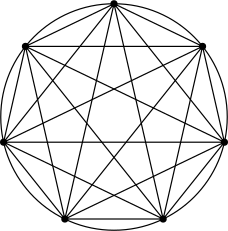
它的全部 条边和对角线长度的 次方之和是多少?
The figure below depicts a regular -gon inscribed in a unit circle.
What is the sum of the th powers of the lengths of all of its edges and diagonals?
小提示:
相隔 步的两个顶点之间,弦长的平方为 ;对于 ,每一类都有 条弦。
A chord between vertices apart has squared length there are of each type
大提示:
使用 来计算 。
Use to evaluate
解答:
相隔 步的两个顶点之间弦长平方为 ,且 时每类有 条弦。因此所求和为
利用 以及 ,括号内的和展开为 。
因此总和是 。
所以正确答案是 C。
A chord joining two vertices steps apart has squared length and there are chords for each of The required sum is
Using and the inner sum expands to
Therefore the total is
Thus, the correct answer is C.
25.
四个正六边形围绕一个边长为 的正方形,每个六边形都与该正方形共用一条边,如下图所示。所得外侧 边非凸多边形的面积可写成 ,其中 、 和 都是整数,且 不被任何质数的平方整除。求 。
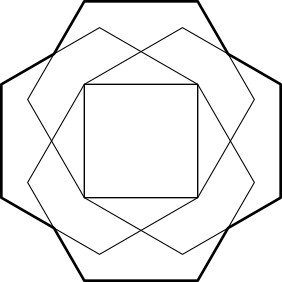
Four regular hexagons surround a square with a side length each one sharing an edge with the square, as shown in the figure below. The area of the resulting -sided outer nonconvex polygon can be written as where and are integers and is not divisible by the square of any prime. What is
小提示:
每个六边形与正方形共用一条边并延伸到对侧;把正方形中心设为原点建立坐标。
Each hexagon shares an edge with the square and reaches across to the far side; set up coordinates with the square centered at the origin
大提示:
外边界有距离中心 的平边,以及相邻六边形边相交形成的凹点 。
The outer boundary has flat edges at distance and reflex notches where adjacent hexagons’ edges cross, at
解答:
将正方形中心置于原点,顶点为 。每个六边形与正方形共用一条边,并向正方形的对侧延伸。例如底边上的六边形,其远端上边从 到 。
外边界是一个 边形,其平边到中心的距离为 ,凸顶点包括 ,而相邻六边形的斜边在 及其对称点相交,形成四个凹入的顶点。
对这 个顶点使用鞋带公式,面积为 ,所以 ,,,从而 。
所以正确答案是 B。
Center the square at the origin with vertices Each hexagon shares one edge with the square and extends across to the opposite side; the hexagon on the bottom edge, for instance, has its far (top) edge from to
The outer boundary is a -gon with flat edges at distance from the center, convex vertices such as and four reflex notches where adjacent hexagons’ slanted edges meet, at and its symmetric images.
Applying the shoelace formula to these vertices gives area so and
Thus, the correct answer is B.