
Problemas del 1998 AMC 12
¡Desplázate hacia abajo y presiona Iniciar para intentar el examen! O ve al PDF imprimible, la clave de respuestas, o las soluciones profesionales preparadas por LIVE by Po-Shen Loh.
Todos los problemas se usan con el permiso legal oficial de la Mathematical Association of America (MAA).
O salta directamente a un solo problema con su solución: 1 · 2 · 3 · 4 · 5 · 6 · 7 · 8 · 9 · 10 · 11 · 12 · 13 · 14 · 15 · 16 · 17 · 18 · 19 · 20 · 21 · 22 · 23 · 24 · 25 · 26 · 27 · 28 · 29 · 30
¿Quieres aprender de forma profesional con clases interactivas en video?
Con tiempo
1:15:00
1.
Cada lado de cinco rectángulos congruentes está marcado con un entero, como se muestra. Los cinco rectángulos se colocan, sin girarlos ni reflejarlos, en las posiciones a , de modo que las etiquetas de los lados coincidentes sean iguales. ¿Cuál de los rectángulos ocupa la posición ?
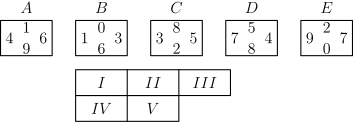
Each of the sides of five congruent rectangles is labeled with an integer, as shown. These five rectangles are placed, without rotating or reflecting, in positions through so that the labels on coincident sides are equal. Which of the rectangles is in position
Respuesta: E
Pista pequeña:
El rectángulo de la posición debe coincidir con otro rectángulo por cada uno de sus dos lados verticales
The rectangle in position must match another rectangle on both vertical sides
Pista grande:
Después de hallar la posición , empareja su etiqueta izquierda con la etiqueta derecha de la posición
After finding position , match its left label to the right label of position
Solución:
La etiqueta izquierda y la derecha de la posición deben aparecer, respectivamente, como etiqueta derecha e izquierda de otros dos rectángulos. Solo con etiquetas laterales y permite ambas coincidencias: tiene etiqueta derecha y tiene etiqueta izquierda Por tanto, la posición contiene así que la respuesta correcta es E.
Position needs both its left and right labels to occur as right and left labels, respectively, on two other rectangles. Only with side labels and permits both matches: has right label and has left label Hence position contains so the correct answer is E.
2.
Las letras y representan cuatro cifras distintas elegidas entre Si es un entero tan grande como sea posible, ¿cuál es el valor de ?
Letters and represent four different digits selected from If is an integer that is as large as possible, what is the value of
Respuesta: E
Pista pequeña:
Haz el denominador tan pequeño como sea posible usando cifras distintas
Make the denominator as small as possible using distinct digits
Pista grande:
Las dos cifras menores y las dos mayores forman pares disjuntos
The two smallest digits and the two largest digits are disjoint pairs
Solución:
El menor denominador positivo es y el mayor numerador que usa otras dos cifras es Su cociente es el entero que es claramente máximo. Por tanto, y la respuesta correcta es E.
The least positive denominator is and the greatest numerator using two other digits is Their ratio is the integer which is plainly maximal. Thus and E is correct.
3.
Si y son cifras tales que entonces
If and are digits for which then
Respuesta: D
Pista pequeña:
La columna de las unidades exige pedir prestado a la columna de las decenas
The units column must borrow from the tens column
Pista grande:
Continúa los préstamos por las columnas de las decenas y de las centenas
Continue the borrowing through the tens and hundreds columns
Solución:
La columna de las unidades da por lo que En la columna de las decenas, debe pedir prestado, y de donde La columna de las centenas da entonces Por tanto, así que la respuesta correcta es D.
The units column gives so In the tens column, must borrow, and giving The hundreds column then gives Therefore so D is correct.
4.
Se define como donde ¿Cuál es el valor de
Define to mean where What is the value of
Respuesta: E
Pista pequeña:
Evalúa primero cada uno de los tres corchetes interiores
Evaluate each of the three inner brackets first
Pista grande:
Los tres corchetes interiores tienen el mismo valor
All three inner brackets have the same value
Solución:
Cada valor interior es y Por tanto, la expresión exterior es La respuesta correcta es E.
Each inner value is and Thus the outer expression is The correct answer is E.
5.
Si ¿cuál es el valor de ?
If what is the value of
Respuesta: C
Pista pequeña:
Saca como factor común la menor potencia de
Factor out the smallest power of
Pista grande:
El coeficiente restante es
The remaining coefficient is
Solución:
Al factorizar se obtiene Por tanto, así que la respuesta correcta es C.
Factoring gives Hence so C is correct.
6.
Si se escribe como producto de dos enteros positivos cuya diferencia sea tan pequeña como sea posible, entonces la diferencia es
If is written as a product of two positive integers whose difference is as small as possible, then the difference is
Respuesta: C
Pista pequeña:
Factoriza y busca divisores cercanos a su raíz cuadrada
Factor and look for divisors near its square root
Pista grande:
El par de factores más próximo contiene y el factor restante
The closest factor pair is formed from and the remaining factor
Solución:
Como el par de factores más cercano a es Su diferencia es así que la respuesta correcta es C.
Since its factor pair nearest is Their difference is so C is correct.
7.
Si entonces
If then
Respuesta: D
Pista pequeña:
Comienza con la raíz cúbica más interior y conviértela en un exponente
Start with the innermost cube root and convert it to an exponent
Pista grande:
En cada nivel exterior, suma al exponente y divide entre
At each outer level, add to the exponent and divide by
Solución:
La raíz más interior es La siguiente es La exterior es Por tanto, la respuesta correcta es D.
The innermost radical is The next is The outermost is Thus D is correct.
8.
Un cuadrado de lado se divide en dos trapecios congruentes y un pentágono de áreas iguales, uniendo el centro del cuadrado con puntos de tres de sus lados, como se muestra. Halla la longitud del lado paralelo mayor de cada trapecio.
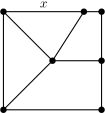
A square with sides of length is divided into two congruent trapezoids and a pentagon, which have equal areas, by joining the center of the square with points on three of the sides, as shown. Find the length of the longer parallel side of each trapezoid.
Respuesta: D
Pista pequeña:
Cada una de las tres regiones tiene área
Each of the three regions has area
Pista grande:
Cada trapecio tiene altura y lados paralelos y
A trapezoid has height and parallel sides and
Solución:
Cada trapecio tiene área Su altura es y sus lados paralelos miden y Por tanto, lo que da Así, la respuesta correcta es D.
Each trapezoid has area Its height is and its parallel sides have lengths and Therefore which gives Thus D is correct.
9.
Un orador habló durante sesenta minutos ante un auditorio lleno. El veinte por ciento del público oyó toda la charla y el diez por ciento durmió durante toda ella. La mitad del resto oyó un tercio de la charla y la otra mitad oyó dos tercios. ¿Cuál fue el número promedio de minutos de la charla que oyó cada asistente?
A speaker talked for sixty minutes to a full auditorium. Twenty percent of the audience heard the entire talk and ten percent slept through the entire talk. Half of the remainder heard one third of the talk and the other half heard two thirds of the talk. What was the average number of minutes of the talk heard by members of the audience?
Respuesta: D
Pista pequeña:
Cada mitad del grupo restante representa el del público
The two halves of the remainder are each of the audience
Pista grande:
Pondera los tiempos y por las fracciones correspondientes del público
Weight the heard times and by their audience fractions
Solución:
El promedio es minutos. Por tanto, la respuesta correcta es D.
The average is minutes. Thus D is correct.
10.
Un cuadrado grande se divide en un cuadrado pequeño rodeado por cuatro rectángulos congruentes, como se muestra. El perímetro de cada rectángulo congruente es ¿Cuál es el área del cuadrado grande?
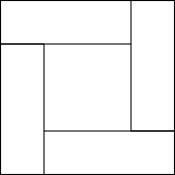
A large square is divided into a small square surrounded by four congruent rectangles as shown. The perimeter of each of the congruent rectangles is What is the area of the large square?
Respuesta: A
Pista pequeña:
Sean y los lados de uno de los rectángulos
Let the sides of one rectangle be and
Pista grande:
El lado del cuadrado grande mide
The side length of the large square is
Solución:
Si un rectángulo tiene lados entonces de modo que El cuadrado grande tiene lado y por tanto área La respuesta correcta es A.
If a rectangle has sides then so The large square has side hence area The correct answer is A.
11.
Sea un rectángulo. ¿Cuántos círculos en el plano de tienen un diámetro cuyos dos extremos son vértices de ?
Let be a rectangle. How many circles in the plane of have a diameter both of whose endpoints are vertices of
Respuesta: D
Pista pequeña:
Hay seis pares no ordenados de vértices del rectángulo
There are six unordered pairs of rectangle vertices
Pista grande:
Las dos diagonales determinan el mismo círculo
The two diagonals determine the same circle
Solución:
Los cuatro lados determinan cuatro círculos distintos que los tienen por diámetro. Las dos diagonales son iguales y comparten punto medio, así que determinan el mismo quinto círculo. Por tanto, hay y la respuesta correcta es D.
The four sides determine four distinct diameter circles. The two diagonals are equal and share a midpoint, so they determine the same fifth circle. Hence there are and D is correct.
12.
¿Cuántos números primos distintos son factores de si
How many different prime numbers are factors of if
Respuesta: A
Pista pequeña:
Deshaz los logaritmos uno por uno, comenzando con el de base
Undo the logarithms one at a time, starting with base
Pista grande:
La expresión final para es una potencia de
The final expression for is a power of
Solución:
Al exponenciar sucesivamente se obtiene Por tanto, es el único factor primo de así que la respuesta correcta es A.
Successively exponentiating gives Thus is the only prime factor of so the correct answer is A.
13.
Walter lanza cuatro dados estándar de seis caras y observa que el producto de los números de las caras superiores es ¿Cuál de los siguientes no podría ser la suma de las cuatro caras superiores?
Walter rolls four standard six-sided dice and finds that the product of the numbers on the upper faces is Which of the following could not be the sum of the upper four faces?
Respuesta: E
Pista pequeña:
Factoriza en cuatro factores entre y
Factor using four factors from through
Pista grande:
Separa los casos con cero, una o dos caras que muestren
Separate the cases with zero, one, or two faces showing
Solución:
Entre los resultados posibles están con suma con suma con suma y con suma Si aparecen dos las otras dos caras tienen producto y suma a lo sumo para un total máximo de los casos con menos tampoco pueden sumar y conservar producto Por tanto, es imposible, y la respuesta correcta es E.
Valid rolls include with sum with sum with sum and with sum If two s occur, the other two faces have product and sum at most giving total at most the cases with fewer s also cannot total while retaining product Thus is impossible, and E is correct.
14.
Una parábola tiene vértice en y dos intersecciones con el eje , una positiva y otra negativa. Si la parábola es la gráfica de ¿cuáles de y deben ser positivos?
A parabola has vertex at and has two -intercepts, one positive and one negative. If this parabola is the graph of which of and must be positive?
solo
only
solo
only
solo
only
solo y
and only
ninguno
none
Respuesta: A
Pista pequeña:
El vértice está por debajo de las dos intersecciones; usa esto para determinar hacia dónde se abre la parábola
The vertex lies below two intercepts, so determine the opening direction
Pista grande:
Usa los signos del producto de las raíces y de
Use the signs of the roots’ product and of
Solución:
La parábola se abre hacia arriba, así que Sus raíces tienen signos opuestos, de modo que y por tanto Además, así que Por consiguiente, solo debe ser positivo, y la respuesta correcta es A.
The parabola opens upward, so Its roots have opposite signs, so and hence Also so Therefore only must be positive, and A is correct.
15.
Un hexágono regular y un triángulo equilátero tienen áreas iguales. ¿Cuál es la razón entre la longitud del lado del triángulo y la longitud del lado del hexágono?
A regular hexagon and an equilateral triangle have equal areas. What is the ratio of the length of a side of the triangle to the length of a side of the hexagon?
Respuesta: C
Pista pequeña:
Divide el hexágono regular en seis triángulos equiláteros
Partition the regular hexagon into six equilateral triangles
Pista grande:
El área de un triángulo equilátero es proporcional al cuadrado de su lado
Equilateral-triangle area is proportional to the square of its side
Solución:
Un hexágono regular de lado está formado por seis triángulos equiláteros de lado Un triángulo equilátero de igual área y lado satisface entonces por lo que La respuesta correcta es C.
A regular hexagon of side is six equilateral triangles of side An equal-area equilateral triangle of side therefore satisfies so The correct answer is C.
16.
La figura mostrada es la unión de un círculo y dos semicírculos de diámetros y cuyos centros son colineales. La razón entre el área de la región sombreada y la de la región no sombreada es
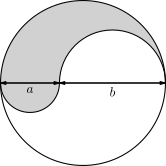
The figure shown is the union of a circle and two semicircles of diameters and all of whose centers are collinear. The ratio of the area of the shaded region to that of the unshaded region is
Respuesta: B
Pista pequeña:
Expresa cada región mediante el semicírculo grande y uno de los semicírculos pequeños
Express each region using the large semicircle and one small semicircle
Pista grande:
Las dos áreas resultantes contienen un factor común múltiplo de
Both resulting areas factor a common multiple of
Solución:
El área sombreada es Del mismo modo, el área no sombreada es Su razón es así que la respuesta correcta es B.
The shaded area is Similarly, the unshaded area is Their ratio is so B is correct.
17.
Sea una función con las dos propiedades siguientes:
(a) para cualesquiera números reales y y
(b)
¿Cuál es el valor de ?
Let be a function with the two properties:
(a) for any two real numbers and and
(b)
What is the value of
Respuesta: E
Pista pequeña:
Pon en la ecuación funcional
Set in the functional equation
Pista grande:
Las dos propiedades determinan directamente para todo número real
The two properties determine directly for every real
Solución:
Al tomar se obtiene Por tanto, así que la respuesta correcta es E.
Taking gives Hence so E is correct.
18.
Un cono circular recto de volumen un cilindro circular recto de volumen y una esfera de volumen tienen el mismo radio, y la altura común del cono y del cilindro es igual al diámetro de la esfera. Entonces
A right circular cone of volume a right circular cylinder of volume and a sphere of volume all have the same radius, and the common height of the cone and the cylinder is equal to the diameter of the sphere. Then
Respuesta: A
Pista pequeña:
Sea el radio común, de modo que la altura del cono y del cilindro es
Let the common radius be , so the cone and cylinder height is
Pista grande:
Escribe los tres volúmenes como múltiplos de
Write all three volumes as multiples of
Solución:
Los volúmenes son y Por tanto, así que la respuesta correcta es A.
The volumes are and Therefore so A is correct.
19.
¿Cuántos triángulos tienen área y vértices en y para algún ángulo ?
How many triangles have area and vertices at and for some angle
Respuesta: C
Pista pequeña:
La base fija mide , y la altura del tercer vértice es
The fixed base has length , and the third vertex has height
Pista grande:
Cuenta los puntos distintos del círculo que satisfacen la ecuación trigonométrica resultante
Count the distinct points on the circle satisfying the resulting sine equation
Solución:
El área es Por tanto, Hay cuatro puntos correspondientes en el círculo, cada uno de los cuales produce un triángulo distinto. Así, la respuesta es y la respuesta correcta es C.
The area is Thus There are four corresponding points on the circle, and each gives a distinct triangle. Hence the answer is making C correct.
20.
Hay tres tarjetas boca abajo sobre una mesa, cada una con un entero positivo escrito. Casey, Stacy y Tracy saben que
(a) los números son todos distintos,
(b) suman y
(c) están en orden creciente de izquierda a derecha.
Primero, Casey mira el número de la tarjeta izquierda y dice: “No tengo información suficiente para determinar los otros dos números”. Después, Tracy mira el número de la tarjeta derecha y dice: “No tengo información suficiente para determinar los otros dos números”. Por último, Stacy mira el número de la tarjeta central y dice: “No tengo información suficiente para determinar los otros dos números”. Supón que cada persona sabe que las otras dos razonan perfectamente y oye sus comentarios. ¿Qué número está en la tarjeta central?
Three cards, each with a positive integer written on it, are lying face-down on a table. Casey, Stacy, and Tracy are told that
(a) the numbers are all different,
(b) they sum to and
(c) they are in increasing order, left to right.
First, Casey looks at the number on the leftmost card and says, “I don’t have enough information to determine the other two numbers.” Then Tracy looks at the number on the rightmost card and says, “I don’t have enough information to determine the other two numbers.” Finally, Stacy looks at the number on the middle card and says, “I don’t have enough information to determine the other two numbers.” Assume that each person knows that the other two reason perfectly and hears their comments. What number is on the middle card?
No hay información suficiente para determinar el número.
There is not enough information to determine the number.
Respuesta: C
Pista pequeña:
Enumera todas las ternas crecientes de enteros positivos con suma
List all increasing positive triples with sum
Pista grande:
Elimina ternas en el orden de las tres afirmaciones, usando lo que cada persona ya ha aprendido
Eliminate triples in the order of the three statements, using what each speaker has learned
Solución:
Las ocho ternas son La afirmación de Casey excluye Sabiendo esto, la afirmación de Tracy excluye los valores derechos y Las ternas restantes son y Un valor central de o identificaría ahora la terna, así que la afirmación de Stacy obliga a que el valor central sea Por tanto, la respuesta correcta es C.
The eight triples are Casey’s statement excludes With that known, Tracy’s statement excludes rightmost values and The remaining triples are and A middle value or would now identify the triple, so Stacy’s statement forces the middle value Thus C is correct.
21.
En una carrera de metros, Sunny está exactamente metros por delante de Windy cuando Sunny termina. La próxima vez que corren, Sunny comienza deportivamente metros detrás de Windy, que está en la línea de salida. Ambos corren a las mismas velocidades constantes que en la primera carrera. ¿Cuántos metros de ventaja lleva Sunny cuando termina la segunda carrera?
In an -meter race, Sunny is exactly meters ahead of Windy when Sunny finishes the race. The next time they race, Sunny sportingly starts meters behind Windy, who is at the starting line. Both runners run at the same constant speed as they did in the first race. How many meters ahead is Sunny when Sunny finishes the second race?
Pista pequeña:
Expresa la velocidad de Windy como una fracción de la de Sunny usando la primera carrera
Express Windy’s speed as a fraction of Sunny’s speed using the first race
Pista grande:
En la segunda carrera, Sunny recorre metros antes de terminar
In the second race Sunny travels meters before finishing
Solución:
Si la velocidad de Sunny es la de Windy es Sunny necesita tiempo en la segunda carrera, durante el cual Windy recorre Sunny termina en la posición así que la ventaja es Por tanto, la respuesta correcta es C.
If Sunny’s speed is Windy’s is Sunny needs time in the second race, during which Windy runs Sunny finishes at position so the lead is Thus C is correct.
22.
¿Cuál es el valor de la expresión
What is the value of the expression
Respuesta: C
Pista pequeña:
Usa la identidad de recíprocos
Use the reciprocal identity
Pista grande:
Combina los logaritmos resultantes de
Combine the resulting logarithms of
Solución:
Cada término es igual a Por tanto, la suma es Así, la respuesta correcta es C.
Each term equals Therefore the sum is Thus C is correct.
23.
Las gráficas de y se intersecan cuando satisface y para ningún otro valor de Halla
The graphs of and intersect when satisfies and for no other values of Find
Respuesta: D
Pista pequeña:
Completa cuadrados para hallar los centros y los radios de ambos círculos
Complete the square to find both circle centers and radii
Pista grande:
Dos círculos se intersecan exactamente cuando la distancia entre sus centros está entre la diferencia y la suma de sus radios
Two circles intersect exactly when the center distance lies between the difference and sum of their radii
Solución:
Los círculos son Sus centros están a unidades de distancia. Si el segundo radio es la intersección exige o sea, Por tanto, y La respuesta correcta es D.
The circles are Their centers are units apart. With second radius intersection requires or Thus and The correct answer is D.
24.
Un número telefónico de cifras - se llama memorable si la secuencia del prefijo coincide exactamente con alguna de las secuencias o (o con ambas). Suponiendo que cada puede ser cualquiera de las diez cifras decimales el número de teléfonos memorables distintos es
Call a -digit telephone number - memorable if the prefix sequence is exactly the same as either of the sequences or (possibly both). Assuming that each can be any of the ten decimal digits the number of different memorable telephone numbers is
Respuesta: C
Pista pequeña:
Cuenta por separado los números que satisfacen cada una de las dos condiciones de coincidencia
Count numbers satisfying each of the two matching conditions separately
Pista grande:
Si se cumplen ambas coincidencias, las siete cifras quedan determinadas por una sola cifra repetida
If both matches hold, all seven digits are forced by one repeated digit
Solución:
Cada condición de coincidencia da números: se eligen las tres cifras del prefijo y la única cifra restante sin restricción. Si se cumplen ambas, entonces lo que obliga a que todas las cifras sean iguales, así que hay intersecciones. Por inclusión-exclusión se obtienen por lo que la respuesta correcta es C.
Each matching condition gives numbers: choose the three prefix digits and the one unconstrained remaining digit. If both hold, then forcing all digits equal, so there are overlaps. Inclusion-exclusion gives so C is correct.
25.
Una hoja de papel cuadriculado se dobla una vez de modo que coincida con y coincida con Halla
A piece of graph paper is folded once so that is matched with and is matched with Find
Respuesta: B
Pista pequeña:
El pliegue es la mediatriz del segmento que une y
The crease is the perpendicular bisector of the segment joining and
Pista grande:
Halla la recta y luego refleja respecto de ella
Find the line , then reflect across it
Solución:
El pliegue pasa por y tiene pendiente así que es La perpendicular por tiene pendiente y corta el pliegue en Este punto es el punto medio de y de donde Por tanto, así que la respuesta correcta es B.
The crease passes through with slope so it is The perpendicular through has slope and meets the crease at This intersection is the midpoint of and giving Hence so B is correct.
26.
En el cuadrilátero se sabe que los ángulos y son rectos, y Entonces
In quadrilateral it is given that angles and are right angles, and Then
Respuesta: B
Pista pequeña:
Los dos ángulos rectos hacen que sea cíclico con como diámetro
The two right angles make cyclic with as a diameter
Pista grande:
Halla en el triángulo y luego usa la ley de los senos extendida
Find in triangle , then use the extended law of sines
Solución:
Como el cuadrilátero es cíclico, y es su diámetro. En el triángulo Por la ley de los senos extendida, Así, la respuesta correcta es B.
Because the quadrilateral is cyclic, and is its diameter. In triangle By the extended law of sines, Thus B is correct.
27.
Un cubo de está compuesto por veintisiete cubos de . Se abren “túneles” en el cubo grande de la siguiente manera: primero se retiran los seis cubos de que forman el centro de cada cara, así como el cubo central de , según se muestra. Segundo, cada uno de los veinte cubos de restantes se reduce de la misma manera; es decir, se retiran los cubos unitarios centrales de sus caras y su cubo central. El área superficial de la figura final es

A cube is composed of twenty-seven cubes. The big cube is “tunneled” as follows: First, the six cubes which make up the center of each face as well as the center cube are removed as shown. Second, each of the twenty remaining cubes is diminished in the same way. That is, the center facial unit cubes as well as each center cube are removed. The surface area of the final figure is
Respuesta: E
Pista pequeña:
Después de la primera etapa, clasifica los veinte subcubos grandes restantes como cubos de esquina o de arista
After the first stage, classify the twenty remaining large subcubes as corner or edge cubes
Pista grande:
Para cada túnel de la segunda etapa, resta los cuadrados centrales expuestos y suma las paredes recién expuestas del túnel
For each second-stage tunnel, subtract exposed center squares and add the newly exposed tunnel walls
Solución:
Después de la primera etapa, subcubos de esquina aportan unidades expuestas cada uno, y subcubos de arista aportan cada uno. Perforar un subcubo de esquina elimina cuadrados unitarios expuestos y añade paredes del túnel; perforar uno de arista elimina y también añade Por tanto, el área final es Así, la respuesta correcta es E.
After the first stage, corner subcubes contribute exposed units each, and edge subcubes contribute each. Tunneling a corner subcube removes exposed unit squares and adds tunnel-wall squares; tunneling an edge subcube removes and also adds Hence the final area is Thus E is correct.
28.
En el triángulo el ángulo es recto y El punto está sobre de modo que el ángulo es el doble del ángulo Si entonces donde y son enteros positivos primos entre sí. Halla
In triangle angle is a right angle and Point is located on so that angle is twice angle If then where and are relatively prime positive integers. Find
Respuesta: B
Pista pequeña:
Sea , de modo que y
Let , so and
Pista grande:
Toma y expresa y mediante y
Set and express and using and
Solución:
Sea Como la identidad de da Tomando Entonces y Por tanto, así que la respuesta correcta es B.
Let Since the identity for gives Taking Thus and Therefore so B is correct.
29.
Un punto del plano se llama punto reticular si tanto como son enteros. El área del mayor cuadrado que contiene exactamente tres puntos reticulares en su interior es la más cercana a
A point in the plane is called a lattice point if both and are integers. The area of the largest square that contains exactly three lattice points in its interior is closest to
Respuesta: D
Pista pequeña:
Tres puntos reticulares interiores colineales obligan a que haya un cuarto; usa un triángulo reticular no colineal mínimo
Three collinear interior lattice points force a fourth, so use a smallest noncollinear lattice triangle
Pista grande:
En un cuadrado máximo, los lados opuestos quedan fijados por puntos reticulares cercanos; compara su separación
At a maximal square, opposite sides are pinned by nearby lattice points; compare their separation
Solución:
Basta encerrar los tres puntos reticulares no colineales En una colocación máxima, dos lados opuestos quedan fijados por puntos reticulares vecinos; la mayor separación posible es la distancia entre las rectas paralelas que pasan por y Por tanto, el área es a lo sumo Este valor se alcanza con el cuadrado limitado por Su área es y contiene exactamente los tres puntos indicados en su interior. Así, la respuesta correcta es D.
It suffices to enclose the three noncollinear lattice points In a maximal placement, two opposite sides are pinned by neighboring lattice points; the greatest possible separation is the distance between parallel lines through and Hence the area is at most This is attained by the square bounded by Its area is and exactly the three stated lattice points lie inside. Thus D is correct.
30.
Para cada entero positivo sea Sea el menor entero positivo para el cual la cifra no nula más a la derecha de es impar. La cifra no nula más a la derecha de es
For each positive integer let Let denote the smallest positive integer for which the rightmost nonzero digit of is odd. The rightmost nonzero digit of is
Respuesta: E
Pista pequeña:
Escribe y compara sus potencias de y
Write and compare its powers of and
Pista grande:
Una cifra no nula impar en el extremo derecho se vuelve posible por primera vez cuando el bloque de diez términos contiene
An odd rightmost nonzero digit first becomes possible when the ten-term block contains
Solución:
Los cinco términos pares de cualesquiera diez enteros consecutivos aportan al menos Por tanto, la cifra no nula final solo puede ser impar cuando el bloque contiene al menos ocho factores de lo que se hace posible por primera vez cuando contiene Para el bloque tiene y así que la cifra sigue siendo par. Para ambas valuaciones son Al cancelar y multiplicar las cifras de unidades impares restantes se obtiene Por consiguiente, la primera cifra no nula final impar es y la respuesta correcta es E.
The five even terms in any ten consecutive integers contribute at least Thus the rightmost nonzero digit can be odd only when the block contains at least eight factors of first possible when it contains For the block has and so the digit remains even. For both valuations are Cancelling and multiplying the remaining odd unit digits gives Hence the first odd rightmost nonzero digit is and E is correct.