
2008 AMC 12A 真题
计时
1:15:00
1.
一家面包店老板在上午 打开甜甜圈机器。到上午 ,机器完成了当天工作的三分之一。甜甜圈机器将在什么时间完成这项工作?
A bakery owner turns on his doughnut machine at am. At am the machine has completed one third of the day’s job. At what time will the doughnut machine complete the job?
下午
pm
下午
pm
下午
pm
下午
pm
下午
pm
小提示:
先求完成前三分之一工作用了多长时间。
Find how long it took to finish the first third of the job
大提示:
全部工作所需时间是前三分之一所需时间的三倍。
The whole job takes three times as long as that first third
解答:
从上午 到 是 小时 分,也就是 分钟,完成了三分之一。
整项工作需要 分钟,即 小时。从 再过 小时,得到 。
所以正确答案是 D。
From am to am is hours minutes, or minutes, to complete one third of the job.
The whole job then takes minutes, or hours. Adding hours to am gives pm.
Thus, D is the correct answer.
2.
下式的倒数是多少:
What is the reciprocal of
答案:A
小提示:
先通分相加。
Add the two fractions using a common denominator
大提示:
取倒数就是交换分子和分母。
The reciprocal swaps the numerator and denominator
解答:
先通分相加,得到
的倒数是 。
所以正确答案是 A。
Using a common denominator,
The reciprocal of is
Thus, A is the correct answer.
3.
假设 根香蕉的 与 个橙子价值相同。那么 根香蕉的 与多少个橙子价值相同?
Suppose that of bananas are worth as much as oranges. How many oranges are worth as much as of bananas?
答案:C
小提示:
先求一根香蕉相当于多少个橙子。
First find how many oranges a single banana is worth
大提示:
根香蕉的 是 根香蕉,相当于 个橙子。
of bananas is bananas, and these equal oranges
解答:
因为 根香蕉的 是 根,价值 个橙子,所以一根香蕉价值 个橙子。
于是 根香蕉的 是 根香蕉,价值 个橙子。
所以正确答案是 C。
Since of bananas is bananas, worth oranges, one banana is worth oranges.
Then of bananas is bananas, worth oranges.
Thus, C is the correct answer.
4.
下列哪一个等于乘积:
Which of the following is equal to the product
答案:B
小提示:
每个分母都会和前一个分数的分子约掉。
Each denominator cancels with the numerator of the previous fraction
大提示:
最后只剩最后一个分子和第一个分母。
Only the last numerator and the first denominator survive
解答:
除第一个分母外,每个分母都与前一个分数的分子相消,所以乘积化为
所以正确答案是 B。
Every denominator except the first cancels with the numerator of the preceding fraction, so the product collapses to
Thus, B is the correct answer.
5.
假设 是整数。下列关于 的说法哪一个一定正确?
Suppose that is an integer. Which of the following statements must be true about
它是负数。
It is negative.
它是偶数,但不一定是 的倍数。
It is even, but not necessarily a multiple of
它是 的倍数,但不一定是偶数。
It is a multiple of but not necessarily even.
它是 的倍数,但不一定是 的倍数。
It is a multiple of but not necessarily a multiple of
它是 的倍数。
It is a multiple of
小提示:
把两个分数通分合并。
Combine the two fractions over a common denominator
大提示:
化简为 ,再判断它在什么整除条件下是整数。
Simplify to then decide what divisibility condition makes this an integer
解答:
通分合并可得
该式为整数当且仅当 是偶数。例如 是偶数但不是 的倍数,这就排除了其余每一个说法。
所以正确答案是 B。
Combining the fractions,
This is an integer exactly when is even. The example is even but not a multiple of which rules out every other statement.
Thus, B is the correct answer.
6.
Heather 比较两家商店中一台新电脑的价格。A 店先按标价打 折扣,再返还 ;B 店对同一标价打 折扣,没有返还。Heather 在 A 店购买比在 B 店购买节省 。电脑标价是多少美元?
Heather compares the price of a new computer at two different stores. Store A offers off the sticker price followed by a rebate, and store B offers off the same sticker price with no rebate. Heather saves by buying the computer at store A instead of store B. What is the sticker price of the computer, in dollars?
小提示:
用标价 表示两家商店的最终价格。
Write each store’s price in terms of the sticker price
大提示:
A 店价格比 B 店低 美元。
Store A’s price is dollars less than store B’s price
解答:
设标价为 美元。A 店价格为 ,B 店价格为 。
因为 A 店便宜 美元,所以 从而 ,。
所以正确答案是 A。
Let be the sticker price in dollars. Store A charges dollars, and store B charges dollars.
Since store A is dollars cheaper, so and
Thus, A is the correct answer.
7.
Steve 和 LeRoy 在离岸 英里的地方钓鱼时,船漏水了,水以每分钟 加仑的恒定速度进入船内。若船中进水超过 加仑,船就会沉。Steve 以每小时 英里的恒定速度划向岸边,同时 LeRoy 把水舀出船。为了在船不沉的情况下到岸,LeRoy 最慢需要以每分钟多少加仑的速度舀水?
While Steve and LeRoy are fishing mile from shore, their boat springs a leak, and water comes in at a constant rate of gallons per minute. The boat will sink if it takes in more than gallons of water. Steve starts rowing toward the shore at a constant rate of miles per hour while LeRoy bails water out of the boat. What is the slowest rate, in gallons per minute, at which LeRoy can bail if they are to reach the shore without sinking?
小提示:
先求到岸需要多少分钟。
Find how many minutes the trip to shore takes
大提示:
水会进入 分钟,而船内最多只能剩 加仑。
Water enters for minutes, and at most gallons may remain in the boat
解答:
以每小时 英里划 英里,需要 小时,即 分钟。这段时间进入 加仑水。
船内最多剩 加仑,所以 LeRoy 必须舀出 加仑,用时 分钟,速率为 加仑每分钟。
所以正确答案是 D。
Rowing mile at miles per hour takes hour, or minutes. In that time gallons of water enter the boat.
Since at most gallons may remain, LeRoy must bail gallons in minutes, a rate of gallons per minute.
Thus, D is the correct answer.
8.
一个立方体的表面积是体积为 的立方体表面积的两倍。这个立方体的体积是多少?
What is the volume of a cube whose surface area is twice that of a cube with volume
小提示:
体积为 的立方体表面积为 。
A cube with volume has surface area
大提示:
若较大立方体边长为 ,则 。
If the larger cube has side then
解答:
体积为 的立方体边长为 ,表面积为 。所求立方体表面积为 。若边长为 ,则 ,所以 。
其体积为
所以正确答案是 C。
The cube with volume has side and surface area The larger cube has surface area so if its side is then giving
Its volume is
Thus, C is the correct answer.
9.
较老的电视屏幕宽高比为 。也就是说,宽与高之比为 。许多电影的宽高比不是 ,所以有时会用“信箱式”显示,也就是在屏幕顶部和底部加等高黑条,如图。假设一部电影宽高比为 ,在一台对角线为 英寸的旧电视上播放。每条黑条的高度是多少英寸?
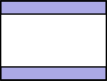
Older television screens have an aspect ratio of That is, the ratio of the width to the height is The aspect ratio of many movies is not so they are sometimes shown on a television screen by “letterboxing” — darkening strips of equal height at the top and bottom of the screen, as shown. Suppose a movie has an aspect ratio of and is shown on an older television screen with a -inch diagonal. What is the height, in inches, of each darkened strip?
小提示:
屏幕宽、高、对角线成 的比例。
The screen’s width, height, and diagonal are in ratio
大提示:
电影画面使用完整宽度,高度等于宽度的一半。
The lit movie region keeps the full width but has height equal to half that width
解答:
屏幕高、宽、对角线成 ,所以高度为 英寸,宽度为 英寸。
电影宽高比为 ,使用完整宽度时高度为 英寸。
因此每条黑条的高度为 英寸。
所以正确答案是 D。
Since the sides and diagonal are in ratio the height is inches and the width is inches.
The movie has aspect ratio so its height is inches.
Each darkened strip therefore has height inches.
Thus, D is the correct answer.
10.
Doug 粉刷一个房间需要 小时。Dave 粉刷同一个房间需要 小时。Doug 和 Dave 一起粉刷房间,并午休一小时。设 为他们完成工作所需总时间(小时),包括午饭时间。 满足下列哪个方程?
Doug can paint a room in hours. Dave can paint the same room in hours. Doug and Dave paint the room together and take a one-hour break for lunch. Let be the total time, in hours, required for them to complete the job working together, including lunch. Which of the following equations is satisfied by
小提示:
他们一起每小时粉刷 个房间。
Together they paint of the room each hour
大提示:
总时间 中有一小时是午饭,所以实际工作时间为 小时。
Of the hours, one hour is lunch, so they actually work hours
解答:
Doug 每小时粉刷 个房间,Dave 每小时粉刷 个房间,所以合速度为 个房间每小时。
总时间为 ,其中 小时用于午饭,所以实际工作 小时。完成一个房间给出
所以正确答案是 D。
In one hour Doug paints of the room and Dave paints so together they paint of the room per hour.
Of the total time one hour is spent at lunch, so they work for hours. The fraction painted must equal giving
Thus, D is the correct answer.
11.
三个立方体都由图中展开图折成。然后把它们一个叠一个放在桌上,使 个可见数字之和尽可能大。这个和是多少?
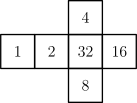
Three cubes are each formed from the pattern shown. They are then stacked on a table one on top of another so that the visible numbers have the greatest possible sum. What is that sum?
小提示:
每个立方体上相对面为 与 , 与 , 与 。
On each cube the opposite faces are & & and &
大提示:
下面两个立方体各隐藏一对相对面;最上面的立方体只隐藏底面。
The two lower cubes each hide a pair of opposite faces; the top cube hides only its bottom face
解答:
每个立方体六面数字和为 。由展开图,相对面分别是 与 , 与 , 与 。
下面两个立方体各隐藏一对上下相对面,应隐藏和最小的 。最上面立方体只隐藏底面,应隐藏 。
最大可见和为
所以正确答案是 C。
The six faces of each cube sum to From the pattern, the pairs of opposite faces are & & and &
Each of the two lower cubes hides a pair of opposite faces (top and bottom); hiding the pair is best. The top cube hides only its bottom face, so hide the
The greatest sum is
Thus, C is the correct answer.
12.
函数 的定义域为 ,值域为 。(记号 表示 。)那么由下式定义的函数 ,其定义域和值域分别是什么:
A function has domain and range (The notation denotes ) What are the domain and range, respectively, of the function defined by
,
,
,
,
,
答案:B
小提示:
有定义当且仅当 。
is defined when
大提示:
从 中减去 会把区间反向,但值域仍是 。
Subtracting from reverses the interval but keeps it
解答:
有定义需要 ,即 ,所以 的定义域为 。
当 取遍 时, 也取遍 ,所以 的值域为 。
所以正确答案是 B。
The value is defined when that is, so the domain of is
As ranges over the value ranges over as well, so the range of is
Thus, B is the correct answer.
13.
点 和 在以 为圆心的圆上,且 。第二个圆内切于第一个圆,并与 和 都相切。小圆面积与大圆面积之比是多少?
Points and lie on a circle centered at and A second circle is internally tangent to the first and tangent to both and What is the ratio of the area of the smaller circle to that of the larger circle?
小提示:
小圆圆心在 的角平分线上。
The center of the small circle lies on the bisector of
大提示:
向 作半径垂线,会得到一个 -- 三角形,其中 。
Dropping a radius to makes a -- triangle in which
解答:
设小圆和大圆半径分别为 和 ,小圆圆心为 。由对称性, 在 的角平分线上,所以 与 成 。
作半径 垂直于 ,得到 -- 三角形,所以 。两圆内切还给出 。
于是 ,所以 ,。于是面积之比为
所以正确答案是 B。
Let and be the radii of the smaller and larger circles, and let be the center of the smaller circle. By symmetry lies on the bisector of so makes a angle with
Dropping the radius perpendicular to gives a -- triangle with Since the circles are internally tangent,
Then so and The ratio of areas is
Thus, B is the correct answer.
14.
求下面不等式所定义的区域的面积:
What is the area of the region defined by the inequality
小提示:
该区域是以 、 的交点为中心的菱形。
The region is a rhombus centered where and
大提示:
它的水平对角线满足 ,竖直对角线满足 。
Its horizontal diagonal spans and its vertical diagonal spans
解答:
该区域是以 为中心的菱形。令 ,得 ,所以 ,水平对角线长 。
令 ,得 ,所以 ,竖直对角线长 。
菱形面积为对角线乘积的一半,即
所以正确答案是 A。
The region is a rhombus centered at Setting gives so a horizontal diagonal of length
Setting gives so a vertical diagonal of length
The area of the rhombus is half the product of its diagonals,
Thus, A is the correct answer.
15.
设 。 的个位数字是多少?
Let What is the units digit of
小提示:
的个位数字按 循环,周期为 。
The units digit of cycles with period
大提示:
先求 的个位数字,再注意 是 的倍数。
Find the units digit of first, then note that is a multiple of
解答:
的个位数字为 。因为 是 的倍数, 的个位数字为 。所以 的个位数字为 ,从而 的个位数字也为零。
又 和 都是 的倍数,故 是 的倍数,因此 的个位数字为 。
因此 的个位数字为 。
所以正确答案是 D。
The units digit of is Since is a multiple of the units digit of is Thus has units digit and so does
Both and are multiples of so is a multiple of Therefore the units digit of is
The units digit of is then
Thus, D is the correct answer.
16.
数 、、 是一个等差数列的前三项,且该数列第 项为 。 是多少?
The numbers and are the first three terms of an arithmetic sequence, and the th term of the sequence is What is
小提示:
把每一项写成 ,并令相邻差相等。
Write each term as and set the consecutive differences equal
大提示:
相邻差相等迫使 ,从而每项都化为 的倍数。
Equal differences force reducing every term to a multiple of
解答:
三项分别为 、 和 。令相邻两项之差相等,得 所以 。
于是第一项为 ,公差为 。
第 项为 所以 。
所以正确答案是 D。
The three terms are and Setting the two consecutive differences equal, so
The first term is then and the common difference is
The th term is so
Thus, D is the correct answer.
17.
整数数列 ,, 按如下规则确定:若 为偶数,则 ;若 为奇数,则 。有多少个正整数 满足 小于 , 和 中的每一个?
Let be a sequence of integers determined by the rule if is even and if is odd. For how many positive integers is it true that is less than each of and
小提示:
若 为偶数,则 ,所以 必须是奇数。
If is even then so must be odd
大提示:
在奇数情形中,按 或 分类。
Split the odd case according to whether or
解答:
若 为偶数,则 ,条件失败。
若 ,则 是 的倍数,,且 ,条件也失败。
若 ,则 为偶数但不是 的倍数,所以 ,且 为奇数,。此时条件成立。
满足条件的 且 的数恰有 个。
所以正确答案是 D。
If is even, then so the condition fails.
If then is a multiple of so and and again the condition fails.
If then is even but not a multiple of so and is odd, giving The condition holds.
Exactly values of satisfy
Thus, D is the correct answer.
18.
边长为 , 和 的三角形 有一个顶点在正 -轴上,一个顶点在正 -轴上,一个顶点在正 -轴上。设 为原点。四面体 的体积是多少?
Triangle with sides of length and has one vertex on the positive -axis, one on the positive -axis, and one on the positive -axis. Let be the origin. What is the volume of tetrahedron
小提示:
令三个顶点为 、、,写出三个边长方程。
Let the vertices be and write the three side-length equations
大提示:
三个方程相加得到 ,而体积为 。
Adding the three equations gives and the volume is
解答:
设 、、。于是
将三个边长方程相加得 ,所以 ,,。
体积为
所以正确答案是 C。
Let Assigning the sides,
Adding gives so and
The volume is
Thus, C is the correct answer.
19.
在展开式 中, 的系数是多少?
In the expansion of what is the coefficient of
小提示:
一项形如 ,其中 ,。
A term has the form with and
大提示:
对 的 种选择,除了 外,都有唯一有效的 。
For each of the pairs there is a unique valid except when
解答:
每项为 ,其中 ,。要得到 ,必须有 。
有 种选择。除了 外,所需的 都在 中。
因此 的系数为 。
所以正确答案是 C。
Each term is with and To get we need
There are choices for For every choice except the required lies in giving a valid term.
The coefficient of is therefore
Thus, C is the correct answer.
20.
三角形 中,、、。点 在 上,且 平分直角。 和 的内切圆半径分别为 和 ,求 。
Triangle has and Point is on and bisects the right angle. The inscribed circles of and have radii and respectively. What is
答案:E
小提示:
由角平分线定理,。
By the Angle Bisector Theorem,
大提示:
对每个小三角形使用 ;两个三角形共享底边 。
For each small triangle the two triangles share the base
解答:
由角平分线定理,,所以 ,。两个小三角形 和 共用底边 ,面积比为 ,面积分别为 和 。
将 沿 分割,该线段与两条直角边都成 ,于是 所以 。
两个三角形的半周长分别为 利用 ,可得
有理化得 ,因此
所以正确答案是 E。
By the Angle Bisector Theorem, so and The areas of and share base so they are in ratio namely and
Splitting along which meets each leg at gives so
The two semiperimeters are Using
Rationalizing, so
Thus, E is the correct answer.
21.
排列 是 的一个排列。若 ,称它为尾重排列。尾重排列有多少个?
A permutation of is heavy-tailed if What is the number of heavy-tailed permutations?
小提示:
由对称性, 与 出现次数相同。
By symmetry, and occur equally often
大提示:
先数平衡排列 ;此时 。
Count the balanced permutations here
解答:
称满足 的排列为平衡排列。把排列反向会交换两种严格不等的情形,所以尾重排列与头重排列的个数相同。
总和 是奇数,所以在平衡排列中 必须是奇数,即 之一。对每种选择,剩下的四个数唯一地分成两组和相等的数对。
这四个数中任何一个都可以作 (于是 随之确定),剩下两个数中任何一个都可以作 (于是 随之确定),共得 个平衡排列。
非平衡排列有 个,两种严格不等情形各占一半,所以有 个尾重排列。
所以正确答案是 D。
Call a permutation balanced if Reversing the entries swaps the two strict cases, so heavy-tailed and heavy-headed permutations are equally numerous.
The total is odd, so in a balanced permutation must be odd, one of For each choice, the remaining four numbers split uniquely into two equal-sum pairs.
Any of the four can be (fixing ), and either remaining number can be (fixing ), giving balanced permutations.
The other permutations split evenly, so there are heavy-tailed permutations.
Thus, D is the correct answer.
22.
一个圆桌半径为 。桌上放置六个矩形餐垫。每个餐垫宽 、长 ,如图。每个餐垫有两个角在桌边上,这两个角是同一条长为 的边的端点。此外,餐垫的位置使得每个内侧角都与相邻餐垫的一个内侧角接触。求 ?
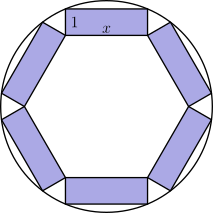
A round table has radius Six rectangular place mats are placed on the table. Each place mat has width and length as shown. They are positioned so that each mat has two corners on the edge of the table, these two corners being endpoints of the same side of length Further, the mats are positioned so that the inner corners each touch an inner corner of an adjacent mat. What is
小提示:
对一个餐垫,设 为外侧角, 为与 直径相对的点;则 是直角三角形且 。
For one mat, let be its outer corners and the point diametrically opposite then is right-angled with
大提示:
内侧角形成顶角 的等腰三角形,贡献长度 。
The inner corners form isosceles triangles with vertex angle contributing a segment of length
解答:
取一个餐垫,外侧两角为 和 ,令 是圆桌边上与 直径相对的点。则 为直径,所以 在 处为直角,且 。
沿 方向,相邻餐垫的内角形成两边长为 、顶角为 的等腰三角形,其底边为 。因此 。
勾股定理给出 化简为 。
取正根,
所以正确答案是 C。
Take one mat with outer corners and and let be the point of the table’s edge diametrically opposite Then is a diameter, so has a right angle at with
Along the inner corners of neighboring mats meet in an isosceles triangle with two sides of length and vertex angle whose base is Hence
The Pythagorean Theorem gives which simplifies to
Taking the positive root,
Thus, C is the correct answer.
23.
方程 的解是复平面中一个凸多边形的顶点。该多边形面积是多少?
The solutions of the equation are the vertices of a convex polygon in the complex plane. What is the area of the polygon?
小提示:
两边加上 ,识别一个四次幂。
Add to both sides to recognize a perfect fourth power
大提示:
的四个值等距分布在半径 的圆上,形成一个正方形。
The four values of lie equally spaced on a circle of radius forming a square
解答:
两边加上 ,左边变为 所以 。
令 。四个解等距分布在半径 的圆上,形成正方形;减去 只会平移图形。
该正方形的外接圆半径为 ,所以对角线为 ,边长为 。
面积为
所以正确答案是 D。
Adding to both sides, the left side becomes so
The four solutions for are equally spaced on a circle of radius and they form a square. Subtracting merely translates it.
A square inscribed in a circle of radius has diagonal so its side is
The area is
Thus, D is the correct answer.
24.
三角形 中,,。点 是 的中点。求 的最大可能值。
Triangle has and Point is the midpoint of What is the largest possible value of
小提示:
取 、、,其中 。
Place and with
大提示:
由斜率可得 ,再对 最大化。
Using slopes gives maximize over
解答:
取 ,,使 且 ,令 ,其中 。则 是 的中点。
向量 和 的叉积的模为 ,点积为 ,后者恒为正。因此
导数的符号与 相同,所以唯一的最大值在 处取得。代入得
所以正确答案是 D。
Place so that and and let with Then is the midpoint of
The vectors and have cross-product magnitude and dot product which is always positive. Hence
The derivative has the sign of so the unique maximum occurs at Substituting,
Thus, D is the correct answer.
25.
坐标平面中的点列 ,,, 满足 已知 。求 。
A sequence of points in the coordinate plane satisfies Suppose that What is
小提示:
写 ;递推变为 。
Write the recurrence becomes
大提示:
因为 ,对 使用棣莫弗定理。
Since apply De Moivre’s theorem to
解答:
令 ,则 所以 ,且 。
因为 ,棣莫弗定理给出 。而 与 同终边,所以它等于 。
于是 ,所以
因此 ,,所以
所以正确答案是 D。
Let Then so and
Since De Moivre’s theorem gives As is coterminal with this equals
Thus so
Then and so
Thus, D is the correct answer.