
2024 AMC 10A 真题
计时
1:15:00
1.
求 的值。
What is the value of
答案:A
小提示:
用 和 展开两个乘积。
Expand each product by writing and
大提示:
两个乘积都非常接近 ;分别算出后相减。
Both products are very close to compute each and subtract
解答:
直接计算: ,而 。因此差为 ,正确答案是 A。
Just compute each piece. We have and Subtracting, Thus, A is the correct answer.
2.
一个用于估计沿小路登上山顶所需时间的模型形如 ,其中 和 为常数, 是分钟数, 是小路长度,单位为英里, 是海拔上升高度,单位为英尺。模型估计,若小路长 英里并上升 英尺,或小路长 英里并上升 英尺,到达山顶都需要 分钟。若小路长 英里并上升 英尺,模型估计需要多少分钟?
A model used to estimate the time it will take to hike to the top of the mountain on a trail is of the form where and are constants, is the time in minutes, is the length of the trail in miles, and is the altitude gain in feet. The model estimates that it will take minutes to hike to the top if a trail is miles long and ascends feet, as well as if a trail is miles long and ascends feet. How many minutes does the model estimate it will take to hike to the top if the trail is miles long and ascends feet?
小提示:
两个已知情况分别给出 和 。
Write the two given trips as and
大提示:
两式相减消去 ,求出 和 。
Subtract the equations to eliminate the constant and find and
解答:
两个方程为 和 。相减消去 ,得到 ,所以 。代入第一式得 ,因此 、。所求时间为 。所以正确答案是 B。
Subtract the two equations and to kill the That leaves so Now substitute: so and Then Therefore, the answer is B.
3.
能写成 个不同质数之和的最小质数,其各位数字之和是多少?
What is the sum of the digits of the smallest prime that can be written as a sum of distinct primes?
小提示:
若使用 ,和会是大于 的偶数,因此不可能是质数;应使用五个奇质数。
Using makes the sum even and larger than so it cannot be prime; use five odd primes
大提示:
五个最小奇质数之和为 ,不是质数;再增加到下一个可能的质数和。
The five smallest odd primes sum to which is not prime; increase to the next prime sum
解答:
如果 是五个质数之一,则总和是大于 的偶数,因此是合数。所以五个质数都必须是奇数。五个最小奇质数之和为 ,不是质数。下一个可能的和是把 换成下一个质数 ;若改动更靠前的项,为保持五个质数互不相同,增加量至少同样大。这样得到 ,它是质数,其各位数字之和为 ,正确答案是 B。
Suppose is one of the five primes. Then the total is even and bigger than so it is composite. Thus all five primes must be odd. The five smallest odd primes give which is not prime. The next possible sum is obtained by replacing with the next prime, changing any earlier term forces at least as large an increase to keep the primes distinct. This gives which is prime. Its digit sum is Thus, B is the correct answer.
4.
数 被写成若干个不一定互不相同的两位数之和。至少需要多少个两位数?
The number is written as the sum of not necessarily distinct two-digit numbers. What is the least number of two-digit numbers needed to write this sum?
小提示:
最大的两位数是 ,所以 个两位数的和至多为 。
The largest two-digit number is so numbers sum to at most
大提示:
找出满足 的最小 ,再确认这么多个两位数确实能达到 。
Find the least with then confirm that many two-digit numbers can reach
解答:
每个两位数至多为 ,所以 个两位数的和至多为 。需要 ,因此 ,所以 。 个确实可行:二十个 加上一个 ,和为 。所以正确答案是 B。
Each two-digit number is at most so of them sum to at most We need which forces so And really works: twenty s plus one give Therefore, the answer is B.
5.
使 是 的倍数的最小 是多少?
What is the least value of such that is a multiple of
小提示:
先分解 。
Factor
大提示:
最大质因数为 ,所以它必须作为 的一个因子出现。
The largest prime factor is so it must appear as a factor in
解答:
分解得 。质数 是关键:要使 含有因子 ,必须有 。当 时, 已经含有因子 、,以及足够多的因子 ,所以 能被 整除,最小值为 。因此正确答案是 D。
Factor The prime is the bottleneck: for to divide we need At the product already has and plenty of factors of so is divisible by The least value is Thus, D is the correct answer.
6.
将字符串 ABCDEF 变成 FEDCBA,最少需要多少次连续交换相邻字母?
例如,将 ABC 变成 CBA 需要 次交换;一种交换序列是 ABC BAC BCA CBA。
What is the minimum number of successive swaps of adjacent letters in the string ABCDEF that are needed to change the string to FEDCBA?
(For example, swaps are required to change ABC to CBA; one such sequence of swaps is ABC BAC BCA CBA.)
小提示:
每次相邻交换只改变一对字母的相对顺序。
Each adjacent swap changes the relative order of exactly one pair of letters
大提示:
完全反转后,每一对字母的相对顺序都颠倒;数一数 对。
In the fully reversed string every pair of letters is out of order; count the pairs with
解答:
反转六个字母会颠倒每一对字母的相对顺序,所以共有 对字母变成逆序。每次相邻交换只改变一个逆序对数,所以至少需要 次。逐个把字母冒泡到正确位置可以正好用 次完成,因此这个下界可以达到,正确答案是 D。
Reversing all six letters flips the relative order of every pair, so all pairs end up inverted. Each adjacent swap fixes exactly one inversion. So we need at least swaps, and bubbling each letter into place hits exactly. Therefore, the answer is D.
7.
三个整数的乘积为 。这三个整数的正的和的最小可能值是多少?
The product of three integers is What is the least possible positive sum of the three integers?
小提示:
正乘积来自三个正因数,或一个正因数与两个负因数。
A positive product uses either three positive factors or one positive and two negative factors
大提示:
使用两个负因数可以让正因数较大;应使正因数减去两个负因数绝对值之和尽量小。
Two negative factors let the positive factor be large; minimize the positive factor minus the sum of the two magnitudes
解答:
正乘积来自三个正整数,或一个正整数与两个负整数。三个正整数的和至少为 。在第二种情形中,把三个数写成 ,其中 均为正数且 。若三数之和为正,则 ,所以 ,从而 。检查 的因数中满足 的因数对, 的最小正值在 时取得,等于 。因此 ,最小正和为 ,正确答案是 B。
A positive product comes from three positive integers or one positive and two negative integers. Three positive integers have sum at least In the second case write the numbers as where are positive and A positive sum requires so and hence The possible products that divide are Checking their factor pairs, the smallest positive value of is Thus and no positive sum below is possible. Therefore, the answer is B.
8.
Amy、Bomani、Charlie 和 Daria 在一家巧克力工厂工作。星期一下午 ,Amy、Bomani 和 Charlie 开始工作,他们每 分钟分别能包装 、 和 包。稍晚,Daria 加入了他们。Daria 每 分钟能包装 包。他们在下午 整完成了 包包装。Daria 是什么时候加入的?
Amy, Bomani, Charlie, and Daria work in a chocolate factory. On Monday Amy, Bomani, and Charlie started working at PM and were able to pack and packages, respectively, every minutes. At some later time, Daria joined the group, and Daria was able to pack packages every minutes. Together, they finished packing packages at exactly PM. At what time did Daria join the group?
下午
PM
下午
PM
下午
PM
下午
PM
下午
PM
小提示:
Amy、Bomani 和 Charlie 合计每 分钟包装 包;从下午 到 是 分钟。
Amy, Bomani, and Charlie together pack packages every minutes; to is minutes
大提示:
从 中减去前三人在 分钟内包装的数量;Daria 以每 分钟 包的速度包装剩余部分。
Subtract what the first three pack in minutes from Daria packs the rest at per minutes
解答:
从下午 到 是 分钟。Amy、Bomani 和 Charlie 合计每 分钟包装 包,即每分钟 包,也就是共包装 包。剩下 包由 Daria 完成。Daria 每分钟包装 包,因此需要 分钟。她工作了最后 分钟,也就是在下午 过后 分钟加入,即下午 。因此正确答案是 A。
From to is minutes. Amy, Bomani, and Charlie pack packages every minutes, so per minute, which is packages. That leaves for Daria, who packs per minute and so needs minutes. She worked the last minutes, joining minutes after That’s PM. Therefore, the answer is A.
9.
有 名十一年级生和 名十二年级生,要组成 个互不重叠的 人队伍,每队有 名十一年级生和 名十二年级生。有多少种方法?
In how many ways can juniors and seniors form disjoint teams of people so that each team has juniors and seniors?
小提示:
将十一年级生分成三个无序对,将十二年级生也分成三个无序对。
Split the juniors into three unordered pairs and the seniors into three unordered pairs
大提示:
每组学生各有 种分法;再用 种方式匹配十一年级生对子和十二年级生对子。
There are such splits for each group; then match junior-pairs to senior-pairs in ways
解答:
将 名十一年级生分成三个无序对,有 种方法。十二年级生同样有 种分法。每个队伍由一个十一年级生对子和一个十二年级生对子组成,所以还要将三个十一年级生对子与三个十二年级生对子配对,有 种方式。总数为 ,正确答案是 B。
Split the juniors into three unordered pairs. There are ways, and the same for the seniors. Each team is one junior-pair paired with one senior-pair, so we match the three junior-pairs to the three senior-pairs in ways. That’s sets of teams. Thus, B is the correct answer.
10.
考虑如下操作。给定正整数 ,若 是 的倍数,就把 替换为 。若 不是 的倍数,就把 替换为 。然后继续这个过程。例如,从 开始,得到 。
如果从 开始,恰好执行这个操作 次后得到什么值?
Consider the following operation. Given a positive integer if is a multiple of then you replace by If is not a multiple of then you replace by Then continue this process. For example, beginning with this procedure gives
Suppose you start with What value results if you perform this operation exactly times?
小提示:
从 开始计算前几项;数值很快会开始循环。
Compute the first several terms from the values soon start repeating
大提示:
一旦序列到达 ,就按 循环,周期为 ;定位第 步。
Once the sequence reaches it cycles with period locate step in the cycle
解答:
从 开始直接运行: 。第 步后到达 ,之后按 循环,周期为 。因此第 步是循环中的第 项。对第 步,有 ,且 ,所以落在 。因此正确答案是 C。
Just run it from After the th step we’re at and from there it cycles with period So step is the th entry of the cycle. For step and which lands on Therefore, the answer is C.
11.
有多少个整数有序对 满足
How many ordered pairs of integers satisfy
无限多个
Infinitely many
小提示:
平方后得到 ,即 。
Squaring gives so
大提示:
的分解很少;还要注意 ,但 可以为负。
has few factorizations; also while may be negative
解答:
因为 且为整数,所以 ,即 。分解 可得 ,或 。因此有序对 为 、、、,共 个,正确答案是 D。
Note has to be an integer, so which means The factorizations of give or So the ordered pairs are That’s of them. Thus, D is the correct answer.
12.
Zelda 在八月 日玩 Adventures of Math 游戏并得了 分。接下来的 天她每天都继续玩。下方柱状图显示了每天得分相比前一天的变化量。例如,Zelda 在八月 日的得分是 分。Zelda 在这 天中的平均得分是多少?
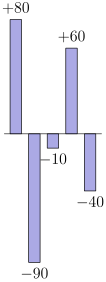
Zelda played the Adventures of Math game on August and scored points. She continued to play daily over the next days. The bar chart below shows the daily change in her score compared to the day before. (For example, Zelda’s score on August was points.) What was Zelda’s average score in points over the days?
小提示:
逐日把当天变化量加到前一天得分上。
Build each day’s score by adding that day’s change to the previous day’s score
大提示:
对六天得分 、 求平均。
Average the six daily scores
解答:
从 开始依次应用每日变化 。六天得分为 、。总和为 ,平均分为 。所以正确答案是 E。
Apply the daily changes to the starting The six scores are They add to so the average is Therefore, the answer is E.
13.
如果先做一个变换再做另一个变换,与先做第二个再做第一个得到同样结果,则称这两个变换可交换。考虑坐标平面的以下四个变换:
• 向右平移 个单位;
• 绕原点逆时针旋转 ;
• 关于 轴反射;
• 以原点为中心、比例因子为 的伸缩。
从这四个变换中选取两个不同变换,共有 对,其中有多少对可交换?
Two transformations are said to commute if applying the first followed by the second gives the same result as applying the second followed by the first. Consider these four transformations of the coordinate plane:
• a translation units to the right,
• a rotation counterclockwise about the origin,
• a reflection across the -axis, and
• a dilation centered at the origin with scale factor
Of the pairs of distinct transformations from this list, how many commute?
小提示:
以原点为中心的伸缩和以原点为中心的旋转一定可交换。
A dilation and a rotation, both centered at the origin, always commute
大提示:
检查 对;平移通常不与会移动原点的变换可交换。
Check each of the pairs; a translation usually fails to commute with maps that move the origin
解答:
伸缩只是关于原点放大,所以它与绕原点旋转可交换,也与关于横轴反射可交换。这给出 对。向右平移与关于 轴反射也可交换,因为两种顺序都把 。另外三对不交换:平移与旋转、平移与伸缩不交换,旋转与反射不交换。共有 对,正确答案是 C。
The dilation just scales about the origin, so it commutes with both the rotation and the reflection. That’s pairs. The translation commutes with the reflection across the -axis too, since either order sends The other three pairs fail: the translation clashes with the rotation and with the dilation, and the rotation clashes with the reflection. So pairs commute. Thus, C is the correct answer.
14.
一个高为 的等边三角形的一边在直线 上。一个半径为 的圆与 相切,并且与该三角形外切。位于三角形和圆外部、并由三角形、圆和直线 围成的区域面积可写成 ,其中 、 和 为正整数,且 不被任何质数的平方整除。求 。
One side of an equilateral triangle of height lies on line A circle of radius is tangent to and is externally tangent to the triangle. The area of the region exterior to the triangle and the circle and bounded by the triangle, the circle, and line can be written as where and are positive integers and is not divisible by the square of any prime. What is
小提示:
高 给出边长 ;把 放在 轴上,所以圆心高度为 。
Height gives side put on the -axis, so the circle’s center is at height
大提示:
从三角形底角顶点看,该区域由两条圆切线和中间圆弧围成;使用切线长和 扇形。
From the triangle’s base vertex the region is bounded by two tangents to the circle and the arc between them; use the tangent length and a sector
解答:
等边三角形边长为 。将 放在 轴上,并取底角顶点 ;斜边所在直线为 。圆与 相切,圆心高度为 ,且从外侧与该边相切。设圆心为 。令 为圆在 上的切点, 为圆在斜边上的切点。所求区域由从 引出的两条切线段和靠近的圆弧围成。切线长为 ,因此风筝 的面积为 。顶点 处夹角为 ,所以要减去的圆心角为 的扇形,面积为 。区域面积为 ,因此 ,正确答案是 D。
The equilateral triangle has side Put on the -axis with base vertex ; the slanted side lies on The circle sits on has radius and touches that side externally, so its center is Let be its tangency point on and let be the tangency point on the slanted side. The two tangent lengths from satisfy so kite has area The angle at is so the removed sector has angle and area The region has area giving Therefore, the answer is D.
15.
设 为最大的整数,使得 和 都是完全平方数。 的个位数字是多少?
Let be the greatest integer such that both and are perfect squares. What is the units digit of
小提示:
设 、;相减得 。
Set and subtract to get
大提示:
两个因子都是偶数;最大的 来自最小的 ,使 尽量大。
Both factors are even; the greatest comes from the smallest making as large as possible
解答:
设 、。相减得 ,即 。所以两个因子同奇偶,而乘积为偶数,二者都为偶数。写 、,则 。要使 最大,即使 最大,需要 尽量小。取 ,得 。因此 ,个位数字为 ,正确答案是 E。
Set and Subtracting, so The two factors share a parity, and their product is even, so both are even: write with To make as large as possible we want as large as possible, so as small as possible. Take giving Then whose units digit is Thus, E is the correct answer.
16.
下图中所有矩形都与外接矩形相似,且图按比例绘制。每个数字表示对应矩形的面积。求长度 ?
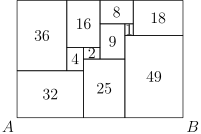
All of the rectangles in the figure below, which is drawn to scale, are similar to the enclosing rectangle. Each number represents the area of the rectangle. What is length
小提示:
这些拼块的总面积为 ;设外接长方形的高为 ,宽
The pieces have total area let the enclosing rectangle have height and width
大提示:
沿左边,面积为 和 的拼块的竖边长度分别为 和
Along the left edge, the vertical sides of the area- and area- pieces have lengths and
解答:
十一个拼块的面积之和为 。设外接矩形的高为 ,宽为 。相似图形的对应边长之比等于它们面积之比的平方根。由图可知,面积为 的拼块把它的短边贡献给左边,长度为 。在它上方,面积为 的拼块贡献的是它的长边,长度为 。这两段合起来构成整个高,所以 ,化简得 。由于 ,我们得到 ,从而 。因此正确答案是 D。
The areas of the eleven pieces sum to Let the enclosing rectangle have height and width Similar figures have corresponding side lengths in the square-root ratio of their areas. From the diagram, the area- piece contributes its short side to the left edge, of length Above it, the area- piece contributes its long side, of length These two segments make the full height, so which simplifies to Since we get and Therefore, the answer is D.
17.
两支队伍进行三局两胜制季后赛:最多打 场,先赢 场的队伍获胜。第一场在 A 队主场进行,剩余场次在 B 队主场进行。A 队主场获胜概率为 ,客场获胜概率为 。各场结果相互独立。A 队赢得系列赛的概率为 。此时 可写成 ,其中 、 为正整数。求 ?
Two teams are in a best-two-out-of-three playoff: the teams will play at most games, and the winner of the playoff is the first team to win games. The first game is played on Team A’s home field, and the remaining games are played on Team B’s home field. Team A has a chance of winning at home, and its probability of winning when playing away from home is Outcomes of the games are independent. The probability that Team A wins the playoff is Then can be written in the form where and are positive integers. What is
小提示:
列出 A 队赢两场的方式:赢第 、 场;赢第 场、输第 场、赢第 场;输第 场、赢第 、 场。
List the ways Team A wins two games: win games and win lose win lose win win
大提示:
将总概率设为 ,解关于 的二次方程。
Set the total probability equal to and solve the resulting quadratic in
解答:
A 队第 场主场获胜概率为 ,后两场客场每场获胜概率为 。A 队赢得系列赛有三种互斥方式:赢第 场;赢第 场、输第 场、赢第 场;输第 场、赢第 场。因此 。化简得 ,合理根为 。所以 、,,正确答案是 E。
Team A takes game at home with probability and each away game with probability It can win the playoff three disjoint ways: win games win lose win lose win Adding those, This cleans up to so Then and Thus, E is the correct answer.
18.
恰有 个正整数 满足 ,使得 进制整数 能被 整除(这里的 用十进制表示)。求 的各位数字之和。
There are exactly positive integers with such that the base- integer is divisible by (where is in base ten). What is the sum of the digits of
小提示:
;要被 整除,需要 能被 整除。
dividing by requires to be divisible by
大提示:
检查 ;余数 可行,再统计区间 中这些 。
Check the residues work, so count those in
解答:
在 进制中, ,因此 能被 整除,当且仅当 能被 整除。检查 模 的余数,可知恰当余数为 。统计 中这三类数,得 ,其各位数字之和为 ,正确答案是 D。
In base so is divisible by exactly when is divisible by Test the residues modulo this holds precisely for Counting the with in those three classes gives whose digit sum is Therefore, the answer is D.
19.
一个等比数列的前三项是整数 、、,且 。 的最小可能值的各位数字之和是多少?
The first three terms of a geometric sequence are the integers and where What is the sum of the digits of the least possible value of
小提示:
由 可知公比是有理数;将其最简写成 ,其中 。
so the common ratio is rational; write it as in lowest terms with
大提示:
和 都必须整除 ;用最小的 使 最小。
Both and must divide minimize using the smallest ratio
解答:
因为 ,公比 是有理数。设 为最简分数,且 。则 和 都为整数,所以 能被 整除,也能被 整除。为了使 最小,需要选择使 同时能被 和 整除的最小比值 ,即 。因此 ,,各位数字之和为 ,正确答案是 E。
Since the common ratio is rational. Write in lowest terms with Then and are integers, which forces to be divisible by and by To make smallest, we want the smallest ratio with divisible by both and which is That gives (and ). The digit sum is Thus, E is the correct answer.
20.
设 为 的一个子集,满足以下两个条件:
• 若 和 是 中不同元素,则 。
• 若 和 是 中不同的奇数元素,则 。
最多可能有多少个元素?
Let be a subset of such that the following two conditions hold:
• If and are distinct elements of then
• If and are distinct odd elements of then
What is the maximum possible number of elements in
小提示:
任意两个选中数至少相差 ,任意两个选中奇数至少相差 。
Any two chosen numbers differ by at least and any two chosen odd numbers differ by at least
大提示:
每个长度为 的重复块最多可容纳 个选中数且其中只有一个奇数;尝试余数 。
A repeating block of can hold at most chosen numbers with only one odd; try residues
解答:
两个条件说明选中数至少相差 ,而选中的奇数至少相差 。在任意长度为 的区块中,若取四个数,就需要三个至少为 的间隔,因此它们只能占据位置 。这样其中两个奇数会相差 ,与条件矛盾。所以每个完整的长度为 的区块最多含 个选中数,最后剩下的四个位置最多含 个,上界为 。这个上界可以达到:取 ,即模十余 的数,再加上 。相邻选中数至少相差 ,而选中的奇数彼此相差 ,正确答案是 C。
The two conditions say chosen numbers are at least apart, and chosen odd numbers at least apart. Any four numbers in a block of would need three gaps of at least so they would have to occupy positions Two of the odd entries would then differ by which is forbidden. Thus each full block of contains at most choices, and the last four positions contain at most This gives the upper bound It is attained by the pattern (residues ), together with Adjacent selected values differ by at least and the selected odd values are apart. Therefore, the answer is C.
21.
一个 整数数组中,每一行从左到右的数以及每一列从上到下的数都构成长度为 的等差数列。位置 、、、 上的数分别为 、、、。位置 上的数是多少?
The numbers, in order, of each row and the numbers, in order, of each column of a array of integers form an arithmetic progression of length The numbers in positions and are and respectively. What number is in position
小提示:
每行每列都是等差数列的数组,其第 行第 列可写为 。
A grid whose every row and column is arithmetic has entry at row column
大提示:
将四个已知位置代入该形式,解出 。
Substitute the four known entries into this form and solve for
解答:
若每行和每列都是等差数列,则第 行第 列可写成双线性形式 。代入 、、、 并求解,得到 、、、。因此位置 的数为 ,正确答案是 C。
If every row and every column is an arithmetic progression, the entry at row column must take the bilinear form Plug in and solve: So position is Thus, C is the correct answer.
22.
令 为由两个直角边分别为 和 的直角三角形沿公共斜边拼成的风筝形。用八个 的副本拼成下图所示多边形。求三角形 的面积。
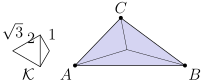
Let be the kite formed by joining two right triangles with legs and along a common hypotenuse. Eight copies of are used to form the polygon shown below. What is the area of
小提示:
每个风筝由两个 -- 三角形组成,直角边为 、,斜边为 ;用这些长度建立坐标。
Each kite is two -- triangles (legs and hypotenuse ); set up coordinates from these lengths
大提示:
取 ,并令 水平; 长六个单位,而从 到 的边界依次使用长度 、方向角 的线段
Take and horizontal; is six unit lengths, while the boundary from to uses lengths at angles
解答:
每个风筝的一半都是 -- 三角形,所以各边具有图示的长度和方向。取 ,并令 水平。图形的水平跨度为六个单位长度,所以 。沿着从 到 的外边界,三条边的向量分别为 ,,和 。它们的和为 ,所以 。因此 ,从 作出的高为 ,面积为 。所以答案是 B。
Each half of a kite is a -- triangle, so its edges have the shown lengths and directions. Take and horizontal. The horizontal span in the figure is six unit lengths, so Along the outer boundary from to the three edges have vectors and Their sum is so Thus and the altitude from is giving area Therefore, the answer is B.
23.
整数 、、 满足
求 。
Integers and satisfy
What is
小提示:
将三个方程相加,关联 和 。
Add all three equations to relate and
大提示:
前两式相减得到 ;枚举 的四个带符号因数对
Subtract the first two equations to get enumerate the four signed factor pairs of
解答:
用第一个方程减去第二个方程:。令 ,。四种可能 、、 和 代入 后,分别给出 、、 和 。只有第三种给出三个原方程的整数解:。(最后一个候选是 ,它不满足 。)把原来的三个方程相加,得到 。由于 ,我们得到 。因此正确答案是 D。
Subtract the second equation from the first: Put and The four possibilities and give, after substitution into respectively and Only the third is an integer solution of all three original equations: (The last candidate is which fails ) Adding the original equations gives Since we obtain Thus, D is the correct answer.
24.
一只蜜蜂在三维空间中移动。掷一个公平六面骰,其面标为 ,,,,、。若蜜蜂位于点 ,骰子显示 时蜜蜂移动到 ,显示 时移动到 。其余四种结果作类似移动。
假设蜜蜂从 出发,骰子掷四次。蜜蜂走过某个单位立方体的四条不同边的概率是多少?
A bee is moving in three-dimensional space. A fair six-sided die with faces labeled and is rolled. Suppose the bee occupies the point If the die shows then the bee moves to the point and if the die shows then the bee moves to the point Analogous moves are made with the other four outcomes.
Suppose the bee starts at the point and the die is rolled four times. What is the probability that the bee traverses four distinct edges of some unit cube?
小提示:
共有 个等可能移动序列;四步必须是某个单位立方体的四条不同边。
There are equally likely move sequences; the four steps must be four different edges of one unit cube
大提示:
把只用两个坐标方向(绕一个正方形面)的路径,与用到全部三个方向、其中某个方向在不相邻的两步中重复出现的路径分开统计。
Separate paths using two coordinate directions (one square face) from paths using all three directions, where one axis repeats in nonadjacent steps
解答:
每次掷骰都会让蜜蜂沿 或 方向移动一个单位,所以共有 个等可能移动序列。有效路径分成两类。第一类走过某个正方形面的四条边:坐标方向对有 种选择,两个方向的正负号有 种选择,第一个方向有 种选择,共 条路径。第二类用到三个坐标方向,其中一个方向使用两次。重复方向有 种选择;它在四步方向序列中的两个位置不能相邻,这两个位置有 种选法,其余两个方向的顺序有 种。对每个这样的方向序列,恰有 种正负号选择能使四条不同的边位于同一个立方体上。因此第二类有 条路径。总共有 个有利序列,所以概率为 ,正确答案是 B。
Every roll moves the bee one unit along or so there are equally likely sequences. There are two types of valid paths. A path around one square face has choices of coordinate plane, choices for the signs of its two axes, and choices for which axis is used first, giving Otherwise all three coordinate directions are used, with one repeated: choose that axis in ways, choose its two nonadjacent positions in ways, order the other two axes in ways, and choose their three initial signs in ways. (The second step on the repeated axis must have the opposite sign.) This gives Hence there are favorable sequences, and the probability is Therefore, the answer is B.
25.
下图显示一个点状网格,由 格宽、 格高的 正方形组成。Carl 沿一些小正方形的边放置 英寸牙签,形成一条不自交的闭合回路。格子中的数字表示该正方形有多少条边要被牙签覆盖;若格子中没有数字,则允许任意数量的牙签。Carl 有多少种放置牙签的方法?
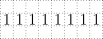
The figure below shows a dotted grid cells wide and cells tall consisting of squares. Carl places -inch toothpicks along some of the sides of the squares to create a closed loop that does not intersect itself. The numbers in the cells indicate the number of sides of that square that are to be covered by toothpicks, and any number of toothpicks are allowed if no number is written. In how many ways can Carl place the toothpicks?
小提示:
中间一行的每个方格必须恰好接触一根牙签;两端折返的列确定后,每个内部方格的那根牙签独立地放在它的上边或下边。
Each middle-row cell must touch exactly one toothpick; after the two turnaround columns are fixed, each interior cell’s toothpick is independently above or below it
大提示:
穿过中间的回路会跨越全部 列、前 列、后 列,或中间 列;内部各列可以独立地向上或向下弯折
A loop crossing the middle uses all the first the last or the middle columns; its interior columns independently bend above or below
解答:
中间一行的每个方格必须恰好接触一根牙签。先考虑从中间条带一侧穿到另一侧的回路。回路可以跨越全部 列、前 列、后 列,或中间 列;更窄的跨度会使外侧的一个中间方格没有接触牙签。固定两个端点后,每个内部的中间方格都可以独立选择把唯一一根牙签放在上边或下边,其余不自交回路随即唯一确定。因此四种情况分别给出 ,和 条回路。另有恰好两条不穿过中间条带的回路:完全沿顶部或完全沿底部延伸的水平长方形。所以总数为 。所以正确答案是 C。
Each middle-row cell must touch exactly one toothpick. First consider loops that pass from one side of the middle strip to the other. The loop can span all columns, the first the last or the middle a narrower span would leave an outer middle cell untouched. Once the two ends are fixed, each interior middle cell independently has its one toothpick on its top or bottom side, and the rest of the non-self-intersecting loop is forced. The four cases therefore contribute and loops. There are also exactly two loops that do not cross the middle strip: the horizontal rectangle running entirely along the top or entirely along the bottom. Hence the total is Thus, C is the correct answer.