
2022 AMC 10A 第 25 题
先试着解答 2022 AMC 10A 第 25 题,然后核对你的答案与视频与精心整理的解答,解答来自 LIVE by Po-Shen Loh。你也可以参加完整限时模拟考试、查看全部 2022 AMC 10A 解答,或核对答案。
所有题目均经美国数学协会(MAA)官方合法授权使用。
25.
设 、、 是坐标平面中的正方形,它们的顶点都在格点上,即两个坐标都是整数的点,并且包含各自内部。
每个正方形的底边都在 轴上。 的左边和 的右边都在 轴上,且 中格点数是 中格点数的 倍。 的顶部两个顶点在 中,且 中格点数是 中格点数的 。见图,图未按比例绘制。
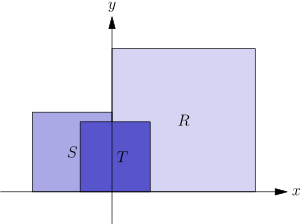
中属于 的格点所占比例,是 中属于 的格点所占比例的 倍。求 、、 的边长之和的最小可能值。
Let and be squares that have vertices at lattice points (i.e., points whose coordinates are both integers) in the coordinate plane, together with their interiors.
The bottom edge of each square is on the -axis. The left edge of and the right edge of are on the -axis, and contains as many lattice points as does The top two vertices of are in and contains of the lattice points contained in See the figure (not drawn to scale).
The fraction of lattice points in that are in is times the fraction of lattice points in that are in What is the minimum possible value of the edge length of plus the edge length of plus the edge length of
小提示:
先数出每条边上的格点个数,再换算成边长
Use lattice-point counts along each side before converting to edge lengths
大提示:
重叠条件给出一个有用的模 同余式
The overlap condition forces a useful congruence modulo
视频讲解:

Click to load, then click again to play
文字解答:
令 为 的每条边上的格点数;类似地,令 对应 ,令 对应 。注意,一个矩形中的格点数等于沿其宽方向的格点数与沿其长方向的格点数之积。
第一个条件给出
中的格点数等于两个区域各自格点数之和,但在 轴上有重叠,也就是正方形 与该轴相接之处。
因此第二个条件给出 由 可知 是 的倍数。把 换成 ,得到 为了使乘积能被 整除, 必须被 整除。再把 换成 ,得到
令 为矩形 底边上的格点数,令 为矩形 底边上的格点数。
这样, 中的格点数为 ,而 中的格点数为 。
第三个条件给出
又已知 (其中已计入重叠部分),于是
由 可得
然而由 可得
同时由 可知 是平方数,因为它与 互质,而它们的乘积是平方数。
因此 必须是满足 的完全平方数。较小的正平方数 都不满足这一同余条件,而 满足,所以 是最小可能值。
由这个 值可得 、,以及 。还可算得 因此 不过题目问的是边长之和。每个正方形的边长都比每边的格点数少 ,三个正方形共要减去 。
这个值可以达到:由方程 得 ,从而 。因为 、,每边有 个格点的正方形 可以跨过 轴形成所需的重叠,而且它的上方两个顶点位于 中。
因此所求答案为 。
所以正确答案是 B。
Let be the number of lattice points on the side length of Similarly define for and for Note that the number of lattice points in a rectangle is the product of the number of lattice points along its width and the number of lattice points along its length.
The first condition gives us that
The number of lattice points in is the sum of the lattice points in each of the regions, but there is overlap along the -axis where touches it.
The second condition, therefore, yields From we get that is a multiple of We can substitute with to get For the product to be divisible by must be divisible by We can again substitute with to get
Let be the number of lattice points along the bottom of the rectangle formed by and be the number of lattice points along the bottom of the rectangle formed by
Using these variables, we get that the number of lattice points in is and in is
The third condition gives us that
We also know that (accounting for overlap), and this yields
gives us that
However, by we get that
By we also get that is a perfect square since it is relatively prime to and they must multiply to a perfect square.
Thus must be a perfect square satisfying The smaller positive squares do not satisfy this congruence, while does, so is the least possible value.
From this value of we get that and We can also find that Therefore, The question, however, asked for the sum of the side lengths. The side lengths of the squares are less than the number of lattice points on the side, so we have to subtract
This value is attainable: equation gives and hence Since and a square with lattice points per side can straddle the -axis with the required overlaps, and its top vertices lie in
Therefore, the desired answer is
Thus, B is the correct answer.
其他年份的第 25 题
2000 AMC 10 · 2001 AMC 10 · 2002 AMC 10A · 2002 AMC 10B · 2003 AMC 10A · 2003 AMC 10B · 2004 AMC 10A · 2004 AMC 10B · 2005 AMC 10A · 2005 AMC 10B · 2006 AMC 10A · 2006 AMC 10B · 2007 AMC 10A · 2007 AMC 10B · 2008 AMC 10A · 2008 AMC 10B · 2009 AMC 10A · 2009 AMC 10B · 2010 AMC 10A · 2010 AMC 10B · 2011 AMC 10A · 2011 AMC 10B · 2012 AMC 10A · 2012 AMC 10B · 2013 AMC 10A · 2013 AMC 10B · 2014 AMC 10A · 2014 AMC 10B · 2015 AMC 10A · 2015 AMC 10B · 2016 AMC 10A · 2016 AMC 10B · 2017 AMC 10A · 2017 AMC 10B · 2018 AMC 10A · 2018 AMC 10B · 2019 AMC 10A · 2019 AMC 10B · 2020 AMC 10A · 2020 AMC 10B · 2021 AMC 10A Spring · 2021 AMC 10B Spring · 2021 AMC 10A Fall · 2021 AMC 10B Fall · 2022 AMC 10B · 2023 AMC 10A · 2023 AMC 10B · 2024 AMC 10A · 2024 AMC 10B · 2025 AMC 10A · 2025 AMC 10B