
2013 AMC 10A 第 18 题
先试着解答 2013 AMC 10A 第 18 题,然后核对你的答案与精心整理的解答,解答来自 LIVE by Po-Shen Loh。你也可以参加完整限时模拟考试、查看全部 2013 AMC 10A 解答,或核对答案。
所有题目均经美国数学协会(MAA)官方合法授权使用。
18.
设点 ,,,。一条经过 的直线把四边形 分成面积相等的两部分。该直线与 交于点 ,其中两个分数均为最简形式。 是多少?
Let points and Quadrilateral is cut into equal area pieces by a line passing through This line intersects at point where these fractions are in lowest terms. What is
小提示:
先求四边形 的总面积。
First compute the total area of
大提示:
经过 的分割线使 的面积等于四边形面积的一半。
The cutting line through makes half the quadrilateral area
解答:
设分割线与 交于 。如图,从 、 和 向 -轴作垂线。
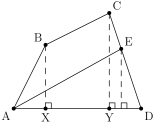
由图中分割可得 、梯形 、 的面积分别为 、 和 ,所以 。
因此 面积为 。因为 ,点 的高度为 。
直线 的方程为 ,所以 ,得到 。因此 。
所以正确答案是 B。
Let the cutting line meet at . Drop perpendiculars from , , and to the -axis as in the diagram.
The areas of , trapezoid , and are , , and , respectively, so .
Thus has area . Since , the height of is .
The line has equation , so , giving . Therefore .
Thus, B is the correct answer.
其他年份的第 18 题
2000 AMC 10 · 2001 AMC 10 · 2002 AMC 10A · 2002 AMC 10B · 2003 AMC 10A · 2003 AMC 10B · 2004 AMC 10A · 2004 AMC 10B · 2005 AMC 10A · 2005 AMC 10B · 2006 AMC 10A · 2006 AMC 10B · 2007 AMC 10A · 2007 AMC 10B · 2008 AMC 10A · 2008 AMC 10B · 2009 AMC 10A · 2009 AMC 10B · 2010 AMC 10A · 2010 AMC 10B · 2011 AMC 10A · 2011 AMC 10B · 2012 AMC 10A · 2012 AMC 10B · 2013 AMC 10B · 2014 AMC 10A · 2014 AMC 10B · 2015 AMC 10A · 2015 AMC 10B · 2016 AMC 10A · 2016 AMC 10B · 2017 AMC 10A · 2017 AMC 10B · 2018 AMC 10A · 2018 AMC 10B · 2019 AMC 10A · 2019 AMC 10B · 2020 AMC 10A · 2020 AMC 10B · 2021 AMC 10A Spring · 2021 AMC 10B Spring · 2021 AMC 10A Fall · 2021 AMC 10B Fall · 2022 AMC 10A · 2022 AMC 10B · 2023 AMC 10A · 2023 AMC 10B · 2024 AMC 10A · 2024 AMC 10B · 2025 AMC 10A · 2025 AMC 10B