
Problemas del 1986 AMC 12
¡Desplázate hacia abajo y presiona Iniciar para intentar el examen! O ve al PDF imprimible, la clave de respuestas, o las soluciones profesionales preparadas por LIVE by Po-Shen Loh.
Todos los problemas se usan con el permiso legal oficial de la Mathematical Association of America (MAA).
O salta directamente a un solo problema con su solución: 1 · 2 · 3 · 4 · 5 · 6 · 7 · 8 · 9 · 10 · 11 · 12 · 13 · 14 · 15 · 16 · 17 · 18 · 19 · 20 · 21 · 22 · 23 · 24 · 25 · 26 · 27 · 28 · 29 · 30
¿Quieres aprender de forma profesional con clases interactivas en video?
Con tiempo
1:15:00
1.
Respuesta: B
Pista pequeña:
Elimina primero los paréntesis interiores antes de restar el segundo corchete
Remove the innermost parentheses before subtracting the second bracket
Pista grande:
Sigue con cuidado el signo menos que precede a cada corchete
Track the minus sign in front of each bracket carefully
Solución:
Al desarrollar las dos expresiones entre corchetes obtenemos
Por lo tanto, la respuesta correcta es B.
Expanding the two bracketed expressions gives
Thus the correct answer is B.
2.
Si la recta en el plano tiene la mitad de la pendiente y el doble de la intersección con el eje de la recta entonces una ecuación de es
If the line in the -plane has half the slope and twice the -intercept of the line then an equation for is
Respuesta: A
Pista pequeña:
Lee la pendiente y la intersección vertical en
Read the slope and intercept from
Pista grande:
Aplica por separado los dos cambios pedidos al coeficiente y al término constante
Apply the two requested changes to the coefficient and constant separately
Solución:
La recta original tiene pendiente e intersección con el eje igual a Por tanto, tiene pendiente e intersección con el eje igual a así que su ecuación es
Por lo tanto, la respuesta correcta es A.
The original line has slope and -intercept Therefore has slope and -intercept so its equation is
Thus the correct answer is A.
3.
En la figura, tiene un ángulo recto en y Si es la bisectriz de entonces
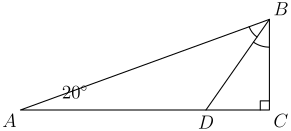
In the figure, has a right angle at and If is the bisector of then
Respuesta: D
Pista pequeña:
Halla primero usando la suma de los ángulos de
First find from the angle sum of
Pista grande:
Usa la bisectriz y luego la suma de los ángulos del triángulo rectángulo
Use the bisector and then the angle sum of right triangle
Solución:
Como y tenemos La bisectriz da Por tanto, en el triángulo rectángulo
Por lo tanto, la respuesta correcta es D.
Since and we have The bisector gives Therefore, in right triangle
Thus the correct answer is D.
4.
Sea la proposición
«Si la suma de los dígitos del número entero es divisible por entonces es divisible por »
Un valor de que muestra que es falsa es
Let be the statement
“If the sum of the digits of the whole number is divisible by then is divisible by ”
A value of which shows to be false is
ninguno de estos
none of these
Respuesta: B
Pista pequeña:
Un contraejemplo debe satisfacer la hipótesis, pero no la conclusión
A counterexample must satisfy the hypothesis but not the conclusion
Pista grande:
Ser divisible por exige ser divisible tanto por como por
Divisibility by requires both divisibility by and by
Solución:
La suma de los dígitos de es que es divisible por Sin embargo, es impar, por lo que no es divisible por Así, hace falsa la implicación.
Por lo tanto, la respuesta correcta es B.
The digit sum of is which is divisible by However, is odd, so it is not divisible by Thus makes the implication false.
Therefore the correct answer is B.
5.
Simplifica
Simplify
Respuesta: A
Pista pequeña:
Escribe como una potencia de y convierte en una fracción impropia
Rewrite as a power of and as an improper fraction
Pista grande:
Simplifica ambos radicales antes de elevar al cuadrado su diferencia
Simplify both radicals before squaring their difference
Solución:
Tenemos y Por tanto, la expresión es
Por lo tanto, la respuesta correcta es A.
We have and Hence the expression is
Thus the correct answer is A.
6.
Sobre una mesa de cierta altura se colocan dos bloques de madera idénticos como se muestra en la Figura Se determina que la longitud mide pulgadas. Tras reacomodar los bloques como en la Figura se determina que la longitud mide pulgadas. ¿Cuánto mide la mesa?
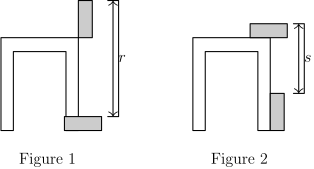
Using a table of a certain height, two identical blocks of wood are placed as shown in Figure Length is found to be inches. After rearranging the blocks as in Figure length is found to be inches. How high is the table?
pulgadas
inches
pulgadas
inches
pulgadas
inches
pulgadas
inches
pulgadas
inches
Respuesta: C
Pista pequeña:
Sea la altura de la mesa y sean y las dimensiones del bloque
Let be the table height and let the block dimensions be and
Pista grande:
Escribe una ecuación para la distancia vertical de cada figura y súmalas
Write one vertical-distance equation for each figure and add them
Solución:
Sea la altura de la mesa y sean las dimensiones larga y corta del bloque. La Figura da mientras que la Figura da Al sumar se cancelan las dimensiones de los bloques: de modo que pulgadas.
Por lo tanto, la respuesta correcta es C.
Let be the table height and let be the long and short block dimensions. Figure gives while Figure gives Adding cancels the block dimensions: so inches.
Thus the correct answer is C.
7.
La suma del mayor entero menor o igual que y el menor entero mayor o igual que es El conjunto solución para es
The sum of the greatest integer less than or equal to and the least integer greater than or equal to is The solution set for is
Respuesta: E
Pista pequeña:
Considera por separado los valores enteros y no enteros de
Treat integer and noninteger values of separately
Pista grande:
Si no es entero, su techo es una unidad mayor que su piso
For noninteger the ceiling is one more than the floor
Solución:
Si es entero, entonces que no puede ser igual a Si no es entero, entonces Esto es igual a exactamente cuando de modo que
Por lo tanto, la respuesta correcta es E.
If is an integer, then which cannot equal If is not an integer, then This equals exactly when so
Thus the correct answer is E.
8.
La población de Estados Unidos en era de El área del país es de millas cuadradas. Una milla cuadrada contiene pies cuadrados. ¿Cuál de los siguientes números aproxima mejor el promedio de pies cuadrados por persona?
The population of the United States in was The area of the country is square miles. There are square feet in one square mile. Which number below best approximates the average number of square feet per person?
Respuesta: E
Pista pequeña:
Divide el total de pies cuadrados entre la población
Divide total square feet by population
Pista grande:
Redondea los valores dados a dos cifras significativas antes de multiplicar
Round the given values to two significant digits before multiplying
Solución:
El promedio es aproximadamente pies cuadrados por persona. Entre las opciones, esto es lo más cercano a
Por lo tanto, la respuesta correcta es E.
The average is approximately square feet per person. Of the choices, this is closest to
Thus the correct answer is E.
9.
El producto es igual a
The product equals
Respuesta: C
Pista pequeña:
Factoriza como una diferencia de cuadrados
Factor as a difference of squares
Pista grande:
Separa el producto en factores y
Separate the product into factors and
Solución:
Para cada Por tanto, el producto se telescopa:
Por lo tanto, la respuesta correcta es C.
For each Therefore the product telescopes:
Thus the correct answer is C.
10.
Las permutaciones de AHSME se ordenan alfabéticamente como si cada una fuera una palabra común de cinco letras. La última letra de la palabra número de esta lista es
The permutations of AHSME are arranged in dictionary order, as if each were an ordinary five-letter word. The last letter of the th word in this list is
Respuesta: E
Pista pequeña:
Agrupa las palabras en bloques de según su primera letra
Group the words into blocks of according to their first letter
Pista grande:
Dentro del bloque que empieza con agrupa por la segunda letra y enumera solo el pequeño bloque necesario
Within the -block, group by the second letter and then list only the needed small block
Solución:
Cada primera letra ocupa un bloque de palabras. Las posiciones a empiezan con por lo que la palabra número es la número de ese bloque. Las primeras empiezan con las siguientes con y de la a la empiezan con Las dos primeras de estas son y Por tanto, la palabra número termina en E.
Por lo tanto, la respuesta correcta es E.
Each first letter occupies a block of words. Positions through begin with so the th word is the th word in that block. The first begin with the next with and the th through th begin with The first two of those are and Thus the th word ends in E.
Therefore the correct answer is E.
11.
En y Además, es el punto medio del lado y es el pie de la altura trazada desde hasta La longitud de es
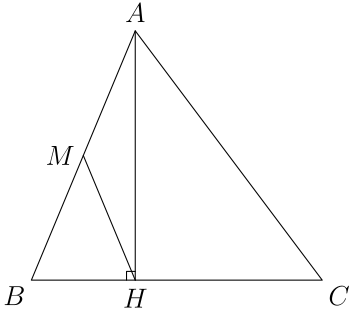
In and Also, is the midpoint of side and is the foot of the altitude from to The length of is
Respuesta: B
Pista pequeña:
Concéntrate en el triángulo rectángulo
Focus on right triangle
Pista grande:
Recuerda la distancia desde el punto medio de la hipotenusa de un triángulo rectángulo hasta cada vértice
Recall the distance from the midpoint of a right triangle’s hypotenuse to each vertex
Solución:
El triángulo es rectángulo en y es el punto medio de su hipotenusa El punto medio de la hipotenusa de un triángulo rectángulo es equidistante de sus tres vértices, por lo que
Por lo tanto, la respuesta correcta es B.
Triangle is right at and is the midpoint of its hypotenuse The midpoint of a right triangle’s hypotenuse is equidistant from all three vertices, so
Thus the correct answer is B.
12.
John obtiene puntos en el AHSME de este año. Si todavía se hubiera usado el sistema anterior, habría obtenido solo puntos con las mismas respuestas. ¿Cuántas preguntas deja sin contestar? (En el sistema nuevo de ese año se recibían puntos por cada respuesta correcta, puntos por cada respuesta incorrecta y puntos por cada problema sin contestar. En el sistema anterior se comenzaba con puntos, se sumaban por cada respuesta correcta, se restaba por cada respuesta incorrecta y no se sumaban ni restaban puntos por las preguntas sin contestar. El AHSME de tiene preguntas.)
John scores on this year’s AHSME. Had the old scoring system still been in effect, he would score only for the same answers. How many questions does he leave unanswered? (In the new scoring system that year, one received points for each correct answer, points for each wrong answer, and points for each problem left unanswered. In the previous scoring system, one started with points, received more for each correct answer, lost point for each wrong answer, and neither gained nor lost points for unanswered questions. There are questions in the AHSME.)
no se puede determinar de manera única
not uniquely determined
Respuesta: B
Pista pequeña:
Sean las cantidades de respuestas correctas, incorrectas y sin contestar
Let be the numbers correct, wrong and unanswered
Pista grande:
Usa para reescribir la puntuación anterior antes de compararla con la nueva
Use to rewrite the old score before comparing it with the new score
Solución:
Sean las cantidades de respuestas correctas, incorrectas y sin contestar. La puntuación anterior y el número total de preguntas dan Al eliminar obtenemos La puntuación nueva es Al restar estas ecuaciones obtenemos
Por lo tanto, la respuesta correcta es B.
Let be the numbers correct, wrong and unanswered. The old score and total number of questions give Eliminating yields The new score is Subtracting these equations gives
Thus the correct answer is B.
13.
Una parábola tiene vértice Si pertenece a la parábola, entonces es igual a
A parabola has vertex If is on the parabola, then equals
Respuesta: E
Pista pequeña:
Escribe la parábola en la forma de vértice
Write the parabola in vertex form
Pista grande:
Usa el punto dado para hallar luego desarrolla para identificar y
Use the given point to find then expand to read and
Solución:
Escribimos la ecuación como Al sustituir obtenemos así que Al desarrollar, Por tanto, y
Por lo tanto, la respuesta correcta es E.
Write the equation as Substituting gives so Expanding, Thus and
Therefore the correct answer is E.
14.
Supongamos que hops, skips y jumps son unidades específicas de longitud. Si hops equivalen a skips, jumps equivalen a hops y jumps equivalen a metros, ¿a cuántos skips equivale un metro?
Suppose hops, skips and jumps are specific units of length. If hops equals skips, jumps equals hops, and jumps equals meters, then one meter equals how many skips?
Respuesta: D
Pista pequeña:
Convierte cada igualdad en un factor de conversión para una unidad
Turn each equality into a conversion factor for one unit
Pista grande:
Convierte, en ese orden, metros a jumps, jumps a hops y hops a skips
Convert meters to jumps, jumps to hops, and hops to skips in that order
Solución:
De las tres relaciones, Al multiplicar los factores de conversión obtenemos skips.
Por lo tanto, la respuesta correcta es D.
From the three relations, Multiplying the conversion factors gives skips.
Thus the correct answer is D.
15.
Un estudiante intentó calcular el promedio de y calculando primero el promedio de y y luego el promedio del resultado y Siempre que el resultado final del estudiante es
A student attempted to compute the average, of and by computing the average of and and then computing the average of the result and Whenever the student’s final result is
correcto
correct
siempre menor que
always less than
siempre mayor que
always greater than
a veces menor que y a veces igual a
sometimes less than and sometimes equal to
a veces mayor que y a veces igual a
sometimes greater than and sometimes equal to
Respuesta: C
Pista pequeña:
Escribe como expresiones algebraicas tanto el promedio verdadero como el resultado del estudiante
Write both the true average and the student’s result as algebraic expressions
Pista grande:
Resta el promedio verdadero y usa el orden para determinar el signo
Subtract the true average and use the order to determine the sign
Solución:
El resultado del estudiante es mientras que el promedio verdadero es Su diferencia es Como y el numerador es positivo. Por tanto, el resultado del estudiante es siempre mayor que
Por lo tanto, la respuesta correcta es C.
The student’s result is while the true average is Their difference is Since and the numerator is positive. The student’s result is therefore always greater than
Thus the correct answer is C.
16.
En y el lado se prolonga, como muestra la figura, hasta un punto de modo que es semejante a La longitud de es
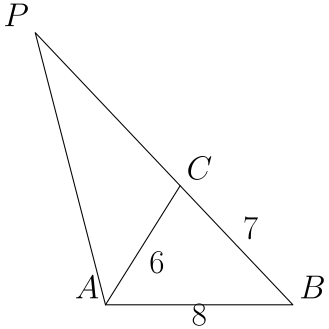
In and side is extended, as shown in the figure, to a point so that is similar to The length of is
Respuesta: C
Pista pequeña:
Usa el orden de los vértices en para emparejar los lados correspondientes
Use the vertex order in to match corresponding sides
Pista grande:
Sea y usa tanto como la razón de semejanza repetida
Set and use both and the repeated similarity ratio
Solución:
El orden indicado en la semejanza da Sea Entonces y Como de donde
Por lo tanto, la respuesta correcta es C.
The stated order of similarity gives Let Then and Since which gives
Thus the correct answer is C.
17.
Un cajón en una habitación oscura contiene calcetines rojos, verdes, azules y negros. Un joven saca calcetines del cajón uno por uno, pero no puede ver su color. ¿Cuál es el menor número de calcetines que debe sacar para garantizar que su selección contenga al menos pares? (Un par está formado por dos calcetines del mismo color. Ningún calcetín puede contarse en más de un par.)
A drawer in a darkened room contains red socks, green socks, blue socks and black socks. A youngster selects socks one at a time from the drawer but is unable to see the color of the socks drawn. What is the smallest number of socks that must be selected to guarantee that the selection contains at least pairs? (A pair of socks is two socks of the same color. No sock may be counted in more than one pair.)
Respuesta: B
Pista pequeña:
Para cada color, a lo sumo uno de los calcetines seleccionados puede quedar sin pareja
For each color, at most one selected sock can remain unpaired
Pista grande:
Usa la paridad del total para mejorar la cota de cuatro calcetines sin pareja y luego construye un caso que casi alcance la garantía
Use the parity of the total to sharpen the four-unpaired bound, then construct a near-miss
Solución:
Con calcetines seleccionados, el número de colores que aparecen una cantidad impar de veces debe ser impar, por lo que es a lo sumo Así, como máximo calcetines quedan sin pareja y al menos forman pares. Sin embargo, calcetines no bastan: las cantidades de los cuatro colores producen solo pares. Por tanto, el mínimo es
Por lo tanto, la respuesta correcta es B.
With selected socks, the number of colors having an odd count must itself be odd, so it is at most Thus at most socks are unpaired, leaving at least socks in pairs. But socks do not suffice: color counts produce only pairs. Therefore the minimum is
Thus the correct answer is B.
18.
Un plano corta un cilindro circular recto de radio y forma una elipse. Si el eje mayor de la elipse es un más largo que el eje menor, la longitud del eje mayor es
A plane intersects a right circular cylinder of radius forming an ellipse. If the major axis of the ellipse is longer than the minor axis, the length of the major axis is
Respuesta: E
Pista pequeña:
El eje menor de una sección elíptica de este tipo es un diámetro del cilindro
The minor axis of such an elliptical section is a diameter of the cylinder
Pista grande:
Aumenta ese diámetro en un para obtener el eje mayor
Increase that diameter by to obtain the major axis
Solución:
El eje menor de una sección plana elíptica de un cilindro circular recto es un diámetro del cilindro. Por tanto, su longitud es El eje mayor es un más largo, por lo que su longitud es
Por lo tanto, la respuesta correcta es E.
The minor axis of an elliptical plane section of a right circular cylinder is a diameter of the cylinder. Its length is therefore The major axis is longer, so its length is
Thus the correct answer is E.
19.
Un parque tiene la forma de un hexágono regular de km de lado. Alice parte de un vértice y camina km por el perímetro del parque. ¿A cuántos kilómetros de su punto de partida se encuentra?
A park is in the shape of a regular hexagon km on a side. Starting at a corner, Alice walks along the perimeter of the park for a distance of km. How many kilometers is she from her starting point?
Respuesta: A
Pista pequeña:
El recorrido consta de dos lados completos y la mitad del lado siguiente
The walk consists of two complete sides and half of the next side
Pista grande:
Descompón los tres segmentos dirigidos en componentes horizontales y verticales
Resolve the three directed segments into horizontal and vertical components
Solución:
Elijamos el primer lado en dirección horizontal. Las tres partes dirigidas del recorrido tienen vectores Su suma es El cuadrado de su longitud es Por tanto, la distancia es km.
Por lo tanto, la respuesta correcta es A.
Choose the first side in the horizontal direction. The three directed portions of the walk have vectors Their sum is Its squared length is The distance is therefore km.
Thus the correct answer is A.
20.
Supongamos que y son positivos e inversamente proporcionales. Si aumenta en entonces disminuye en
Suppose and are inversely proportional and positive. If increases by then decreases by
Respuesta: E
Pista pequeña:
Un aumento de multiplica por
An increase by multiplies by
Pista grande:
La proporcionalidad inversa divide entre ese factor; compara el valor nuevo con el anterior
Inverse proportionality divides by that factor; compare the new value with the old one
Solución:
El nuevo valor de es Por tanto, el nuevo valor de es La disminución fraccionaria es Expresada como porcentaje, es
Por lo tanto, la respuesta correcta es E.
The new value of is Hence the new value of is The fractional decrease is Expressed as a percentage, this is
Thus the correct answer is E.
21.
En la configuración siguiente, se mide en radianes, es el centro del círculo, y son segmentos de recta, y es tangente al círculo en
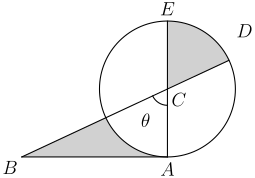
Una condición necesaria y suficiente para que las dos áreas sombreadas sean iguales, dado que es
In the configuration below, is measured in radians, is the center of the circle, and are line segments, and is tangent to the circle at
A necessary and sufficient condition for the equality of the two shaded areas, given is
Respuesta: B
Pista pequeña:
Sea el radio del círculo y compara un sector con el triángulo
Let the circle’s radius be and compare a sector with triangle
Pista grande:
La igualdad de las dos regiones sombreadas significa que el triángulo completo tiene el doble del área del sector
Equality of the two shaded pieces means the whole triangle has twice the sector’s area
Solución:
Sea El sector sombreado superior tiene área La región sombreada inferior es el triángulo menos un sector de la misma área. Por tanto, las dos regiones sombreadas son iguales exactamente cuando Esto equivale a Como es tangente en el triángulo es rectángulo en y Por consiguiente, la condición es
Por tanto, la respuesta correcta es B.
Let The upper shaded sector has area The lower shaded region is triangle with an equal sector removed. Thus the two shaded regions are equal exactly when This is equivalent to Since is tangent at triangle is right at and Therefore the condition is
Thus the correct answer is B.
22.
Se eligen al azar seis enteros distintos de ¿Cuál es la probabilidad de que, entre los seleccionados, el segundo menor sea ?
Six distinct integers are picked at random from What is the probability that, among those selected, the second smallest is
ninguna de estas
none of these
Respuesta: C
Pista pequeña:
Cuenta todos los subconjuntos de seis elementos de los diez enteros
Count all six-element subsets of the ten integers
Pista grande:
Para que el segundo menor sea elige un elemento menor que y cuatro mayores que
For second-smallest choose one element below and four above
Solución:
Hay conjuntos posibles. Si el segundo menor es entonces se selecciona se elige un elemento de y cuatro de Esto da conjuntos favorables. La probabilidad es
Por tanto, la respuesta correcta es C.
There are possible sets. If the second-smallest element is then is selected, one element is chosen from and four are chosen from This gives favorable sets. The probability is
Thus the correct answer is C.
23.
Sea ¿Cuántos enteros positivos son factores de ?
Let How many positive integers are factors of
Respuesta: E
Pista pequeña:
Reconoce los coeficientes
Recognize the coefficients
Pista grande:
Después de usar el teorema del binomio, factoriza en primos la base resultante
After using the binomial theorem, factor the resulting base into primes
Solución:
Por el teorema del binomio, Un divisor elige de manera independiente un exponente de a para cada uno de los tres primos. Por tanto, tiene divisores positivos.
Por tanto, la respuesta correcta es E.
By the binomial theorem, A divisor independently chooses an exponent from through for each of the three primes. Thus has positive divisors.
Therefore the correct answer is E.
24.
Sea donde y son enteros. Si es un factor tanto de
como de
¿cuánto vale ?
Let where and are integers. If is a factor of both
and
what is
Respuesta: D
Pista pequeña:
Un factor común divide toda combinación lineal entera de los dos polinomios
A common factor divides every integer linear combination of the two polynomials
Pista grande:
Resta el segundo polinomio de tres veces el primero
Subtract the second polynomial from three times the first
Solución:
El factor común divide Como es mónico y tiene coeficientes enteros, el lema de Gauss implica que divide Ambos polinomios son mónicos y tienen el mismo grado, así que Por tanto,
Por tanto, la respuesta correcta es D.
The common factor divides Because is monic with integer coefficients, Gauss’s lemma implies that it divides The two polynomials are monic and have the same degree, so Hence
Thus the correct answer is D.
25.
Si es el mayor entero menor o igual que entonces
If is the greatest integer less than or equal to then
ninguna de estas
none of these
Respuesta: B
Pista pequeña:
Agrupa los enteros según el intervalo
Group the integers according to the interval
Pista grande:
Hay enteros en el grupo ; considera por separado
There are integers in the th group; handle separately
Solución:
Para exactamente enteros satisfacen y cada uno aporta El entero final aporta Por tanto, La identidad para la suma geométrica finita da por lo que la suma pedida es
Por tanto, la respuesta correcta es B.
For exactly integers satisfy and each contributes The final integer contributes Hence The finite geometric-sum identity gives so the requested sum is
Thus the correct answer is B.
26.
Se desea construir un triángulo rectángulo en el plano coordenado de modo que sus catetos sean paralelos a los ejes e y que las medianas a los puntos medios de los catetos estén sobre las rectas y El número de constantes distintas para las cuales existe tal triángulo es
It is desired to construct a right triangle in the coordinate plane so that its legs are parallel to the and axes and so that the medians to the midpoints of the legs lie on the lines and The number of different constants for which such a triangle exists is
más de
more than
Respuesta: C
Pista pequeña:
Coloca un triángulo rectángulo con catetos paralelos a los ejes en coordenadas convenientes y calcula las pendientes de las dos medianas a sus catetos
Place an axis-aligned right triangle at convenient coordinates and compute the slopes of the two medians to its legs
Pista grande:
Las dos pendientes difieren por un factor de recuerda que cualquiera de las rectas dadas podría ser la de mayor pendiente
The two slopes differ by a factor of remember that either given line could be the steeper one
Solución:
Coloca el vértice del ángulo recto en y los otros vértices en y Las medianas a los catetos tienen pendientes y cuya razón es Por tanto, si una mediana tiene pendiente la otra puede tener pendiente o Ambas posibilidades se dan: elige un triángulo con el par de pendientes requerido y traslada su centroide a la intersección de las dos rectas especificadas. Así, hay dos valores posibles de
Por tanto, la respuesta correcta es C.
Place the right-angle vertex at and the other vertices at and The medians to the legs have slopes and whose ratio is Therefore, if one median has slope the other can have slope or Both occur: choose a triangle with the required pair of slopes and translate its centroid to the intersection of the two specified lines. Thus there are two possible values of
Therefore the correct answer is C.
27.
En la figura adjunta, es un diámetro del círculo, es una cuerda paralela a y corta a en con La razón entre el área de y la de es
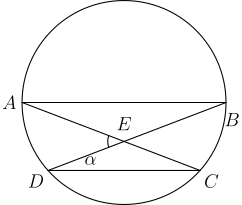
In the adjoining figure, is a diameter of the circle, is a chord parallel to and intersects at with The ratio of the area of to that of is
Respuesta: C
Pista pequeña:
Expresa el área de cada triángulo usando los dos lados que se encuentran en
Express each triangle’s area using the two sides meeting at
Pista grande:
Usa el teorema de las cuerdas que se cortan; después traza y usa el triángulo rectángulo creado por el diámetro
Use the intersecting-chords theorem, then draw and use the right triangle created by diameter
Solución:
Los triángulos usan el mismo ángulo en así que Las cuerdas que se cortan dan de modo que esta razón se convierte en Traza Como es un diámetro, y son colineales. Por tanto, el triángulo es rectángulo en y La razón pedida es
Por tanto, la respuesta correcta es C.
The triangles use the same angle at so Intersecting chords give so this ratio becomes Draw Since is a diameter, and are collinear. Thus triangle is right at and The required ratio is
Thus the correct answer is C.
28.
es un pentágono regular. y son las perpendiculares trazadas desde a a la prolongación de y a la prolongación de respectivamente. Sea el centro del pentágono. Si entonces es igual a
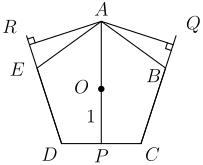
is a regular pentagon. and are the perpendiculars dropped from onto extended and extended, respectively. Let be the center of the pentagon. If then equals
Respuesta: C
Pista pequeña:
Sea la longitud del lado y calcula el área del pentágono a partir de sus cinco triángulos centrales
Let be the side length and compute the pentagon’s area from its five central triangles
Pista grande:
Divide también el pentágono en los triángulos y cuyas alturas son
Also split the pentagon into triangles and with altitudes
Solución:
Sea la longitud del lado. Como el apotema los cinco triángulos centrales dan un área del pentágono de El mismo pentágono es la unión de los triángulos y cuyas alturas respectivas sobre bases de la longitud del lado son Por tanto, de modo que Además, Por consiguiente,
Por tanto, la respuesta correcta es C.
Let the side length be Since the apothem the five central triangles give pentagon area The same pentagon is the union of triangles and whose respective altitudes to side-length bases are Hence so Also Therefore
Thus the correct answer is C.
29.
Dos de las alturas del triángulo escaleno miden y Si la longitud de la tercera altura también es un entero, ¿cuál es su mayor valor posible?
Two of the altitudes of the scalene triangle have length and If the length of the third altitude is also an integer, what is the biggest it can be?
ninguna de estas
none of these
Respuesta: B
Pista pequeña:
Para un área fija del triángulo, cada lado es inversamente proporcional a su altura correspondiente
For a fixed triangle area, each side is inversely proportional to its corresponding altitude
Pista grande:
Aplica las desigualdades del triángulo a longitudes de lado proporcionales a
Apply the triangle inequalities to side lengths proportional to
Solución:
Sea la tercera altura. Como cada lado es igual al doble del área común dividido entre su altura, las longitudes de los lados son proporcionales a Las dos desigualdades no triviales del triángulo dan Por tanto, La mayor posibilidad entera es y sus tres alturas son distintas, como se requiere para un triángulo escaleno.
Por tanto, la respuesta correcta es B.
Let the third altitude be Since each side equals twice the common area divided by its altitude, the side lengths are proportional to The two nontrivial triangle inequalities give Thus The largest integral possibility is and its three altitudes are distinct as required for a scalene triangle.
Therefore the correct answer is B.
30.
El número de soluciones reales del sistema de ecuaciones es
The number of real solutions of the simultaneous equations is
Respuesta: B
Pista pequeña:
Las ecuaciones obligan a que las cuatro variables tengan el mismo signo
The equations force all four variables to have the same sign
Pista grande:
Para positivo, estudia en relación con y con
For positive study relative to and to
Solución:
Cada expresión tiene el mismo signo que así que las cuatro variables tienen el mismo signo. Supongamos primero que son positivas. Por la desigualdad entre las medias aritmética y geométrica, cada variable es al menos Para Si alguna variable excediera las ecuaciones producirían el ciclo estricto imposible Por tanto, la única solución positiva es Cambiar de signo las cuatro variables conserva el sistema, lo que da exactamente una solución negativa, con todas las variables iguales a Así, hay dos soluciones reales.
Por tanto, la respuesta correcta es B.
Each expression has the same sign as so all four variables have the same sign. Suppose first that they are positive. By AM-GM, every variable is at least For If any variable exceeded the equations would give the impossible strict cycle Hence the only positive solution is Negating all four variables preserves the system, giving exactly one negative solution, with all variables equal to Thus there are two real solutions.
Therefore the correct answer is B.