
2020 AMC 12B 真题
计时
1:15:00
1.
下列表达式的最简值是多少?
What is the value in simplest form of the following expression?
2.
下列表达式的值是多少?
What is the value of the following expression?
答案:A
小提示:
使用平方差公式 。
大提示:
分解 和 ,再观察可以约去的因子。
Factor and , then look for cancellation
解答:
由平方差公式,,且 。原式变为
所以正确答案是 A。
Using the difference of squares, and The expression becomes
Thus, the correct answer is A.
3.
与 的比为 , 与 的比为 ,且 与 的比为 。 与 的比是多少?
The ratio of to is the ratio of to is and the ratio of to is What is the ratio of to
答案:E
小提示:
取一个方便的值,例如 ,再依次求出 ,然后求 。
Pick a convenient value such as and work out then
大提示:
由 ,可取 ;于是 ,。
From take then and
解答:
令 。由 ,得 ;由 ,得 ;由 ,得 。
因此 。
所以正确答案是 E。
Let From we get From we get From we get
Therefore
Thus, the correct answer is E.
4.
一个直角三角形的两个锐角分别是 和 ,其中 ,且 和 都是质数。 的最小可能值是多少?
The acute angles of a right triangle are and where and both and are prime numbers. What is the least possible value of
小提示:
两个锐角满足 。
The acute angles satisfy
大提示:
从最小的质数开始试 ,并检查 是否也是质数。
Try the smallest primes for and check whether is also prime
解答:
直角三角形的两个锐角互余,所以 。要使 尽可能小,可依次检查较小的质数,并要求 也是质数。
当 时, 都不是质数。当 时, 是质数。因此最小可能值是 。
所以正确答案是 D。
Since the angles are complementary, To minimize try small primes and require to be prime as well.
For the value is not prime. For we get which is prime. So the least possible value is
Thus, the correct answer is D.
5.
队和 队在一个篮球联赛中比赛,每场比赛必有一队胜、一队负。 队赢了自己所有比赛的 , 队赢了自己所有比赛的 。此外, 队比 队多赢 场,也多输 场。 队一共打了多少场比赛?
Teams and are playing in a basketball league where each game results in a win for one team and a loss for the other team. Team has won of its games and team has won of its games. Also, team has won more games and lost more games than team How many games has team played?
小提示:
设 队打了 场, 队打了 场,分别写出胜场和负场的条件。
Let play games and play games, then write both the win and loss conditions
大提示:
胜场给出 ;负场给出 。
Wins: losses:
解答:
设 队打了 场, 队打了 场。 队的胜场数和负场数分别为 和 , 队的胜场数和负场数分别为 和 。题意给出 以及
两式相减得 ,所以 。代回负场方程,得 ,即 。因此 ,所以 。
所以正确答案是 C。
Let be the number of games team played and the number team played. Team wins and loses team wins and loses The conditions give and
Subtracting the equations gives so Substituting into the loss equation: i.e. so and
Thus, the correct answer is C.
6.
对所有整数 ,
的值总是下列哪一种?
For all integers the value of
is always which of the following?
的倍数
a multiple of
的倍数
a multiple of
质数
a prime number
完全平方数
a perfect square
完全立方数
a perfect cube
7.
-坐标平面中两条既不水平也不竖直的直线相交,形成一个 角。其中一条直线的斜率等于另一条直线斜率的 倍。这两条直线斜率乘积的最大可能值是多少?
Two nonhorizontal, non-vertical lines in the -coordinate plane intersect to form a angle. One line has slope equal to times the slope of the other line. What is the greatest possible value of the product of the slopes of the two lines?
小提示:
斜率为 的两直线夹角的正切为 。
The tangent of the angle between lines of slopes is
大提示:
设斜率为 和 ,令 ,再求 的最大值。
With slopes and set and maximize
解答:
设两条直线的斜率为 和 。它们的夹角满足 所以 ,从而 或 。
第一个方程给出 或 ,第二个方程给出它们的相反数。斜率乘积为 ,并在 时达到最大值 。
所以正确答案是 C。
Let the slopes be and The angle between the lines satisfies so giving or
The first yields or the second yields the negatives of these. The product of the slopes is which is largest when giving
Thus, the correct answer is C.
8.
有多少个整数有序对 满足方程
How many ordered pairs of integers satisfy the equation
无限多个
infinitely many
小提示:
对 配方,得 。
Complete the square in
大提示:
因为 且 ,只有 才可能满足条件。
Since and only can work
解答:
配方得 。两项都非负,所以 ,从而 。
若 ,则 ,所以 或 。若 ,则 ,从而 ,故 。所有解为 和 ,一共四个。
所以正确答案是 D。
Completing the square gives Both terms are nonnegative, so forcing
If then giving or If then so and The solutions are and — four in all.
Thus, the correct answer is D.
9.
一个半径为 英寸的圆的四分之三扇形及其内部,可以沿图中所示的两条半径粘合卷成一个直圆锥的侧面。这个圆锥的体积是多少立方英寸?
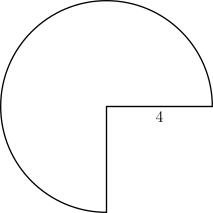
A three-quarter sector of a circle of radius inches together with its interior can be rolled up to form the lateral surface of a right circular cone by taping together along the two radii shown. What is the volume of the cone in cubic inches?
小提示:
扇形的弧长会成为圆锥底面的周长。
The arc length of the sector becomes the circumference of the cone’s base
大提示:
扇形半径 会成为圆锥的母线长;先求底面半径,再求圆锥高。
The sector radius becomes the slant height; find the base radius, then the cone’s height
解答:
扇形弧长为 ,它等于底面周长。因此 ,所以 。
母线长是 ,因此由勾股定理可得高为 。圆锥体积为
所以正确答案是 C。
The sector’s arc length is which becomes the base circumference: so
The slant height is the sector radius so the height is The volume is
Thus, the correct answer is C.
10.
在单位正方形 中,内切圆 与 相交于 , 与 还相交于不同于 的点 。 等于多少?
In unit square the inscribed circle intersects at and intersects at a point different from What is
小提示:
取 则圆心为 ,且 。
Place so the circle has center and
大提示:
把直线 代入圆的方程;两个根分别对应 和 。
Substitute the line into the circle’s equation; the two roots give and
解答:
令 、、、。内切圆圆心为 ,半径为 ,并在 处与 相切。
直线 为 。代入 ,得到 ,其根为 (点 )和 (点 )。
因此 ,且 。
所以正确答案是 B。
Let The inscribed circle has center and radius touching at
Line is Substituting into gives with roots (point ) and (point ).
So and
Thus, the correct answer is B.
11.
如下图,六个半圆位于边长为 的正六边形内部,且这些半圆的直径分别与六边形的各边重合。阴影区域在六边形内部、但在所有半圆外部。阴影区域的面积是多少?
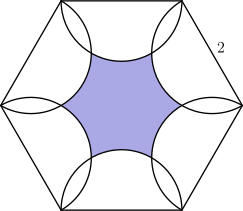
As shown in the figure below, six semicircles lie in the interior of a regular hexagon with side length so that the diameters of the semicircles coincide with the sides of the hexagon. What is the area of the shaded region—inside the hexagon but outside all of the semicircles?
小提示:
六边形面积为 ,其中 且每个半圆的半径为 。
The hexagon area is with and each semicircle has radius
大提示:
相邻半圆会重叠;减去半圆并集时,要计入六个重叠透镜形区域。
Adjacent semicircles overlap; subtract the union, accounting for the six overlapping lenses
解答:
六边形的面积为 。每个半圆的半径为 ,面积为 ,所以六个半圆的面积之和为 。
相邻半圆的圆心距离为 ,因此每对相邻半圆的重叠透镜形面积为 。
共有六个这样的透镜形,所以六个半圆的并集面积为 从六边形面积中减去它,得到阴影面积 。
所以正确答案是 D。
The hexagon has area Each semicircle has radius and area totaling
Adjacent semicircle centers (side midpoints) are a distance apart, so each adjacent pair overlaps in a lens of area There are six such lenses.
The union of the semicircles is Subtracting from the hexagon gives the shaded area
Thus, the correct answer is D.
12.
是半径为 的圆的一条直径。 是圆中的一条弦,与 相交于点 ,且满足 、。求 。
Let be a diameter in a circle of radius Let be a chord in the circle that intersects at a point such that and What is
小提示:
把圆心放在原点,把 放在 -轴上,并从 沿 方向参数化这条弦。
Put the center at the origin with on the -axis and parametrize the chord from at
大提示:
若 是从 到 的有向距离,则 。
If are the signed distances from to then
解答:
将圆心置于原点, 放在 -轴上;半径为 ,所以 。于是 ,其中 ,但它的具体值不需要算出。
把弦参数化为 。代入圆方程 得到 ,其根 是到 和 的有向距离。
由韦达定理,,且 ,所以
所以正确答案是 E。
Place the center at the origin with on the -axis; the radius is so Then with (its exact value is not needed).
Parametrize the chord as Substituting into gives whose roots are the signed distances to and
By Vieta, and so
Thus, the correct answer is E.
13.
14.
Bela 和 Jenn 在实数轴闭区间 上玩如下游戏,其中 是大于 的固定整数。两人轮流行动,Bela 先手。Bela 第一次可以在区间 中任选一个实数。此后,轮到的玩家必须选择一个与此前任一玩家选过的所有数都相距大于一的实数。无法选择者失败。在最优策略下,谁会获胜?
Bela and Jenn play the following game on the closed interval of the real number line, where is a fixed integer greater than They take turns playing, with Bela going first. At his first turn, Bela chooses any real number in the interval Thereafter, the player whose turn it is chooses a real number that is more than one unit away from all numbers previously chosen by either player. A player unable to choose such a number loses. Using optimal strategy, which player will win the game?
Bela 总会获胜。
Bela will always win.
Jenn 总会获胜。
Jenn will always win.
Bela 获胜当且仅当 为奇数。
Bela will win if and only if is odd.
Jenn 获胜当且仅当 为奇数。
Jenn will win if and only if is odd.
Jenn 获胜当且仅当 。
Jenn will win if and only if
小提示:
考虑 Bela 第一步恰好选在区间中点时会发生什么。
Consider what happens if Bela plays exactly at the midpoint of the interval first
大提示:
占据中心后,Bela 可以把 Jenn 的每一步关于中点镜像。
After claiming the center, Bela can mirror each of Jenn’s moves through the midpoint
解答:
Bela 第一步选择区间中点 。这样,局面关于区间中心对称。
此后,每当 Jenn 选择一个数 ,Bela 就选择它关于中点的镜像 。因为 Bela 已经选了 ,Jenn 的合法选择必满足 。因此 ,所以 Bela 的回应与 Jenn 刚选的点相距足够远。 由对称性,它与先前的每个点也相距足够远。因此,只要 Jenn 有合法行动,Bela 就一定也有合法行动, 所以 Jenn 会先无路可走。Bela 总会获胜。
所以正确答案是 A。
Bela first plays the midpoint This choice makes the configuration symmetric about the center of the interval.
Thereafter, whenever Jenn picks a number Bela responds with its mirror image Since Bela has already chosen Jenn’s legal move satisfies Therefore so Bela’s response is far enough from Jenn’s new point. Symmetry shows that it is also far enough from every earlier point. Thus Bela always has a move whenever Jenn does, so Jenn is the first to be stuck. Bela always wins.
Thus, the correct answer is A.
15.
个人等间隔地站成一圈。每个人恰好认识其他 个人中的 个:站在其两侧的 个人,以及正对面的人。将这 个人分成 对,且每对的两人互相认识,一共有多少种分法?
There are people standing equally spaced around a circle. Each person knows exactly of the other people: the people standing next to her or him, as well as the person directly across the circle. How many ways are there for the people to split up into pairs so that the members of each pair know each other?
小提示:
把允许的配对看作边:相邻边或直径边,然后数完美匹配。
Count perfect matchings using edges that are either adjacent (neighbor) pairs or diameters (across)
大提示:
按使用了多少条直径边分类;可能的数量只有 或 。
Organize by how many diameter pairs are used; only or of them can occur
解答:
将人编号为 到 。允许的配对是相邻边 或直径边 。我们按使用的直径边数量分类计算完美匹配。
不使用直径边时,相邻的人可以按两种交错方式配对,共有 种。恰用一条直径边时,选择这条直径有 种,其余的人随后被唯一配对,因此共有 种。使用全部五条直径边时有 种。
只要使用了直径边,沿圆周考察被迫出现的相邻配对,就可看出直径边数必须是奇数。恰用三条直径边时,余下四人必须组成两对彼此对置的相邻配对;其中一对的位置唯一确定整个匹配,所以有 种。综上,总数为 。
所以正确答案是 C。
Label the people through Allowed pairings use neighbor edges or diameter edges Count perfect matchings by the number of diameter edges used.
Using no diameters, the ten people split into adjacent pairs in ways (all “even” edges or all “odd” edges). Using exactly one diameter, choose it in ways; the remaining two arcs of four people each pair up uniquely, giving Using all five diameters gives matching.
If at least one diameter is used, following the forced adjacent pairings around the circle shows that the number of diameters must be odd. With exactly three diameters, the four remaining people must be two opposite adjacent pairs. The position of one such opposite pair determines the matching, giving possibilities. Hence the total is
Thus, the correct answer is C.
16.
一个罐子中有一个红球和一个蓝球,旁边有一盒额外的红球和蓝球。George 重复如下操作四次:从罐子中随机取出一个球,然后从盒中取一个相同颜色的球,把这两个同色球都放回罐子。四次操作后,罐子中有六个球。罐子中红球和蓝球各有三个的概率是多少?
An urn contains one red ball and one blue ball. A box of extra red and blue balls lies nearby. George performs the following operation four times: he draws a ball from the urn at random and then takes a ball of the same color from the box and returns those two matching balls to the urn. After the four iterations the urn contains six balls. What is the probability that the urn contains three balls of each color?
小提示:
最后两种颜色各有三个,等价于四次新增的球中恰有两个红球。
Reaching three of each color means exactly two of the four added balls are red
大提示:
任意一个“两红两蓝”的出现顺序都有相同概率,所以红球个数是均匀分布的。
Any specific order of two red and two blue additions has the same probability, so the number of red balls is uniform
解答:
要最后两种颜色各有三个,四次新增的球中必须恰有两个红球。当罐中有 个球,其中有 个某色球时,下一次抽到该色的概率为 。
每个恰含两次红球和两次蓝球的指定序列,其概率都为 。这样的序列有 个,所以总概率为 。(等价地,四次后红球数在 中均匀分布;其中目标值为 ,概率也为 。)
所以正确答案是 B。
To end with three of each color, exactly two of the four added balls must be red. Consider any sequence of draws. When the urn holds balls, drawing a particular color with count has probability
Any ordering with two red and two blue additions gives the same product and there are such orderings, for probability (Equivalently, the number of red balls after four steps is uniform on so red occurs with probability )
Thus, the correct answer is B.
17.
有多少个形如 的多项式,其中 ,, 和 都是实数,满足如下性质:只要 是一个根,那么 也是一个根?(注:。)
How many polynomials of the form where and are real numbers, have the property that whenever is a root, so is (Note that )
小提示:
是本原三次单位根,所以非零根按 这样的三元组出现。
is a primitive cube root of unity, so nonzero roots come in triples
大提示:
个根只能来自一个不同根三元组并带有重数;实系数还要求根关于共轭对称。
With five roots the distinct roots form one triple with multiplicities summing to real coefficients force conjugate symmetry
解答:
设 ,它是本原三次单位根。由于 不是根,不同根的集合在乘以 后保持不变,所以根按 这样的三元组出现。五个根无法填满两个三元组,因此只有一个三元组,其重数 之和为 。
实系数要求根的多重集在共轭下不变。这只可能发生在三元组的辐角关于实轴对称时,即 或 。
全部根的乘积必须为 。第一种构型中的实根为正,会导致乘积为正,不可能。第二种构型中的实根为负,乘积为 ;取 即可。共轭对称的重数方案为 和 ,因此有 个多项式。
所以正确答案是 C。
Here is a primitive cube root of unity. Since is not a root, the set of distinct roots is closed under multiplication by so it consists of triples equally spaced in argument. Five roots cannot fill two such triples, so there is exactly one triple, with multiplicities summing to
Real coefficients require the root multiset to be closed under conjugation. This is possible only when the triple’s arguments are symmetric about the real axis, which happens for the two configurations and
The product of the roots must equal In the first configuration the real root is positive, forcing a positive product, which is impossible. In the second, the real root is negative and the product is setting works, and the two conjugate-symmetric multiplicity patterns and each give a valid polynomial. Hence there are
Thus, the correct answer is C.
18.
在正方形 中,点 和 分别在 和 上,且 。点 和 分别在 和 上,点 和 在 上,并满足 、。见下图。三角形 、四边形 、四边形 和五边形 的面积都为 。求 。
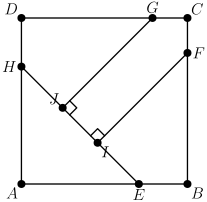
In square points and lie on and respectively, so that Points and lie on and respectively, and points and lie on so that and See the figure below. Triangle quadrilateral quadrilateral and pentagon each has area What is
小提示:
四个区域铺满正方形,所以正方形面积为 ,边长为 。
The four regions tile the square, so its area is and its side is
大提示:
是面积为 的等腰直角三角形,所以 ;建立坐标系并利用 的面积。
is an isosceles right triangle of area so set coordinates and use the area of
解答:
四个区域总面积为 ,所以正方形边长为 。取 、、、。由于 是面积为 的等腰直角三角形,所以 ,从而 ,。直线 的方程为 。
设 。它到直线 的垂直距离为 。令 ,则垂足为 。对 、、、 使用鞋带公式,得到 。由于该面积为 ,所以 。
因此 。
所以正确答案是 B。
The four regions have total area so the square has side Put Since is an isosceles right triangle with area we get so and Line is
Let Its perpendicular distance to line is Write so the foot of the perpendicular is The shoelace formula on and gives Since this area is we get
Then
Thus, the correct answer is B.
19.
坐标平面中的正方形 的顶点为 、、 和 。考虑以下四个变换:
,绕原点逆时针旋转 ;
,绕原点顺时针旋转 ;
,关于 -轴反射;
,关于 -轴反射。
每个变换都会把正方形映到自身,但标记顶点的位置会改变。例如,先做 再做 ,会把顶点 从 送到 ,并把顶点 从 送回原位。从 中选出长度为 的变换序列,有多少个会把所有标记顶点都送回原位?(例如,,,, 是一个长度为 的有效序列。)
Square in the coordinate plane has vertices at the points and Consider the following four transformations:
a rotation of counterclockwise around the origin;
a rotation of clockwise around the origin;
a reflection across the -axis; and
a reflection across the -axis.
Each of these transformations maps the square onto itself, but the positions of the labeled vertices will change. For example, applying and then would send the vertex at to and would send the vertex at to itself. How many sequences of transformations chosen from will send all of the labeled vertices back to their original positions? (For example, is one sequence of transformations that will send the vertices back to their original positions.)
小提示:
前 个变换可以任意选择;最后一个变换会被唯一地强制为前面合成的逆。
The first transformations can be anything; the last one is then forced to be the unique inverse
大提示:
这个被强制的最后一步必须是四个允许变换之一;求它属于允许集合的计数。
The forced last move must be one of the four allowed transformations; find the probability that it is
解答:
将顶点依次标为 。每个允许的变换都形如 ,其中 且 。这四种选择恰好给出两个四分之一周旋转和题中所述的两个反射。
在复合时, 的奇偶性在每一步都会改变。因此, 个允许变换的复合仍有奇数的 ,所以它仍是四个允许变换之一。它的逆变换也被允许。因此,前 步的每个序列都恰有一种最后一步的选择,共得到 个成功序列。
因此,正确答案是 C。
Label the vertices cyclically. Each allowed transformation has the form where and These four choices give exactly the two quarter-turns and the two stated reflections.
Under composition, the parity of changes at every move. Thus a composition of allowed transformations again has odd and so is one of the four allowed transformations. Its inverse is also allowed. Consequently every sequence of the first moves has exactly one choice for the final move, giving successful sequences.
Thus, the correct answer is C.
20.
两个大小相同但彼此不同的立方体要被涂色,每个面的颜色独立随机选择为黑色或白色。涂色后,这两个立方体可以通过旋转变得外观相同的概率是多少?
Two different cubes of the same size are to be painted, with the color of each face being chosen independently and at random to be either black or white. What is the probability that after they are painted, the cubes can be rotated to be identical in appearance?
小提示:
概率为 ,其中对所有涂色方案的旋转等价类 求和。
The probability equals , where the sum is over rotation-equivalence classes of colorings
大提示:
按黑色面的个数分类,并找出每个等价类的轨道大小;例如两个黑面时,对面给出大小 ,相邻给出大小 。
Group colorings by number of black faces and find each class’s orbit size (e.g. two black faces: opposite gives size adjacent gives size )
解答:
固定第一个立方体后,与它旋转后相同的第二个立方体数等于其旋转轨道的大小。因此所求概率为 。
按黑色面数量分类: 或 个黑面时 ; 或 个黑面时 ; 或 个黑面时,对面情形 ,相邻情形为 ; 个黑面时,共顶点情形 ,环带情形为 。于是
因此概率为 。
所以正确答案是 D。
For a fixed first cube, the number of second cubes matching it (up to rotation) equals the size of its rotation orbit. So the desired probability is
Grouping by black-face count, the orbit sizes are: or black or black or black (opposite) and (adjacent); black (corner) and (band). Then
The probability is
Thus, the correct answer is D.
21.
有多少个正整数 满足
( 表示不超过 的最大整数。)
How many positive integers satisfy
(Recall that is the greatest integer not exceeding )
小提示:
令 ,则 必须满足 。
Let so must satisfy
大提示:
这给出 和 ;数出满足条件的整数 。
This gives and count integer
解答:
右边是整数,令 。则 ,而 要求 。
下界 给出 ,即 。上界 给出 ,即 或 。
取交集得 ,因此有 个 值。
所以正确答案是 C。
The right side is an integer, so let Then and requires
The lower bound gives i.e. The upper bound gives i.e. or
Intersecting, giving values of
Thus, the correct answer is C.
22.
下列表达式的最大值是多少?
其中 取遍所有实数。
What is the maximum value of
for real values of
小提示:
令 ,则 。
Let then
大提示:
表达式变为 ,这是关于 的开口向下抛物线。
The expression becomes a downward parabola in
解答:
拆开分式:。令 ,则 ,原式变为 。
这个抛物线在 时取得最大值 。由于 连续且能取到 ,该最大值确实可以达到。
所以正确答案是 C。
Split the fraction: Let so and the expression is
This parabola has maximum at with value Since is continuous and attains the value the maximum is achieved.
Thus, the correct answer is C.
23.
有多少个整数 具有如下性质:只要复数 、、、 满足 以及 那么 、、、 在复平面的单位圆上等间隔分布?
How many integers are there such that whenever are complex numbers such that and then the numbers are equally spaced on the unit circle in the complex plane?
小提示:
检查小情形: 强制两点互为对径, 强制形成等边三角形。
Check small cases: forces antipodal points and forces an equilateral triangle
大提示:
对 可用一个较小的和为零构型加上一对对径点构造反例。
For build a counterexample by combining a smaller balanced configuration with an antipodal pair
解答:
当 时, 强制 ,所以两点等间隔分布。当 时,三个和为零的单位向量必须构成等边三角形,所以也等间隔分布。
对每个偶数 ,取 对处于一般位置、且不构成正 边形的对径点。对每个奇数 ,取一个等边三角形的三个顶点,再加上 对处于一般位置的对径点。每种构造的各数之和都是 ,但它们并不等间隔分布。
因此只有 和 满足条件,共 个值。
所以正确答案是 B。
For forces which is equally spaced. For three unit vectors summing to zero must form an equilateral triangle, so they are equally spaced.
For every even choose antipodal pairs at generic angles that do not form a regular -gon. For every odd choose the vertices of an equilateral triangle together with generic antipodal pairs. Each construction has sum but is not equally spaced.
Hence only and work, giving values.
Thus, the correct answer is B.
24.
令 表示将正整数 写成乘积 的方法数,其中 ,每个 都是严格大于 的整数,并且因子的排列顺序有区别 (也就是说,两个只在因子顺序上不同的表示也算作不同的方法)。例如,数 可以写成 、 和 ,所以 。求 。
Let denote the number of ways of writing the positive integer as a product where the are integers strictly greater than and the order in which the factors are listed matters (that is, two representations that differ only in the order of the factors are counted as distinct). For example, the number can be written as and so What is
小提示:
使用递推 并设 。
Use the recursion with
大提示:
因为 ,逐步计算其因子 、、、、、、、、、、 的 值。
Since build up on the divisors
解答:
第一个因子 可以是任意因子 ,之后剩余部分是 的有序分解。因此 ,并设 。
在 的因子上逐步计算:,,,,,,,,。
最后
所以正确答案是 A。
The first factor can be any divisor after which the rest is an ordered factorization of So with
Computing over the divisors of
Finally
Thus, the correct answer is A.
25.
对每个满足 的实数 ,从区间 和 中分别独立随机选择 和 。令 为下列不等式成立的概率: 的最大值是多少?
For each real number with let numbers and be chosen independently at random from the intervals and respectively, and let be the probability that What is the maximum value of
小提示:
条件等价于 ;固定 时,关于 的概率是一个简单的三角形函数。
The condition is for fixed the probability over is a simple triangular function
大提示:
写成 ,其中 先增后减,然后对 最大化。
Express where rises then falls, then maximize over
解答:
由 ,条件等价于 。固定 ,当 时,所求概率在 时为 ,在 时为 。
因此 。当 时,,并递增到 。当 时,
将导数令为零得 ,所以 ,且 。
所以正确答案是 B。
Since the condition is For fixed the probability over is for and for
Then For increasing to For
Setting the derivative to zero gives so and
Thus, the correct answer is B.