
2004 AMC 12A 真题
计时
1:15:00
1.
Alicia 每小时赚 ,其中 被扣除用于缴纳地方税。Alicia 每小时的工资中有多少美分用于缴纳地方税?
Alicia earns per hour, of which is deducted to pay local taxes. How many cents per hour of Alicia’s wages are used to pay local taxes?
2.
在 AMC 中,每道答对的题得 分,每道答错的题得 分,每道未作答的题得 分。如果 Charlyn 在 道题中有 道未作答,那么剩下的题中她至少要答对多少道,才能得到至少 分?
On the AMC each correct answer is worth points, each incorrect answer is worth points, and each problem left unanswered is worth points. If Charlyn leaves of the problems unanswered, how many of the remaining problems must she answer correctly in order to score at least
小提示:
道空题已经贡献 分。
The blanks already contribute points
大提示:
求每题 分的正确答案至少需要多少道,才能补足剩余分数。
Find the smallest number of correct answers whose points each cover the remaining points
解答:
道未作答的题值 分,所以 Charlyn 还需要从答对的题中得到至少 分。
每道答对的题值 分,而不小于 的最小 的倍数是 。所以她至少需要答对 道题。
所以正确答案是 C。
The unanswered problems are worth points, so Charlyn needs at least more points from correct answers.
Each correct answer is worth points, and the smallest multiple of that is at least is So she needs at least correct answers.
Thus, the correct answer is C.
3.
有多少个正整数有序对 满足 ?
For how many ordered pairs of positive integers is
小提示:
用 表示 。
Solve for in terms of
大提示:
必须为正数,这限制了正整数 的最大值。
must be positive, which bounds how large the positive integer can be
解答:
写成 。当且仅当 是满足 的正整数时, 才是正整数。
因此共有 个有效有序对。
所以正确答案是 B。
Writing the value of is a positive integer precisely when is a positive integer with
This gives valid ordered pairs.
Thus, the correct answer is B.
4.
Bertha 有 个女儿,没有儿子。她的一些女儿各有 个女儿,其余女儿没有女儿。Bertha 一共有 个女儿和外孙女,并且没有曾外孙女。Bertha 的女儿和外孙女中,有多少人没有女儿?
Bertha has daughters and no sons. Some of her daughters have daughters, and the rest have none. Bertha has a total of daughters and granddaughters, and no great-granddaughters. How many of Bertha’s daughters and granddaughters have no daughters?
答案:E
小提示:
先数外孙女,再确定有多少个女儿有孩子。
First count the granddaughters, then determine how many daughters have children
大提示:
每个有女儿的人都恰好有 个女儿。
Every woman with daughters has exactly of them
解答:
Bertha 有 个外孙女,她们都没有女儿。
这些外孙女是 Bertha 的 个女儿所生,所以恰好有 人有女儿。
因此没有女儿的人数是 。
所以正确答案是 E。
Bertha has granddaughters, none of whom have daughters.
These granddaughters are the children of of Bertha’s daughters, so exactly women have daughters.
Therefore the number of women with no daughters is
Thus, the correct answer is E.
5.
直线 的图像如下。下列哪一项正确?

The graph of a line is shown. Which of the following is true?
小提示:
分别读出斜率 和 截距 的符号与大小。
Read the sign and size of the slope and the -intercept separately
大提示:
和 的绝对值都小于 ,但符号相反。
Both and have absolute value less than but opposite signs
解答:
截距在 和 之间,所以 。
斜率为负且较平缓,在 和 之间,所以 。
因此乘积 为负,且绝对值小于 ,从而得到 。
所以正确答案是 B。
The -intercept of the line is between and so
The slope is negative and shallow, between and so
The product is therefore negative with absolute value less than giving
Thus, the correct answer is B.
6.
设 ,,,,,且 。下列哪一个最大?
Let and Which of the following is largest?
小提示:
将每个差因式分解,写成 的某个幂的倍数。
Factor each difference to write it as a multiple of a power of
大提示:
而其他每一项都是较小的 的倍数。
while every other choice is a multiple of the smaller
解答:
逐个因式分解这些差:
,,,,且 。
因为 大于其他各项,而其他各项都达不到 ,所以 最大。
所以正确答案是 A。
Compute each difference by factoring:
and
Since exceeds each of the others, none of which reaches the difference is the largest.
Thus, the correct answer is A.
7.
一个游戏按照以下规则使用筹码。每一轮中,筹码最多的玩家给其他每个玩家各一个筹码,并且还把一个筹码放入弃置堆。当某个玩家没有筹码时,游戏结束。玩家 、 和 分别以 、 和 个筹码开始。这个游戏会进行多少轮?
A game is played with tokens according to the following rule. In each round, the player with the most tokens gives one token to each of the other players and also places one token into a discard pile. The game ends when some player runs out of tokens. Players and start with and tokens, respectively. How many rounds will there be in the game?
小提示:
追踪完整三轮循环中的筹码数。
Track the token counts over one full cycle of three rounds
大提示:
每三轮每个玩家都恰好少一个筹码,所以找出领先者何时变为
Every three rounds each player loses exactly one token, so find when the leader hits
解答:
三轮后,玩家 、 和 分别有 、 和 个筹码。之后每三轮都会使每个玩家的筹码数减少一个。
经过 轮后,他们分别有 、 和 个筹码;第 轮中,玩家 把自己的三个筹码全部给出并放入弃置堆后归零,游戏结束。
所以正确答案是 B。
After three rounds the players and have and tokens, respectively. Every subsequent three rounds reduces each player’s supply by one token.
After rounds they have and tokens. In the th round player who has the most, gives away all three of their tokens and runs out, ending the game.
Thus, the correct answer is B.
8.
如图, 和 是直角,,,,且 与 交于 。 与 的面积之差是多少?

In the figure, and are right angles, and and intersect at What is the difference between the areas of and
小提示:
给这两个三角形都加上公共的 。
Add the shared triangle to each of the two triangles
大提示:
这个差等于 。
The difference equals
解答:
设 ,,和 的面积分别为 ,,和 。
则 的面积为 ,而 的面积为 。
所求差为
所以正确答案是 B。
Let and be the areas of and respectively.
Then has area and has area
The requested difference is
Thus, the correct answer is B.
9.
一家公司用圆柱形罐子销售花生酱。市场研究表明,使用更宽的罐子会增加销量。如果罐子的直径增加 ,但体积不变,那么高度必须减少百分之多少?
A company sells peanut butter in cylindrical jars. Marketing research suggests that using wider jars will increase sales. If the diameter of the jars is increased by without altering the volume, by what percent must the height be decreased?
答案:C
小提示:
底面积按直径的平方缩放。
The base area scales with the square of the diameter
大提示:
直径乘以 会使底面积乘以 。
Multiplying the diameter by multiplies the base area by
解答:
直径乘以 会使底面积乘以 。
为保持体积不变,高度必须乘以 ,也就是减少 ,即 。
所以正确答案是 C。
Multiplying the diameter by multiplies the base area by
To keep the volume fixed, the height must be multiplied by That is a decrease of or
Thus, the correct answer is C.
10.
个连续整数的和为 。它们的中位数是多少?
The sum of consecutive integers is What is their median?
小提示:
对连续整数来说,中位数等于平均数。
For consecutive integers the median equals the mean
大提示:
中位数是总和除以项数,即 。
The median is the sum divided by the number of terms,
解答:
一组连续整数的和等于项数乘以平均数,而对连续整数来说,平均数等于中位数。
所以中位数为
所以正确答案是 C。
The sum of a set of consecutive integers equals the number of terms times their mean, and for consecutive integers the mean equals the median.
So the median is
Thus, the correct answer is C.
11.
Paula 钱包中所有一美分、五美分、十美分和二十五美分硬币的平均币值是 美分。如果她再有一枚二十五美分硬币,平均币值会变成 美分。她的钱包中有多少枚十美分硬币?
The average value of all the pennies, nickels, dimes, and quarters in Paula’s purse is cents. If she had one more quarter, the average value would be cents. How many dimes does she have in her purse?
小提示:
设 为当前硬币数,并用两种方式写出加入一枚二十五美分硬币后的总币值
Let be the current number of coins and write the total value two ways after adding a quarter
大提示:
解 求出 ,再判断哪些硬币合计 美分。
Solve for then figure out which coins total cents
解答:
如果 Paula 有 枚硬币,它们的总币值是 美分。再加入一枚二十五美分硬币后共有 枚硬币,总币值为 美分,而它也必须等于 美分。
因此 ,解得 。
这四枚硬币合计 美分,只能是三枚二十五美分硬币和一枚五美分硬币,所以十美分硬币的数量为 。
所以正确答案是 A。
If Paula has coins, their total value is cents. Adding a quarter gives coins worth cents, which must also equal cents.
So giving
Four coins totalling cents must be three quarters and one nickel, so the number of dimes is
Thus, the correct answer is A.
12.
设 且 。点 和 在直线 上,并且 与 交于 。 的长度是多少?
Let and Points and are on the line and and intersect at What is the length of
小提示:
求出直线 和 的方程,再分别与 相交。
Find the equations of lines and then intersect each with
大提示:
和 都在 上,所以各自的两个坐标相等。
and both lie on so each has equal coordinates
解答:
直线 经过 ,斜率为 ,所以方程是 。令 ,得到 。
直线 经过 ,斜率为 ,所以方程是 。令 ,得到 。
因此
所以正确答案是 B。
Line passes through with slope so its equation is Setting gives
Line passes through with slope so Setting gives
Then
Thus, the correct answer is B.
13.
设 为坐标平面中的点集 ,其中 和 都可以是 ,,或 。有多少条不同的直线至少经过 中的两个点?
Let be the set of points in the coordinate plane, where each of and may be or How many distinct lines pass through at least two members of
小提示:
从 对点开始,每一对点确定一条直线。
Start from the pairs of points, each of which determines a line
大提示:
有些直线经过三个共线点,因此被计数了 次。
Some lines pass through three collinear points and get counted times
解答:
共有 对点,每一对点确定一条直线。
但是有三条水平线、三条竖直线和两条对角线各经过 中的 个共线点,因此每条这样的直线被多算 次。
这样的直线共有 条,所以不同直线的数量为 。
所以正确答案是 B。
There are pairs of points, and each pair determines a line.
However, there are three horizontal, three vertical, and two diagonal lines that each pass through three collinear points of Each such line is counted times, an overcount of per line.
With such lines, the number of distinct lines is
Thus, the correct answer is B.
14.
三个实数组成的数列是等差数列,首项为 。如果给第二项加上 ,给第三项加上 得到的三个数构成等比数列。这个等比数列第三项的最小可能值是多少?
A sequence of three real numbers forms an arithmetic progression with a first term of If is added to the second term and is added to the third term, the three resulting numbers form a geometric progression. What is the smallest possible value for the third term of the geometric progression?
小提示:
将等差数列写成 ,,。
Write the arithmetic terms as
大提示:
在等比数列中,中项的平方等于两端项的乘积。
In a geometric progression the middle term squared equals the product of the outer terms
解答:
等差数列为 ,,。加上指定数后,等比数列为 ,,。
等比条件给出 ,化简为 ,所以 或 。
对应的第三项 分别为 和 ,所以最小可能值为 。
所以正确答案是 A。
The arithmetic progression is After the additions, the geometric progression is
The geometric condition gives which simplifies to so or
The corresponding third terms are and so the smallest possible value is
Thus, the correct answer is A.
15.
Brenda 和 Sally 在一条圆形跑道上沿相反方向跑步,从直径两端的点同时出发。她们第一次相遇时,Brenda 已跑了 米。她们下一次相遇时,Sally 已经从第一次相遇点又跑了 米。两人的速度都恒定。跑道长多少米?
Brenda and Sally run in opposite directions on a circular track, starting at diametrically opposite points. They first meet after Brenda has run meters. They next meet after Sally has run meters past their first meeting point. Each girl runs at a constant speed. What is the length of the track in meters?
小提示:
到第一次相遇时,两人合计跑了半圈。
By the first meeting the two together have covered half the track
大提示:
第一次和第二次相遇之间,两人合计跑了一整圈,所以 Brenda 跑了第一次路程的两倍。
Between the first and second meetings they together cover a full track, so Brenda runs twice her first leg
解答:
从相对两端出发时,她们第一次相遇时合计跑了半个跑道长度。
第一次和第二次相遇之间,她们合计跑了一个完整跑道长度。因为 Brenda 第一次相遇前跑了 米,所以这段时间她跑了 米。
同一时间段内 Sally 跑了 米,因此跑道长度为 米。
所以正确答案是 C。
Starting at opposite ends, when they first meet they have together run half the track. Between the first and second meetings, they together run a full track length.
Since Brenda runs at a constant speed and covered meters before the first meeting, she covers meters between the two meetings.
Adding Sally’s meters over that same interval gives a track length of meters.
Thus, the correct answer is C.
16.
使 有定义的所有实数 的集合是 。 的值是多少?
The set of all real numbers for which is defined is What is the value of
小提示:
从外向内处理:每个对数都要求它的真数为正。
Work from the outside in: each logarithm requires its argument to be positive
大提示:
有定义仅当 ,也就是下一层真数大于 。
is defined only when i.e. the next argument exceeds
解答:
该表达式有定义当且仅当 ,也就是 。
这当且仅当 ,等价于 。
因此 。
所以正确答案是 B。
The expression is defined if and only if that is,
This holds if and only if which is equivalent to
Therefore
Thus, the correct answer is B.
17.
设 是满足以下性质的函数:
(i) ,且
(ii) 对任意正整数 ,都有 。
的值是多少?
Let be a function with the following properties:
(i) and
(ii) for any positive integer
What is the value of
18.
正方形 的边长为 。在正方形内部作以 为直径的半圆,从 向该半圆作切线,切线与边 交于 。 的长度是多少?
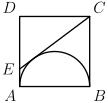
Square has side length A semicircle with diameter is constructed inside the square, and the tangent to the semicircle from intersects side at What is the length of
小提示:
从同一个外点向圆作的两条切线段相等。
Two tangent segments from a common external point to a circle are equal
大提示:
令 ,由切线段得到 ,再对 用勾股定理。
With the tangent lengths give then apply the Pythagorean theorem to
解答:
设 为 与半圆的切点。由于 和 都是从 作出的切线,所以 。同理,令 ,从 作出的切线给出 。
因此 。在直角三角形 中, 且 ,所以
展开得 ,所以 ,并且 。
所以正确答案是 D。
Let be the point where touches the semicircle. Since and are both tangents from we have Similarly, with the tangents from give
Thus In right triangle where and
Expanding gives so and
Thus, the correct answer is D.
19.
圆 、 和 两两外切,并且都内切于圆 。圆 和 全等。圆 的半径为 ,并且经过圆 的圆心。圆 的半径是多少?

Circles and are externally tangent to each other and internally tangent to circle Circles and are congruent. Circle has radius and passes through the center of What is the radius of circle
小提示:
因为圆 经过圆 的圆心且与圆 内切,所以大圆的半径为 。
Since passes through the center of and is internally tangent, circle has radius
大提示:
把圆 的圆心放在原点;利用各圆心与对称轴形成的直角三角形。
Place the center of at the origin; use right triangles formed by the centers and the axis of symmetry
解答:
圆 半径为 ,经过圆 的圆心并与圆 内切,所以圆 的半径为 。
将圆 的圆心放在原点,圆 的圆心在 。由对称性, 的圆心为 ,半径为 而 是它关于水平轴的镜像,所以两圆在该轴上相切,且 。
与圆 内切给出 ,与圆 外切给出 。
两式相减并使用 得到 且 。因此圆 的半径是 。
所以正确答案是 D。
Circle has radius and passes through the center of while being internally tangent to so has radius
Place the center of at the origin, with centered at By symmetry, has center and radius with its mirror image across the horizontal axis, so the two congruent circles touch on that axis and
Internal tangency to gives and external tangency to gives
Subtracting and using yields and The radius of circle is
Thus, the correct answer is D.
20.
独立随机地选取 和 之间的数 与 ,并令 为它们的和。将 ,,和 分别四舍五入到最接近的整数,所得结果为 ,,和 。 的概率是多少?
Select numbers and between and independently and at random, and let be their sum. Let and be the results when and respectively, are rounded to the nearest integer. What is the probability that
小提示:
将 看成单位正方形中的随机点,并按 是否小于 分类。
Model as a random point in the unit square and split by whether each of is below
大提示:
只有当 但 ,或 但 时条件失败。
The condition fails only when but or but
解答:
将选择表示为单位正方形中的点 。 和 小于 时四舍五入为 ,否则四舍五入为 ;而 的分界点为 和 。
这个等式恰好在两个区域内不成立。若 ,则当 时不成立,这是一个面积为 的直角三角形。若 ,则当 时不成立,这是另一个面积为 的直角三角形。当 中恰好有一个不小于 时,等式总是成立。
因此不成立的概率为 ,所以所求概率为 。
所以正确答案是 E。
Represent the choices as a point in the unit square. Each of and rounds to if below and to otherwise, while rounds based on and
The equation fails in exactly two regions. If it fails when this is a right triangle of area If it fails when this is another right triangle of area When exactly one of is at least the equation always holds.
Thus the failure probability is so the requested probability is
Thus, the correct answer is E.
21.
22.
三个互相相切、半径为 的球放在一个水平平面上。一个半径为 的球放在它们上面。从平面到较大球顶部的距离是多少?
Three mutually tangent spheres of radius rest on a horizontal plane. A sphere of radius rests on them. What is the distance from the plane to the top of the larger sphere?
小提示:
三个小球的球心在离平面高度 处形成边长为 的等边三角形。
The three small centers form an equilateral triangle of side at height
大提示:
大球球心在该三角形重心正上方;利用球心间距离 求其高度。
The big center lies above the triangle’s centroid; use the distance between centers to find its height
解答:
设三个单位球的球心为 ,,,它们在离平面高度 处形成边长为 的等边三角形;设 为大球球心,位于 的重心 正上方。
从顶点到重心的距离为 ,且 ,所以
因为 位于平面上方 个单位,而大球顶部在 上方 个单位,所以总高度为
所以正确答案是 B。
Let the centers of the three unit spheres be forming an equilateral triangle of side at height above the plane, and let be the center of the large sphere directly above the centroid of
The distance from a vertex to the centroid is and so
Since is unit above the plane and the top of the large sphere is units above the total height is
Thus, the correct answer is B.
23.
多项式 的系数均为实数,且 。它有 个不同的复数零点 ,其中 , 和 均为实数,,并且 下列哪个量可能是非零数?
A polynomial has real coefficients with and distinct complex zeros with and real, and Which of the following quantities can be a nonzero number?
小提示:
因为 是根,所以 ;非实根成共轭对出现。
Since is a root, nonreal roots come in conjugate pairs
大提示:
,它不一定为零;检查其他每个选项都必须为零。
which is not forced to be zero; check each other option must vanish
解答:
因为 是根,所以 。
非实零点成共轭对出现,所以 而题设于是强制 。系数 等于 乘以根之和 ,所以 。
因为次数为偶数, 中至少有一个实根,使得某个 ,所以 。因此 (A) 到 (D) 都必须为 。
另一方面,。一个有效多项式例如 满足 ,所以只有 可能非零。
所以正确答案是 E。
Since is a root,
The nonreal zeros occur in conjugate pairs, so and the hypothesis then forces The coefficient equals times the sum of the roots so
Because the degree is even, at least one of is real, making one so Thus (A) through (D) all must be
On the other hand, and a valid polynomial such as has So only can be nonzero.
Thus, the correct answer is E.
24.
一个平面中有点 和 ,且 。设 为平面中所有覆盖线段 的半径为 的圆盘的并集。 的面积是多少?
A plane contains points and with Let be the union of all disks of radius in the plane that cover What is the area of
小提示:
一个半径为 的圆盘覆盖 ,当且仅当它的圆心到 和 的距离都不超过 。
A radius- disk covers exactly when its center lies within of both and
大提示:
先找出圆心所在的透镜形区域 ,再注意 是所有到 距离不超过 的点。
Find that lens-shaped region of centers, then is all points within of
解答:
一个半径为 的圆盘覆盖线段 ,当且仅当它的圆心到 和 的距离都不超过 。这个区域 是以 和 为圆心的两个单位圆的重叠透镜。
每个单位圆都经过另一个圆的圆心,所以透镜由两段 圆弧围成。两个 扇形的面积各为 ,重叠中扣掉的两个等边三角形总面积为 ,所以 的面积为 。
集合 由所有到 距离不超过 的点组成。除 本身外,还增加两个 半径 的扇形(每个面积 )和两个 外半径 、内半径 的环形区域(每个面积 )。
因此 的面积为
所以正确答案是 C。
A radius- disk covers segment exactly when its center is within of both and That region is the lens where the two unit circles centered at and overlap.
Each unit circle passes through the other’s center, so the lens is bounded by two arcs. Two sectors of area overlap in two equilateral triangles of total area giving area
The set consists of all points within of Beyond itself, this adds two sectors of radius (each area ) and two annuli of outer radius and inner radius (each area ).
Therefore the area of is
Thus, the correct answer is C.
25.
对每个整数 ,令 表示 进制数 。乘积 可表示为 ,其中 和 是正整数,且 尽可能小。 的值是多少?
For each integer let denote the base- number The product can be expressed as where and are positive integers and is as small as possible. What is the value of
小提示:
一个循环 进制小数 等于 。
A repeating base- fraction equals
大提示:
注意 ,这会使乘积裂项相消。
Note which makes the product telescope
解答:
因为 ,得到
写成 ,以及 ,乘积 裂项相消为
它化简为 。若 ,把这个分数改写成以 为分母会要求 整除 ,但并不成立。因此最小可能的 是 ,且 。
所以正确答案是 E。
Since we get
Writing and the product telescopes to
This simplifies to If then rewriting this fraction with denominator would require to divide which it does not. Hence the smallest possible is and
Thus, the correct answer is E.