
2007 AIME I 真题
计时
3:00:00
1.
小于 的正完全平方数中,有多少个是 的倍数?
How many positive perfect squares less than are multiples of
小提示:
一个完全平方数是 的倍数,当且仅当它的平方根是 的倍数
A perfect square is a multiple of exactly when its square root is a multiple of
大提示:
统计 的倍数中平方小于 的数,也就是 的倍数中小于 的数
Count the multiples of whose squares are less than i.e. the multiples of less than
解答:
因为 ,平方数 是 的倍数,当且仅当 是 的倍数:因子 要求 含有 ,因子 要求 含有 ,反过来 一定是 的倍数。同时 当且仅当 。
这些 的倍数若小于 ,就是 ,共有 个。
Since a square is a multiple of exactly when is a multiple of the factor forces to contain the factor forces to contain and conversely is always a multiple of Also exactly when
The multiples of less than are and there are of them.
2.
一条 英尺长的自动人行道以每秒 英尺的恒定速度移动。Al 走到人行道起点并站在上面。Bob 在两秒后走到人行道起点,并以每秒 英尺的恒定速度沿人行道向前步行。再过两秒,Cy 到达人行道起点,并在人行道旁以每秒 英尺的恒定速度快步向前走。在某个时刻,这三人中的一人恰好位于另外两人的正中间。在那个时刻,求中间那人与人行道起点之间的距离,单位为英尺。
A foot long moving walkway moves at a constant rate of feet per second. Al steps onto the start of the walkway and stands. Bob steps onto the start of the walkway two seconds later and strolls forward along the walkway at a constant rate of feet per second. Two seconds after that, Cy reaches the start of the walkway and walks briskly forward beside the walkway at a constant rate of feet per second. At a certain time, one of these three persons is exactly halfway between the other two. At that time, find the distance in feet between the start of the walkway and the middle person.
小提示:
从 Al 踏上人行道开始计时为 :Al 在 ,Bob 在 ,Cy 在
Measure time from Al’s step: Al is at Bob at and Cy at
大提示:
分别尝试三人中谁在中间:中间位置的两倍必须等于另外两人位置之和。只有一种情形给出 。
Try each person as the one in the middle: twice the middle position must equal the sum of the other two. Only one case gives
解答:
从 Al 踏上人行道开始,设经过的时间为 秒。Al 站在人行道上,所以位置是 ;Bob 的速度为 英尺每秒,所以位置是 ;Cy 在人行道旁以 英尺每秒行走,所以位置是 。当 时三人都已经在运动。
中间人的位置的两倍必须等于另外两人的位置之和。若 Bob 在中间, 得 ,不可能。若 Cy 在中间, 化简为 ,无解。若 Al 在中间, ,所以 。
此时 Al 的位置为 英尺,而 Bob 和 Cy 的位置分别为 和 ,二者的平均值确实是 。中间人与起点相距 英尺。
Measure time in seconds from when Al steps on. Al stands on the walkway, so he is at Bob moves at feet per second, so he is at Cy walks beside the walkway at feet per second, so he is at All three are moving once
The middle person’s position doubled must equal the sum of the other two. If Bob were in the middle, gives impossible. If Cy were in the middle, reduces to with no solution. If Al is in the middle, so
At that moment Al is at feet, while Bob and Cy are at and whose average is indeed The middle person is feet from the start.
3.
复数 等于 ,其中 是正实数且 。已知 和 的虚部相等,求 。
The complex number is equal to where is a positive real number and Given that the imaginary parts of and are equal, find
小提示:
用二项式定理展开 和 然后取出虚部
Expand and with the binomial theorem and extract the imaginary parts
大提示:
两个虚部都能被 整除;先约去它再求解
Both imaginary parts are divisible by cancel it before solving
解答:
由二项式定理,,且 。令虚部相等,得到 。
因为 为正,所以可同除以 ,得 ,因此 。
By the binomial theorem, and Setting the imaginary parts equal gives
Since is positive we may divide by leaving so
4.
三颗行星绕一颗恒星在同一平面内做圆周运动,恒星位于圆心。所有行星沿同一方向、以各自恒定速度运行,它们的公转周期分别为 ,,和 年。现在恒星和三颗行星的位置共线。它们下一次共线将在 年后。求 。
Three planets revolve about a star in coplanar circular orbits with the star at the center. All planets revolve in the same direction, each at a constant speed, and the periods of their orbits are and years. The positions of the star and all three planets are currently collinear. They will next be collinear after years. Find
小提示:
四个天体共线当且仅当每一对行星的公转圈数之差都是 的倍数
All four bodies are collinear exactly when each pair of planets has revolution counts differing by a multiple of
大提示:
两个两两间隔以每年 圈增长,第三个间隔增长速度是它的两倍;让每个间隔都是 的倍数
Two of the pairwise gaps grow at revolution per year and the third twice as fast; make every gap a multiple of
解答:
四个天体在同一直线上,当且仅当每一对行星都与恒星共线,也就是说每一对行星的角位置相差 的倍数,即半圈的倍数。在 年内,三颗行星分别转过 ,,和 圈,所以两两差为
我们需要 和 都是 的倍数。第一个条件要求 是 的倍数,而任何这样的 都会使 为整数。最小的正数选择为 。
All four bodies lie on one line exactly when every pair of planets is collinear with the star, i.e. when each pair’s angular positions differ by a multiple of — half a revolution. In years the planets complete and revolutions, so the pairwise differences are
We need and to be multiples of The first requires to be a multiple of and any such makes an integer. The smallest positive choice is
5.
将华氏温度 转换为对应摄氏温度 的公式是 。一个整数华氏温度先被转换为摄氏温度并四舍五入到最接近的整数;得到的整数摄氏温度再转换回华氏温度,并四舍五入到最接近的整数。对于整数华氏温度 ,若 ,有多少个原温度等于最终温度?
The formula for converting a Fahrenheit temperature to the corresponding Celsius temperature is An integer Fahrenheit temperature is converted to Celsius and rounded to the nearest integer; the resulting integer Celsius temperature is converted back to Fahrenheit and rounded to the nearest integer. For how many integer Fahrenheit temperatures with does the original temperature equal the final temperature?
小提示:
将 加到 上,恰好会把 加到 上,所以 与 的往返转换行为相同
Adding to adds exactly to so the round trip behaves identically for and
大提示:
手算 到 ,看每连续 个温度中有多少个能保留下来,再单独处理 到
Check through by hand to see how many of each consecutive temperatures survive, then handle through separately
解答:
将 加到 上,恰好会把 加到 上,因而四舍五入后的摄氏值也增加 ,最终华氏值也增加 。所以 能回到自身当且仅当 能回到自身,因此只需检查连续九个温度。检查 到 :最终值为 ,所以恰好有 这五个温度能保留下来。
从 到 的范围含有 个整数,贡献 个保留下来的温度。剩下的 行为与 相同,其中 能保留下来,又增加 个。
总数为 。
Adding to adds exactly to hence to the rounded Celsius value, hence to the final Fahrenheit value. So returns to itself if and only if does, and it suffices to check nine consecutive temperatures. Checking through the final values are so exactly the five temperatures survive.
The range from through contains integers, contributing survivors. The remaining behave like of which survive, adding more.
The total is
6.
一只青蛙被放在数轴原点,并按如下规则移动:每次移动时,青蛙前进到坐标更大的整数点中最近的 的倍数,或前进到坐标更大的整数点中最近的 的倍数。一个移动序列是由合法移动对应的坐标组成的序列,从 开始,以 结束。例如,、、、、、、 是一个移动序列。青蛙可能有多少个移动序列?
A frog is placed at the origin on the number line, and moves according to the following rule: in a given move, the frog advances to either the closest point with a greater integer coordinate that is a multiple of or to the closest point with a greater integer coordinate that is a multiple of A move sequence is a sequence of coordinates which correspond to valid moves, beginning with and ending with For example, is a move sequence. How many move sequences are possible for the frog?
小提示:
在标志点 和 处分段:分别计算每一段的路径数并相乘
Split the journey at the landmarks and count routes for each segment and multiply
大提示:
有 条路径连接相邻的 的倍数,而有 条路径跨过一段并跳过中间那个 的倍数
There are routes between consecutive multiples of and routes across a stretch that skips the multiple of in the middle
解答:
在标志点 和 处分段。从 出发时,青蛙沿 的倍数上升,并可跳到 ,起跳点可为 、、、、 中的任一点,所以共有 条从 到 的路径;同理,有 条从 到 的路径(跳到 时可从 、、、、 起跳),也有 条从 到 的路径。若完全跳过 ,青蛙必须每次选择 的倍数选项经过 ,然后跳到 ,起跳点为 、、、 中的一点:这给出 条从 到 且避开 的路径。同理,有 条从 到 且避开 的路径,也有 条从 到 且同时避开二者的路径。
合并各段:经过两个标志点的路径数为 ;只经过 的为 ;只经过 的为 ;两者都不经过的为 。总数为 。
Split the journey at the landmarks and From the frog climbs the multiples of and may jump to from any of giving routes from to likewise there are routes from to (jump to from ) and from to To skip entirely the frog must take the multiple-of- option every time through then jump to from one of routes from to avoiding Similarly there are routes from to avoiding and from to avoiding both.
Combining the segments: through both landmarks, through only, through only, through neither, The total is
7.
令 求 除以 的余数。(这里 表示小于或等于 的最大整数, 表示大于或等于 的最小整数。)
Let Find the remainder when is divided by (Here denotes the greatest integer that is less than or equal to and denotes the least integer that is greater than or equal to )
小提示:
等于 ,除非 是整数;此时它等于
equals unless is an integer, when it equals
大提示:
对整数 , 是整数当且仅当 是 的幂,所以要从所有整数的和中减去 的幂;这里所有整数的和是
For integers is an integer exactly when is a power of so subtract the powers of from
解答:
差 在参数不是整数时等于 ,而当 是整数时等于 。现在, 是整数当且仅当 ,其中 为某个整数;要使 为整数, 必须为偶数,也就是说 必须是 的幂。不超过 的这些幂为 。
因此 除以 的余数为 。
The difference equals when is not an integer and when it is. Now is an integer exactly when for some integer and for to be an integer, must be even — that is, must be a power of The powers at most are
Therefore and the remainder upon division by is
8.
多项式 是三次多项式。求 的最大值,使得多项式 和 都是 的因式。
The polynomial is cubic. What is the largest value of for which the polynomials and are both factors of
小提示:
一个三次多项式的两个二次因式必须有一个公共根
Two quadratic factors of a cubic must share a common root
大提示:
在公共根 处, 是一个线性方程,给出 ;再代回
At a common root is a linear equation giving substitute back into
解答:
如果 和 没有公共根,那么它们的乘积是 次多项式,却要整除三次多项式 ,这是不可能的。所以它们有公共根 ,且 。计算得 ,因此 。
代入 ,得到 ;两边乘以 并化简,得 ,所以 或 。
当 时, ,且 ,二者都整除 。最大值为 。
If and had no common root, their product — of degree — would divide the cubic which is impossible. So they share a root and Computing, so
Substituting into gives multiplying by and simplifying yields so or
For and and both divide The largest value is
9.
在直角三角形 中,直角在 ,且 ,。将两条直角边 和 分别越过 和 延长。点 和 位于三角形外部,并且是两个半径相等的圆的圆心。以 为圆心的圆与斜边以及直角边 的延长线相切;以 为圆心的圆与斜边以及直角边 的延长线相切;两个圆还彼此外切。任一圆的半径长度可表示为 ,其中 和 为互素正整数。求 。
In right triangle with right angle and Its legs and are extended beyond and Points and lie in the exterior of the triangle and are the centers of two circles with equal radii. The circle with center is tangent to the hypotenuse and to the extension of leg the circle with center is tangent to the hypotenuse and to the extension of leg and the circles are externally tangent to each other. The length of the radius of either circle can be expressed as where and are relatively prime positive integers. Find
小提示:
每个圆都内切于三角形的一个外角,所以从 沿斜边到切点的切线长为
Each circle is inscribed in an external angle of the triangle, so its tangent length from along the hypotenuse is
大提示:
两个切点分割斜边:,其中 ,且
The tangency points split the hypotenuse: with and
解答:
斜边长为 。设 和 分别为两个圆与 的切点。两圆半径均为 ,两个圆心都在直线 远离三角形的一侧,所以 平行于 ,并且 ,因为两个圆外切。因此 。
圆 内切于 处由射线 和 越过 的延长线形成的角,该角大小为 。因此从 出发的切线长为 。由 和 ,半角公式给出 ,同理 。
所以 ,得 。因为 与 没有公因数,所以 。
The hypotenuse is Let and be the points where the circles touch Both centers lie at distance from line on the side away from the triangle, so is parallel to and since the circles are externally tangent. Thus
Circle is inscribed in the angle at between ray and the extension of beyond which measures Its tangent length from is therefore With and the half-angle formula gives and similarly
So giving Since and share no common factor,
10.
在图示的 方格中,要给 个小方格涂色,而小方格总数为 ,使每一行有两个被涂色的小方格,每一列有三个被涂色的小方格。设 为满足这一性质的涂色方法数。求 除以 的余数。
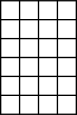
In the grid shown, of the squares are to be shaded so that there are two shaded squares in each row and three shaded squares in each column. Let be the number of shadings with this property. Find the remainder when is divided by
小提示:
先给第 列涂色,再按前两列中都被涂色的行数 分类
Shade column first, then classify by the number of rows shaded in both of the first two columns
大提示:
那 个仍为空的行必须在剩下两列中都被涂色;选择第 列后,第 列就被确定
The rows still empty must be shaded in both remaining columns; choosing column then forces column
解答:
先在第 列中选三行涂色:有 种。令 为第 列和第 列都被涂色的行数;那么第 列可用 种方式选择。前两列涂完后,有 行已经有两个涂色方格, 行有一个涂色方格, 行没有涂色方格。
空行必须在第 列和第 列中都被涂色。第 列取这 个空行,再取 个已有一个涂色方格的行,这些行共有 个,因此有 种方式;第 列随后被确定:它必须覆盖这些空行,并恰好覆盖第 列跳过的那些已有一个涂色方格的行。
求和得 所以余数为 。
Shade three of the six rows in column ways. Let be the number of rows shaded in both columns and column can then be chosen in ways. After these two columns, rows are complete with two shaded squares, rows have one, and rows have none.
The empty rows must be shaded in both columns and Column takes those rows plus of the singly-shaded rows, in ways, and column is then forced: it must cover the empty rows and exactly the singly-shaded rows skipped by column
Summing, so the remainder is
11.
对每个正整数 ,令 表示唯一的正整数 使得 。例如,,且 。若 ,求 除以 的余数。
For each positive integer let denote the unique positive integer such that For example, and If find the remainder when is divided by
小提示:
当且仅当 ,这是含有 个 值的一段
exactly when a block of values of
大提示:
对 的完整区段覆盖到 ;剩下的每个 ,直到 ,都满足
Complete blocks for cover every remaining up to has
解答:
对正整数 ,条件 意味着 ,对整数 而言,这恰好等价于 。因此,满足 的取值范围含有 个 。
因为 ,区段 恰好覆盖所有 ,贡献 剩下的 个值 都有 ,又增加 。
因此 ,余数为 。
For a positive integer the condition means which for integers is exactly So for precisely values of
Since the blocks exactly cover and contribute The remaining values each have adding
Thus and the remainder is
12.
在等腰三角形 中, 位于原点, 位于 。点 在第一象限,且 ,。将 绕点 逆时针旋转,直到 的像落在正 轴上。原三角形与旋转后三角形的公共区域面积可写成 ,其中 ,,, 为整数。求 。
In isosceles triangle is located at the origin and is located at Point is in the first quadrant with and If is rotated counterclockwise about point until the image of lies on the positive -axis, the area of the region common to the original triangle and the rotated triangle is in the form where are integers. Find
小提示:
旋转角为 ,且由于 ,,也就是 的像,垂直于
The rotation is by and since the image of is perpendicular to
大提示:
重叠部分为 ,其中 是 到 的垂足,、 在 上;使用正弦定理以及
The overlap is where is the foot of on and lie on use the law of sines and
解答:
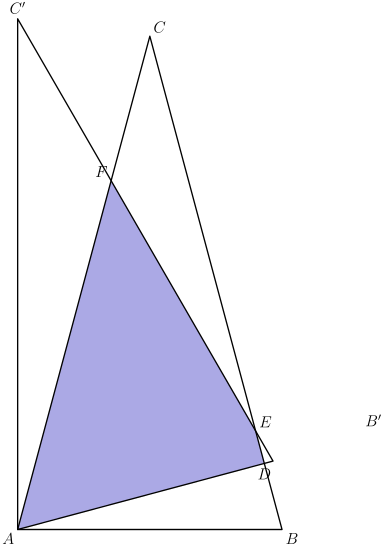
因为 与正 轴成 角,所以旋转角为 。设 和 分别为 和 的像。由于 且 ,线段 垂直于 ;令 为它们的交点,并令 ,。公共区域为四边形 ,其面积为 。
在三角形 中,,且 ,所以 ,正弦定理给出 。又 ,
在直角三角形 中,,且 ,所以 ,并且 。三角形 与 相似(都在 处为直角,且 ),所以利用 ,因此,所以 ,且 。
Since makes a angle with the positive -axis, the rotation is by Let and be the images of and Because and segment is perpendicular to let be their intersection, and let and The common region is the quadrilateral whose area is
In triangle and so and the law of sines gives With
In right triangle and so and Triangles and are similar (right angles at and ), so, using Therefore so and
13.
一个以 为底面、 为顶点的正方形棱锥有八条长为 的边。一个平面经过 ,,和 的中点。该平面与棱锥的截面面积可表示为 。求 。
A square pyramid with base and vertex has eight edges of length A plane passes through the midpoints of and The plane’s intersection with the pyramid has an area that can be expressed as Find
小提示:
使用坐标:底面为 ,,,,顶点为 ;经过三个中点的平面为
Use coordinates: base and apex the plane through the three midpoints is
大提示:
截面是一个五边形;把它分成一个等腰三角形和一个等腰梯形来求面积
The cross-section is a pentagon; split it into an isosceles triangle and an isosceles trapezoid to find its area
解答:
将底面放在 ,,,;则顶点为 ,因为 。给定的三个中点为 ,,和 ,它们都满足 ,这是切割平面的方程。
对边 和 参数化,可得平面与它们分别交于 和 。截面是五边形 ,其中 ,,,对角线 。
沿 分割五边形。等腰三角形 的高为 ,面积为 。等腰梯形 的高为 ,面积为 。总面积为 ,所以 。
Place the base at the apex is then since The given midpoints are and and all three satisfy the equation of the cutting plane.
Parametrizing edges and shows the plane meets them at and The cross-section is the pentagon with and diagonal
Split the pentagon along Isosceles triangle has height and area Isosceles trapezoid has height and area The total is so
14.
令一个数列定义如下:,,且对 ,。求不超过 的最大整数。
Let a sequence be defined as follows: and for Find the largest integer less than or equal to
小提示:
将相邻下标的递推式相减,说明 对所有 都相同
Subtract the relation for consecutive indices to show is the same for all
大提示:
将这个常数比例关系乘以 ,并使用原递推式:目标分式等于该常数减去一个很小的正数
Multiply the constant-ratio relation by and use the original recurrence: the target fraction is that constant minus a tiny positive amount
解答:
对 有 和 。相减并重新组合,得到 ,因而 对所有 取同一值。因为 ,该值为 ,数列满足 。
将 乘以 ,并代入 ,得到 ,因此
该数列递增:,且关系 在每次 时成立。因此 ,所以该分式严格介于 与 之间,答案为 。
For both and hold. Subtracting and regrouping gives so has the same value for every Since that value is and the sequence satisfies
Multiplying by and substituting yields so
The sequence increases: and whenever Hence so the fraction lies strictly between and and the answer is
15.
设 为等边三角形,点 和 分别在边 和 上,且 ,。点 在边 上,使得 。三角形 的面积为 。边长 的两个可能值为 ,其中 和 为有理数, 是不被任何质数平方整除的整数。求 。
Let be an equilateral triangle, and let and be points on sides and respectively, with and Point lies on side such that The area of triangle is The two possible values of the length of side are where and are rational, and is an integer not divisible by the square of a prime. Find
小提示:
令 且 ,从 中减去三个角上的三角形,可得
Let and and subtract the three corner triangles from to get
大提示:
强制 ,所以
forces so
解答:
令 且 。利用 角(分别位于 、、)以及面积公式 :有 ,,且 。从 中减去这三个面积并化简,所以 。
在 处,角 和 之和为 ,而在三角形 中,角 和 之和也为 。因此 ,又因为 ,三角形 与 相似。于是 给出 ,所以 。
将 代入 ,得到 ,即 ,所以 。由 可得 ,因此 。两个值都给出有效构型,所以 。
Let and Using the angles at and the area formula and Subtracting all three from and simplifying, so
At the angles and sum to while in triangle the angles and also sum to Hence and since triangles and are similar. Then gives so
Substituting into gives or so From we get so Both values yield valid configurations, so