
2006 AIME II 真题
计时
3:00:00
1.
在凸六边形 中,六条边全等, 和 是直角,且 、、 和 全等。这个六边形区域的面积为 。求 。
In convex hexagon all six sides are congruent, and are right angles, and and are congruent. The area of the hexagonal region is Find
小提示:
角 、、、 都等于 。画出对角线 和 。
Each of angles measures Draw diagonals and
大提示:
这些对角线把六边形分成两个等腰直角三角形和一个边长为 与 的矩形。
These diagonals cut the hexagon into two right isosceles triangles and a rectangle with side lengths and
解答:
六边形内角和为 ,所以这四个全等角各为 度。设 。对角线 和 截出等腰直角三角形 和 ,每个三角形的直角边为 ,斜边为 ,而 的角保证剩下的部分 是一个边长为 和 的矩形。
因此面积为 所以 ,从而 。
The angles of a hexagon sum to so each of the four congruent angles measures degrees. Let The diagonals and cut off the right isosceles triangles and each with legs and hypotenuse and the angles guarantee that the remaining piece is a rectangle with sides and
Hence the area is so and
2.
一个面积为正的三角形的三边长分别为 、 和 ,其中 是正整数。求 的可能取值个数。
The lengths of the sides of a triangle with positive area are and where is a positive integer. Find the number of possible values for
小提示:
三条边长必须满足三角形不等式;其中两个条件会从两侧限制 。
The three lengths must satisfy the triangle inequality; two of the three conditions bound from both sides.
大提示:
,所以 。
so
解答:
三角形不等式要求 ,以及 ,即 。剩下的不等式 自动成立,因为 且 。
因此 ,对整数来说就是 。共有 个可能的 值。
The triangle inequality requires and that is The remaining inequality, is automatic because and
So which for integers means That gives possible values of
3.
令 为前 个正奇数的乘积。求最大的整数 ,使得 能被 整除。
Let be the product of the first positive odd integers. Find the largest integer such that is divisible by
小提示:
数一数 中有多少个能被 整除,再数能被 、 和 整除的个数。
Count how many of are divisible by then by by and by
大提示:
每一层可整除性都会给每个保留下来的项多贡献一个因子 ,所以 是这四个计数之和。
Each divisibility layer adds one more factor of per surviving term, so is the sum of the four counts.
解答:
,所以 是因子 的总个数,统计范围是不超过 的奇数。 的奇数倍为 ,共有 个。 的奇数倍为 ,共有 个。 的奇数倍为 ,共有 个。 的奇数倍中,不超过 的唯一一个是 本身,而且没有 的倍数。
每一层都贡献一个额外的因子 ,所以 。
so is the total number of factors of among the odd numbers up to The odd multiples of are and there are of them. The odd multiples of are of them. The odd multiples of are of them. The only odd multiple of at most is itself, and there are no multiples of
Each layer contributes one additional factor of so
4.
令 是 的一个排列,满足 且 这样的排列的一个例子是 。求这类排列的个数。
Let be a permutation of for which and An example of such a permutation is Find the number of such permutations.
小提示:
小于其他十一个项,所以 。
is less than all eleven other terms, so
大提示:
一旦选出剩余 个数中的哪五个填入前五个位置,两半的顺序就都被确定了。
Once you choose which five of the remaining numbers fill the first five slots, the order of both halves is forced.
解答:
项 小于这个排列中的其他所有项,所以 。现在从剩余 个数中选择五个占据位置 到 :它们必须按递减顺序出现,所以排列方式被确定;其余六个数必须按递增顺序填入位置 到 ,这也被确定。
每一种五个数的选择都给出唯一一个合法排列,所以总数为 。
The term is smaller than every other term of the permutation, so Now choose which five of the remaining numbers occupy positions through they must appear in decreasing order, so their arrangement is forced, and the other six numbers must fill positions through in increasing order, which is also forced.
Every choice of the five numbers gives exactly one valid permutation, so the count is
5.
掷一个特定的不公平六面骰子,六个面编号为 、、、、 和 ,出现面 的概率大于 ,出现与面 相对的面的概率小于 ,出现其他每个面的概率都是 ,且每一对相对面的数字之和都是 。掷两个这样的骰子时,得到点数和为 的概率是 。已知出现面 的概率为 ,其中 和 是互质正整数,求 。
When rolling a certain unfair six-sided die with faces numbered and the probability of obtaining face is greater than the probability of obtaining the face opposite face is less than the probability of obtaining each of the other faces is and the sum of the numbers on each pair of opposite faces is When two such dice are rolled, the probability of obtaining a sum of is Given that the probability of obtaining face is where and are relatively prime positive integers, find
小提示:
将面 的概率写成 ,则相对面的概率为 。
Write the probability of face as so the opposite face has probability
大提示:
点数和为 总是来自一对相对面: 。
A sum of always comes from a pair of opposite faces:
解答:
设出现面 的概率为 ,则与 相对的面概率为 (六个概率之和必须为 )。由于相对面的数字之和为 ,点数和为 恰好发生在两个骰子显示一对相对面时。在六个有序的和为 的结果中,四个只用普通面,两个把 与它的相对面配对。因此
因为 ,得到 ,所以 。面 的概率为 ,且 。
Let the probability of face be so the face opposite has probability (the six probabilities must sum to ). Since opposite faces sum to a total of occurs exactly when the two dice show a pair of opposite faces. Of the six ordered pairs that sum to four use only ordinary faces, and two pair with its opposite. Thus
Since this gives so The probability of face is and
6.
正方形 的边长为 。点 和 分别在 和 上,使得 是等边三角形。一个以 为顶点的正方形的边与 的边平行,且有一个顶点在 上。这个小正方形的边长为 ,其中 、、 是正整数,且 不被任何质数的平方整除。求 。
Square has sides of length Points and are on and respectively, so that is equilateral. A square with vertex has sides that are parallel to those of and a vertex on The length of a side of this smaller square is where and are positive integers and is not divisible by the square of any prime. Find
小提示:
若 ,等边条件 给出 ,所以 。
If the equilateral condition gives so
大提示:
将 放在原点,直线 为 ,小正方形的远端顶点 必须落在这条直线上。
With at the origin, line is and the small square’s far corner must lie on it.
解答:
设 ,,,。由等边三角形关于对角线 的对称性,有 。令 ,则 。于是 ,,令二者相等得到 ,所以 (取小于 的根)。
因此 ,直线 为 。若小正方形的边长为 ,则它与 相对的顶点是 ,该点必须在直线 上:
所以 ,,,且 。
Place By the symmetry of the equilateral triangle across diagonal we have Let so Then and and setting them equal gives so (taking the root less than ).
Thus and line is If the smaller square has side its vertex opposite is which must lie on line
So and
7.
求正整数有序对 的个数,使得 ,并且 和 的十进制表示中都不含数字零。
Find the number of ordered pairs of positive integers such that and neither nor has a zero digit.
小提示:
改为数不合格的数对。若 的个位是 ,则 的个位也是零,可写成 ,,其中 。
Count the bad pairs instead. If ends in then so does giving with
大提示:
如果两个数的个位都不是 ,那么零数字只能是中间一位,形式为 ;此时另一个数的十位为 。
If neither number ends in a zero digit can only be a middle digit — and then the other number’s tens digit is
解答:
总共有 个数对();数其中不合格的。若 的个位为 ,则 的个位也为零,写成 , 得到 ,且 :共有 个不合格数对。
现在假设两个数的个位都非零。此时一个数含有零数字,当且仅当它是形如 的三位数,其中 (个位非零的一位数或两位数没有零数字)。若 ,则 的十位为 ,所以 不会也是这种形式。因此这里的不合格数对正好是 中恰有一个等于 :共有 个。
不合格数对总数为 ,所以答案是 。
There are pairs in all (); count the forbidden ones. If has units digit so does and writing gives with that is forbidden pairs.
Now suppose both units digits are nonzero. Then a number in the pair has a zero digit exactly when it is a three-digit number of the form with (a one- or two-digit number with nonzero units digit has no zero digit). If then has tens digit so is not also of that form. Hence the forbidden pairs here are those where exactly one of equals pairs.
The total number of forbidden pairs is so the answer is
8.
有无限多个全等的彩纸等边三角形。每个三角形都是纯色,并且纸的两面颜色相同。用其中四个纸三角形按图所示拼成一个大的等边三角形。如果不能通过平移、旋转和/或反射把一个大三角形放到另一个上面并使对应的小三角形颜色相同,则认为这两个大三角形可区分。已知可选的三角形有六种不同颜色,可以构造多少个可区分的大等边三角形?
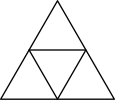
There is an unlimited supply of congruent equilateral triangles made of colored paper. Each triangle is a solid color with the same color on both sides of the paper. A large equilateral triangle is constructed from four of these paper triangles as shown. Two large triangles are considered distinguishable if it is not possible to place one on the other, using translations, rotations, and/or reflections, so that their corresponding small triangles are of the same color. Given that there are six different colors of triangles from which to choose, how many distinguishable large equilateral triangles can be constructed?
小提示:
旋转和反射可以任意置换三个角上的三角形,所以只有中心颜色和角上颜色的多重集合重要。
Rotations and reflections can permute the three corner triangles arbitrarily, so only the center color and the multiset of corner colors matter.
大提示:
数从六种颜色中选三个角上颜色的多重集合:全相同、恰有两个相同、全不同。然后乘以中心颜色的选择数。
Count the multisets of three corner colors from six: all alike, exactly two alike, all different. Then multiply by the choices for the center.
解答:
大三角形的旋转和反射能实现三个角上三角形的任意置换,同时固定中心三角形。因此两个大三角形不可区分,当且仅当它们有相同的中心颜色以及相同的三个角上颜色的多重集合。
从六种颜色中数角上颜色的多重集合:三个全相同有 种,恰有两个相同有 种(选择重复颜色和另一个不同颜色),三个全不同有 种。总共 个多重集合。
中心颜色可独立选择 种,所以总数为 。
The rotations and reflections of the large triangle realize every permutation of the three corner triangles while fixing the center triangle. So two large triangles are indistinguishable exactly when they have the same center color and the same multiset of three corner colors.
Count the multisets of corner colors from six colors: all three the same ( ways), exactly two the same ( ways, choosing the repeated color and then the different one), or all three different ( ways). That is multisets.
With independent choices for the center color, the total is
9.
圆 、、 的圆心分别为 、、,半径分别为 、、。直线 是 和 的一条公内切线,且斜率为正;直线 是 和 的一条公内切线,且斜率为负。已知直线 与 相交于 ,且 ,其中 、、 是正整数,且 不被任何质数的平方整除,求 。
Circles and have their centers at and and have radii and respectively. Line is a common internal tangent to and and has a positive slope, and line is a common internal tangent to and and has a negative slope. Given that lines and intersect at and that where and are positive integers and is not divisible by the square of any prime, find
小提示:
公内切线与两圆心连线相交于按半径之比分割该线段的点。
A common internal tangent crosses the segment joining the centers at the point that divides it in the ratio of the radii.
大提示:
是 , 是 ;令它们相等并有理化。
is and is set them equal and rationalize.
解答:
公内切线与两圆心的连线相交于按半径之比分割该线段的点。对于 和 ,该点为 ,与圆心 相距 。若 与 轴所成的角为 ,则 ,所以 ,且 的方程为 。对于 和 ,该点为 ,与圆心 相距 。此时 ,所以斜率为 ,且 的方程为 。
令两式相等并乘以 ,得到 ,所以 ,且
因此 。
A common internal tangent meets the segment between the centers at the point dividing it in the ratio of the radii. For and that point is at distance from If makes angle with the -axis, then so and is For and the point is at distance from here so the slope is and is
Setting the two expressions equal and multiplying by gives so and
Thus
10.
七支球队参加一项足球锦标赛,每支球队与其他每支球队恰好比赛一次。没有平局,每支球队在每场比赛中获胜的概率都是 ,且各场比赛结果相互独立。每场比赛中,胜者得 分,负者得 分。用总积分决定球队排名。在锦标赛第一场比赛中,球队 击败球队 。球队 最终积分高于球队 的概率为 ,其中 和 是互质正整数。求 。
Seven teams play a soccer tournament in which each team plays every other team exactly once. No ties occur, each team has a chance of winning each game it plays, and the outcomes of the games are independent. In each game, the winner is awarded point and the loser gets points. The total points are accumulated to decide the ranks of the teams. In the first game of the tournament, team beats team The probability that team finishes with more points than team is where and are relatively prime positive integers. Find
小提示:
开始时领先一分,且不会再与 比赛,所以 最终领先恰好等价于 在剩余 场中获胜场数不少于 。
starts one point ahead and never plays again, so finishes ahead exactly when wins at least as many of its remaining games as does.
大提示:
剩余胜场数相等的概率为 ;由对称性,其他结果在两队之间平分。
The chance the remaining win counts are equal is by symmetry the other outcomes split evenly between the teams.
解答:
球队 和 各还剩 场比赛,彼此之间没有比赛,所以所有 种结果等可能。由于 已领先一分, 最终积分更高恰好发生在 剩余获胜场数至少与 一样多时。
胜场数相等的结果数为 由对称性,其余 种结果平均分为 胜场更多和 胜场更多两类。
所以概率为 ,且 。
Teams and each have games left, none against each other, so all outcomes are equally likely. Since already leads by one point, finishes with more points exactly when wins at least as many remaining games as does.
The number of outcomes with equal win counts is By symmetry, the other outcomes split evenly between winning more and winning more.
So the probability is and
11.
一个数列定义如下:,且对所有正整数 ,。已知 ,,且 ,求 除以 的余数。
A sequence is defined as follows: and, for all positive integers Given that and find the remainder when is divided by
小提示:
计算前几个部分和,并将它们与数列本身比较,从中找出规律。
Compute the first several partial sums and compare them with the sequence itself to spot a pattern.
大提示:
用递推式归纳可得 。
Induction using the recurrence shows
解答:
令 。我们断言 ,对 成立,因为 。若它对 成立,则 这一步用到了递推式,归纳因而完成。
因此 ,除以 的余数为 。
Let We claim which holds for since If it holds for then by the recurrence, completing the induction.
Therefore whose remainder upon division by is
12.
等边 内接于半径为 的圆。将 经过 延长到点 ,使 ,并将 经过 延长到点 ,使 。过 ,作直线 平行于 ,过 ,作直线 平行于 。令 为 和 的交点。令 为圆上与 和 共线且不同于 的点。已知 的面积可表示为 ,其中 、 和 是正整数, 与 互质,且 不被任何质数的平方整除,求 。
Equilateral is inscribed in a circle of radius Extend through to point so that and extend through to point so that Through draw a line parallel to and through draw a line parallel to Let be the intersection of and Let be the point on the circle that is collinear with and and distinct from Given that the area of can be expressed in the form where and are positive integers, and are relatively prime, and is not divisible by the square of any prime, find
小提示:
是平行四边形,所以 ;用余弦定理求出 和 。
is a parallelogram, so find and by the law of cosines.
大提示:
圆周角说明 ,相似比为 ,其中 。
Inscribed angles show with ratio where
解答:
根据构造, 是平行四边形,其中 ,,且 。因此 ,由余弦定理,
因为 在圆上,圆周角给出 (都截同一段弧 )以及 (都截同一段弧 );并且 ,因为 。所以 ,相似比为 。内接于半径 的圆的等边三角形边长为 。
因此 且 。
By construction is a parallelogram with and Hence and by the law of cosines,
Since lies on the circle, inscribed angles give (both subtend arc ) and (both subtend arc ); and because So with ratio The side of an equilateral triangle inscribed in a circle of radius is
Therefore and
13.
有多少个整数 小于 可以写成 个连续正奇数之和,并且这样的表示恰好对应 个 的取值?
How many integers less than can be written as the sum of consecutive positive odd integers for exactly values of
小提示:
连续奇数之和是平方差:它等于 。
A sum of consecutive odd numbers is a difference of squares: it equals
大提示:
因此要数分解 ,其中 且二者同奇偶。当 (奇数情形)或 (偶数情形)有 或 个因数时,恰有五个这样的分解。
So count factorizations with of equal parity: exactly five occur when (odd case) or (even case) has or divisors.
解答:
从第 个到第 个正奇数的和为 。令 ,,则 的表示与分解 一一对应,其中 且 同奇偶(此时 ,)。所以我们需要 恰有 个这样的分解。
如果 是奇数,每一对因数都可行,所以 需要有 或 个因数,即 、、 或 ,其中 是不同奇质数。小于 时, 和 不可能, 给出 和 ,而 给出 、、:共五个奇数值。
如果 是偶数,两个因数都必须为偶数,所以 ,这些分解对应于 的因数对,没有奇偶限制;我们需要 且有 或 个因数。有 个因数的数为 、、、;有 个因数的数(形如 )为 、、、、、。这给出 个偶数值,总计 。
The sum of the th through th positive odd integers is Writing and the representations of correspond exactly to the factorizations with and of the same parity (then ). So we need to have exactly such factorizations.
If is odd, every divisor pair works, so needs or divisors, i.e. or with distinct odd primes. Below and are impossible, gives and and gives five odd values.
If is even, both factors must be even, so and the factorizations correspond to divisor pairs of with no parity restriction; we need with or divisors. With divisors: With divisors (): That is even values, for a total of
14.
令 为从 到 (含端点)所有整数的非零数字的倒数之和。求最小的正整数 ,使得 是整数。
Let be the sum of the reciprocals of the nonzero digits of the integers from to inclusive. Find the smallest positive integer for which is an integer.
小提示:
用前导零补齐:在小于 的整数中,每个数字出现次数相同,所以每个非零数字出现 次。
Pad with leading zeros: among the integers below every digit appears equally often — each nonzero digit times.
大提示:
,所以需要 能被 整除;检查 中哪些因子无法由 的幂提供。
so you need to be divisible by — check which factors of the power of cannot supply.
解答:
将 到 的整数写成带前导零的 位字符串。在这 个数位中的每一个上,每个数字出现的次数都相同,所以每个非零数字共出现 次。再计入数字 ,它来自 本身,得到
因为 ,该和是整数当且仅当 能被 整除。现在 ,且当 时,因子 提供 ,剩下条件 能被 整除( 的幂不含因子 或 )。对于 ,乘积 都不是 的倍数。
因此最小解为 。
Write the integers from to as -digit strings with leading zeros. Each of the digit positions takes each digit value equally often, so each nonzero digit appears times. Adding the digit of itself,
Since the sum is an integer exactly when is divisible by Now and for the factor supplies leaving the condition that be divisible by (a power of has no factors of or ). For the products are not multiples of
The smallest solution is therefore
15.
已知 、、 是实数,且满足 又已知 ,其中 和 是正整数,且 不被任何质数的平方整除。求 。
Given that and are real numbers that satisfy and that where and are positive integers, and is not divisible by the square of any prime, find
小提示:
将 理解为一个直角三角形的直角边,其中斜边为 ,另一条直角边为 。
Interpret as a leg of a right triangle with hypotenuse and other leg
大提示:
构造一个边长为 、、 的三角形,其高分别为 、、。则 、、,其中面积为 ;使用海伦公式。
Build a triangle with sides whose altitudes are Then with area use Heron.
解答:
每个根式 都可看作一个直角三角形的直角边,其中斜边为 ,另一条直角边为 。因此第一个方程表示:在一个三角形 中,令 、、,从 作出的高为 ,且高的垂足把 分成两个根式长度。其他方程说明到边 和 的高分别为 和 。
若 为这个三角形的面积,则 给出 ,同理 ,。它们与 成比例,且 ,所以三角形为锐角三角形,高的垂足确实落在边内。海伦公式配合 给出 所以 ,且 。
于是 ,所以 。
Each radical is the leg of a right triangle with hypotenuse and other leg So the first equation says: in a triangle with the altitude from has length and its foot splits into the two radical lengths. The other equations say the altitudes to sides and are and
If is the area of this triangle, then gives and likewise and These are proportional to and so the triangle is acute and the altitude feet do land inside the sides. Heron’s formula with gives so and
Then so