
Soluciones del 2020 AMC 12B
Desplázate hacia abajo para ver las soluciones preparadas profesionalmente de LIVE by Po-Shen Loh, imprime las soluciones en PDF, consulta la clave de respuestas, o haz el examen cronometrado completo.
Todos los problemas se usan con el permiso legal oficial de la Mathematical Association of America (MAA).
1.
¿Cuál es el valor, en su forma más simple, de la siguiente expresión?
What is the value in simplest form of the following expression?
Pista pequeña:
La suma de los primeros números impares es .
The sum of the first odd numbers is
Pista grande:
Cada término se simplifica a y .
Each term simplifies to and
Solución:
La suma de los primeros números impares es igual a así que cada radicando es un cuadrado perfecto:
Por lo tanto, la respuesta correcta es C.
The sum of the first odd numbers equals so each radicand is a perfect square:
Thus, the correct answer is C.
2.
¿Cuál es el valor de la siguiente expresión?
What is the value of the following expression?
Pista pequeña:
Diferencia de cuadrados: .
Pista grande:
Factoriza y , luego busca los factores que se cancelan.
Factor and , then look for cancellation
Solución:
Usando la diferencia de cuadrados, y La expresión se convierte en
Por lo tanto, la respuesta correcta es A.
Using the difference of squares, and The expression becomes
Thus, the correct answer is A.
3.
La razón de a es la razón de a es y la razón de a es ¿Cuál es la razón de a ?
The ratio of to is the ratio of to is and the ratio of to is What is the ratio of to
Pista pequeña:
Elige un valor conveniente como y calcula y luego .
Pick a convenient value such as and work out then
Pista grande:
A partir de toma entonces y .
From take then and
Solución:
Sea A partir de obtenemos A partir de obtenemos A partir de obtenemos
Por lo tanto,
Por lo tanto, la respuesta correcta es E.
Let From we get From we get From we get
Therefore
Thus, the correct answer is E.
4.
Los ángulos agudos de un triángulo rectángulo son y donde y tanto como son números primos. ¿Cuál es el menor valor posible de ?
The acute angles of a right triangle are and where and both and are prime numbers. What is the least possible value of
Pista pequeña:
Los ángulos agudos satisfacen .
The acute angles satisfy
Pista grande:
Prueba los primos más pequeños para y verifica si también es primo.
Try the smallest primes for and check whether is also prime
Solución:
Como los ángulos son complementarios, Para minimizar prueba primos pequeños y exige que también sea primo.
Para el valor no es primo. Para obtenemos que es primo. Así que el menor valor posible es
Por lo tanto, la respuesta correcta es D.
Since the angles are complementary, To minimize try small primes and require to be prime as well.
For the value is not prime. For we get which is prime. So the least possible value is
Thus, the correct answer is D.
5.
Los equipos y juegan en una liga de baloncesto donde cada partido resulta en una victoria para un equipo y una derrota para el otro. El equipo ha ganado de sus partidos y el equipo ha ganado de los suyos. Además, el equipo ha ganado partidos más y perdido partidos más que el equipo ¿Cuántos partidos ha jugado el equipo ?
Teams and are playing in a basketball league where each game results in a win for one team and a loss for the other team. Team has won of its games and team has won of its games. Also, team has won more games and lost more games than team How many games has team played?
Pista pequeña:
Supón que juega partidos y juega partidos, luego escribe las condiciones de victorias y derrotas.
Let play games and play games, then write both the win and loss conditions
Pista grande:
Victorias: derrotas: .
Wins: losses:
Solución:
Sea el número de partidos que jugó el equipo y el número que jugó el equipo . El equipo gana y pierde el equipo gana y pierde Las condiciones dan y
Restando las ecuaciones se obtiene así que Sustituyendo en la ecuación de derrotas: es decir de modo que y
Por lo tanto, la respuesta correcta es C.
Let be the number of games team played and the number team played. Team wins and loses team wins and loses The conditions give and
Subtracting the equations gives so Substituting into the loss equation: i.e. so and
Thus, the correct answer is C.
6.
Para todos los enteros el valor de
¿es siempre cuál de las siguientes opciones?
For all integers the value of
is always which of the following?
un múltiplo de
a multiple of
un múltiplo de
a multiple of
un número primo
a prime number
un cuadrado perfecto
a perfect square
un cubo perfecto
a perfect cube
Pista pequeña:
Factoriza del numerador.
Factor out of the numerator
Pista grande:
.
Solución:
Factoriza del numerador:
Al dividir entre queda que siempre es un cuadrado perfecto.
Por lo tanto, la respuesta correcta es D.
Factor from the numerator:
Dividing by leaves which is always a perfect square.
Thus, the correct answer is D.
7.
Dos rectas del plano de coordenadas , ninguna horizontal ni vertical, se intersecan formando un ángulo de . Una recta tiene pendiente igual a veces la pendiente de la otra. ¿Cuál es el mayor valor posible del producto de las pendientes de las dos rectas?
Two nonhorizontal, non-vertical lines in the -coordinate plane intersect to form a angle. One line has slope equal to times the slope of the other line. What is the greatest possible value of the product of the slopes of the two lines?
Pista pequeña:
La tangente del ángulo entre rectas de pendientes es .
The tangent of the angle between lines of slopes is
Pista grande:
Con pendientes y plantea y maximiza .
With slopes and set and maximize
Solución:
Sean las pendientes y El ángulo entre las rectas cumple así que lo que da o
La primera da o la segunda da los opuestos de estos. El producto de las pendientes es que es máximo cuando dando
Por lo tanto, la respuesta correcta es C.
Let the slopes be and The angle between the lines satisfies so giving or
The first yields or the second yields the negatives of these. The product of the slopes is which is largest when giving
Thus, the correct answer is C.
8.
¿Cuántos pares ordenados de enteros satisfacen la ecuación
How many ordered pairs of integers satisfy the equation
Infinitos
infinitely many
Pista pequeña:
Completa el cuadrado en .
Complete the square in
Pista grande:
Como y solo puede funcionar.
Since and only can work
Solución:
Completar el cuadrado da Ambos términos son no negativos, así que lo que obliga a
Si entonces lo que da o Si entonces así que y Las soluciones son y : cuatro en total.
Por lo tanto, la respuesta correcta es D.
Completing the square gives Both terms are nonnegative, so forcing
If then giving or If then so and The solutions are and — four in all.
Thus, the correct answer is D.
9.
Un sector de tres cuartos de un círculo de radio pulgadas, junto con su interior, se puede enrollar para formar la superficie lateral de un cono circular recto pegando a lo largo de los dos radios mostrados. ¿Cuál es el volumen del cono en pulgadas cúbicas?
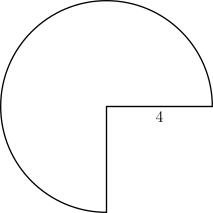
A three-quarter sector of a circle of radius inches together with its interior can be rolled up to form the lateral surface of a right circular cone by taping together along the two radii shown. What is the volume of the cone in cubic inches?
Pista pequeña:
La longitud del arco del sector se convierte en la circunferencia de la base del cono.
The arc length of the sector becomes the circumference of the cone’s base
Pista grande:
El radio del sector se convierte en la generatriz; halla el radio de la base y luego la altura del cono.
The sector radius becomes the slant height; find the base radius, then the cone’s height
Solución:
La longitud del arco del sector es que se convierte en la circunferencia de la base: así que
La generatriz es el radio del sector así que la altura es El volumen es
Por lo tanto, la respuesta correcta es C.
The sector’s arc length is which becomes the base circumference: so
The slant height is the sector radius so the height is The volume is
Thus, the correct answer is C.
10.
En el cuadrado unitario la circunferencia inscrita corta a en y corta a en un punto distinto de ¿Cuánto vale ?
In unit square the inscribed circle intersects at and intersects at a point different from What is
Pista pequeña:
Coloca de modo que la circunferencia tiene centro y .
Place so the circle has center and
Pista grande:
Sustituye la recta en la ecuación de la circunferencia; las dos raíces dan y .
Substitute the line into the circle’s equation; the two roots give and
Solución:
Sea La circunferencia inscrita tiene centro y radio y toca en
La recta es Sustituyendo en se obtiene con raíces (punto ) y (punto ).
Así que y
Por lo tanto, la respuesta correcta es B.
Let The inscribed circle has center and radius touching at
Line is Substituting into gives with roots (point ) and (point ).
So and
Thus, the correct answer is B.
11.
Como se muestra en la figura de abajo, seis semicírculos están en el interior de un hexágono regular de lado , de modo que los diámetros de los semicírculos coinciden con los lados del hexágono. ¿Cuál es el área de la región sombreada, dentro del hexágono pero fuera de todos los semicírculos?
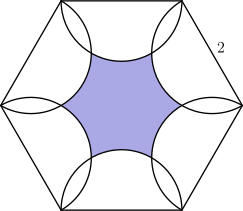
As shown in the figure below, six semicircles lie in the interior of a regular hexagon with side length so that the diameters of the semicircles coincide with the sides of the hexagon. What is the area of the shaded region—inside the hexagon but outside all of the semicircles?
Pista pequeña:
El área del hexágono es con y cada semicírculo tiene radio .
The hexagon area is with and each semicircle has radius
Pista grande:
Los semicírculos adyacentes se solapan; resta la unión, teniendo en cuenta las seis lentes de solapamiento.
Adjacent semicircles overlap; subtract the union, accounting for the six overlapping lenses
Solución:
El hexágono tiene área Cada semicírculo tiene radio y área sumando
Los centros de semicírculos adyacentes (puntos medios de los lados) están a distancia , así que cada par adyacente se solapa en una lente de área Hay seis lentes de este tipo.
La unión de los semicírculos tiene área Al restarla del hexágono, se obtiene el área sombreada
Por lo tanto, la respuesta correcta es D.
The hexagon has area Each semicircle has radius and area totaling
Adjacent semicircle centers (side midpoints) are a distance apart, so each adjacent pair overlaps in a lens of area There are six such lenses.
The union of the semicircles is Subtracting from the hexagon gives the shaded area
Thus, the correct answer is D.
12.
Sea un diámetro de una circunferencia de radio Sea una cuerda de la circunferencia que corta a en un punto tal que y ¿Cuánto vale ?
Let be a diameter in a circle of radius Let be a chord in the circle that intersects at a point such that and What is
Pista pequeña:
Coloca el centro en el origen con sobre el eje y parametriza la cuerda desde a .
Put the center at the origin with on the -axis and parametrize the chord from at
Pista grande:
Si son las distancias con signo desde hasta entonces .
If are the signed distances from to then
Solución:
Coloca el centro en el origen con sobre el eje ; el radio es así que Entonces con (su valor exacto no hace falta).
Parametriza la cuerda como Sustituyendo en se obtiene cuyas raíces son las distancias con signo hasta y
Por Vieta, y así que
Por lo tanto, la respuesta correcta es E.
Place the center at the origin with on the -axis; the radius is so Then with (its exact value is not needed).
Parametrize the chord as Substituting into gives whose roots are the signed distances to and
By Vieta, and so
Thus, the correct answer is E.
13.
¿Cuál de las siguientes es el valor de ?
Which of the following is the value of
Pista pequeña:
Escribe y .
Write and
Pista grande:
Compara con usando .
Compare with using
Solución:
Sea así que Entonces
Mientras tanto, que es igual a la expresión anterior.
Tomando raíces cuadradas,
Por lo tanto, la respuesta correcta es D.
Let so Then
Meanwhile which equals the expression above.
Taking square roots,
Thus, the correct answer is D.
14.
Bela y Jenn juegan al siguiente juego en el intervalo cerrado de la recta de los números reales, donde es un entero fijo mayor que Se turnan para jugar, y Bela empieza. En su primer turno, Bela elige cualquier número real del intervalo Después, el jugador al que le toca elige un número real que esté a más de una unidad de distancia de todos los números elegidos previamente por cualquiera de los dos. Un jugador que no pueda elegir tal número pierde. Con estrategia óptima, ¿qué jugador ganará el juego?
Bela and Jenn play the following game on the closed interval of the real number line, where is a fixed integer greater than They take turns playing, with Bela going first. At his first turn, Bela chooses any real number in the interval Thereafter, the player whose turn it is chooses a real number that is more than one unit away from all numbers previously chosen by either player. A player unable to choose such a number loses. Using optimal strategy, which player will win the game?
Bela siempre ganará.
Bela will always win.
Jenn siempre ganará.
Jenn will always win.
Bela ganará si y solo si es impar.
Bela will win if and only if is odd.
Jenn ganará si y solo si es impar.
Jenn will win if and only if is odd.
Jenn ganará si y solo si
Jenn will win if and only if
Pista pequeña:
Considera qué pasa si Bela juega primero exactamente en el punto medio del intervalo.
Consider what happens if Bela plays exactly at the midpoint of the interval first
Pista grande:
Después de ocupar el centro, Bela puede reflejar cada jugada de Jenn a través del punto medio.
After claiming the center, Bela can mirror each of Jenn’s moves through the midpoint
Solución:
Bela juega primero el punto medio Esta elección hace que la configuración sea simétrica respecto al centro del intervalo.
Después, cada vez que Jenn elige un número Bela responde con su imagen reflejada Como Bela ya eligió toda jugada legal de Jenn satisface Por tanto, de modo que la respuesta de Bela está suficientemente alejada del nuevo punto de Jenn. Por simetría, también está suficientemente alejada de todos los puntos anteriores. Así, Bela siempre tiene una jugada cuando Jenn la tiene, por lo que Jenn es la primera en quedarse sin movimientos. Bela siempre gana.
Por lo tanto, la respuesta correcta es A.
Bela first plays the midpoint This choice makes the configuration symmetric about the center of the interval.
Thereafter, whenever Jenn picks a number Bela responds with its mirror image Since Bela has already chosen Jenn’s legal move satisfies Therefore so Bela’s response is far enough from Jenn’s new point. Symmetry shows that it is also far enough from every earlier point. Thus Bela always has a move whenever Jenn does, so Jenn is the first to be stuck. Bela always wins.
Thus, the correct answer is A.
15.
Hay personas dispuestas de forma equidistante alrededor de un círculo. Cada persona conoce exactamente a de las otras : las personas que están a su lado, así como la persona directamente al otro lado del círculo. ¿De cuántas maneras pueden las personas dividirse en parejas de modo que los dos miembros de cada pareja se conozcan?
There are people standing equally spaced around a circle. Each person knows exactly of the other people: the people standing next to her or him, as well as the person directly across the circle. How many ways are there for the people to split up into pairs so that the members of each pair know each other?
Pista pequeña:
Cuenta los emparejamientos perfectos usando aristas que son pares adyacentes (vecinos) o diámetros (opuestos).
Count perfect matchings using edges that are either adjacent (neighbor) pairs or diameters (across)
Pista grande:
Organiza según cuántos pares diámetro se usan; solo pueden ocurrir o de ellos.
Organize by how many diameter pairs are used; only or of them can occur
Solución:
Etiqueta a las personas del al Los emparejamientos permitidos usan aristas de vecinos o aristas de diámetro Cuenta los emparejamientos perfectos según el número de aristas de diámetro usadas.
Sin diámetros, las diez personas se emparejan en parejas adyacentes de maneras (todas las aristas “pares” o todas las “impares”). Con exactamente un diámetro, se elige de maneras; los dos arcos restantes de cuatro personas cada uno se emparejan de forma única, dando Con los cinco diámetros se obtiene emparejamiento.
Si se usa al menos un diámetro, seguir los emparejamientos adyacentes forzados alrededor del círculo muestra que el número de diámetros debe ser impar. Con exactamente tres diámetros, las cuatro personas restantes deben formar dos pares adyacentes opuestos. La posición de uno de esos pares determina el emparejamiento, dando posibilidades. En total,
Por lo tanto, la respuesta correcta es C.
Label the people through Allowed pairings use neighbor edges or diameter edges Count perfect matchings by the number of diameter edges used.
Using no diameters, the ten people split into adjacent pairs in ways (all “even” edges or all “odd” edges). Using exactly one diameter, choose it in ways; the remaining two arcs of four people each pair up uniquely, giving Using all five diameters gives matching.
If at least one diameter is used, following the forced adjacent pairings around the circle shows that the number of diameters must be odd. With exactly three diameters, the four remaining people must be two opposite adjacent pairs. The position of one such opposite pair determines the matching, giving possibilities. Hence the total is
Thus, the correct answer is C.
16.
Una urna contiene una bola roja y una bola azul. Cerca hay una caja con bolas rojas y azules adicionales. George realiza la siguiente operación cuatro veces: saca una bola de la urna al azar y luego toma de la caja una bola del mismo color, y devuelve esas dos bolas iguales a la urna. Después de las cuatro iteraciones, la urna contiene seis bolas. ¿Cuál es la probabilidad de que la urna contenga tres bolas de cada color?
An urn contains one red ball and one blue ball. A box of extra red and blue balls lies nearby. George performs the following operation four times: he draws a ball from the urn at random and then takes a ball of the same color from the box and returns those two matching balls to the urn. After the four iterations the urn contains six balls. What is the probability that the urn contains three balls of each color?
Pista pequeña:
Llegar a tres de cada color significa que exactamente dos de las cuatro bolas añadidas son rojas.
Reaching three of each color means exactly two of the four added balls are red
Pista grande:
Cualquier orden específico de dos adiciones rojas y dos azules tiene la misma probabilidad, así que el número de bolas rojas es uniforme.
Any specific order of two red and two blue additions has the same probability, so the number of red balls is uniform
Solución:
Para terminar con tres de cada color, exactamente dos de las cuatro bolas añadidas deben ser rojas. Considera cualquier secuencia de extracciones. Cuando la urna tiene bolas, sacar un color concreto con conteo tiene probabilidad
Cualquier orden con dos adiciones rojas y dos azules da el mismo producto y hay de esos órdenes, para una probabilidad (Equivalentemente, el número de bolas rojas después de cuatro pasos es uniforme en así que rojas ocurre con probabilidad )
Por lo tanto, la respuesta correcta es B.
To end with three of each color, exactly two of the four added balls must be red. Consider any sequence of draws. When the urn holds balls, drawing a particular color with count has probability
Any ordering with two red and two blue additions gives the same product and there are such orderings, for probability (Equivalently, the number of red balls after four steps is uniform on so red occurs with probability )
Thus, the correct answer is B.
17.
¿Cuántos polinomios de la forma donde y son números reales, tienen la propiedad de que siempre que es raíz, también lo es ? (Nota que )
How many polynomials of the form where and are real numbers, have the property that whenever is a root, so is (Note that )
Pista pequeña:
es una raíz cúbica primitiva de la unidad, así que las raíces no nulas vienen en tríos .
is a primitive cube root of unity, so nonzero roots come in triples
Pista grande:
Con cinco raíces, las raíces distintas forman un solo trío con multiplicidades que suman los coeficientes reales fuerzan simetría conjugada.
With five roots the distinct roots form one triple with multiplicities summing to real coefficients force conjugate symmetry
Solución:
Aquí es una raíz cúbica primitiva de la unidad. Como no es raíz, el conjunto de raíces distintas es cerrado bajo la multiplicación por así que consta de tríos igualmente espaciados en argumento. Cinco raíces no pueden llenar dos de esos tríos, así que hay exactamente un trío, con multiplicidades que suman
Los coeficientes reales exigen que el multiconjunto de raíces sea cerrado bajo conjugación. Esto solo es posible cuando los argumentos del trío son simétricos respecto al eje real, lo que ocurre para las dos configuraciones y
El producto de las raíces debe ser igual a En la primera configuración la raíz real es positiva, forzando un producto positivo, lo cual es imposible. En la segunda, la raíz real es negativa y el producto es tomar funciona, y los dos patrones de multiplicidad simétricos por conjugación y dan cada uno un polinomio válido. Por lo tanto hay
Por lo tanto, la respuesta correcta es C.
Here is a primitive cube root of unity. Since is not a root, the set of distinct roots is closed under multiplication by so it consists of triples equally spaced in argument. Five roots cannot fill two such triples, so there is exactly one triple, with multiplicities summing to
Real coefficients require the root multiset to be closed under conjugation. This is possible only when the triple’s arguments are symmetric about the real axis, which happens for the two configurations and
The product of the roots must equal In the first configuration the real root is positive, forcing a positive product, which is impossible. In the second, the real root is negative and the product is setting works, and the two conjugate-symmetric multiplicity patterns and each give a valid polynomial. Hence there are
Thus, the correct answer is C.
18.
En el cuadrado los puntos y están sobre y respectivamente, de modo que Los puntos y están sobre y respectivamente, y los puntos y están sobre de modo que y Ve la figura de abajo. El triángulo el cuadrilátero el cuadrilátero y el pentágono tienen área ¿Cuánto vale ?
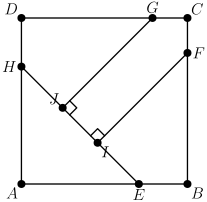
In square points and lie on and respectively, so that Points and lie on and respectively, and points and lie on so that and See the figure below. Triangle quadrilateral quadrilateral and pentagon each has area What is
Pista pequeña:
Las cuatro regiones cubren el cuadrado, así que su área es y su lado es .
The four regions tile the square, so its area is and its side is
Pista grande:
es un triángulo rectángulo isósceles de área así que establece coordenadas y usa el área de .
is an isosceles right triangle of area so set coordinates and use the area of
Solución:
Las cuatro regiones tienen área total así que el cuadrado tiene lado Pon Como es un triángulo rectángulo isósceles de área obtenemos así que y La recta es
Sea Su distancia perpendicular a la recta es Escribe entonces el pie de la perpendicular es La fórmula del cordón para y da Como esta área es se obtiene
Entonces
Por lo tanto, la respuesta correcta es B.
The four regions have total area so the square has side Put Since is an isosceles right triangle with area we get so and Line is
Let Its perpendicular distance to line is Write so the foot of the perpendicular is The shoelace formula on and gives Since this area is we get
Then
Thus, the correct answer is B.
19.
El cuadrado en el plano de coordenadas tiene vértices en los puntos y Considera las siguientes cuatro transformaciones:
una rotación de en sentido antihorario alrededor del origen;
una rotación de en sentido horario alrededor del origen;
una reflexión respecto al eje ; y
una reflexión respecto al eje .
Cada una de estas transformaciones mapea el cuadrado sobre sí mismo, pero las posiciones de los vértices etiquetados cambiarán. Por ejemplo, aplicar y luego enviaría el vértice en a y enviaría el vértice en a sí mismo. ¿Cuántas secuencias de transformaciones elegidas de enviarán todos los vértices etiquetados de vuelta a sus posiciones originales? (Por ejemplo, es una secuencia de transformaciones que envía los vértices de vuelta a sus posiciones originales.)
Square in the coordinate plane has vertices at the points and Consider the following four transformations:
a rotation of counterclockwise around the origin;
a rotation of clockwise around the origin;
a reflection across the -axis; and
a reflection across the -axis.
Each of these transformations maps the square onto itself, but the positions of the labeled vertices will change. For example, applying and then would send the vertex at to and would send the vertex at to itself. How many sequences of transformations chosen from will send all of the labeled vertices back to their original positions? (For example, is one sequence of transformations that will send the vertices back to their original positions.)
Pista pequeña:
Las primeras transformaciones pueden ser cualquier cosa; la última queda entonces forzada a ser la inversa única.
The first transformations can be anything; the last one is then forced to be the unique inverse
Pista grande:
El último movimiento forzado debe ser una de las cuatro transformaciones permitidas; halla la probabilidad de que lo sea.
The forced last move must be one of the four allowed transformations; find the probability that it is
Solución:
Etiquetemos los vértices cíclicamente. Cada transformación permitida tiene la forma donde y Estas cuatro elecciones dan exactamente los dos giros de un cuarto de vuelta y las dos reflexiones indicadas.
Bajo composición, la paridad de cambia en cada paso. Por tanto, una composición de transformaciones permitidas vuelve a tener impar y es una de las cuatro transformaciones permitidas. Su inversa también está permitida. En consecuencia, cada sucesión de los primeros movimientos tiene exactamente una opción para el movimiento final, lo que da sucesiones exitosas.
Por lo tanto, la respuesta correcta es C.
Label the vertices cyclically. Each allowed transformation has the form where and These four choices give exactly the two quarter-turns and the two stated reflections.
Under composition, the parity of changes at every move. Thus a composition of allowed transformations again has odd and so is one of the four allowed transformations. Its inverse is also allowed. Consequently every sequence of the first moves has exactly one choice for the final move, giving successful sequences.
Thus, the correct answer is C.
20.
Dos cubos diferentes del mismo tamaño se van a pintar, eligiendo el color de cada cara de forma independiente y al azar entre negro o blanco. ¿Cuál es la probabilidad de que, después de pintarlos, los cubos puedan rotarse para verse idénticos?
Two different cubes of the same size are to be painted, with the color of each face being chosen independently and at random to be either black or white. What is the probability that after they are painted, the cubes can be rotated to be identical in appearance?
Pista pequeña:
La probabilidad es , donde la suma recorre las clases de equivalencia por rotación de las coloraciones.
The probability equals , where the sum is over rotation-equivalence classes of colorings
Pista grande:
Agrupa las coloraciones según el número de caras negras y halla el tamaño de órbita de cada clase (por ejemplo, dos caras negras: opuestas dan tamaño adyacentes dan tamaño ).
Group colorings by number of black faces and find each class’s orbit size (e.g. two black faces: opposite gives size adjacent gives size )
Solución:
Para un primer cubo fijo, el número de segundos cubos que coinciden con él (salvo rotación) es igual al tamaño de su órbita de rotación. Así que la probabilidad buscada es
Agrupando por número de caras negras, los tamaños de órbita son: o negras o negras o negras (opuestas) y (adyacentes); negras (vértice) y (banda). Entonces
La probabilidad es
Por lo tanto, la respuesta correcta es D.
For a fixed first cube, the number of second cubes matching it (up to rotation) equals the size of its rotation orbit. So the desired probability is
Grouping by black-face count, the orbit sizes are: or black or black or black (opposite) and (adjacent); black (corner) and (band). Then
The probability is
Thus, the correct answer is D.
21.
¿Cuántos enteros positivos satisfacen
(Recuerda que es el mayor entero que no supera a )
How many positive integers satisfy
(Recall that is the greatest integer not exceeding )
Pista pequeña:
Sea de modo que debe satisfacer .
Let so must satisfy
Pista grande:
Esto da y cuenta los enteros .
This gives and count integer
Solución:
El lado derecho es un entero, así que sea Entonces y requiere
La cota inferior da es decir La cota superior da es decir o
Intersecando, lo que da valores de
Por lo tanto, la respuesta correcta es C.
The right side is an integer, so let Then and requires
The lower bound gives i.e. The upper bound gives i.e. or
Intersecting, giving values of
Thus, the correct answer is C.
22.
¿Cuál es el valor máximo de
para valores reales de ?
What is the maximum value of
for real values of
Pista pequeña:
Sea entonces .
Let then
Pista grande:
La expresión se convierte en una parábola hacia abajo en .
The expression becomes a downward parabola in
Solución:
Separa la fracción: Sea así que y la expresión es
Esta parábola tiene su máximo en con valor Como es continua y alcanza el valor el máximo se alcanza.
Por lo tanto, la respuesta correcta es C.
Split the fraction: Let so and the expression is
This parabola has maximum at with value Since is continuous and attains the value the maximum is achieved.
Thus, the correct answer is C.
23.
¿Cuántos enteros tienen la propiedad de que, siempre que sean números complejos tales que y entonces están igualmente espaciados en la circunferencia unitaria del plano complejo?
How many integers are there such that whenever are complex numbers such that and then the numbers are equally spaced on the unit circle in the complex plane?
Pista pequeña:
Revisa casos pequeños: fuerza puntos antipodales y fuerza un triángulo equilátero.
Check small cases: forces antipodal points and forces an equilateral triangle
Pista grande:
Para construye un contraejemplo combinando una configuración balanceada más pequeña con un par antipodal.
For build a counterexample by combining a smaller balanced configuration with an antipodal pair
Solución:
Para fuerza que está igualmente espaciado. Para tres vectores unitarios que suman cero deben formar un triángulo equilátero, así que están igualmente espaciados.
Para todo entero par elige pares antipodales en ángulos genéricos que no formen un -gono regular. Para todo entero impar elige los vértices de un triángulo equilátero junto con pares antipodales genéricos. Cada construcción tiene suma pero sus puntos no están igualmente espaciados.
Por lo tanto, solo y funcionan, dando valores.
Por lo tanto, la respuesta correcta es B.
For forces which is equally spaced. For three unit vectors summing to zero must form an equilateral triangle, so they are equally spaced.
For every even choose antipodal pairs at generic angles that do not form a regular -gon. For every odd choose the vertices of an equilateral triangle together with generic antipodal pairs. Each construction has sum but is not equally spaced.
Hence only and work, giving values.
Thus, the correct answer is B.
24.
Sea el número de maneras de escribir el entero positivo como un producto donde los son enteros estrictamente mayores que y el orden en que se listan los factores importa (es decir, dos representaciones que difieren solo en el orden de los factores se cuentan como distintas). Por ejemplo, el número se puede escribir como y así que ¿Cuánto vale ?
Let denote the number of ways of writing the positive integer as a product where the are integers strictly greater than and the order in which the factors are listed matters (that is, two representations that differ only in the order of the factors are counted as distinct). For example, the number can be written as and so What is
Pista pequeña:
Usa la recursión con .
Use the recursion with
Pista grande:
Como calcula sucesivamente para los divisores .
Since build up on the divisors
Solución:
El primer factor puede ser cualquier divisor tras lo cual el resto es una factorización ordenada de Así que con
Calculando sobre los divisores de
Finalmente
Por lo tanto, la respuesta correcta es A.
The first factor can be any divisor after which the rest is an ordered factorization of So with
Computing over the divisors of
Finally
Thus, the correct answer is A.
25.
Para cada número real con elige y de forma independiente y al azar de los intervalos y respectivamente, y sea la probabilidad de que ¿Cuál es el valor máximo de ?
For each real number with let numbers and be chosen independently at random from the intervals and respectively, and let be the probability that What is the maximum value of
Pista pequeña:
La condición es fijando la probabilidad sobre es una función triangular simple.
The condition is for fixed the probability over is a simple triangular function
Pista grande:
Expresa donde primero sube y luego baja, y luego maximiza sobre .
Express where rises then falls, then maximize over
Solución:
Como la condición es Fijando la probabilidad sobre es para y para
Entonces Para que crece hasta Para
Igualando la derivada a cero se obtiene así que y
Por lo tanto, la respuesta correcta es B.
Since the condition is For fixed the probability over is for and for
Then For increasing to For
Setting the derivative to zero gives so and
Thus, the correct answer is B.