
Soluciones del 2018 AMC 12B
Desplázate hacia abajo para ver las soluciones preparadas profesionalmente de LIVE by Po-Shen Loh, imprime las soluciones en PDF, consulta la clave de respuestas, o haz el examen cronometrado completo.
Todos los problemas se usan con el permiso legal oficial de la Mathematical Association of America (MAA).
1.
Kate hornea una bandeja de pan de maíz de pulgadas por pulgadas. El pan de maíz se corta en trozos que miden pulgadas por pulgadas. ¿Cuántos trozos de pan de maíz contiene la bandeja?
Kate bakes a -inch by -inch pan of cornbread. The cornbread is cut into pieces that measure inches by inches. How many pieces of cornbread does the pan contain?
Pista pequeña:
Divide el área total de la bandeja entre el área de un trozo.
Divide the total area of the pan by the area of one piece
Pista grande:
La bandeja tiene área y cada trozo tiene área .
The pan has area and each piece has area
Solución:
La bandeja tiene un área de pulgadas cuadradas, y cada trozo tiene un área de pulgadas cuadradas.
El número de trozos es
Por lo tanto, la respuesta correcta es A.
The pan has area square inches, and each piece has area square inches.
The number of pieces is
Thus, the correct answer is A.
2.
Sam condujo millas en minutos. Su velocidad promedio durante los primeros minutos fue de mph (millas por hora), y su velocidad promedio durante los segundos minutos fue de mph. ¿Cuál fue su velocidad promedio, en mph, durante los últimos minutos?
Sam drove miles in minutes. His average speed during the first minutes was mph (miles per hour), and his average speed during the second minutes was mph. What was his average speed, in mph, during the last minutes?
Pista pequeña:
Halla la distancia recorrida en cada uno de los primeros dos segmentos de minutos.
Find the distance covered in each of the first two -minute segments
Pista grande:
La distancia restante se recorre en hora; divide para obtener la velocidad.
The remaining distance is covered in hour; divide to get the speed
Solución:
En los primeros minutos Sam recorrió millas, y en los segundos recorrió millas.
En los últimos minutos recorrió millas, de modo que la velocidad fue
Por lo tanto, la respuesta correcta es D.
In the first minutes Sam covered miles, and in the second he covered miles.
The last minutes covered miles, so the speed was
Thus, the correct answer is D.
3.
Una recta de pendiente corta a una recta de pendiente en el punto ¿Cuál es la distancia entre las intersecciones con el eje de estas dos rectas?
A line with slope intersects a line with slope at the point What is the distance between the -intercepts of these two lines?
Pista pequeña:
Escribe cada recta en la forma punto-pendiente pasando por .
Write each line in point-slope form through
Pista grande:
Haz en cada ecuación para hallar su intersección con el eje .
Set in each equation to find its -intercept
Solución:
La recta de pendiente es al hacer se obtiene La recta de pendiente es al hacer se obtiene
La distancia entre las intersecciones es
Por lo tanto, la respuesta correcta es B.
The line of slope is setting gives The line of slope is setting gives
The distance between the intercepts is
Thus, the correct answer is B.
4.
Un círculo tiene una cuerda de longitud y la distancia desde el centro del círculo a la cuerda es ¿Cuál es el área del círculo?
A circle has a chord of length and the distance from the center of the circle to the chord is What is the area of the circle?
Pista pequeña:
El radio, la mitad de la cuerda y la distancia a la cuerda forman un triángulo rectángulo.
The radius, half the chord, and the distance to the chord form a right triangle
Pista grande:
Con catetos y el radio cumple .
With legs and the radius satisfies
Solución:
Al trazar una perpendicular desde el centro a la cuerda, esta queda bisecada, formando un triángulo rectángulo con catetos (la mitad de la cuerda) y (la distancia), e hipotenusa
Entonces por lo que el área es
Por lo tanto, la respuesta correcta es B.
Dropping a perpendicular from the center to the chord bisects it, forming a right triangle with legs (half the chord) and (the distance), and hypotenuse
Then so the area is
Thus, the correct answer is B.
5.
¿Cuántos subconjuntos de contienen al menos un número primo?
How many subsets of contain at least one prime number?
Pista pequeña:
Cuenta todos los subconjuntos y luego resta los que no contienen ningún número primo.
Count all subsets, then subtract those containing no prime number
Pista grande:
Los no primos son así que los subconjuntos sin ningún primo son subconjuntos de ese conjunto.
The non-primes are so subsets with no prime number are subsets of that set
Solución:
El conjunto tiene elementos, lo que da subconjuntos. Los subconjuntos sin ningún primo usan solo los cuatro no primos y hay de ellos.
Así que el número de los que contienen al menos un primo es
Por lo tanto, la respuesta correcta es D.
The set has elements, giving subsets. The subsets with no prime use only the four non-primes and there are of these.
So the number containing at least one prime is
Thus, the correct answer is D.
6.
Supongamos que se pueden comprar latas de refresco en una máquina expendedora por monedas de veinticinco centavos. ¿Cuál de las siguientes expresiones describe el número de latas de refresco que se pueden comprar con dólares, donde dólar equivale a monedas de veinticinco centavos?
Suppose cans of soda can be purchased from a vending machine for quarters. Which of the following expressions describes the number of cans of soda that can be purchased for dollars, where dollar is worth quarters?
Pista pequeña:
Una lata cuesta monedas de veinticinco centavos.
One can costs quarters
Pista grande:
Convierte dólares en monedas de veinticinco centavos y luego divide entre el precio por lata.
Convert dollars to quarters, then divide by the price per can
Solución:
Una lata cuesta monedas de veinticinco centavos, que son dólares. El número de latas que se pueden comprar con dólares es
Por lo tanto, la respuesta correcta es B.
One can costs quarters, which is dollars. The number of cans that dollars can buy is
Thus, the correct answer is B.
7.
¿Cuál es el valor de
What is the value of
Pista pequeña:
Aplica la fórmula de cambio de base .
Apply the change-of-base formula
Pista grande:
Sepáralo en dos cadenas telescópicas: bases y bases .
Separate into two telescoping chains: bases and bases
Solución:
Los factores se separan en dos cadenas telescópicas. Los factores en posición impar forman y los factores en posición par forman
El producto es
Por lo tanto, la respuesta correcta es C.
The factors split into two telescoping chains. The odd-position factors form and the even-position factors form
The product is
Thus, the correct answer is C.
8.
El segmento es un diámetro de un círculo con El punto distinto de o está sobre el círculo. A medida que el punto se mueve alrededor del círculo, el baricentro (centro de masa) de traza una curva cerrada a la que le faltan dos puntos. Redondeando al entero positivo más cercano, ¿cuál es el área de la región acotada por esta curva?
Line segment is a diameter of a circle with Point not equal to or lies on the circle. As point moves around the circle, the centroid (center of mass) of traces out a closed curve missing two points. To the nearest positive integer, what is the area of the region bounded by this curve?
Pista pequeña:
Sea el centro; el baricentro se encuentra a un tercio del camino de hacia .
Let be the center; the centroid lies one-third of the way from toward
Pista grande:
A medida que se mueve en el círculo de radio el baricentro traza un círculo de radio .
As moves on the circle of radius the centroid traces a circle of radius
Solución:
Sea el centro del círculo. El baricentro de es el promedio de y como es el punto medio de el baricentro se encuentra a un tercio del camino de a
A medida que traza el círculo de radio el baricentro traza un círculo de radio Su área es
Por lo tanto, la respuesta correcta es C.
Let be the center of the circle. The centroid of is the average of and since is the midpoint of the centroid lies one-third of the way from to
As traces the circle of radius the centroid traces a circle of radius Its area is
Thus, the correct answer is C.
9.
¿Cuánto vale
What is
Pista pequeña:
Separa la suma en .
Split the sum into
Pista grande:
La suma de los primeros enteros positivos es .
The sum of the first positive integers is
Solución:
Separando la suma,
Como esto es igual a
Por lo tanto, la respuesta correcta es E.
Splitting the sum,
Since this equals
Thus, the correct answer is E.
10.
Una lista de enteros positivos tiene una moda única, que aparece exactamente veces. ¿Cuál es el menor número de valores distintos que pueden aparecer en la lista?
A list of positive integers has a unique mode, which occurs exactly times. What is the least number of distinct values that can occur in the list?
Pista pequeña:
Las entradas que no son la moda pueden aparecer cada una a lo sumo veces.
The non-mode entries can each appear at most times
Pista grande:
Halla el menor número de valores distintos distintos de la moda que se necesitan, y luego suma por la moda.
Find the fewest distinct non-mode values needed, then add for the mode
Solución:
La moda usa de las entradas, dejando Como la moda es única, cualquier otro valor aparece a lo sumo veces, por lo que se necesitan al menos valores distintos que no sean la moda.
Al añadir la moda se obtiene Esto es alcanzable: usa copias de cada uno de hasta diez copias de y una copia de
Por lo tanto, la respuesta correcta es D.
The mode uses of the entries, leaving Because the mode is unique, every other value appears at most times, so at least distinct non-mode values are needed.
Adding the mode gives This is achievable: use copies each of through ten copies of and one copy of
Thus, the correct answer is D.
11.
Una caja cerrada con base cuadrada se va a envolver con una hoja cuadrada de papel de regalo. La caja se coloca centrada sobre el papel de regalo, con los vértices de la base situados sobre las líneas medias de la hoja cuadrada de papel, como se muestra en la figura de la izquierda. Las cuatro esquinas del papel de regalo se doblan hacia arriba sobre los lados y se juntan para encontrarse en el centro de la parte superior de la caja, el punto en la figura de la derecha. La caja tiene longitud de base y altura ¿Cuál es el área de la hoja de papel de regalo?
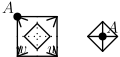
A closed box with a square base is to be wrapped with a square sheet of wrapping paper. The box is centered on the wrapping paper with the vertices of the base lying on the midlines of the square sheet of paper, as shown in the figure on the left. The four corners of the wrapping paper are to be folded up over the sides and brought together to meet at the center of the top of the box, point in the figure on the right. The box has base length and height What is the area of the sheet of wrapping paper?
Pista pequeña:
La distancia desde una esquina de la hoja hasta su centro es .
The distance from a corner of the sheet to its center is
Pista grande:
Un lado de la hoja cuadrada es veces esa distancia de esquina a centro.
A side of the square sheet is times that corner-to-center distance
Solución:
Siguiendo un doblez desde una esquina del papel hasta el centro de la parte superior de la caja, la distancia desde una esquina de la hoja hasta su centro es
Ese segmento es un cateto de un triángulo -- cuya hipotenusa es un lado completo de la hoja cuadrada, así que la longitud del lado es
El área de la hoja es
Por lo tanto, la respuesta correcta es A.
Following a fold from a corner of the paper to the center of the box top, the distance from a corner of the sheet to its center is
That segment is a leg of a -- triangle whose hypotenuse is a full side of the square sheet, so the side length is
The area of the sheet is
Thus, the correct answer is A.
12.
El lado del tiene longitud La bisectriz del ángulo corta a en y El conjunto de todos los valores posibles de es un intervalo abierto ¿Cuánto vale ?
Side of has length The bisector of angle meets at and The set of all possible values of is an open interval What is
Pista pequeña:
Por el teorema de la bisectriz, .
By the angle bisector theorem,
Pista grande:
Sea de modo que luego aplica las tres desigualdades triangulares.
Let so then apply the three triangle inequalities
Solución:
Sean y El teorema de la bisectriz da por lo que
Aplicando las desigualdades triangulares a los lados y y sustituyendo se obtiene y (la tercera desigualdad se cumple automáticamente). Juntas, estas obligan a
Así que y
Por lo tanto, la respuesta correcta es C.
Let and The angle bisector theorem gives so
Applying the triangle inequalities to sides and and substituting yields and (the third inequality holds automatically). Together these force
So and
Thus, the correct answer is C.
13.
El cuadrado tiene lado de longitud El punto está dentro del cuadrado de modo que y Los baricentros de y son los vértices de un cuadrilátero convexo. ¿Cuál es el área de ese cuadrilátero?
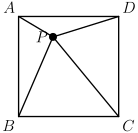
Square has side length Point lies inside the square so that and The centroids of and are the vertices of a convex quadrilateral. What is the area of that quadrilateral?
Pista pequeña:
Coloca el cuadrado en coordenadas y escribe .
Place the square in coordinates and write
Pista grande:
Cada baricentro promedia tres vértices; los cuatro baricentros forman un cuadrado cuyas diagonales tienen longitud .
Each centroid averages three vertices; the four centroids form a square whose diagonals have length
Solución:
Coloca y Promediando los vértices, los cuatro baricentros son
Estos forman un cuadrado cuyas diagonales, una horizontal y una vertical, tienen cada una longitud Su área es independiente de dónde se encuentre .
Por lo tanto, la respuesta correcta es C.
Place and Averaging the vertices, the four centroids are
These form a square whose diagonals, one horizontal and one vertical, each have length Its area is independent of where lies.
Thus, the correct answer is C.
14.
Joey y Chloe y su hija Zoe tienen todos el mismo cumpleaños. Joey es año mayor que Chloe, y Zoe tiene exactamente año hoy. Hoy es el primero de los cumpleaños en los que la edad de Chloe será un múltiplo entero de la edad de Zoe. ¿Cuál será la suma de los dos dígitos de la edad de Joey la próxima vez que su edad sea un múltiplo de la edad de Zoe?
Joey and Chloe and their daughter Zoe all have the same birthday. Joey is year older than Chloe, and Zoe is exactly year old today. Today is the first of the birthdays on which Chloe’s age will be an integral multiple of Zoe’s age. What will be the sum of the two digits of Joey’s age the next time his age is a multiple of Zoe’s age?
Pista pequeña:
Sea la edad de Chloe hoy; dentro de años su edad es un múltiplo de la de Zoe exactamente cuando divide a .
Let Chloe be today; years from now her age is a multiple of Zoe’s exactly when divides
Pista grande:
Así que debe tener exactamente divisores; halla el único valor de dos dígitos con esa propiedad.
So must have exactly divisors; find the only two-digit such value
Solución:
Sea la edad actual de Chloe, de modo que ella es años mayor que Zoe. Dentro de años, la edad de Chloe es múltiplo de la edad de Zoe exactamente cuando divide a Tener cumpleaños así significa que tiene exactamente divisores.
Un número con exactamente divisores tiene la forma para primos distintos o la forma Como la edad de Joey en el cumpleaños futuro pedido tiene dos dígitos, la única posibilidad es Así, Chloe tiene y Joey
La edad de Joey es múltiplo de exactamente cuando divide a La próxima vez ocurre para cuando Joey tiene cuya suma de dígitos es
Por lo tanto, la respuesta correcta es E.
Let Chloe be today, so she is years older than Zoe. In years Chloe’s age is a multiple of Zoe’s age exactly when divides Having such birthdays means has exactly divisors.
A number with exactly divisors has the form for distinct primes or Because Joey’s age at the requested future birthday has two digits, the only possibility is So Chloe is and Joey is
Joey’s age is a multiple of exactly when divides The next time is making Joey with digit sum
Thus, the correct answer is E.
15.
¿Cuántos enteros positivos impares de dígitos que son múltiplos de no incluyen el dígito ?
How many -digit positive odd multiples of do not include the digit
Pista pequeña:
Elige primero el dígito de las centenas (que no sea ni ) y el dígito de las unidades (impar, distinto de ).
Choose the hundreds digit (not or ) and the units digit (odd, not ) first
Pista grande:
Para cada uno de esos pares, los dígitos de las decenas permitidos se reparten equitativamente en tres clases de residuo módulo .
For each such pair, the allowed tens digits split evenly into three residue classes mod
Solución:
Escribe el número como El dígito de las centenas tiene opciones (), y el dígito de las unidades tiene opciones ().
El dígito de las decenas puede ser cualquiera de Estos se reparten en tres clases de residuo módulo de igual tamaño así que exactamente opciones de hacen que sea divisible entre
El total es
Por lo tanto, la respuesta correcta es A.
Write the number as The hundreds digit has choices (), and the units digit has choices ().
The tens digit may be any of These split into three residue classes mod of equal size so exactly choices of make divisible by
The count is
Thus, the correct answer is A.
16.
Las soluciones de la ecuación se conectan en el plano complejo para formar un polígono regular convexo, tres de cuyos vértices se marcan y ¿Cuál es la menor área posible del ?
The solutions to the equation are connected in the complex plane to form a convex regular polygon, three of whose vertices are labeled and What is the least possible area of
Pista pequeña:
Desplazar en no cambia la forma; las raíces de forman un octágono regular.
Shifting by does not change the shape; the roots of form a regular octagon
Pista grande:
El circunradio es y el triángulo más pequeño usa tres vértices consecutivos.
The circumradius is and the smallest triangle uses three consecutive vertices
Solución:
Trasladando en las soluciones de son ocho puntos sobre un círculo de radio que forman un octágono regular. El triángulo de área mínima usa tres vértices consecutivos.
Toma y Entonces y la altura es así que el área es
Por lo tanto, la respuesta correcta es B.
Translating by the solutions of are eight points on a circle of radius forming a regular octagon. The minimum-area triangle uses three consecutive vertices.
Take and Then and the height is so the area is
Thus, the correct answer is B.
17.
Sean y enteros positivos tales que y sea lo más pequeño posible. ¿Cuánto vale ?
Let and be positive integers such that and is as small as possible. What is
Pista pequeña:
Como y con miembros enteros, y .
Since and with integer sides, and
Pista grande:
Súmalas después de escribir para acotar .
Add these after writing to bound
Solución:
De obtenemos y de obtenemos Ahora
Por lo tanto Con la fracción está estrictamente entre y así que y
Por lo tanto, la respuesta correcta es A.
From we get and from we get Now
Hence With the fraction lies strictly between and so and
Thus, the correct answer is A.
18.
Una función se define recursivamente por y para todos los enteros ¿Cuánto vale ?
A function is defined recursively by and for all integers What is
Pista pequeña:
Calcula varios términos y busca un patrón en .
Compute several terms and look for a pattern in
Pista grande:
Al expandir la recursión cuatro veces se muestra que .
Expanding the recursion four times shows
Solución:
Sustituyendo repetidamente la recursión en sí misma se obtiene Así que aumenta en cada vez que aumenta en
Como tenemos
Por lo tanto, la respuesta correcta es B.
Repeatedly substituting the recursion into itself gives So increases by every time increases by
Since we have
Thus, the correct answer is B.
19.
Mary eligió un número par de dígitos Escribió todos los divisores de en orden creciente de izquierda a derecha: En cierto momento Mary escribió como divisor de ¿Cuál es el menor valor posible del siguiente divisor escrito a la derecha de ?
Mary chose an even -digit number She wrote down all the divisors of in increasing order from left to right: At some moment Mary wrote as a divisor of What is the smallest possible value of the next divisor written to the right of
Pista pequeña:
Factoriza .
Factor
Pista grande:
Si el siguiente divisor fuera coprimo con entonces así que comparte un primo con .
If the next divisor were coprime to then so shares a prime with
Solución:
Sea el siguiente divisor después de Si entonces divide a obligando a que imposible para un número de dígitos. Así que comparte un factor primo con
Entonces así que En efecto, ocurre para que es par y de dígitos.
Por lo tanto, la respuesta correcta es C.
Let be the next divisor after If then divides forcing impossible for a -digit number. So shares a prime factor with
Then so Indeed occurs for which is even and -digit.
Thus, the correct answer is C.
20.
Sea un hexágono regular de lado Denota por y los puntos medios de los lados y respectivamente. ¿Cuál es el área del hexágono convexo cuyo interior es la intersección de los interiores de y ?
Let be a regular hexagon with side length Denote by and the midpoints of sides and respectively. What is the area of the convex hexagon whose interior is the intersection of the interiors of and
Pista pequeña:
Coloca el hexágono regular sobre la circunferencia unitaria y escribe las coordenadas de y de los tres puntos medios.
Put the regular hexagon on the unit circle and write coordinates for and the three midpoints
Pista grande:
Interseca las rectas laterales de los dos triángulos equiláteros para hallar los seis vértices, y luego usa la fórmula del cordón.
Intersect the side lines of the two equilateral triangles to find the six vertices, then use shoelace
Solución:
Coloquemos el hexágono regular sobre la circunferencia unitaria con y Los tres puntos medios indicados son y
Al intersectar las rectas laterales de y , se obtienen los seis vértices de su interior común, en orden cíclico: La fórmula del cordón aplicada a estos vértices da el área
Así, la respuesta correcta es C.
Place the regular hexagon on the unit circle with and The three specified midpoints are and
Intersecting the side lines of and gives the six vertices of their common interior, in cyclic order: The shoelace formula applied to these vertices gives area
Thus, the correct answer is C.
21.
En el con longitudes de lado y sean e el circuncentro y el incentro, respectivamente. Un círculo con centro es tangente a los catetos y y a la circunferencia circunscrita del ¿Cuál es el área del ?
In with side lengths and let and denote the circumcenter and incenter, respectively. A circle with center is tangent to the legs and and to the circumcircle of What is the area of
Pista pequeña:
El triángulo es rectángulo en coloca en el origen con los catetos sobre los ejes.
The triangle is right-angled at put at the origin with the legs on the axes
Pista grande:
es el punto medio de la hipotenusa e el círculo en es tangente a la circunferencia circunscrita.
is the midpoint of the hypotenuse and the circle at is tangent to the circumcircle
Solución:
Como el triángulo es rectángulo en Pon y Entonces es el punto medio de es decir con circunradio El inradio es por lo que
Como el círculo de es tangente a ambos catetos, La tangencia interna con la circunferencia circunscrita da Igualando esto a y resolviendo se obtiene por lo que
La fórmula del cordón de zapato sobre da un área de
Por lo tanto, la respuesta correcta es E.
Since the triangle is right-angled at Set and Then is the midpoint of namely with circumradius The inradius is so
Because ’s circle is tangent to both legs, Internal tangency to the circumcircle gives Setting this equal to and solving gives so
The shoelace formula on gives area
Thus, the correct answer is E.
22.
Considera polinomios de grado a lo sumo cada uno de cuyos coeficientes es un elemento de ¿Cuántos de esos polinomios satisfacen ?
Consider polynomials of degree at most each of whose coefficients is an element of How many such polynomials satisfy
Pista pequeña:
Escribe entonces .
Write then
Pista grande:
Sustituye y para convertirlo en con cada variable en .
Substitute and to turn it into with each variable in
Solución:
Escribe con cada uno de en La condición es
Sea y ambos en Entonces Por el método de estrellas y barras, el número de soluciones no negativas es y cada una satisface automáticamente las cotas superiores, ya que la suma es
Por lo tanto, la respuesta correcta es D.
Write with each of in The condition is
Let and both in Then By stars and bars the number of nonnegative solutions is and each automatically satisfies the upper bounds since the sum is
Thus, the correct answer is D.
23.
Ajay está de pie en el punto cerca de Pontianak, Indonesia, a de latitud y de longitud E. Billy está de pie en el punto cerca de Big Baldy Mountain, Idaho, EE. UU., a N de latitud y O de longitud. Supongamos que la Tierra es una esfera perfecta con centro ¿Cuál es la medida en grados del ?
Ajay is standing at point near Pontianak, Indonesia, latitude and E longitude. Billy is standing at point near Big Baldy Mountain, Idaho, USA, N latitude and W longitude. Assume that Earth is a perfect sphere with center What is the degree measure of
Pista pequeña:
La diferencia de longitud es .
The longitude difference is
Pista grande:
Coloca ambos puntos sobre una esfera unitaria y calcula el producto punto de sus vectores de posición.
Put both points on a unit sphere and take the dot product of their position vectors
Solución:
Las longitudes difieren en y está a latitud N. Coloca sobre la esfera unitaria.
Entonces El producto punto es así que y
Por lo tanto, la respuesta correcta es C.
The longitudes differ by and is at latitude N. Place on the unit sphere.
Then The dot product is so and
Thus, the correct answer is C.
24.
Sea el mayor entero menor o igual que ¿Cuántos números reales satisfacen la ecuación ?
Let denote the greatest integer less than or equal to How many real numbers satisfy the equation
Pista pequeña:
Reescribe la ecuación como .
Rewrite the equation as
Pista grande:
Entonces así que cuenta una solución por cada intervalo unitario.
Then so count one solution per unit interval
Solución:
Sea La ecuación se convierte en así que Como necesitamos es decir,
En cada intervalo escribimos con La ecuación se convierte en Para el lado izquierdo es estrictamente decreciente; en vale mientras que, cuando se aproxima a , se aproxima a Por tanto, cada uno de estos intervalos contiene exactamente una solución. Hay intervalos.
Así, la respuesta correcta es C.
Let The equation becomes so Since we need i.e.
On each interval write with The equation becomes For the left side is strictly decreasing; at it is while as approaches it approaches Thus each of these intervals contains exactly one solution. There are such intervals.
Thus, the correct answer is C.
25.
Los círculos y tienen cada uno radio y están colocados en el plano de modo que cada círculo es tangente externamente a los otros dos. Los puntos y están sobre y respectivamente, de modo que y la recta es tangente a para cada donde Ver la figura de abajo. El área del se puede escribir en la forma donde y son enteros positivos. ¿Cuánto vale ?

Circles and each have radius and are placed in the plane so that each circle is externally tangent to the other two. Points and lie on and respectively, so that and line is tangent to for each where See the figure below. The area of can be written in the form where and are positive integers. What is
Pista pequeña:
Como es tangente a en el radio es perpendicular a .
Since is tangent to at the radius is perpendicular to
Pista grande:
Sea con aplica la ley de cosenos en el .
Let with apply the Law of Cosines in
Solución:
Sea el centro de y sea la intersección de las rectas y Como el triángulo es un triángulo --. Con obtenemos y
La ley de cosenos en el (con ) da que se simplifica a por lo que
Entonces y el área es
Así que
Por lo tanto, la respuesta correcta es D.
Let be the center of and let be the intersection of lines and Because triangle is a -- triangle. With we get and
The Law of Cosines in (with ) gives which simplifies to so
Then and the area is
So
Thus, the correct answer is D.