
2012 AMC 10A 第 25 题
先试着解答 2012 AMC 10A 第 25 题,然后核对你的答案与精心整理的解答,解答来自 LIVE by Po-Shen Loh。你也可以参加完整限时模拟考试、查看全部 2012 AMC 10A 解答,或核对答案。
所有题目均经美国数学协会(MAA)官方合法授权使用。
25.
实数 、 和 独立且均匀地从区间 中随机选取,其中 是某个正整数。、 和 中任意两个数的距离都不小于 的概率超过 。满足条件的最小 是多少?
Real numbers and are chosen independently and at random from the interval for some positive integer The probability that no two of and are within unit of each other is greater than What is the smallest possible value of
小提示:
先把三个随机数排序。
Order the three random numbers first
大提示:
从中间的数减去 ,从最大的数减去 。
Subtract from the middle number and from the largest number
解答:
这个问题可以看作几何概率问题,把区间看成坐标轴上的范围。
不妨先考虑
满足这个顺序限制的点 构成一个四面体。
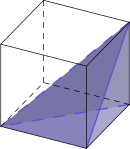
这个四面体的高为 ,底面积为 ,所以体积为
现在加入题目中的限制。需要找出满足下面条件的区域:
根据已经规定的顺序,这些不等式可化为
这两个限制形成如下图所示的另一个四面体。
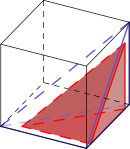
注意,在新的四面体中,所有线性尺寸都减少了 。因此高为 ,底面积为 。
因此体积为
所求概率为
逐一检查选项可知,使这个比例大于 的最小值是 。
所以正确答案是 D。
This problem lends itself to geometric probability since we can view the interval as a range on an axis.
WLOG, let
Then we have that the points which satisfy this restriction form a tetrahedron.
The height of this tetrahedron is and the base has an area of This makes the volume
Now we have to apply the restrictions from the problem statement. We need to find the region where
From our ordering condition that we imposed, these inequalities reduce to
These two restrictions form another tetrahedron as shown below.
Note that in the new tetrahedron, all the dimensions have been reduced by This makes the height and the base
The volume is then
The desired probability is then
Plugging in all the answer choices, we get that the smallest value such that this fraction is greater than is
Thus, D is the correct answer.
其他年份的第 25 题
- 2000 AMC 10
- 2001 AMC 10
- 2002 AMC 10A
- 2002 AMC 10B
- 2003 AMC 10A
- 2003 AMC 10B
- 2004 AMC 10A
- 2004 AMC 10B
- 2005 AMC 10A
- 2005 AMC 10B
- 2006 AMC 10A
- 2006 AMC 10B
- 2007 AMC 10A
- 2007 AMC 10B
- 2008 AMC 10A
- 2008 AMC 10B
- 2009 AMC 10A
- 2009 AMC 10B
- 2010 AMC 10A
- 2010 AMC 10B
- 2011 AMC 10A
- 2011 AMC 10B
- 2012 AMC 10B
- 2013 AMC 10A
- 2013 AMC 10B
- 2014 AMC 10A
- 2014 AMC 10B
- 2015 AMC 10A
- 2015 AMC 10B
- 2016 AMC 10A
- 2016 AMC 10B
- 2017 AMC 10A
- 2017 AMC 10B
- 2018 AMC 10A
- 2018 AMC 10B
- 2019 AMC 10A
- 2019 AMC 10B
- 2020 AMC 10A
- 2020 AMC 10B
- 2021 AMC 10A Spring
- 2021 AMC 10B Spring
- 2021 AMC 10A Fall
- 2021 AMC 10B Fall
- 2022 AMC 10A
- 2022 AMC 10B
- 2023 AMC 10A
- 2023 AMC 10B
- 2024 AMC 10A
- 2024 AMC 10B
- 2025 AMC 10A
- 2025 AMC 10B