
2004 AMC 10A 第 21 题
先试着解答 2004 AMC 10A 第 21 题,然后核对你的答案与精心整理的解答,解答来自 LIVE by Po-Shen Loh。你也可以参加完整限时模拟考试、查看全部 2004 AMC 10A 解答,或核对答案。
所有题目均经美国数学协会(MAA)官方合法授权使用。
21.
两条不同直线通过三个同心圆的圆心,三个圆的半径分别为 、、。图中阴影区域面积是非阴影区域面积的 。两条直线所成锐角的弧度数是多少?(注: 弧度等于 度。)
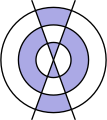
Two distinct lines pass through the center of three concentric circles of radii and The area of the shaded region in the diagram is of the area of the unshaded region. What is the radian measure of the acute angle formed by the two lines? (Note: radians is degrees.)
小提示:
设锐角为 ,把每块阴影区域表示为扇形面积。
Let be the acute angle and express each shaded piece as a sector area
大提示:
阴影面积总和为 ,总面积为 。
The shaded pieces total out of the whole area
解答:
设锐角为 。阴影区域分三部分:单位圆中的两个锐角扇形总面积为 ;半径 到 的圆环中两个钝角扇形总面积为 ;半径 到 的圆环中两个锐角扇形总面积为 。
相加得到阴影面积
阴影面积是非阴影面积的 ,因此是总面积 的 。于是 解得 。
所以正确答案是 B。
Let be the acute angle. The shaded region has three parts: two acute sectors of the unit disk with total area two obtuse sectors of the ring between radii and with total area and two acute sectors of the ring between radii and with total area
Adding these gives a shaded area of
The shaded region is of the unshaded region, so it is of the total area Then which gives
Thus, the correct answer is B.
其他年份的第 21 题
2000 AMC 10 · 2001 AMC 10 · 2002 AMC 10A · 2002 AMC 10B · 2003 AMC 10A · 2003 AMC 10B · 2004 AMC 10B · 2005 AMC 10A · 2005 AMC 10B · 2006 AMC 10A · 2006 AMC 10B · 2007 AMC 10A · 2007 AMC 10B · 2008 AMC 10A · 2008 AMC 10B · 2009 AMC 10A · 2009 AMC 10B · 2010 AMC 10A · 2010 AMC 10B · 2011 AMC 10A · 2011 AMC 10B · 2012 AMC 10A · 2012 AMC 10B · 2013 AMC 10A · 2013 AMC 10B · 2014 AMC 10A · 2014 AMC 10B · 2015 AMC 10A · 2015 AMC 10B · 2016 AMC 10A · 2016 AMC 10B · 2017 AMC 10A · 2017 AMC 10B · 2018 AMC 10A · 2018 AMC 10B · 2019 AMC 10A · 2019 AMC 10B · 2020 AMC 10A · 2020 AMC 10B · 2021 AMC 10A Spring · 2021 AMC 10B Spring · 2021 AMC 10A Fall · 2021 AMC 10B Fall · 2022 AMC 10A · 2022 AMC 10B · 2023 AMC 10A · 2023 AMC 10B · 2024 AMC 10A · 2024 AMC 10B · 2025 AMC 10A · 2025 AMC 10B