
Soluciones del 2024 AMC 12A
Desplázate hacia abajo para ver las soluciones preparadas profesionalmente de LIVE by Po-Shen Loh, imprime las soluciones en PDF, consulta la clave de respuestas, o haz el examen cronometrado completo.
Todos los problemas se usan con el permiso legal oficial de la Mathematical Association of America (MAA).
1.
¿Cuál es el valor de ?
What is the value of
Pista pequeña:
Pista grande:
Solución:
Directamente, y Su diferencia es Por lo tanto, la respuesta correcta es A.
Directly, and Their difference is Thus, the correct answer is A.
2.
Un modelo para estimar el tiempo que tomará subir hasta la cima de una montaña por un sendero tiene la forma donde y son constantes, es el tiempo en minutos, es la longitud del sendero en millas, y es el desnivel de altitud en pies. El modelo estima que tomará minutos subir hasta la cima si un sendero mide millas de largo y asciende pies, así como si un sendero mide millas de largo y asciende pies.
¿Cuántos minutos estima el modelo que tomará subir hasta la cima si el sendero mide millas de largo y asciende pies?
A model used to estimate the time it will take to hike to the top of a mountain on a trail is of the form where and are constants, is the time in minutes, is the length of the trail in miles, and is the altitude gain in feet. The model estimates that it will take minutes to hike to the top if a trail is miles long and ascends feet, as well as if a trail is miles long and ascends feet.
How many minutes does the model estimate it will take to hike to the top if the trail is miles long and ascends feet?
Pista pequeña:
Iguala las dos estimaciones:
Set the two estimates equal:
Pista grande:
Esto da así que
This gives so
Solución:
De obtenemos así que Entonces lo que da y Para Por lo tanto, la respuesta correcta es B.
From we get so Then giving and For Thus, the correct answer is B.
3.
El número se escribe como la suma de números de dos dígitos, no necesariamente distintos. ¿Cuál es la menor cantidad de números de dos dígitos necesarios para escribir esta suma?
The number is written as the sum of not necessarily distinct two-digit numbers. What is the least number of two-digit numbers needed to write this sum?
Pista pequeña:
El mayor número de dos dígitos es así que se necesitan muchos números
The largest two-digit number is so many numbers are needed
Pista grande:
lo cual no alcanza; ¿pueden números llegar exactamente a ?
which falls short; can numbers reach exactly
Solución:
Cada número es a lo sumo así que números suman a lo sumo Como se requieren al menos números. Con podemos usar veinte y un : Por lo tanto, la respuesta correcta es B.
Each number is at most so numbers sum to at most Since at least numbers are required. With we can use twenty s and one : Thus, the correct answer is B.
4.
¿Cuál es el menor valor de tal que es múltiplo de ?
What is the least value of such that is a multiple of
Pista pequeña:
Factoriza
Factor
Pista grande:
debe contener el primo así que
must contain the prime so
Solución:
Factorizando, El factorial contiene el primo solo cuando En el producto ya incluye y muchos factores de así que es múltiplo de Por lo tanto, la respuesta correcta es D.
Factoring, The factorial contains the prime only when At the product already includes and plenty of factors of so is a multiple of Thus, the correct answer is D.
5.
Un conjunto de datos que contiene números, algunos de los cuales son tiene media Cuando se eliminan todos los , el conjunto de datos tiene media ¿Cuántos había en el conjunto de datos original?
A data set containing numbers, some of which are has mean When all the s are removed, the data set has mean How many s were in the original data set?
Pista pequeña:
Los números suman
The numbers sum to
Pista grande:
Si hay seises, los números restantes suman
If there are sixes, the remaining numbers sum to
Solución:
El conjunto completo suma Eliminar seises deja números que suman con media así que Entonces lo que da Por lo tanto, la respuesta correcta es D.
The full set sums to Removing sixes leaves numbers summing to with mean so Then giving Thus, the correct answer is D.
6.
El producto de tres enteros es ¿Cuál es la menor suma positiva posible de los tres enteros?
The product of three integers is What is the least possible positive sum of the three integers?
Pista pequeña:
Los enteros pueden ser negativos; el producto sigue siendo positivo con dos factores negativos
Integers may be negative; the product stays positive with two negative factors
Pista grande:
Escribiendo los números como con minimiza manteniéndolo positivo
Writing the numbers as with minimize while keeping it positive
Solución:
Para obtener una suma positiva pequeña, usamos dos enteros negativos y uno positivo donde Salvo el orden, las ternas de factores positivos de son Un valor positivo de es mínimo cuando elegimos como el factor mayor. Los valores positivos de la lista son las dos últimas ternas dan valores negativos. Por tanto, la menor suma positiva es (Tres enteros positivos tienen suma al menos y tres enteros negativos no pueden tener producto positivo). Así, la respuesta correcta es B.
To obtain a small positive sum, use two negative integers and one positive integer where Up to order, the positive factor triples of are A positive value of is smallest when the largest factor is chosen as The positive values from the list are the last two triples give negative values. Thus the least positive sum is (Three positive integers have sum at least and three negative integers cannot have positive product.) Thus, the correct answer is B.
7.
En y Los puntos están sobre la hipotenusa de modo que
¿Cuál es la longitud de la siguiente suma vectorial?
In and Points lie on hypotenuse so that
What is the length of the vector sum
Pista pequeña:
Los puntos son simétricos respecto al punto medio de así que los vectores se emparejan
The points are symmetric about the midpoint of so the vectors pair up
Pista grande:
La suma es igual a la mediana a la hipotenusa de un triángulo rectángulo es la mitad de la hipotenusa
The sum equals the median to the hypotenuse of a right triangle is half the hypotenuse
Solución:
Los puntos son simétricos respecto al punto medio de así que emparejar con su reflejo da Por lo tanto la suma completa es En un triángulo rectángulo la mediana a la hipotenusa tiene longitud igual a la mitad de la hipotenusa; aquí así que La longitud de la suma es Por lo tanto, la respuesta correcta es D.
The points are symmetric about the midpoint of so pairing with its mirror gives Hence the whole sum is In a right triangle the median to the hypotenuse has length half the hypotenuse; here so The length of the sum is Thus, the correct answer is D.
8.
¿Cuántos ángulos con satisfacen ?
How many angles with satisfy
Pista pequeña:
que debe ser igual a
which must equal
Pista grande:
Un producto de dos números cada uno a lo sumo es igual a solo cuando ambos son
A product of two numbers each at most equals only when both equal
Solución:
La ecuación significa con ambos factores positivos (para que los logaritmos estén definidos). Como y su producto es solo si y simultáneamente. Pero obliga a donde Ningún ángulo funciona. Por lo tanto, la respuesta correcta es A.
The equation means with both factors positive (for the logs to be defined). Since and their product is only if and simultaneously. But forces where No angle works. Thus, the correct answer is A.
9.
Sea el mayor entero tal que tanto como sean cuadrados perfectos. ¿Cuál es la cifra de las unidades de ?
Let be the greatest integer such that both and are perfect squares. What is the units digit of
Pista pequeña:
Sea y resta para obtener
Let and subtract to get
Pista grande:
con ambos factores pares; para maximizar haz lo más pequeño posible
with both factors even; to maximize make as small as possible
Solución:
Escribimos y así que es decir Ambos factores tienen la misma paridad, por lo que ambos son pares. Para maximizar (y por tanto ), minimizamos tomamos así que Entonces cuya cifra de las unidades es Por lo tanto, la respuesta correcta es E.
Write and so i.e. Both factors have the same parity, hence both even. To maximize (and thus ), minimize take so Then whose units digit is Thus, the correct answer is E.
10.
Sea la medida en radianes del ángulo más pequeño de un triángulo rectángulo . Sea la medida en radianes del ángulo más pequeño de un triángulo rectángulo . En términos de ¿cuánto vale ?
Let be the radian measure of the smallest angle in a right triangle. Let be the radian measure of the smallest angle in a right triangle. In terms of what is
Pista pequeña:
aplica la fórmula del ángulo doble para
apply the double-angle formula for
Pista grande:
es el recíproco de
is the reciprocal of
Solución:
El ángulo menor del triángulo satisface Entonces El ángulo menor del triángulo satisface Por ello, Así, C es la respuesta correcta.
The smallest angle of the triangle has Then The smallest angle of the triangle has Hence Thus, the correct answer is C.
11.
Hay exactamente enteros positivos con tales que el entero en base es divisible por (donde está en base diez). ¿Cuál es la suma de las cifras de ?
There are exactly positive integers with such that the base- integer is divisible by (where is in base ten). What is the sum of the digits of
Pista pequeña:
así que necesitas que sea divisible por
so you need to be divisible by
Pista grande:
Reduce y cuenta los en cada clase residual válida de
Reduce and count in each valid residue class of
Solución:
Aquí así que es divisible por exactamente cuando es divisible por Revisando los residuos precisamente para
Contando los en el residuo da ( valores), el residuo da ( valores), y el residuo da ( valores). Así que y su suma de cifras es
Por lo tanto, la respuesta correcta es D.
Here so is divisible by exactly when is divisible by Checking residues precisely for
Counting in residue gives ( values), residue gives ( values), and residue gives ( values). So and its digit sum is
Thus, the correct answer is D.
12.
Los primeros tres términos de una progresión geométrica son los enteros y donde ¿Cuál es la suma de las cifras del menor valor posible de ?
The first three terms of a geometric sequence are the integers and where What is the sum of the digits of the least possible value of
Pista pequeña:
El término central da así que
The middle term gives so
Pista grande:
Para minimizar toma el mayor divisor de
To minimize take the largest divisor of
Solución:
Como los términos son geométricos, así que Como minimizar significa encontrar el menor divisor de mayor que No hay divisor estrictamente entre y si su exponente de es o entonces, tras dividir entre o respectivamente, un número de la forma tendría que estar en o las potencias permitidas no dan ninguno. Como es divisor, es el menor posible. Su divisor emparejado es y la suma de dígitos de es Por lo tanto, la respuesta correcta es E.
Since the terms are geometric, so Because minimizing means finding the smallest divisor of greater than There is no divisor strictly between and if its exponent of is or then after dividing by or respectively, a number of the form would have to lie in or the allowed powers give none. Since is a divisor, it is the least possible Its paired divisor is and the digit sum of is Thus, the correct answer is E.
13.
La gráfica de tiene un eje de simetría. ¿Cuál es la reflexión del punto respecto a este eje?
The graph of has an axis of symmetry. What is the reflection of the point over this axis?
Pista pequeña:
El eje de simetría es la recta vertical donde la función alcanza su mínimo
The axis of symmetry is the vertical line where the function attains its minimum
Pista grande:
Iguala la derivada para hallar luego refleja respecto a ella
Set the derivative to find then reflect across it
Solución:
La curva es simétrica respecto a la recta vertical que pasa por su mínimo. Igualar la derivada da así que Al reflejar respecto a se conserva la coordenada y va a La imagen es Por lo tanto, la respuesta correcta es D.
The curve is symmetric about the vertical line through its minimum. Setting the derivative gives so Reflecting across keeps the -coordinate and sends to The image is Thus, the correct answer is D.
14.
Los números, en orden, de cada fila y los números, en orden, de cada columna de un arreglo de enteros forman una progresión aritmética de longitud Los números en las posiciones y son y respectivamente. ¿Qué número está en la posición ?
The numbers, in order, of each row and the numbers, in order, of each column of a array of integers form an arithmetic progression of length The numbers in positions and are and respectively. What number is in position
Pista pequeña:
Si cada fila y cada columna es aritmética, la entrada tiene la forma
If every row and every column is arithmetic, the entry has the form
Pista grande:
Sustituye las cuatro entradas conocidas en esa forma y despeja
Substitute the four known entries into that form and solve for
Solución:
Una cuadrícula cuyas filas y columnas son todas aritméticas tiene entradas de la forma bilineal Los cuatro datos dan
Al resolver se obtiene Entonces
Por lo tanto, la respuesta correcta es C.
A grid whose rows and columns are all arithmetic has entries of the bilinear form The four givens yield
Solving gives Then
Thus, the correct answer is C.
15.
Las raíces de son , , y . Halla el valor de la siguiente expresión:
The roots of are , , and . What is the value of
Pista pequeña:
así que el producto se relaciona con y donde
so the product relates to and where
Pista grande:
y son conjugados complejos; multiplícalos para obtener un número real
and are complex conjugates; multiply them to get a real number
Solución:
Como al agrupar sobre todas las raíces se obtiene Calculamos y Su producto es Así, D es la respuesta correcta.
Since grouping over all roots gives Compute and Their product is Thus, the correct answer is D.
16.
Un conjunto de fichas, de las cuales son rojas, blancas, azul y negras, se reparte al azar entre jugadores, fichas por jugador. La probabilidad de que algún jugador reciba todas las fichas rojas, otro reciba todas las blancas, y el jugador restante reciba la ficha azul se puede escribir como donde y son enteros positivos primos entre sí. ¿Cuánto vale ?
A set of tokens — red, white, blue, and black — is to be distributed at random to game players, tokens per player. The probability that some player gets all the red tokens, another gets all the white tokens, and the remaining player gets the blue token can be written as where and are relatively prime positive integers. What is
Pista pequeña:
Asigna los tres roles (todas las rojas, todas las blancas, la única azul) a los jugadores de maneras
Assign the three roles (all reds, all whites, the lone blue) to the players in ways
Pista grande:
Las fichas negras deben repartirse entonces como entre los jugadores; divide entre
The black tokens must then split as among the players; divide by
Solución:
Tratamos todas las fichas como distintas; el número total de maneras de repartir a cada jugador es Para el evento favorable, elegimos qué jugador recibe las rojas, las blancas y la azul de maneras. El jugador rojo necesita ficha más, el blanco más, y el azul más, todas negras; las fichas negras se reparten como de maneras. Así que la probabilidad es Entonces Por lo tanto, la respuesta correcta es C.
Treat all tokens as distinct; the total number of ways to deal to each player is For the favorable event, choose which player gets the reds, whites, and blue in ways. The red player needs more token, the white player more, and the blue player more, all black; the black tokens split as in ways. So the probability is Then Thus, the correct answer is C.
17.
Los enteros y satisfacen y ¿Cuánto vale ?
Integers and satisfy and What is
Pista pequeña:
Resta las ecuaciones por pares, por ejemplo se factoriza como
Subtract equations in pairs, e.g. factors as
Pista grande:
es primo, así que tiene pocas opciones; pruébalas para soluciones enteras
is prime, so has few options; test them for integer solutions
Solución:
Al restar la segunda ecuación de la primera se obtiene Por tanto, Los valores correspondientes de son Al sustituir en , los dos primeros casos quedan descartados porque exigirían o El caso da y que satisfacen las tres ecuaciones. El caso da que no satisface Así, la única solución entera es y Por tanto, D es la respuesta correcta.
Subtracting the second equation from the first gives Hence The corresponding values of are Substituting into eliminates the first two cases because they would require or The case gives and which satisfies all three equations. The case gives which fails Thus the unique integer solution is and Thus, the correct answer is D.
18.
Sobre una tarjeta rectangular con lados de longitud y se coloca una tarjeta idéntica de modo que dos de sus diagonales coincidan, como se muestra ( en este caso).
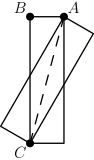
Continúa el proceso, agregando una tercera tarjeta a la segunda, y así sucesivamente, alineando diagonales sucesivas tras rotar en sentido horario. En total, ¿cuántas tarjetas deben usarse hasta que un vértice de una nueva tarjeta caiga exactamente sobre el vértice etiquetado en la figura?
On top of a rectangular card with sides of length and an identical card is placed so that two of their diagonals line up, as shown ( in this case).
Continue the process, adding a third card to the second, and so on, lining up successive diagonals after rotating clockwise. In total, how many cards must be used until a vertex of a new card lands exactly on the vertex labeled in the figure?
Ningún vértice nuevo caerá sobre
No new vertex will land on
Pista pequeña:
La diagonal forma un ángulo con el lado largo, ya que
The diagonal makes angle with the long side, since
Pista grande:
Las dos diagonales se cortan formando sigue la diagonal libre a medida que se añaden cinco tarjetas nuevas
The two diagonals meet at track the unused diagonal as five new cards are added
Solución:
Una diagonal forma un ángulo con un lado largo, donde Por tanto, el ángulo agudo entre las dos diagonales de una tarjeta es
Cada tarjeta nueva comparte una diagonal con la tarjeta anterior, y su otra diagonal es la siguiente recta que se obtiene al girar en sentido horario. Todas estas diagonales iguales tienen el mismo punto medio y son diámetros de una misma circunferencia. La recta que contiene la otra diagonal de la tarjeta original, y que pasa por está girada en sentido antihorario respecto de Como recta no orientada, equivale a estar girada en sentido horario respecto de Cinco adiciones hacen avanzar la diagonal libre así que la sexta tarjeta es la primera tarjeta nueva que tiene un vértice en
Así, la respuesta correcta es A.
A diagonal makes an angle with a long side, where Thus the acute angle between the two diagonals of a card is
Each new card shares one diagonal with the previous card, and its other diagonal is the next line obtained by turning clockwise. All these equal diagonals have the same midpoint and are diameters of one common circle. The line through the original card’s other diagonal, which contains is counterclockwise from As an unoriented line, this is the same as clockwise from Five additions advance the unused diagonal by so the sixth card is the first new card with a vertex at
Thus, the correct answer is A.
19.
El cuadrilátero cíclico tiene lados y con ¿Cuál es la longitud de la diagonal más corta de ?
Cyclic quadrilateral has lengths and with What is the length of the shorter diagonal of
Pista pequeña:
En
In
Pista grande:
Halla usando luego aplica Ptolomeo:
Find using then apply Ptolemy:
Solución:
En la ley de cosenos da así que
Como es cíclico, En con y la ley de cosenos da así que Por Ptolomeo, de donde Esto es más corto que
Por lo tanto, la respuesta correcta es D.
In the law of cosines gives so
Since is cyclic, In with and the law of cosines gives so By Ptolemy, hence This is shorter than
Thus, the correct answer is D.
20.
Los puntos y se eligen de manera uniforme e independiente al azar sobre los lados y respectivamente, del triángulo equilátero ¿Cuál de los siguientes intervalos contiene la probabilidad de que el área de sea menor que la mitad del área de ?
Points and are chosen uniformly and independently at random on sides and respectively, of equilateral triangle Which of the following intervals contains the probability that the area of is less than half the area of
Pista pequeña:
Sean y uniformes en la razón de áreas es
Let and be uniform on the area ratio is
Pista grande:
Calcula y réstalo de
Compute and subtract from
Solución:
Con y uniformes en la razón de áreas es El evento complementario exige y y tiene probabilidad Por tanto, que pertenece a Así, D es la respuesta correcta.
With and uniform on the area ratio The complementary event requires and with probability Therefore which lies in Thus, the correct answer is D.
21.
Supongamos que y la sucesión satisface la relación de recurrencia para todo Halla el mayor entero menor o igual que
Suppose that and the sequence satisfies the recurrence relation for all What is the greatest integer less than or equal to
Pista pequeña:
Calcula algunos términos y conjetura la forma cerrada
Compute a few terms and conjecture the closed form
Pista grande:
Entonces y está estrictamente entre y
Then and lies strictly between and
Solución:
La recurrencia se reordena como Los primeros términos sugieren que Esto se demuestra por inducción: al sustituir en la recurrencia, se obtiene Entonces así que donde y Por tanto, la suma está entre y y su parte entera es Así, la respuesta correcta es B.
The recurrence rearranges to Computing early terms suggests This follows by induction: substituting into the recurrence gives Then so where and Hence the sum is between and and its floor is Thus, the correct answer is B.
22.
La figura de abajo muestra una cuadrícula de puntos de celdas de ancho y celdas de alto formada por cuadrados de . Carl coloca palillos de pulgada a lo largo de algunos de los lados de los cuadrados para crear un lazo cerrado que no se cruza a sí mismo. Los números en las celdas indican cuántos lados de ese cuadrado deben quedar cubiertos por palillos, y se permite cualquier cantidad de palillos donde no hay número escrito. ¿De cuántas maneras puede Carl colocar los palillos?
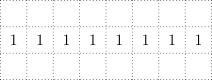
The figure below shows a dotted grid cells wide and cells tall consisting of squares. Carl places -inch toothpicks along some of the sides of the squares to create a closed loop that does not intersect itself. The numbers in the cells indicate the number of sides of that square that are to be covered by toothpicks, and any number of toothpicks are allowed if no number is written. In how many ways can Carl place the toothpicks?
Pista pequeña:
Cada celda de la fila central debe tocar exactamente un palillo; una vez fijadas las dos columnas donde el lazo da la vuelta, el palillo de cada celda interior está independientemente arriba o abajo de ella
Each middle-row cell must touch exactly one toothpick; after the two turnaround columns are fixed, each interior cell’s toothpick is independently above or below it
Pista grande:
Un lazo que cruza la franja central usa las columnas, las primeras las últimas o las centrales; sus columnas interiores se curvan independientemente hacia arriba o hacia abajo
A loop crossing the middle uses all the first the last or the middle columns; its interior columns independently bend above or below
Solución:
Cada celda de la fila central debe tocar exactamente un palillo. Consideremos primero los lazos que pasan de un lado de la franja central al otro. El lazo puede abarcar las columnas, las primeras las últimas o las centrales; un tramo menor dejaría sin tocar una celda central exterior.
Una vez fijados los dos extremos, cada celda central interior elige independientemente si su único palillo está en el lado superior o inferior, y el resto del lazo sin autointersecciones queda forzado. Los cuatro casos aportan, por tanto, y lazos. También hay exactamente dos lazos que no cruzan la franja central: el rectángulo horizontal que corre enteramente por arriba o enteramente por abajo. Así, el total es
Por lo tanto, la respuesta correcta es C.
Each middle-row cell must touch exactly one toothpick. First consider loops that pass from one side of the middle strip to the other. The loop can span all columns, the first the last or the middle a narrower span would leave an outer middle cell untouched.
Once the two ends are fixed, each interior middle cell independently has its one toothpick on its top or bottom side, and the rest of the non-self-intersecting loop is forced. The four cases therefore contribute and loops. There are also exactly two loops that do not cross the middle strip: the horizontal rectangle running entirely along the top or entirely along the bottom. Hence the total is
Thus, the correct answer is C.
23.
Halla el valor de la siguiente expresión:
What is the value of
Pista pequeña:
Sean la suma se factoriza como
Let the sum factors as
Pista grande:
y
and
Solución:
Con la expresión es
Como tenemos así que De igual modo Su producto es
Por lo tanto, la respuesta correcta es B.
With the expression is
Since we have so Likewise Their product is
Thus, the correct answer is B.
24.
Un disfenoide es un tetraedro cuyas caras triangulares son congruentes entre sí. ¿Cuál es el área total de superficie mínima de un disfenoide cuyas caras son triángulos escalenos con lados de longitud entera?
A disphenoid is a tetrahedron whose triangular faces are congruent to one another. What is the least total surface area of a disphenoid whose faces are scalene triangles with integer side lengths?
Pista pequeña:
Un disfenoide puede construirse a partir de un triángulo exactamente cuando ese triángulo es acutángulo; su superficie consta de caras
A disphenoid can be built from a triangle exactly when that triangle is acute; its surface is faces
Pista grande:
Busca el triángulo escaleno acutángulo de lados enteros con menor área; es rectángulo, así que prueba
Seek the smallest-area acute scalene integer triangle; is right, so try
Solución:
Un disfenoide existe (como el tetraedro formado por los centros de las caras de una caja) exactamente cuando el triángulo común de las caras es acutángulo, y su área total de superficie es veces el área de una cara. Escribamos las longitudes enteras de los lados como Si entonces y (con igualdad solo para ), así que el triángulo no es acutángulo. Por tanto
El triángulo es acutángulo porque Además, es el de menor área posible. El mayor ángulo de cualquier triángulo acutángulo mide al menos así que un candidato con tiene área al menos que es mayor que el área de
Por la fórmula de Herón con esa área es El área total de superficie es
Por lo tanto, la respuesta correcta es D.
A disphenoid exists (as the tetrahedron formed by the face-plane midpoints of a box) exactly when the common face triangle is acute, and its total surface area is times one face’s area. Write the integer side lengths as If then and (with equality only for ), so the triangle is not acute. Thus
The triangle is acute because It also has the least possible area. The largest angle of any acute triangle is at least so a candidate with has area at least which is greater than the area of
By Heron’s formula with that area is The total surface area is
Thus, the correct answer is D.
25.
Una gráfica es simétrica respecto a una recta si la gráfica permanece sin cambios tras reflejarse en esa recta. ¿Para cuántas cuádruplas de enteros donde y y no son ambos la gráfica de es simétrica respecto a la recta ?
A graph is symmetric about a line if the graph remains unchanged after reflection in that line. For how many quadruples of integers where and and are not both is the graph of symmetric about the line
Pista pequeña:
Reflejar sobre da su inversa, así que la simetría significa que es su propia inversa
Reflecting over gives its inverse, so symmetry means is its own inverse
Pista grande:
Una función es una involución exactamente cuando (y es no degenerada); cuenta también la identidad
A map is an involution exactly when (and it is nondegenerate); also count the identity
Solución:
Reflejar la gráfica de respecto a produce la gráfica de su inversa, así que la gráfica es simétrica respecto a exactamente cuando coincide con su propia inversa. Para , esto ocurre de dos maneras: cuando con (una involución genuina, incluidas las rectas de pendiente cuando ), o cuando es la identidad ().
Para ponemos el determinante debe ser distinto de cero, así que necesitamos junto con Cuando tanto como deben ser distintos de cero, lo que da opciones. Para cada no nulo, partimos de opciones para Si o exactamente pares satisfacen si lo hacen exactamente pares. Por tanto, el número de involuciones genuinas es El caso de la identidad aporta más (), para un total de
Así, la respuesta correcta es B.
Reflecting the graph of over produces the graph of its inverse, so the graph is symmetric about exactly when equals its own inverse. For this happens in two ways: when with (a genuine involution, including the slope lines when ), or when is the identity ().
For set the determinant must be nonzero, so we need together with When both and must be nonzero, giving choices. For each nonzero start with choices of If or exactly pairs satisfy if exactly pairs do. Thus the genuine involutions number The identity case adds more (), for a total of
Thus, the correct answer is B.