
Soluciones del 2023 AMC 12A
Desplázate hacia abajo para ver las soluciones preparadas profesionalmente de LIVE by Po-Shen Loh, imprime las soluciones en PDF, consulta la clave de respuestas, o haz el examen cronometrado completo.
Todos los problemas se usan con el permiso legal oficial de la Mathematical Association of America (MAA).
1.
Las ciudades y están a millas de distancia. Alicia vive en y Beth vive en Alicia va en bicicleta hacia a millas por hora. Saliendo al mismo tiempo, Beth va en bicicleta hacia a millas por hora. ¿A cuántas millas de la ciudad estarán cuando se encuentren?
Cities and are miles apart. Alicia lives in and Beth lives in Alicia bikes towards at miles per hour. Leaving at the same time, Beth bikes toward at miles per hour. How many miles from City will they be when they meet?
Pista pequeña:
Su velocidad de acercamiento es de millas por hora
Their closing speed is miles per hour
Pista grande:
Halla el tiempo hasta que se encuentren y luego multiplícalo por la velocidad de Alicia
Find the time until they meet, then multiply by Alicia’s speed
Solución:
La distancia entre ellas se reduce a millas por hora, así que se encuentran al cabo de horas.
En ese tiempo Alicia ha recorrido millas desde la ciudad
Por lo tanto, la respuesta correcta es E.
The gap between them closes at miles per hour, so they meet after hours.
In that time Alicia has ridden miles from City
Thus, the correct answer is E.
2.
El peso de de una pizza grande junto con tazas de rodajas de naranja es igual al peso de de una pizza grande junto con taza de rodajas de naranja. Una taza de rodajas de naranja pesa de libra. ¿Cuánto pesa, en libras, una pizza grande?
The weight of of a large pizza together with cups of orange slices is the same as the weight of of a large pizza together with cup of orange slices. A cup of orange slices weighs of a pound. What is the weight, in pounds, of a large pizza?
Pista pequeña:
Sea el peso de la pizza en libras; cada taza de rodajas de naranja pesa
Let the pizza weigh pounds; each cup of orange slices weighs
Pista grande:
Iguala los dos pesos y agrupa los términos con en un mismo lado
Set the two weights equal and gather the terms on one side
Solución:
Sea el peso de la pizza en libras. Entonces tazas pesan y taza pesa
La ecuación es
Al restar se obtiene así que y
Por lo tanto, la respuesta correcta es A.
Let the pizza weigh pounds. Then cups weigh and cup weighs
The equation is
Subtracting gives so and
Thus, the correct answer is A.
3.
¿Cuántos cuadrados perfectos positivos menores que son divisibles por ?
How many positive perfect squares less than are divisible by
Pista pequeña:
Un cuadrado perfecto es divisible por exactamente cuando su raíz es un múltiplo de
A perfect square is divisible by exactly when its root is a multiple of
Pista grande:
Los cuadrados son ; halla cuántos satisfacen
The squares are ; find how many satisfy
Solución:
Un cuadrado perfecto es divisible por solo si su raíz lo es, así que los cuadrados son
Como la raíz puede ser es decir hasta
Por lo tanto, la respuesta correcta es A.
A perfect square is divisible by only if its root is, so the squares are
Since the root can be which is through
Thus, the correct answer is A.
4.
¿Cuántos dígitos tiene la representación en base diez de ?
How many digits are in the base-ten representation of
Pista pequeña:
Factoriza cada base en primos:
Factor each base into primes:
Pista grande:
Empareja cada con un para formar una potencia de dejando un factor pequeño
Pair every with a to form a power of leaving a small factor
Solución:
Escribiendo todo en primos,
Esto es igual a que es seguido de ceros, para un total de dígitos.
Por lo tanto, la respuesta correcta es E.
Writing everything in primes,
This equals which is followed by zeros, for a total of digits.
Thus, the correct answer is E.
5.
Janet lanza un dado estándar de caras veces y va llevando la suma acumulada de los números que obtiene. ¿Cuál es la probabilidad de que en algún momento su suma acumulada sea igual a ?
Janet rolls a standard -sided die times and keeps a running total of the numbers she rolls. What is the probability that at some point, her running total will equal
Pista pequeña:
Una vez que la suma acumulada supera ya no puede volver, así que solo importan los primeros lanzamientos
Once the running total passes it can never return, so only the first few rolls matter
Pista grande:
Suma las probabilidades de los inicios disjuntos y
Add the probabilities of the disjoint openings and
Solución:
La suma acumulada es creciente, así que llega a exactamente cuando ocurre uno de estos inicios disjuntos: un primer lanzamiento de los lanzamientos los lanzamientos o los lanzamientos
Sus probabilidades son
Por lo tanto, la respuesta correcta es B.
The running total is increasing, so it hits exactly when one of these disjoint openings occurs: a first roll of rolls rolls or rolls
Their probabilities are
Thus, the correct answer is B.
6.
Los puntos y están en la gráfica de El punto medio de es ¿Cuál es la diferencia positiva entre las coordenadas de y ?
Points and lie on the graph of The midpoint of is What is the positive difference between the -coordinates of and
Pista pequeña:
Las coordenadas suman
The -coordinates sum to
Pista grande:
Las coordenadas promedian así que lo que da
The -coordinates average to so giving
Solución:
Sean y las coordenadas El punto medio da y el promedio de los valores da así que
Entonces
Por lo tanto, la respuesta correcta es D.
Let the -coordinates be and The midpoint gives and the average of the -values gives so
Then
Thus, the correct answer is D.
7.
Una pantalla digital muestra la fecha actual como un entero de dígitos que consta de un año de dígitos, seguido de un mes de dígitos, seguido del día del mes de dígitos. Por ejemplo, el Día del Árbol de este año se muestra como ¿Para cuántas fechas de aparecerá cada dígito un número par de veces en la pantalla de dígitos de esa fecha?
A digital display shows the current date as an -digit integer consisting of a -digit year, followed by a -digit month, followed by a -digit date within the month. For example, Arbor Day this year is displayed as For how many dates in will each digit appear an even number of times in the -digit display for that date?
Pista pequeña:
El año fijo ya aporta dos , un y un
The fixed year already contributes two ’s, one and one
Pista grande:
Los cuatro dígitos de mes y día deben hacer que las cantidades de y sean impares, la cantidad de sea par, y cada otro dígito par
The four month-day digits must make the counts of and odd, the count of even, and every other digit even
Solución:
El año aporta los dígitos así que aparece dos veces mientras que y aparecen una vez cada uno. Para que cada dígito termine con una cantidad par, los cuatro dígitos del mes y el día deben aportar una cantidad impar de , una cantidad impar de , y una cantidad par de cada otro dígito.
Con solo cuatro dígitos disponibles, la cadena de mes y día debe usar exactamente un un y un par repetido de algún dígito. Al revisar los meses y días válidos quedan nueve fechas: y
Por lo tanto, la respuesta correcta es E.
The year contributes the digits so appears twice while and each appear once. For every digit to end up with an even count, the four digits of the month and day must supply an odd number of ’s, an odd number of ’s, and an even number of every other digit.
With only four digits available, the month-day string must use exactly one one and a repeated pair of some digit. Checking valid months and days leaves nine dates: and
Thus, the correct answer is E.
8.
Maureen lleva el registro del promedio de sus calificaciones de los cuestionarios de este semestre. Si Maureen saca un en el próximo cuestionario, su promedio aumentará en Si saca un en cada uno de los próximos tres cuestionarios, su promedio aumentará en ¿Cuál es el promedio actual de sus calificaciones?
Maureen is keeping track of the mean of her quiz scores this semester. If Maureen scores an on the next quiz, her mean will increase by If she scores an on each of the next three quizzes, her mean will increase by What is the mean of her quiz scores currently?
Pista pequeña:
Sea su promedio actual sobre cuestionarios, con total
Let her current mean be over quizzes, with total
Pista grande:
Un adicional da simplifica a
One extra gives simplify to
Solución:
Sea el promedio actual sobre cuestionarios, así que el total es Añadir un da lo que se simplifica a
Añadir tres da lo que se simplifica a
Resolver y da
Por lo tanto, la respuesta correcta es D.
Let the current mean be over quizzes, so the total is Adding one gives which simplifies to
Adding three ’s gives which simplifies to
Solving and gives
Thus, the correct answer is D.
9.
Un cuadrado de área está inscrito en un cuadrado de área formando cuatro triángulos congruentes, como se muestra a continuación. ¿Cuál es la razón entre el cateto más corto y el cateto más largo en el triángulo rectángulo sombreado?

A square of area is inscribed in a square of area creating four congruent triangles, as shown below. What is the ratio of the shorter leg to the longer leg in the shaded right triangle?
Pista pequeña:
El cuadrado exterior tiene lado y el cuadrado interior tiene lado
The outer square has side and the inner square has side
Pista grande:
Si los catetos son y entonces y
If the legs are and then and
Solución:
El cuadrado exterior tiene lado y el cuadrado interior tiene lado Cada triángulo es rectángulo, con catetos y a lo largo de un lado exterior, así que y con hipotenusa igual a un lado interior, así que
Entonces da así que y son las raíces de es decir
La razón del cateto más corto al más largo es
Por lo tanto, la respuesta correcta es C.
The outer square has side and the inner square has side Each triangle is right, with legs and along an outer side, so and with hypotenuse an inner side, so
Then gives so and are the roots of namely
The ratio of shorter to longer leg is
Thus, the correct answer is C.
10.
Los números reales positivos y satisfacen y ¿Cuánto vale ?
Positive real numbers and satisfy and What is
Pista pequeña:
Al tomar raíces cuadradas,
Taking square roots,
Pista grande:
La positividad descarta un signo y obliga a sustituye en
Positivity rules out one sign and forces substitute into
Solución:
De obtenemos La opción da imposible, así que es decir
Sustituyendo en se obtiene de donde y
Por lo tanto, la respuesta correcta es D.
From we get The choice gives impossible, so meaning
Substituting into gives hence and
Thus, the correct answer is D.
11.
¿Cuál es la medida en grados del ángulo agudo formado por rectas con pendientes y ?
What is the degree measure of the acute angle formed by lines with slopes and
Pista pequeña:
Usa
Use
Pista grande:
Tanto el numerador como el denominador resultan
Both the numerator and denominator work out to
Solución:
La tangente del ángulo entre las rectas es
El ángulo agudo con tangente es
Por lo tanto, la respuesta correcta es C.
The tangent of the angle between the lines is
The acute angle with tangent is
Thus, the correct answer is C.
12.
¿Cuál es el valor de
What is the value of
Pista pequeña:
Agrupa los términos en pares para hasta
Group the terms into pairs for to
Pista grande:
Cada par es igual a suma usando y
Each pair equals sum using and
Solución:
Agrupa en pares para Al desarrollar,
Sumando para hasta con y se obtiene
Por lo tanto, la respuesta correcta es D.
Group into pairs for Expanding,
Summing for to with and gives
Thus, the correct answer is D.
13.
En un torneo de tenis de mesa cada participante jugó contra cada otro participante exactamente una vez. Aunque había el doble de jugadores diestros que de jugadores zurdos, el número de partidos ganados por los jugadores zurdos fue mayor que el número de partidos ganados por los jugadores diestros. (No hubo empates ni jugadores ambidiestros.) ¿Cuál es el número total de partidos jugados?
In a table tennis tournament every participant played every other participant exactly once. Although there were twice as many right-handed players as left-handed players, the number of games won by left-handed players was more than the number of games won by right-handed players. (There were no ties and no ambidextrous players.) What is the total number of games played?
Pista pequeña:
Supón que hay jugadores zurdos y diestros, así que hay jugadores en total
Let there be left-handed and right-handed players, so players total
Pista grande:
Si los diestros ganan partidos, el total es así que el total debe ser un múltiplo de
If right-handers win games, the total is so the total must be a multiple of
Solución:
Supón que hay jugadores zurdos y diestros, de modo que hay jugadores y partidos en total.
Si los diestros ganan partidos, los zurdos ganan así que el total es Para que ese conteo sea entero, el número total de partidos debe ser un múltiplo de
Los zurdos pueden ganar a lo sumo todos los partidos en los que interviene al menos un zurdo, es decir Por otra parte, deben ganar partidos. Al comparar estas cantidades se obtiene así que
Probando se obtienen totales solo es múltiplo de Es alcanzable: los zurdos pueden ganar los partidos mixtos y sus partidos internos, lo que da victorias.
Por lo tanto, la respuesta correcta es B.
Let there be left-handed and right-handed players, for players and games total.
If right-handers win games, left-handers win so the total is For this to be an integer count, the total number of games must be a multiple of
The left-handers can win at most every game involving at least one left-hander, namely On the other hand, they must win games. Comparing these quantities gives so
Testing gives totals only is a multiple of It is achievable: the left-handers can win all mixed games and their internal games, giving wins.
Thus, the correct answer is B.
14.
¿Cuántos números complejos satisfacen la ecuación donde es el conjugado del número complejo ?
How many complex numbers satisfy the equation where is the conjugate of the complex number
Pista pequeña:
Toma valores absolutos: así que o
Take absolute values: so or
Pista grande:
Multiplicar por da trata por separado
Multiplying by gives handle separately
Solución:
Tomar módulos da así que o El valor funciona, dando una solución.
Si multiplica la ecuación por para obtener Esto tiene raíces distintas, todas de módulo
En total hay soluciones.
Por lo tanto, la respuesta correcta es E.
Taking magnitudes gives so or The value works, giving one solution.
If multiply the equation by to get This has distinct roots, all of modulus
Altogether there are solutions.
Thus, the correct answer is E.
15.
Usain camina para hacer ejercicio zigzagueando a través de un campo rectangular de metros por metros, comenzando en el punto y terminando en el segmento Quiere aumentar la distancia caminada zigzagueando como se muestra en la figura de abajo (). ¿Qué ángulo producirá una longitud de metros? (No supongas que la trayectoria en zigzag tiene exactamente cuatro segmentos como se muestra; podría haber más o menos.)
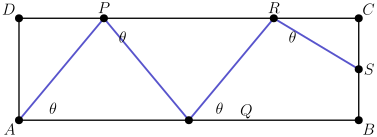
Usain is walking for exercise by zigzagging across a -meter by -meter rectangular field, beginning at point and ending on the segment He wants to increase the distance walked by zigzagging as shown in the figure below (). What angle will produce a length that is meters? (Do not assume the zigzag path has exactly four segments as shown; there could be more or fewer.)
Pista pequeña:
La proyección horizontal de cada segmento del zigzag es su longitud multiplicada por
The horizontal projection of each zigzag segment is its length multiplied by
Pista grande:
Suma las proyecciones horizontales de todos los segmentos y compara el avance de metros con la trayectoria de metros
Add the horizontal projections of all the segments and compare the -meter progress with the -meter path
Solución:
Cada segmento del zigzag forma un ángulo con un lado horizontal del campo. Por tanto, un segmento de longitud avanza metros horizontalmente. Esto también vale para el último segmento, aunque termine antes de cruzar todo el ancho del campo.
Al sumar las proyecciones horizontales de toda la trayectoria de metros, obtenemos
Por tanto, y
Por lo tanto, la respuesta correcta es A.
Every segment of the zigzag makes angle with a horizontal side of the field. Therefore a segment of length advances meters horizontally. This remains true for the last segment even if it ends before crossing the full width of the field.
Adding the horizontal projections over the entire -meter path gives
Therefore so
Thus, the correct answer is A.
16.
Considera el conjunto de números complejos que satisfacen El valor máximo de la parte imaginaria de puede escribirse en la forma donde y son enteros positivos primos entre sí. ¿Cuánto vale ?
Consider the set of complex numbers satisfying The maximum value of the imaginary part of can be written in the form where and are relatively prime positive integers. What is
Pista pequeña:
Escribe y desarrolla
Write and expand
Pista grande:
Maximizar fuerza el caso simétrico resuelve la ecuación resultante para
Maximizing forces the symmetric case solve the resulting equation for
Solución:
Escribe Entonces y la restricción es
En un punto donde es máximo sobre esta curva cerrada y acotada, la derivación implícita (o los multiplicadores de Lagrange) da donde Pero así que
Entonces así que la restricción se reduce a Tomando se obtiene así que el máximo es
Aquí y así que
Por lo tanto, la respuesta correcta es B.
Write Then and the constraint is
At a point where is maximal on this closed, bounded curve, implicit differentiation (or Lagrange multipliers) gives where But so
Then so the constraint reduces to Taking gives so the maximum is
Here and so
Thus, the correct answer is B.
17.
La rana Flora empieza en en la recta numérica y realiza una sucesión de saltos hacia la derecha. En cualquier salto, independientemente de los saltos anteriores, Flora salta una distancia entera positiva con probabilidad ¿Cuál es la probabilidad de que Flora acabe cayendo en ?
Flora the frog starts at on the number line and makes a sequence of jumps to the right. In any one jump, independent of previous jumps, Flora leaps a positive integer distance with probability What is the probability that Flora will eventually land at
Pista pequeña:
Sea la probabilidad de que Flora caiga alguna vez en condiciona sobre el tamaño del primer salto
Let be the probability Flora ever lands on condition on the size of the first jump
Pista grande:
La recursión da el mismo valor para todo
The recursion gives the same value for every
Solución:
Sea la probabilidad de que Flora caiga alguna vez exactamente en con Condicionando según el primer salto,
Demostramos por inducción que para todo El caso es inmediato. Si la afirmación vale hasta entonces
Por tanto, la probabilidad de caer en es
Así, la respuesta correcta es E.
Let be the probability that Flora ever lands exactly on with Conditioning on the first jump,
We prove by induction that for every The case is immediate. If the claim holds through then
Hence the probability of landing on is
Thus, the correct answer is E.
18.
Los círculos y tienen cada uno radio y la distancia entre sus centros es El círculo es el mayor círculo tangente internamente a y El círculo es tangente internamente a y y tangente externamente a ¿Cuál es el radio de ?
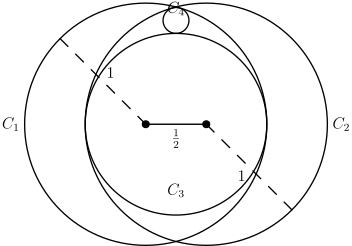
Circle and each have radius and the distance between their centers is Circle is the largest circle internally tangent to both and Circle is internally tangent to both and and externally tangent to What is the radius of
Pista pequeña:
Por simetría tiene su centro en el punto medio de su radio es
By symmetry is centered at the midpoint of its radius is
Pista grande:
Coloca sobre la mediatriz; su centro está a del centro de un círculo unitario y a del centro de
Place on the perpendicular bisector; its center is from a unit circle’s center and from the center of
Solución:
Coloca los centros en y Por simetría tiene su centro en el origen, y la tangencia interna a da radio
Sea de radio con centro en sobre el eje de simetría. La tangencia externa a da y la tangencia interna a da
Sustituyendo, que se simplifica a así que
Por lo tanto, la respuesta correcta es D.
Put the centers at and By symmetry is centered at the origin, and internal tangency to gives radius
Let have radius centered at on the axis of symmetry. External tangency to gives and internal tangency to gives
Substituting, which simplifies to so
Thus, the correct answer is D.
19.
¿Cuál es el producto de todas las soluciones de la ecuación
What is the product of all the solutions to the equation
Pista pequeña:
Convierte a base y define nota que así que
Convert to base and set note so
Pista grande:
La ecuación se convierte en una cuadrática en cuyas dos raíces suman
The equation becomes a quadratic in whose two roots sum to
Solución:
Sea y Como tenemos Escribiendo cada logaritmo se vuelve un recíproco, y la ecuación se convierte en
Al desarrollar y usar los términos lineales se cancelan, dejando Sus dos raíces satisfacen
Las soluciones correspondientes se multiplican dando
Por lo tanto, la respuesta correcta es C.
Let and Since we have Writing each logarithm becomes a reciprocal, and the equation turns into
Expanding and using the linear terms cancel, leaving Its two roots satisfy
The corresponding solutions multiply to
Thus, the correct answer is C.
20.
A continuación se muestran las filas y de un arreglo triangular de enteros.
Cada fila después de la primera se forma colocando un en cada extremo de la fila, y cada entrada interior es mayor que la suma de los dos números diagonalmente por encima de ella en la fila anterior. ¿Cuál es el dígito de las unidades de la suma de los números de la fila ?
Rows and of a triangular array of integers are shown below.
Each row after the first row is formed by placing a at each end of the row, and each interior entry is greater than the sum of the two numbers diagonally above it in the previous row. What is the units digit of the sum of the numbers in the rd row?
Pista pequeña:
Sea la suma de la fila cada entrada interior añade dos copias de la fila de arriba más un
Let be the sum of row each interior entry adds two copies of the row above plus a
Pista grande:
Esto da cuya forma cerrada es
This yields whose closed form is
Solución:
Sea la suma de la fila Cada entrada interior es más que la suma de las dos entradas por encima de ella, y sumar sobre la fila da la recurrencia
Con esto se resuelve como (verificación: ).
Así que Como las potencias de tienen dígitos de las unidades que ciclan y termina en Entonces da dígito de las unidades
Por lo tanto, la respuesta correcta es C.
Let be the sum of row Each interior entry is more than the sum of the two entries above it, and summing over the row gives the recurrence
With this solves to (check: ).
So Since powers of cycle with units digits and ends in Then gives units digit
Thus, the correct answer is C.
21.
Si y son vértices de un poliedro, define la distancia como el número mínimo de aristas del poliedro que hay que recorrer para conectar y Por ejemplo, si es una arista del poliedro, entonces pero si y son aristas y no es una arista, entonces Sean y vértices distintos elegidos al azar de un icosaedro regular (poliedro regular formado por triángulos equiláteros). ¿Cuál es la probabilidad de que ?
If and are vertices of a polyhedron, define the distance to be the minimum number of edges of the polyhedron one must traverse in order to connect and For example, if is an edge of the polyhedron, then but if and are edges and is not an edge, then Let and be randomly chosen distinct vertices of a regular icosahedron (regular polyhedron made up of equilateral triangles). What is the probability that
Pista pequeña:
Fija Los otros vértices se reparten en a distancia a distancia y a distancia
Fix The other vertices split into at distance at distance and at distance
Pista grande:
Por simetría
By symmetry
Solución:
Fija Entre los otros vértices del icosaedro, están a distancia están a distancia y (el antípoda) está a distancia
Al elegir distintos y ordenados, la probabilidad de que es
Por la simetría entre y
Por lo tanto, la respuesta correcta es A.
Fix Among the other vertices of the icosahedron, are at distance are at distance and (the antipode) is at distance
Choosing ordered distinct the probability that is
By the symmetry between and
Thus, the correct answer is A.
22.
Sea la única función definida sobre los enteros positivos tal que para todo entero positivo donde la suma se toma sobre todos los divisores positivos de ¿Cuánto vale ?
Let be the unique function defined on the positive integers such that for all positive integers where the sum is taken over all positive divisors of What is
Pista pequeña:
La relación determina de forma recursiva; resulta ser multiplicativa
The relation determines recursively; turns out to be multiplicative
Pista grande:
Calcula y aquí
Compute and here
Solución:
Poner da Para un primo da así que Para da
Como la relación que la define es una convolución de Dirichlet de funciones multiplicativas, es multiplicativa. Con
Por lo tanto, la respuesta correcta es B.
Setting gives For a prime gives so For gives
Since the defining relation is a Dirichlet convolution of multiplicative functions, is multiplicative. With
Thus, the correct answer is B.
23.
¿Cuántos pares ordenados de números reales positivos satisfacen la ecuación
How many ordered pairs of positive real numbers satisfy the equation
un número infinito
an infinite number
Pista pequeña:
Aplica AM-GM por separado a y
Apply AM-GM separately to and
Pista grande:
El producto es al menos así que la igualdad debe cumplirse en las tres desigualdades a la vez
The product is at least so equality must hold in all three inequalities at once
Solución:
Por AM-GM, y Multiplicando,
La igualdad requiere y simultáneamente. Estas dan que son consistentes, así que hay exactamente una solución.
Por lo tanto, la respuesta correcta es B.
By AM-GM, and Multiplying,
Equality requires and simultaneously. These give which are consistent, so there is exactly one solution.
Thus, the correct answer is B.
24.
Sea el número de sucesiones tales que es un entero positivo menor o igual que cada es un subconjunto de y es un subconjunto de para cada entre y inclusive. Por ejemplo, es una de esas sucesiones, con ¿Cuál es el residuo cuando se divide entre ?
Let be the number of sequences such that is a positive integer less than or equal to each is a subset of and is a subset of for each between and inclusive. For example, is one such sequence, with What is the remainder when is divided by
Pista pequeña:
Para un fijo, cada uno de los elementos elige independientemente el primer conjunto en el que entra, o nunca entra
For a fixed each of the elements independently chooses the first set it enters, or never enters
Pista grande:
Eso da cadenas, así que reduce cada término módulo
That gives chains, so reduce each term modulo
Solución:
Para una longitud fija cada elemento de o bien nunca aparece o bien aparece por primera vez en uno de dando opciones. Por lo tanto hay cadenas de longitud
Sumando, Módulo los términos se reducen a que suman
Por lo tanto, la respuesta correcta es C.
For a fixed length each element of independently either never appears or first appears in one of giving choices. Hence there are chains of length
Summing, Modulo the terms reduce to which sum to
Thus, the correct answer is C.
25.
Existe una única sucesión de enteros tal que siempre que esté definido. ¿Cuánto vale ?
There is a unique sequence of integers such that whenever is defined. What is
Pista pequeña:
Desarrolla y usa
Expand and use
Pista grande:
Dividiendo entre el coeficiente principal de es
Dividing by the top coefficient of is
Solución:
Por De Moivre, Al desarrollar el lado izquierdo y tomar la razón de la parte imaginaria a la real se obtiene como la función racional indicada de tras dividir numerador y denominador entre
El coeficiente es el coeficiente de en el numerador, que proviene del término :
Por lo tanto, la respuesta correcta es C.
By De Moivre, Expanding the left side and taking the ratio of imaginary to real parts gives as the stated rational function of after dividing numerator and denominator by
The coefficient is the coefficient of in the numerator, which comes from the term:
Thus, the correct answer is C.