
Soluciones del 2021 AMC 12B Fall
Desplázate hacia abajo para ver las soluciones preparadas profesionalmente de LIVE by Po-Shen Loh, imprime las soluciones en PDF, consulta la clave de respuestas, o haz el examen cronometrado completo.
Todos los problemas se usan con el permiso legal oficial de la Mathematical Association of America (MAA).
1.
¿Cuál es el valor de
What is the value of
Pista pequeña:
Cada uno de los dígitos aparece una vez en cada valor posicional.
Each of the digits appears once in every place value
Pista grande:
Cada columna suma .
Every column adds to
Solución:
Cada uno de los dígitos aparece exactamente una vez en las columnas de los millares, las centenas, las decenas y las unidades. Así, cada columna suma
Por lo tanto, el total es
Por lo tanto, la respuesta correcta es E.
Each of the digits appears exactly once in the thousands, hundreds, tens, and units columns. So each column sums to
The total is therefore
Thus, the correct answer is E.
2.
¿Cuál es el área de la figura sombreada que se muestra abajo?
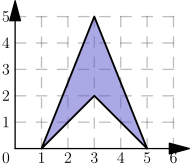
What is the area of the shaded figure shown below?
Pista pequeña:
La región sombreada es un triángulo grande al que se le ha quitado una muesca triangular de su base.
The shaded region is a large triangle with a triangular notch removed from its base
Pista grande:
Ambos triángulos tienen base a lo largo del eje .
Both triangles have base along the -axis
Solución:
El triángulo exterior tiene vértices y con base y altura de modo que su área es
Se le quita el triángulo con vértices y que tiene base y altura así que área
El área sombreada es
Por lo tanto, la respuesta correcta es B.
The outer triangle has vertices and giving base and height so its area is
Removed from it is the triangle with vertices and which has base and height so area
The shaded area is
Thus, the correct answer is B.
3.
Al mediodía de cierto día, Minneapolis está grados más cálida que St. Louis. A las la temperatura en Minneapolis ha bajado grados mientras que la temperatura en St. Louis ha subido grados, momento en el cual las temperaturas de las dos ciudades difieren en grados. ¿Cuál es el producto de todos los valores posibles de ?
At noon on a certain day, Minneapolis is degrees warmer than St. Louis. At the temperature in Minneapolis has fallen by degrees while the temperature in St. Louis has risen by degrees, at which time the temperatures in the two cities differ by degrees. What is the product of all possible values of
Pista pequeña:
Al mediodía la diferencia es ; sigue cómo cada cambio afecta la brecha.
At noon the difference is ; track how each change affects the gap
Pista grande:
La nueva diferencia es .
The new difference is
Solución:
Al mediodía la brecha es Minneapolis pierde entonces grados y St. Louis gana así que la brecha cambia en La nueva diferencia absoluta es
Esto da o cuyo producto es
Por lo tanto, la respuesta correcta es C.
At noon the gap is Minneapolis then loses degrees and St. Louis gains so the gap changes by The new absolute difference is
This gives or whose product is
Thus, the correct answer is C.
4.
Sea ¿Cuál de las siguientes opciones es igual a
Let Which of the following is equal to
Pista pequeña:
Reescribe todo como una potencia de .
Rewrite everything as a power of
Pista grande:
Dividir entre cuatro reduce el exponente en dos: .
Solución:
Escribe Entonces
Como esto corresponde a la última opción.
Por lo tanto, la respuesta correcta es E.
Write Then
Since this matches the last option.
Thus, the correct answer is E.
5.
Llamamos a una fracción no necesariamente en su forma más simple, especial si y son enteros positivos cuya suma es ¿Cuántos enteros distintos se pueden escribir como la suma de dos fracciones especiales, no necesariamente diferentes?
Call a fraction not necessarily in the simplest form, special if and are positive integers whose sum is How many distinct integers can be written as the sum of two, not necessarily different, special fractions?
Pista pequeña:
Enumera las fracciones especiales y observa cuáles son enteras, semienteras o de cuarto de entero.
List the special fractions and note which are integers, half-integers, or quarter-integers
Pista grande:
Dos especiales suman un entero solo cuando sus partes fraccionarias se cancelan.
Two specials sum to an integer only when their fractional parts cancel
Solución:
Al enumerar para los enteros son las fracciones cuya parte fraccionaria es son y tienen partes fraccionarias complementarias
Las partes fraccionarias restantes son y ninguno de sus complementos aparece. Así, solo los casos entero, semientero y de cuarto pueden dar sumas enteras.
Los pares de enteros dan Los pares de semienteros dan El par de cuartos da
Los enteros distintos son un total de
Por lo tanto, la respuesta correcta es C.
Listing for the integers are the fractions with fractional part are and have complementary fractional parts
The remaining fractional parts are and none of their complements occurs. Thus only the integer, half-integer, and quarter cases can give integer sums.
Integer pairs give Half-integer pairs give The quarter pair gives
The distinct integers are a total of
Thus, the correct answer is C.
6.
El mayor número primo que es divisor de es porque ¿Cuál es la suma de los dígitos del mayor número primo que es divisor de ?
The greatest prime number that is a divisor of is because What is the sum of the digits of the greatest prime number that is a divisor of
Pista pequeña:
.
Pista grande:
Factoriza como
Factor as
Solución:
Tenemos Luego así que
El mayor factor primo es cuya suma de dígitos es
Por lo tanto, la respuesta correcta es C.
We have Then so
The greatest prime factor is whose digit sum is
Thus, the correct answer is C.
7.
¿Cuál de las siguientes condiciones es suficiente para garantizar que los enteros y satisfagan la ecuación
Which of the following conditions is sufficient to guarantee that integers and satisfy the equation
y
and
y
and
y
and
y
and
Pista pequeña:
Multiplica por : el lado izquierdo es igual a
Multiply by : the left side equals
Pista grande:
Para enteros, esa suma es igual a solo cuando dos diferencias son y una es .
For integers, that sum equals only when two differences are and one is
Solución:
La expresión satisface Así que la ecuación se cumple exactamente cuando esta suma de cuadrados es igual a
Como las tres diferencias suman esto exige que dos de ellas sean y una sea
La opción D da y de modo que los cuadrados son Esto funciona para todos esos enteros.
Por lo tanto, la respuesta correcta es D.
The expression satisfies So the equation holds exactly when this sum of squares equals
Since the three differences sum to this requires two of them to be and one to be
Option D gives and so the squares are This works for all such integers.
Thus, the correct answer is D.
8.
El producto de las longitudes de los dos lados congruentes de un triángulo isósceles obtuso es igual al producto de la base y el doble de la altura del triángulo sobre la base. ¿Cuál es la medida, en grados, del ángulo del vértice de este triángulo?
The product of the lengths of the two congruent sides of an obtuse isosceles triangle is equal to the product of the base and twice the triangle’s height to the base. What is the measure, in degrees, of the vertex angle of this triangle?
Pista pequeña:
Escribe el área de dos maneras usando los lados iguales y el ángulo del vértice .
Write the area two ways using the legs and the vertex angle
Pista grande:
El área es a la vez y .
The area is both and
Solución:
Sean los lados congruentes de longitud la base y la altura sobre la base La condición dada es
El área es igual a y también a donde es el ángulo del vértice. Así,
Sustituyendo se obtiene así que Como el triángulo es obtuso,
Por lo tanto, la respuesta correcta es D.
Let the congruent sides have length the base be and the height to the base be The given condition is
The area equals and also where is the vertex angle. So
Substituting gives so Since the triangle is obtuse,
Thus, the correct answer is D.
9.
El triángulo es equilátero con longitud de lado Supongamos que es el centro del círculo inscrito de este triángulo. ¿Cuál es el área del círculo que pasa por y ?
Triangle is equilateral with side length Suppose that is the center of the inscribed circle of this triangle. What is the area of the circle passing through and
Pista pequeña:
En un triángulo equilátero el incentro coincide con el circuncentro.
In an equilateral triangle the incenter coincides with the circumcenter
Pista grande:
En el triángulo el ángulo y ; aplica la ley de los senos
In triangle angle and ; apply the law of sines
Solución:
Para un triángulo equilátero, es también el circuncentro, así que El ángulo central
En el triángulo el lado es opuesto al ángulo de , así que el circunradio de este triángulo satisface lo que da
El área del círculo es
Por lo tanto, la respuesta correcta es B.
For an equilateral triangle, is also the circumcenter, so The central angle
In triangle side is opposite the angle, so the circumradius of this triangle satisfies giving
The area of the circle is
Thus, the correct answer is B.
10.
¿Cuál es la suma de todos los valores posibles de entre y tales que el triángulo en el plano de coordenadas cuyos vértices son y es isósceles?
What is the sum of all possible values of between and such that the triangle in the coordinate plane whose vertices are and is isosceles?
Pista pequeña:
Los tres puntos están sobre el círculo unitario, así que lados iguales significan cuerdas iguales, es decir, separaciones de arco iguales.
All three points lie on the unit circle, so equal sides mean equal chords, i.e. equal arc separations
Pista grande:
Considera los tres casos en que el tercer punto iguala la distancia a a o está sobre su mediatriz.
Consider the three cases where the third point matches distance to to or lies on their perpendicular bisector
Solución:
Los tres puntos están sobre el círculo unitario en los ángulos y La longitud de una cuerda depende solo de la separación angular de sus extremos.
Si el tercer punto es equidistante de los otros dos, está sobre la mediatriz: o
Si su distancia a es igual a la cuerda fija (separación ), entonces (ya que es degenerado). Si su distancia a coincide, entonces (ya que es degenerado).
Los valores válidos son que suman
Por lo tanto, la respuesta correcta es E.
The three points lie on the unit circle at angles and A chord’s length depends only on the angular separation of its endpoints.
If the third point is equidistant from the other two, it lies on the perpendicular bisector: or
If its distance to equals the fixed chord (separation ), then (since is degenerate). If its distance to matches, then (since is degenerate).
The valid values are summing to
Thus, the correct answer is E.
11.
Una lanza dados estándar de caras simultáneamente y calcula el producto de los números obtenidos. ¿Cuál es la probabilidad de que el producto sea divisible entre ?
Una rolls standard -sided dice simultaneously and calculates the product of the numbers obtained. What is the probability that the product is divisible by
Pista pequeña:
Usa conteo complementario: el producto tiene menos de dos factores de .
Use complementary counting: the product has fewer than two factors of
Pista grande:
Sigue si cada dado aporta cero, uno o dos factores de .
Track whether each die contributes zero, one, or two factors of
Solución:
El producto no es divisible entre cuando tiene a lo sumo un factor de Cada dado es impar con probabilidad aporta exactamente un factor de (un o un ) con probabilidad y dos factores (un ) con probabilidad
Los seis impares: Exactamente un dado un o un y el resto impares:
El complemento es así que la respuesta es
Por lo tanto, la respuesta correcta es C.
The product fails to be divisible by when it has at most one factor of Each die is odd with probability contributes exactly one factor of (a or ) with probability and two factors (a ) with probability
All six odd: Exactly one die a or and the rest odd:
The complement is so the answer is
Thus, the correct answer is C.
12.
Para un entero positivo, sea el cociente que se obtiene al dividir la suma de todos los divisores positivos de entre Por ejemplo, ¿Cuánto vale ?
For a positive integer, let be the quotient obtained when the sum of all positive divisors of is divided by For example, What is
Pista pequeña:
Factoriza y luego usa de una potencia de primo.
Factor and then use of a prime power
Pista grande:
Pon ambos sobre un denominador común de .
Put both over a common denominator of
Solución:
Como su suma de divisores es así que
Como su suma de divisores es así que
La diferencia es
Por lo tanto, la respuesta correcta es B.
Since its divisor sum is so
Since its divisor sum is so
The difference is
Thus, the correct answer is B.
13.
Sea ¿Cuál es el valor de
Let What is the value of
Pista pequeña:
Cada ángulo es un múltiplo de ; reduce los ángulos del numerador módulo .
Each angle is a multiple of ; reduce the numerator angles modulo
Pista grande:
Usa para relacionar los factores del numerador que quedan con los del denominador
Use to relate leftover numerator factors to denominator factors
Solución:
Escribe cada ángulo como Reduciendo módulo y
Así, el numerador es Al cancelar los factores comunes queda
Ahora y así que la razón es igual a
Por lo tanto, la respuesta correcta es E.
Write each angle as Reducing modulo and
So the numerator is Cancelling the common factors leaves
Now and so the ratio equals
Thus, the correct answer is E.
14.
Supongamos que y son polinomios con coeficientes reales, de grados y respectivamente, y términos constantes y respectivamente. Sea el número de números complejos distintos que satisfacen la ecuación ¿Cuál es el valor mínimo posible de ?
Suppose that and are polynomials with real coefficients, having degrees and respectively, and constant terms and respectively. Let be the number of distinct complex numbers that satisfy the equation What is the minimum possible value of
Pista pequeña:
Considera ; ¿cuál es su grado y su término constante?
Consider ; what is its degree and constant term?
Pista grande:
Un polinomio de grado puede tener una única raíz de multiplicidad .
A degree- polynomial can have a single root of multiplicity
Solución:
Sea Como tiene grado y tiene grado el grado de es Su término constante es
Como no está restringido en lo demás, puede hacerse igual a cualquier polinomio real de grado con término constante por ejemplo
Tal polinomio tiene una única raíz distinta, así que el mínimo es
Por lo tanto, la respuesta correcta es B.
Let Since has degree and has degree the degree of is Its constant term is
Because is otherwise unconstrained, can be made equal to any real degree- polynomial with constant term for instance
Such a polynomial has a single distinct root, so the minimum is
Thus, the correct answer is B.
15.
Tres hojas de papel cuadradas idénticas, cada una con longitud de lado , se apilan una sobre otra. La hoja del medio se gira en sentido horario alrededor de su centro y la hoja de arriba se gira en sentido horario alrededor de su centro, lo que da como resultado el polígono de lados que se muestra en la figura de abajo. El área de este polígono se puede expresar en la forma donde y son enteros positivos, y no es divisible entre el cuadrado de ningún primo. ¿Cuánto vale ?

Three identical square sheets of paper each with side length are stacked on top of each other. The middle sheet is rotated clockwise about its center and the top sheet is rotated clockwise about its center, resulting in the -sided polygon shown in the figure below. The area of this polygon can be expressed in the form where and are positive integers, and is not divisible by the square of any prime. What is
Pista pequeña:
Por simetría, los vértices del polígono alternan entre esquinas exteriores de los cuadrados y cruces interiores de aristas, cada .
By symmetry the polygon’s vertices alternate between outer square-corners and inner edge-crossings, every
Pista grande:
Los vértices exteriores están a distancia del centro y los interiores a distancia .
The outer vertices are at distance from the center and the inner ones at distance
Solución:
Como los tres cuadrados están girados y la figura tiene simetría de orden . Sus vértices alternan cada : los vértices exteriores son las esquinas de los cuadrados a distancia del centro, y los vértices interiores son cruces de aristas a distancia
Al conectar el centro con los vértices, el polígono se divide en triángulos, cada uno con lados y y ángulo comprendido El área total es
Esto se simplifica a así que
Por lo tanto, la respuesta correcta es E.
Because the three squares are rotated by and the figure has -fold symmetry. Its vertices alternate every : outer vertices are the square corners at distance from the center, and inner vertices are edge crossings at distance
Connecting the center to all vertices splits the polygon into triangles, each with sides and and included angle The total area is
This simplifies to so
Thus, the correct answer is E.
16.
Supongamos que son enteros positivos tales que y ¿Cuál es la suma de todos los valores distintos posibles de ?
Suppose are positive integers such that and What is the sum of all possible distinct values of
Pista pequeña:
Por simetría, supón entonces y
By symmetry assume then and
Pista grande:
Usa y revisa el corto rango
Use and check the short range
Solución:
La condición es simétrica, así que supón Entonces y para cada fijo se tiene y La suma de los máximos comunes divisores se puede evaluar como
Al revisar estos cortos rangos, las sumas de gcd posibles para son, respectivamente, y El valor aparece solo en y
La terna tiene suma de igual a y La terna tiene suma de igual a y
La suma de los valores distintos es
Por lo tanto, la respuesta correcta es B.
The condition is symmetric, so assume Then and for each fixed we have and The gcd sum can be evaluated as
Checking these short ranges, the possible gcd sums for are, respectively, and The value occurs only at and
The triple has sum and The triple has sum and
The sum of the distinct values is
Thus, the correct answer is B.
17.
Un bicho parte de un vértice de una cuadrícula formada por triángulos equiláteros de lado En cada paso el bicho se mueve en una de las direcciones posibles a lo largo de las líneas de la cuadrícula de forma aleatoria e independiente con igual probabilidad. ¿Cuál es la probabilidad de que después de movimientos el bicho nunca haya estado a más de unidad de la posición inicial?
A bug starts at a vertex of a grid made of equilateral triangles of side length At each step the bug moves in one of the possible directions along the grid lines randomly and independently with equal probability. What is the probability that after moves the bug never will have been more than unit away from the starting position?
Pista pequeña:
El bicho debe estar siempre en el punto de partida o en uno de sus vecinos.
The bug must always be at the start or one of its neighbors
Pista grande:
Desde un vecino, solo de los movimientos se mantienen a distancia : de vuelta al inicio o a los dos vecinos adyacentes.
From a neighbor, only of the moves stay within distance : back to start or to the two adjacent neighbors
Solución:
Mantenerse a distancia significa que el bicho está siempre en el origen o en uno de sus vecinos. Desde el origen, los movimientos están permitidos. Desde un vecino, solo movimientos lo mantienen en rango: de vuelta al origen, o a cualquiera de los dos vecinos adyacentes.
Sean y el número de trayectorias válidas de pasos que terminan en el origen y en un vecino. Entonces y partiendo de
Iterando se obtiene luego El número total de trayectorias válidas es
La probabilidad es
Por lo tanto, la respuesta correcta es A.
Staying within distance means the bug is always at the origin or one of its neighbors. From the origin, all moves are allowed. From a neighbor, only moves keep it in range: back to the origin, or to either of the two adjacent neighbors.
Let and count valid -step paths ending at the origin and at a neighbor. Then and starting from
Iterating gives then The total number of valid paths is
The probability is
Thus, the correct answer is A.
18.
Sea y para sea determinado por la recurrencia Esta sucesión tiende a un límite; llámalo ¿Cuál es el menor valor de tal que
Set and for let be determined by the recurrence This sequence tends to a limit; call it What is the least value of such that
Pista pequeña:
El límite es ; sustituye .
The limit is ; substitute
Pista grande:
La sustitución da así que se eleva al cuadrado repetidamente.
The substitution gives so squares repeatedly
Solución:
El límite satisface lo que da Sea Entonces
Como obtenemos así que
Necesitamos es decir El menor tal es ya que
Por lo tanto, la respuesta correcta es A.
The limit satisfies giving Let Then
Since we get so
We need i.e. The least such is since
Thus, the correct answer is A.
19.
Polígonos regulares de y lados están inscritos en el mismo círculo. No hay dos polígonos que compartan un vértice, y no hay tres de sus lados que se corten en un punto común. ¿En cuántos puntos dentro del círculo se cortan dos de sus lados?
Regular polygons with and sides are inscribed in the same circle. No two of the polygons share a vertex, and no three of their sides intersect at a common point. At how many points inside the circle do two of their sides intersect?
Pista pequeña:
Considera cada par de polígonos por separado.
Consider each pair of polygons separately
Pista grande:
Dos polígonos inscritos con y lados en posición general se cruzan en puntos.
Two inscribed polygons with and sides in general position cross at points
Solución:
Para dos polígonos convexos inscritos en el mismo círculo sin vértices compartidos, cada lado del polígono menor cruza la frontera del polígono mayor exactamente dos veces, así que se encuentran en puntos.
Sumando sobre todos los pares: dan cada uno; dan cada uno; da
El total es
Por lo tanto, la respuesta correcta es E.
For two convex polygons inscribed in the same circle with no shared vertices, each side of the smaller polygon crosses the larger polygon’s boundary exactly twice, so they meet at points.
Summing over all pairs: give each; give each; gives
The total is
Thus, the correct answer is E.
20.
Un cubo se construye con cubos unitarios blancos y cubos unitarios azules. ¿De cuántas maneras diferentes se puede construir el cubo usando estos cubos más pequeños? (Dos construcciones se consideran iguales si una se puede girar para coincidir con la otra.)
A cube is constructed from white unit cubes and blue unit cubes. How many different ways are there to construct the cube using these smaller cubes? (Two constructions are considered the same if one can be rotated to match the other.)
Pista pequeña:
Usa el lema de Burnside sobre las rotaciones del cubo que actúan sobre las posiciones de las esquinas.
Use Burnside’s lemma over the rotations of the cube acting on the corner positions
Pista grande:
Para cada tipo de rotación, cuenta las coloraciones con exactamente cubos azules que deja fijas.
For each rotation type, count the colorings with exactly blue cubes that it fixes
Solución:
Por el lema de Burnside, el conteo es el número promedio de coloraciones con azules que quedan fijas por cada una de las rotaciones que actúan sobre los cubitos.
La identidad deja fijas Los cuartos de vuelta de cara dejan fijas cada uno Las medias vueltas de cara dejan fijas cada una Las rotaciones de vértice dejan fijas cada una Las medias vueltas de arista dejan fijas cada una
El total es y
Por lo tanto, la respuesta correcta es A.
By Burnside’s lemma, the count is the average number of -blue colorings fixed by each of the rotations acting on the cubies.
The identity fixes The face quarter-turns fix each The face half-turns fix each The vertex rotations fix each The edge half-turns fix each
The total is and
Thus, the correct answer is A.
21.
Para números reales sea donde ¿Para cuántos valores de con se cumple
For real numbers let where For how many values of with does
Pista pequeña:
Escribe y exige que tanto la parte real como la imaginaria se anulen.
Write and require both the real and imaginary parts to vanish
Pista grande:
La parte imaginaria se factoriza como
The imaginary part factors as
Solución:
Agrupa mediante la fórmula de Euler: La parte imaginaria es
Esto se anula cuando (es decir ) o (es decir ).
Al comprobar la parte real en cada uno de estos valores se obtiene o nunca Así que ningún hace
Por lo tanto, la respuesta correcta es A.
Group by Euler’s formula: The imaginary part is
This vanishes when (so ) or (so ).
Checking the real part at each of these values gives or never So no makes
Thus, the correct answer is A.
22.
El triángulo rectángulo tiene lados y Un círculo con centro en es tangente a la recta en y pasa por Un círculo con centro en es tangente a la recta en y pasa por ¿Cuánto vale ?
Right triangle has side lengths and A circle centered at is tangent to line at and passes through A circle centered at is tangent to line at and passes through What is
Pista pequeña:
Coloca en el origen con los catetos a lo largo de los ejes.
Place at the origin with legs along the axes
Pista grande:
El radio en un punto de tangencia es perpendicular a la recta tangente, así que queda directamente encima de y directamente enfrente de .
A tangent point’s radius is perpendicular to the tangent line, so lies directly above and directly across from
Solución:
Coloca y de modo que el ángulo recto está en
El círculo es tangente a la recta (-eje) en así que Al imponer se obtiene así que y
El círculo es tangente a la recta (-eje) en así que Al imponer se obtiene así que y
Entonces
Por lo tanto, la respuesta correcta es C.
Place and so the right angle is at
Circle is tangent to line (the -axis) at so Setting gives so and
Circle is tangent to line (the -axis) at so Setting gives so and
Then
Thus, the correct answer is C.
23.
Se elige al azar un subconjunto de enteros distintos del conjunto . ¿Cuál es el número promedio de pares de enteros consecutivos que contiene? (Por ejemplo, el conjunto contiene pares de enteros consecutivos.)
What is the average number of pairs of consecutive integers in a randomly selected subset of distinct integers chosen from the set (For example the set has pairs of consecutive integers.)
Pista pequeña:
Usa la linealidad de la esperanza sobre los pares consecutivos posibles .
Use linearity of expectation over the possible consecutive pairs
Pista grande:
La probabilidad de que tanto como sean elegidos es .
The probability that both and are chosen is
Solución:
Para cada uno de los pares adyacentes sea un indicador igual a si ambos están en el subconjunto. La probabilidad de esto es
Por la linealidad de la esperanza, el número esperado de pares consecutivos es
Por lo tanto, la respuesta correcta es A.
For each of the adjacent pairs let an indicator be if both are in the subset. The probability of this is
By linearity of expectation, the expected number of consecutive pairs is
Thus, the correct answer is A.
24.
El triángulo tiene lados y La bisectriz de corta a en el punto y corta al circuncírculo de en el punto El circuncírculo de corta a la recta en los puntos y ¿Cuánto vale ?
Triangle has side lengths and The bisector of intersects in point and intersects the circumcircle of in point The circumcircle of intersects the line in points and What is
Pista pequeña:
Aplica la potencia del punto al círculo que pasa por : .
Apply power of the point to the circle through :
Pista grande:
Como obtenemos así que .
Because we get so
Solución:
Los puntos son colineales sobre la bisectriz, y son colineales sobre la recta La potencia de respecto al círculo que pasa por da
Como y (subtendiendo ), los triángulos y son semejantes, así que Por lo tanto
Coloca A partir de el punto El punto está sobre el rayo con así que
Entonces así que
Por lo tanto, la respuesta correcta es C.
Points are collinear on the bisector, and are collinear on line The power of with respect to the circle through gives
Since and (subtending ), triangles and are similar, so Therefore
Place From point Point lies on ray with so
Then so
Thus, the correct answer is C.
25.
Para un entero positivo, sea la suma de los residuos cuando se divide entre y Por ejemplo, ¿Cuántos enteros positivos de dos dígitos satisfacen
For a positive integer, let be the sum of the remainders when is divided by and For example, How many two-digit positive integers satisfy
Pista pequeña:
Cuando aumenta en cada residuo sube en a menos que sea divisible por en cuyo caso cae a .
When increases by each remainder rises by unless is divisible by where it drops to
Pista grande:
así que necesitas que los divisores de entre sumen .
so you need the divisors of among to sum to
Solución:
Al pasar de a cada residuo aumenta en , salvo que sea divisible por en cuyo caso baja de a Por tanto,
Los enteros distintos de a pueden sumar solo como o El cierre por divisibilidad elimina todos los casos salvo por ejemplo, un múltiplo de también tiene divisor y uno de también tiene divisores y Así, debe ser múltiplo de sin ningún otro divisor en
Al probar los múltiplos del intervalo requerido, quedan solo y Por tanto, o lo que da valores.
Por lo tanto, la respuesta correcta es C.
Going from to each remainder increases by unless is divisible by in which case it drops from to So
Distinct integers from through can sum to only as or Divisibility closure eliminates every case except for example, a multiple of also has divisor and a multiple of also has divisors and Thus must be a multiple of with no other divisor in
Testing the multiples in the required range leaves only and Hence or giving values.
Thus, the correct answer is C.