
Soluciones del 2010 AMC 12A
Desplázate hacia abajo para ver las soluciones preparadas profesionalmente de LIVE by Po-Shen Loh, imprime las soluciones en PDF, consulta la clave de respuestas, o haz el examen cronometrado completo.
Todos los problemas se usan con el permiso legal oficial de la Mathematical Association of America (MAA).
1.
¿Cuál es el valor de ?
What is
Pista pequeña:
Distribuye los signos negativos y busca términos que se cancelen.
Distribute the negative signs and look for terms that cancel
Pista grande:
Después de que se cancelan los términos y , solo quedan los dos .
After the and terms cancel, only the two s remain
Solución:
Al distribuir los signos negativos se obtiene
Por lo tanto, C es la respuesta correcta.
Distributing the negative signs gives
Thus, C is the correct answer.
2.
Un transbordador lleva turistas a una isla cada hora, comenzando a las de la mañana hasta su último viaje, que sale a las de la tarde. Un día el capitán del barco nota que en el viaje de las de la mañana había turistas en el transbordador, y que en cada viaje sucesivo el número de turistas era menos que en el viaje anterior. ¿Cuántos turistas llevó el transbordador a la isla ese día?
A ferry boat shuttles tourists to an island every hour starting at am until its last trip, which starts at pm. One day the boat captain notes that on the am trip there were tourists on the ferry boat, and that on each successive trip, the number of tourists was fewer than on the previous trip. How many tourists did the ferry take to the island that day?
Pista pequeña:
Cuenta cuántos viajes hay desde las de la mañana hasta las de la tarde.
Count how many trips run from am through pm
Pista grande:
Los conteos de viajes son súmalos.
The trip counts are add them
Solución:
El transbordador hace viajes: a las y
Los números de turistas son así que el total es
Por lo tanto, A es la respuesta correcta.
The ferry makes trips: at and
The numbers of tourists are so the total is
Thus, A is the correct answer.
3.
El rectángulo mostrado abajo, comparte de su área con el cuadrado El cuadrado comparte de su área con el rectángulo ¿Cuánto vale ?
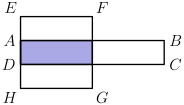
Rectangle pictured below, shares of its area with square Square shares of its area with rectangle What is
Pista pequeña:
Sea la longitud del lado del cuadrado; el traslape sombreado tiene ancho y altura .
Let be the side length of the square; the shaded overlap has width and height
Pista grande:
La mitad del área del rectángulo es igual al traslape, lo que da un quinto del área del cuadrado da .
Half the rectangle’s area equals the overlap, giving one fifth of the square’s area gives
Solución:
Sea la longitud del lado del cuadrado El traslape sombreado tiene ancho y altura así que su área es
Como el traslape es el del rectángulo, así que Como es el del cuadrado, así que
Por lo tanto
Por lo tanto, E es la respuesta correcta.
Let be the side length of square The shaded overlap has width and height so its area is
Because the overlap is of the rectangle, so Because it is of the square, so
Therefore
Thus, E is the correct answer.
4.
Si ¿cuál de las siguientes opciones debe ser positiva?
If then which of the following must be positive?
Pista pequeña:
Prueba cada opción con un valor negativo como .
Test each choice with a negative value such as
Pista grande:
Reescribe como el recíproco de un número negativo es negativo, así que su opuesto es positivo.
Rewrite as dividing into a negative number flips the sign
Solución:
La opción (D) es Cuando así que
Al probar se ve que las otras opciones no tienen por qué ser positivas: y
Por lo tanto, D es la respuesta correcta.
Choice (D) is When so
Testing shows the other choices need not be positive: and
Thus, D is the correct answer.
5.
A la mitad de un torneo de tiro con arco de tiros, Chelsea lleva una ventaja de puntos. En cada tiro, dar en el blanco vale puntos, y las otras puntuaciones posibles son y puntos. Chelsea siempre obtiene al menos puntos en cada tiro. Si los siguientes tiros de Chelsea dan en el blanco, tendrá la victoria asegurada. ¿Cuál es el valor mínimo de ?
Halfway through a -shot archery tournament, Chelsea leads by points. For each shot a bullseye scores points, with other possible scores being and points. Chelsea always scores at least points on each shot. If Chelsea’s next shots are bullseyes she will be guaranteed victory. What is the minimum value for
Pista pequeña:
El oponente de Chelsea puede obtener a lo sumo puntos en cada uno de los tiros restantes.
Chelsea’s opponent can score at most points on each of the remaining shots
Pista grande:
Con blancos y al menos puntos en los otros tiros, se necesita .
With bullseyes and at least points on the other shots, require
Solución:
El oponente puede obtener a lo sumo en los últimos tiros. Como Chelsea lleva una ventaja de debe obtener más de puntos en sus tiros restantes para asegurar la victoria.
Sus blancos dan puntos, y sus otros tiros dan al menos puntos, así que Esto se simplifica a es decir
Por lo tanto, Chelsea necesita al menos blancos.
Por lo tanto, C es la respuesta correcta.
The opponent can score at most on the last shots. Since Chelsea leads by she must score more than points on her remaining shots to guarantee victory.
Her bullseyes give points, and her other shots give at least points, so This simplifies to i.e.
Therefore Chelsea needs at least bullseyes.
Thus, C is the correct answer.
6.
Un palíndromo, como es un número que permanece igual cuando se invierten sus dígitos. Los números y son palíndromos de tres y cuatro dígitos, respectivamente. ¿Cuál es la suma de los dígitos de ?
A palindrome, such as is a number that remains the same when its digits are reversed. The numbers and are three-digit and four-digit palindromes, respectively. What is the sum of the digits of
Pista pequeña:
Acota el palíndromo de cuatro dígitos entre y .
Bound the four-digit palindrome between and
Pista grande:
Encuentra el único palíndromo en ese intervalo, luego resta .
Find the only palindrome in that interval, then subtract
Solución:
Nota que es a lo sumo Esto significa que tiene un máximo de
De manera similar, el valor mínimo de es
El único palíndromo en este rango es así que a esto equivale .
Entonces cuya suma de dígitos es
Por lo tanto, E es la respuesta correcta.
Note that is at most This means that has a maximum of
Similarly, we have that the minimum value of is
The only palindrome in this range is so this is what equals.
Thus whose digit sum is
Thus, E is the correct answer.
7.
Logan está construyendo un modelo a escala de su ciudad. La torre de agua de la ciudad mide metros de altura, y la parte superior es una esfera que contiene litros de agua. La torre de agua en miniatura de Logan contiene litros. ¿Qué altura, en metros, debe tener la torre de Logan?
Logan is constructing a scaled model of his town. The city’s water tower stands meters high, and the top portion is a sphere that holds liters of water. Logan’s miniature water tower holds liters. How tall, in meters, should Logan make his tower?
Pista pequeña:
La escala de volumen es el cubo de la escala de longitud.
Volume scale is the cube of length scale
Pista grande:
Compara litros con litros, luego toma la raíz cúbica.
Compare liters to liters, then take a cube root
Solución:
La razón entre el volumen del modelo y el original es Las longitudes se escalan por la raíz cúbica, así que la razón de alturas es Por tanto, el modelo debe medir metros de altura.
Por lo tanto, C es la respuesta correcta.
The model-to-original volume ratio is Lengths scale by the cube root, so the model-to-original height ratio is Therefore the model should be meters tall.
Thus, C is the correct answer.
8.
El triángulo cumple Sean y puntos sobre y respectivamente, tales que Sea la intersección de los segmentos y y supongamos que es equilátero. ¿Cuánto vale ?
Triangle has Let and be on and respectively, such that Let be the intersection of segments and and suppose that is equilateral. What is
Pista pequeña:
Sea .
Let
Pista grande:
Usa para hallar luego persigue ángulos para .
Use to find then angle-chase
Solución:
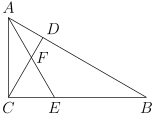
Sea Como es equilátero, Los rayos y son opuestos, así que
En obtenemos Como está en este ángulo es Entonces
Sea de modo que La ley de cosenos da Así, los lados están en razón con como hipotenusa, por lo que
Por lo tanto, C es la respuesta correcta.
Let Because is equilateral, Rays and are opposite, so
In we get Since lies on this is Hence
Put so The Law of Cosines gives Thus the side lengths are in the ratio with the hypotenuse, so
Thus, C is the correct answer.
9.
Un cubo sólido tiene lado de pulgadas. En el centro de cada cara se corta un agujero cuadrado de pulgadas por pulgadas. Los bordes de cada corte son paralelos a las aristas del cubo, y cada agujero atraviesa todo el cubo. ¿Cuál es el volumen, en pulgadas cúbicas, del sólido restante?
A solid cube has side length inches. A -inch by -inch square hole is cut into the center of each face. The edges of each cut are parallel to the edges of the cube, and each hole goes all the way through the cube. What is the volume, in cubic inches, of the remaining solid?
Pista pequeña:
Usa inclusión-exclusión para los tres agujeros rectangulares.
Use inclusion-exclusion for the three rectangular holes
Pista grande:
Los tres agujeros se traslapan en el cubo central .
The three holes overlap in the central cube
Solución:
Nota que todos los sólidos extraídos se intersecan en el centro del cubo.
Esta región de intersección es un cubo con lado Entonces el volumen de la región extraída es
Tenemos que restar la región central dos veces, ya que está incluida en las regiones.
El volumen restante es entonces
Por lo tanto, A es la respuesta correcta.
Note that all the cut out solids intersect in the middle of the cube.
This region of intersection is a cube with side length Then the volume of the cutout region is
We have to subtract out the center region twice since it is included in all regions.
The remaining volume is then
Thus, A is the correct answer.
10.
Los primeros cuatro términos de una sucesión aritmética son y ¿Cuál es el término de esta sucesión?
The first four terms of an arithmetic sequence are and What is the th term of this sequence?
Pista pequeña:
La diferencia común es igual a .
The common difference equals
Pista grande:
Además y despeja y .
Also and solve for and
Solución:
Los términos consecutivos difieren en una diferencia común De los dos últimos términos,
De los dos primeros términos, y del segundo y el tercero, Resolviendo este sistema se obtiene y
El término es
Por lo tanto, A es la respuesta correcta.
Consecutive terms differ by a common difference From the last two terms,
From the first two terms, and from the second and third, Solving this system gives and
The th term is
Thus, A is the correct answer.
11.
La solución de la ecuación puede expresarse en la forma ¿Cuánto vale ?
The solution of the equation can be expressed in the form What is
Pista pequeña:
significa que .
means
Pista grande:
Multiplica para combinar las bases: .
Multiply to combine the bases:
Solución:
Como tenemos
Entonces
Como se sigue que así que
Por lo tanto, C es la respuesta correcta.
Since we have
Then
Because it follows that so
Thus, C is the correct answer.
12.
En un pantano mágico hay dos especies de anfibios parlantes: los sapos, cuyas afirmaciones siempre son verdaderas, y las ranas, cuyas afirmaciones siempre son falsas. Cuatro anfibios, Brian, Chris, LeRoy y Mike, viven juntos en este pantano y hacen las siguientes afirmaciones.
Brian: «Mike y yo somos de especies diferentes.»
Chris: «LeRoy es una rana.»
LeRoy: «Chris es una rana.»
Mike: «De los cuatro, al menos dos somos sapos.»
¿Cuántos de estos cuatro anfibios son ranas?
In a magical swamp there are two species of talking amphibians: toads, whose statements are always true, and frogs, whose statements are always false. Four amphibians, Brian, Chris, LeRoy, and Mike live together in this swamp, and they make the following statements.
Brian: “Mike and I are different species.”
Chris: “LeRoy is a frog.”
LeRoy: “Chris is a frog.”
Mike: “Of the four of us, at least two are toads.”
How many of these four amphibians are frogs?
Pista pequeña:
Chris y LeRoy no pueden ser de la misma especie.
Chris and LeRoy cannot have the same species
Pista grande:
Si Brian fuera un sapo, la afirmación de Mike crearía una contradicción.
If Brian were a toad, Mike’s statement would create a contradiction
Solución:
Chris y LeRoy son de especies opuestas: si Chris es un sapo, su afirmación hace que LeRoy sea una rana; si Chris es una rana, su afirmación falsa hace que LeRoy sea un sapo. Así que exactamente uno de ellos es un sapo.
Si Brian es un sapo, su afirmación verdadera hace que Mike sea una rana. Si Brian es una rana, su afirmación falsa dice que él y Mike son de la misma especie, lo que de nuevo hace que Mike sea una rana. Por lo tanto, Mike siempre es una rana.
En consecuencia, la afirmación de Mike es falsa, así que hay menos de dos sapos. Chris y LeRoy ya aportan exactamente un sapo, lo que obliga a que Brian sea una rana. Por lo tanto, hay un sapo y ranas.
Por lo tanto, D es la respuesta correcta.
Chris and LeRoy are of opposite species: if Chris is a toad, his statement makes LeRoy a frog; if Chris is a frog, his false statement makes LeRoy a toad. Thus exactly one of them is a toad.
If Brian is a toad, his true statement makes Mike a frog. If Brian is a frog, his false statement says that he and Mike are the same species, again making Mike a frog. Therefore Mike is always a frog.
Mike’s statement is therefore false, so there are fewer than two toads. Chris and LeRoy already supply exactly one toad, forcing Brian to be a frog. Hence there is one toad and frogs.
Thus, D is the correct answer.
13.
¿Para cuántos valores enteros de las gráficas de y no se intersecan?
For how many integer values of do the graphs of and not intersect?
Pista pequeña:
Para es una circunferencia de radio y es una hipérbola.
For is a circle of radius and is a hyperbola
Pista grande:
Los puntos de la hipérbola más cercanos al origen están a distancia compáralos con el radio .
The hyperbola’s points closest to the origin are at distance compare with the radius
Solución:
Para la gráfica de es el único punto y son los dos ejes, que se encuentran en el origen, así que las gráficas se intersecan.
Para la circunferencia tiene radio y la hipérbola tiene sus dos vértices más cercanos al origen a distancia Las gráficas se encuentran exactamente cuando es decir
Así que no se intersecan solo cuando es decir y lo que da valores.
Por lo tanto, C es la respuesta correcta.
For the graph of is the single point and is the two axes, which meet at the origin, so the graphs intersect.
For the circle has radius and the hyperbola has its two vertices nearest the origin at distance The graphs meet exactly when that is
So they fail to intersect only when namely and giving values.
Thus, C is the correct answer.
14.
El triángulo no degenerado tiene longitudes de lados enteras, es una bisectriz de ángulo, y ¿Cuál es el menor valor posible del perímetro?
Nondegenerate has integer side lengths, is an angle bisector, and What is the smallest possible value of the perimeter?
Pista pequeña:
Usa el teorema de la bisectriz del ángulo.
Use the Angle Bisector Theorem
Pista grande:
y .
and
Solución:
Usando el teorema de la bisectriz del ángulo, tenemos que
Para que y sean enteros, debemos tener que es múltiplo de
Para minimizar el perímetro, podemos poner y Sin embargo, esto hace que el triángulo sea degenerado.
Entonces debe ser y Como el perímetro es
Por lo tanto, B es la respuesta correcta.
Using the Angle Bisector Theorem, we have that
For and to be integers, we must have that is a multiple of
To minimize the perimeter, we can set and This, however, makes the triangle degenerate.
must then be and Since the perimeter is
Thus, B is the correct answer.
15.
Una moneda se altera de modo que la probabilidad de que caiga en cara es menor que y cuando la moneda se lanza cuatro veces, la probabilidad de un número igual de caras y cruces es ¿Cuál es la probabilidad de que la moneda caiga en cara?
A coin is altered so that the probability that it lands on heads is less than and when the coin is flipped four times, the probability of an equal number of heads and tails is What is the probability that the coin lands on heads?
Pista pequeña:
La probabilidad de dos caras y dos cruces es .
The chance of two heads and two tails is
Pista grande:
Esto se reduce a resuelve la ecuación cuadrática y toma la raíz con .
This reduces to solve the quadratic and take the root with
Solución:
Sea la probabilidad de cara. La probabilidad de dos caras y dos cruces en cuatro lanzamientos es
Así que por lo tanto
Esto da así que Como tomamos
Por lo tanto, D es la respuesta correcta.
Let be the probability of heads. The chance of two heads and two tails in four flips is
Thus so
This gives so Since we take
Thus, D is the correct answer.
16.
Bernardo elige al azar números distintos del conjunto y los ordena en orden descendente para formar un número de dígitos. Silvia elige al azar números distintos del conjunto y también los ordena en orden descendente para formar un número de dígitos. ¿Cuál es la probabilidad de que el número de Bernardo sea mayor que el número de Silvia?
Bernardo randomly picks distinct numbers from the set and arranges them in descending order to form a -digit number. Silvia randomly picks distinct numbers from the set and also arranges them in descending order to form a -digit number. What is the probability that Bernardo’s number is larger than Silvia’s number?
Pista pequeña:
Separa en casos según si Bernardo elige el .
Separate cases according to whether Bernardo picks
Pista grande:
Sin un los dos números son simétricos, salvo cuando los conjuntos elegidos coinciden.
Without a the two numbers are symmetric except when the chosen sets match
Solución:
Hay dos casos: Bernardo elige un o no lo hace.
Caso Bernardo elige un
Como un número está fijo, hay maneras de elegir los otros dos números.
Hay en total maneras de elegir los tres números. La probabilidad es entonces
Nota que si Bernardo elige un automáticamente tiene un número mayor que Silvia.
Esto significa que Bernardo siempre gana en este caso.
Caso Bernardo no elige un
Hay una probabilidad de de que esto ocurra. Como ambos eligen de los mismos números, tienen igual probabilidad de ganar.
Todavía debemos hallar la probabilidad de que los números sean iguales. Hay una probabilidad de de que Silvia elija los mismos números que Bernardo. La probabilidad de que Bernardo obtenga un número mayor es entonces
La probabilidad total de que Bernardo obtenga un número mayor es entonces
Por lo tanto, B es la respuesta correcta.
There are two cases: Bernardo picks a or he doesn’t.
Case Bernardo picks a
Since a number is fixed, there are ways to choose the other two numbers.
There are a total of ways to pick all three numbers. The probability is then
Note that if Bernardo picks a he automatically has a greater number than Silvia.
This means that Bernardo always wins in this case.
Case Bernardo doesn’t pick a
There is a chance of this happening. Since both people are choosing from the same numbers, they have an equal chance of winning.
We still need to find the probability that the numbers are the same. There is a chance that Silvia chooses the same numbers as Bernardo. The probability that Bernardo gets a higher number is then
The total probability of Bernardo getting a higher number is then
Thus, B is the correct answer.
17.
El hexágono equiangular tiene longitudes de lados y El área de es el del área del hexágono. ¿Cuál es la suma de todos los valores posibles de ?
Equiangular hexagon has side lengths and The area of is of the area of the hexagon. What is the sum of all possible values of
Pista pequeña:
Divide el hexágono en y tres triángulos en las esquinas.
Split the hexagon into and three corner triangles
Pista grande:
Expresa ambas áreas usando y .
Express both areas using and
Solución:
Nota que es equilátero. Usando la ley de cosenos en obtenemos
El área de es entonces
Los tres triángulos de las esquinas y tienen cada uno área
Así que el hexágono tiene área
La condición da así que
Por las fórmulas de Vieta, la suma de los valores posibles de es
Por lo tanto, E es la respuesta correcta.
Note that is equilateral. Using the Law of Cosines in we get
The area of is then
The three corner triangles and each have area
Thus the hexagon has area
The condition gives so
By Vieta’s formulas, the sum of the possible values of is
Thus, E is the correct answer.
18.
Un camino de pasos debe ir de a , donde cada paso aumenta la coordenada o la coordenada en ¿Cuántos de esos caminos permanecen fuera o sobre la frontera del cuadrado en cada paso?
A -step path is to go from to with each step increasing either the -coordinate or the -coordinate by How many such paths stay outside or on the boundary of the square at each step?
Pista pequeña:
Cada paso aumenta en así que el camino toca la recta en exactamente un punto reticular.
Each step increases by so the path meets the line at exactly one lattice point
Pista grande:
Para evitar el interior del cuadrado, ese punto es o cuenta los caminos que pasan por cada uno.
To avoid the square’s interior, that point is or count paths through each
Solución:
Cada paso aumenta en que va de a así que cada camino pasa por exactamente un punto reticular con
Para permanecer fuera del cuadrado abierto, ese punto debe cumplir así que es uno de
Por simetría, considera los tres puntos y duplica. El número de caminos de a es y el número que continúa hasta es también
Por lo tanto, el total es
Por lo tanto, D es la respuesta correcta.
Every step increases by which runs from to so each path passes through exactly one lattice point with
To stay out of the open square, that point must have so it is one of
By symmetry consider the three points and double. The number of paths from to is and the number continuing on to is also
Therefore the total is
Thus, D is the correct answer.
19.
Cada una de cajas en fila contiene una única canica roja, y para la caja en la posición contiene además canicas blancas. Isabella comienza en la primera caja y extrae sucesivamente una única canica al azar de cada caja, en orden. Se detiene cuando extrae por primera vez una canica roja. Sea la probabilidad de que Isabella se detenga después de extraer exactamente canicas. ¿Cuál es el menor valor de para el cual ?
Each of boxes in a line contains a single red marble, and for the box in the th position also contains white marbles. Isabella begins at the first box and successively draws a single marble at random from each box, in order. She stops when she first draws a red marble. Let be the probability that Isabella stops after drawing exactly marbles. What is the smallest value of for which
Pista pequeña:
Las primeras extracciones deben ser blancas, y luego la extracción roja.
The first draws must be white, then the th draw red
Pista grande:
Las probabilidades de blanco se telescopan: .
The white probabilities telescope:
Solución:
Como hay canicas en la caja , Isabella tiene probabilidad de extraer una canica blanca.
La probabilidad de extraer una roja es Para detenerse después de la canica , las primeras deben haber sido blancas.
Esto ocurre con probabilidad
Todos los numeradores se cancelan con el denominador adyacente, por lo que la expresión se reduce a
Debemos hallar el menor tal que
Como , pero el menor es
Por lo tanto, A es la respuesta correcta.
Since there are marbles in the th box, there is a chance Isabella draws a white marble from it.
The probability of drawing a red marble is then To stop after drawing the th marble, the first marbles must have been white.
This happens with a probability of
Note that all the numerators cancel with the adjacent denominator, which means that this expression reduces to
We have to find the smallest such that
Since but the smallest such is
Thus, A is the correct answer.
20.
Las sucesiones aritméticas y tienen términos enteros con y para algún ¿Cuál es el mayor valor posible de ?
Arithmetic sequences and have integer terms with and for some What is the largest possible value of
Pista pequeña:
Escribe y así que divide tanto a como a .
Write and so divides both and
Pista grande:
Revisa cada par de factores de con entonces debe dividir a .
Check each factor pair of with then must divide
Solución:
Como y para enteros el valor divide tanto a como a y por lo tanto divide a
Los pares de factores de con son y
Para cada par excepto los números y son primos entre sí, lo que fuerza Para así que puede ser igual a dando
Las sucesiones y logran esto, así que el mayor valor es
Por lo tanto, C es la respuesta correcta.
Since and for integers the value divides both and hence divides
The factor pairs of with are and
For every pair except the numbers and are relatively prime, forcing For so can equal giving
The sequences and realize this, so the largest value is
Thus, C is the correct answer.
21.
La gráfica de está por encima de la recta excepto en tres valores de donde la gráfica y la recta se intersecan. ¿Cuál es el mayor de esos valores?
The graph of lies above the line except at three values of where the graph and the line intersect. What is the largest of those values?
Pista pequeña:
La gráfica menos la recta es no negativa y tiene tres raíces dobles, así que es igual a .
The graph minus the line is nonnegative with three double roots, so it equals
Pista grande:
Iguala los coeficientes de para determinar el cúbico, luego factorízalo.
Match the coefficients of to determine the cubic, then factor it
Solución:
Sea la gráfica menos la recta. Es no negativa y se anula en tres puntos, cada uno una raíz doble, así que
Igualar los coeficientes da luego luego
Así que el cúbico es con raíces y El mayor es
Por lo tanto, A es la respuesta correcta.
Let be the graph minus the line. It is nonnegative and vanishes at three points, each a double root, so
Matching coefficients gives then then
Thus the cubic is with roots and The largest is
Thus, A is the correct answer.
22.
¿Cuál es el valor mínimo de
What is the minimum value of
Pista pequeña:
es lineal por tramos con esquinas en el mínimo está donde su pendiente pasa de negativa a positiva.
is piecewise linear with corners at the minimum is where its slope turns from negative to positive
Pista grande:
En la pendiente es halla dónde se anula.
On the slope is find where it vanishes
Solución:
La función es lineal por tramos con puntos de quiebre en En el intervalo su pendiente es donde
Esta pendiente es cero cuando es decir así que el mínimo ocurre en el extremo derecho
Ahí, los términos con contribuyen y los términos con contribuyen así que
Por lo tanto, A es la respuesta correcta.
The function is piecewise linear with breakpoints at On the interval its slope is where
This slope is zero when i.e. so the minimum occurs at the right endpoint
There, terms with contribute and terms with contribute so
Thus, A is the correct answer.
23.
El número formado por los dos últimos dígitos no nulos de es igual a ¿Cuánto vale ?
The number obtained from the last two nonzero digits of is equal to What is
Pista pequeña:
Elimina los factores que producen ceros finales, luego trabaja módulo .
Remove the factors making trailing zeroes, then work modulo
Pista grande:
Usa congruencias módulo y módulo para determinar los dos últimos dígitos.
Use congruences modulo and modulo to pin down the last two digits
Solución:
El número de ceros finales de es Sea
Quedan más de dos factores de después de quitar así que
Sea el producto de los factores de no divisibles entre y sea el producto de los factores divisibles entre Cada bloque es y hay bloques, así que
Después de quitar los factores de de los factores restantes pueden agruparse como
Por tanto, Como y el inverso de módulo es obtenemos
El número congruente con y es así que los dos últimos dígitos no nulos forman
Por lo tanto, A es la respuesta correcta.
The number of trailing zeroes in is Let
There are still more than two factors of left after removing so
Let be the product of factors of not divisible by and let be the product of the factors divisible by Each block is and there are blocks, so
After removing the factors of from the remaining factors can be grouped as
Therefore Since and the inverse of modulo is we get
The number congruent to and is so the last two nonzero digits form
Thus, A is the correct answer.
24.
Sea La intersección del dominio de con el intervalo es una unión de intervalos abiertos disjuntos. ¿Cuánto vale ?
Let The intersection of the domain of with the interval is a union of disjoint open intervals. What is
Pista pequeña:
El dominio es donde es simétrica respecto a .
The domain is where is symmetric about
Pista grande:
Cuenta los ceros en y nota que el signo no cambia en y .
Count the zeros in and note the sign fails to flip at and
Solución:
Sea el dominio de es donde Como y es par, así que basta estudiar y duplicar.
En los ceros de son las fracciones con y Para hay de ellos, en total
Estos ceros dividen en subintervalos en los que tiene signo constante. Cerca de todo factor es positivo, así que ahí, y el signo cambia en cada cero excepto en y donde se anula un número par de factores.
Siguiendo los signos, exactamente de los subintervalos tienen Por simetría hay más en así que
Por lo tanto, B es la respuesta correcta.
Let the domain of is where Since and is even, so it suffices to study and double.
In the zeros of are the fractions with and For there are of them, totaling
These zeros split into subintervals on which has constant sign. Near every factor is positive, so there, and the sign flips at each zero except and where an even number of factors vanish.
Tracking the signs, exactly of the subintervals have By symmetry there are more in so
Thus, B is the correct answer.
25.
Dos cuadriláteros se consideran iguales si uno puede obtenerse del otro mediante una rotación y una traslación. ¿Cuántos cuadriláteros cíclicos convexos diferentes hay con lados enteros y perímetro igual a ?
Two quadrilaterals are considered the same if one can be obtained from the other by a rotation and a translation. How many different convex cyclic quadrilaterals are there with integer sides and perimeter equal to
Pista pequeña:
Un cuadrilátero cíclico convexo con longitudes de lados dadas en un orden cíclico dado es único; cada lado es a lo sumo .
A convex cyclic quadrilateral with given side lengths in a given cyclic order is unique; each side is at most
Pista grande:
Cuenta las cuádruplas ordenadas que suman luego toma el cociente por rotación cíclica usando el lema de Burnside.
Count ordered quadruples summing to then quotient by cyclic rotation using Burnside’s lemma
Solución:
Un cuadrilátero cíclico convexo queda determinado, salvo rotación y traslación, por su sucesión cíclica de longitudes de lados, y existe exactamente cuando el lado mayor es menor que la suma de los otros. Con perímetro esto significa que cada lado es a lo sumo
Primero cuenta las cuádruplas ordenadas de enteros positivos con y cada entrada a lo sumo Sin la cota superior hay al quitar aquellas con alguna entrada al menos se restan dejando
Las rotaciones del cuadrilátero corresponden a permutaciones cíclicas de Por el lema de Burnside, el número de cuadriláteros distintos es donde cuenta las cuádruplas fijadas al rotar posiciones.
Una rotación de uno o tres pasos fija solo así que Una rotación de dos pasos fija con y dando
Por lo tanto, el conteo es
Por lo tanto, C es la respuesta correcta.
A convex cyclic quadrilateral is determined up to rotation and translation by its cyclic sequence of side lengths, and it exists exactly when the largest side is less than the sum of the others. With perimeter this means each side is at most
First count ordered quadruples of positive integers with and each entry at most Without the upper bound there are removing those with some entry at least subtracts leaving
Rotations of the quadrilateral correspond to cyclic permutations of By Burnside’s lemma the number of distinct quadrilaterals is where counts quadruples fixed by rotating positions.
A one- or three-step rotation fixes only so A two-step rotation fixes with and giving
Hence the count is
Thus, C is the correct answer.