
Soluciones del 2007 AMC 12B
Desplázate hacia abajo para ver las soluciones preparadas profesionalmente de LIVE by Po-Shen Loh, imprime las soluciones en PDF, consulta la clave de respuestas, o haz el examen cronometrado completo.
Todos los problemas se usan con el permiso legal oficial de la Mathematical Association of America (MAA).
1.
La casa de Isabella tiene dormitorios. Cada dormitorio mide pies de largo, pies de ancho y pies de alto. Isabella debe pintar las paredes de todos los dormitorios. Las puertas y ventanas, que no se pintarán, ocupan pies cuadrados en cada dormitorio. ¿Cuántos pies cuadrados de pared debe pintar?
Isabella’s house has bedrooms. Each bedroom is feet long, feet wide, and feet high. Isabella must paint the walls of all the bedrooms. Doorways and windows, which will not be painted, occupy square feet in each bedroom. How many square feet of walls must be painted?
Pista pequeña:
Las cuatro paredes de una habitación forman una franja de altura que rodea el suelo.
The four walls of a room form a band of height wrapping around the floor
Pista grande:
El área pintada por habitación es (perímetro del suelo)(altura).
The painted area per room is (floor perimeter)(height)
Solución:
El perímetro del suelo de cada dormitorio es pies.
Así que el área de pared de un dormitorio es pies cuadrados. En los tres dormitorios, Isabella pinta pies cuadrados.
Por lo tanto, la respuesta correcta es E.
The perimeter of each bedroom floor is feet.
So the wall area in one bedroom is square feet. Across all three bedrooms, Isabella paints square feet.
Thus, the correct answer is E.
2.
Un estudiante universitario condujo su auto compacto millas hasta su casa para el fin de semana y promedió millas por galón. En el viaje de regreso condujo la camioneta SUV de sus padres y promedió solo millas por galón. ¿Cuál fue el consumo promedio de gasolina, en millas por galón, para el viaje de ida y vuelta?
A college student drove his compact car miles home for the weekend and averaged miles per gallon. On the return trip the student drove his parents’ SUV and averaged only miles per gallon. What was the average gas mileage, in miles per gallon, for the round trip?
Pista pequeña:
El consumo promedio es el total de millas dividido por el total de galones, no el promedio de las dos tasas.
Average mileage is total miles divided by total gallons, not the average of the two rates
Pista grande:
El auto usa galones y la SUV usa galones.
The car uses gallons and the SUV uses gallons
Solución:
El viaje de ida usa galones, y el viaje de regreso usa galones.
El viaje de ida y vuelta recorre millas con galones, así que el promedio es
Por lo tanto, la respuesta correcta es B.
The trip home uses gallons, and the return trip uses gallons.
The round trip covers miles on gallons, so the average is
Thus, the correct answer is B.
3.
El punto es el centro de la circunferencia circunscrita al con y como se muestra. ¿Cuál es la medida en grados de ?
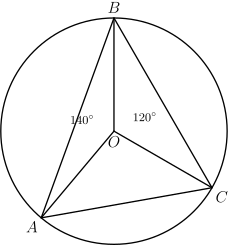
The point is the center of the circle circumscribed about with and as shown. What is the degree measure of
Pista pequeña:
Los tres ángulos centrales en suman .
The three central angles at add up to
Pista grande:
El ángulo inscrito es la mitad del ángulo central .
The inscribed angle is half of the central angle
Solución:
Los ángulos alrededor de suman así que
Por el teorema del ángulo inscrito, subtiende el mismo arco que el ángulo central así que
Por lo tanto, la respuesta correcta es D.
The angles around sum to so
By the inscribed angle theorem, subtends the same arc as the central angle so
Thus, the correct answer is D.
4.
En el Mercado de Frutas de Frank, plátanos cuestan lo mismo que manzanas, y manzanas cuestan lo mismo que naranjas. ¿Cuántas naranjas cuestan lo mismo que plátanos?
At Frank’s Fruit Market, bananas cost as much as apples, and apples cost as much as oranges. How many oranges cost as much as bananas?
Pista pequeña:
Primero convierte plátanos en un número equivalente de manzanas.
First convert bananas into an equivalent number of apples
Pista grande:
Luego convierte esas manzanas en naranjas usando manzanas naranjas.
Then convert those apples into oranges using apples oranges
Solución:
Como plátanos cuestan lo mismo que manzanas, plátanos cuestan lo mismo que manzanas.
Como manzanas cuestan lo mismo que naranjas, manzanas cuestan lo mismo que naranjas. Por lo tanto, plátanos cuestan lo mismo que naranjas.
Por lo tanto, la respuesta correcta es B.
Since bananas cost as much as apples, bananas cost as much as apples.
Since apples cost as much as oranges, apples cost as much as oranges. Therefore bananas cost as much as oranges.
Thus, the correct answer is B.
5.
Los concursos AMC de se calificarán otorgando puntos por cada respuesta correcta, puntos por cada respuesta incorrecta y puntos por cada problema dejado sin responder. Tras revisar los problemas, Sarah ha decidido intentar los primeros y dejar los últimos sin responder. ¿Cuántos de los primeros problemas debe resolver correctamente para obtener al menos puntos?
The AMC contests will be scored by awarding points for each correct response, points for each incorrect response, and points for each problem left unanswered. After looking over the problems, Sarah has decided to attempt the first and leave the last unanswered. How many of the first problems must she solve correctly in order to score at least points?
Pista pequeña:
Los problemas sin responder ya aportan puntos.
The unanswered problems already contribute points
Pista grande:
Resuelve y redondea hacia arriba el número de aciertos a un entero.
Solve and round the number correct up to a whole number
Solución:
Los tres problemas sin responder dan puntos.
Así que Sarah necesita al menos puntos de las respuestas correctas. Como debe resolver correctamente al menos problemas, lo que le daría puntos.
Por lo tanto, la respuesta correcta es D.
The three unanswered problems give points.
So Sarah needs at least points from correct answers. Since she must solve at least problems correctly, which would give her points.
Thus, the correct answer is D.
6.
El triángulo tiene lados de longitud y Dos insectos parten simultáneamente desde y se arrastran a lo largo de los lados del triángulo en direcciones opuestas a la misma velocidad. Se encuentran en el punto ¿Cuánto vale ?
Triangle has side lengths and Two bugs start simultaneously from and crawl along the sides of the triangle in opposite directions at the same speed. They meet at point What is
Pista pequeña:
Juntos los dos insectos recorren todo el perímetro, así que cada uno se arrastra la mitad.
Together the two bugs cover the whole perimeter, so each crawls half of it
Pista grande:
Un insecto recorre una distancia de .
One bug travels a distance of
Solución:
El perímetro es así que cada insecto se arrastra antes de encontrarse.
El insecto que va llega a sobre el lado habiendo recorrido Como obtenemos
Por lo tanto, la respuesta correcta es D.
The perimeter is so each bug crawls before they meet.
The bug going reaches on side having traveled Since we get
Thus, the correct answer is D.
7.
Todos los lados del pentágono convexo tienen la misma longitud, y ¿Cuál es la medida en grados de ?
All sides of the convex pentagon are of equal length, and What is the degree measure of
Pista pequeña:
Los lados y los dos ángulos rectos hacen que sea un cuadrado.
The sides and the two right angles make a square
Pista grande:
Entonces es equilátero, y .
Then is equilateral, and
Solución:
Como y el cuadrilátero es un cuadrado, así que y es igual a la longitud del lado común.
Entonces así que es equilátero y Por lo tanto,
Por lo tanto, la respuesta correcta es E.
Because and quadrilateral is a square, so and equals the common side length.
Then so is equilateral and Therefore
Thus, the correct answer is E.
8.
La edad de Tom es de años, que es también la suma de las edades de sus tres hijos. Su edad hace años era el doble de la suma de las edades de ellos en ese momento. ¿Cuánto vale ?
Tom’s age is years, which is also the sum of the ages of his three children. His age years ago was twice the sum of their ages then. What is
Pista pequeña:
Hace años Tom tenía cada hijo era años más joven.
years ago Tom was each child was years younger
Pista grande:
Los hijos sumaban entonces plantea .
The children then totaled set
Solución:
La edad de Tom hace años era Sus tres hijos eran cada uno años más jóvenes, así que sus edades entonces sumaban
La condición da así que y
Por lo tanto, la respuesta correcta es D.
Tom’s age years ago was His three children were each years younger, so their ages then totaled
The condition gives so and
Thus, the correct answer is D.
9.
Una función tiene la propiedad de que para todos los números reales ¿Cuánto vale ?
A function has the property that for all real numbers What is
Pista pequeña:
Elige de modo que .
Pick so that
Pista grande:
Con ese calcula .
With that compute
Solución:
Al plantear se obtiene
Entonces
Por lo tanto, la respuesta correcta es A.
Setting gives
Then
Thus, the correct answer is A.
10.
Unos niños y niñas están haciendo un lavado de autos para recaudar dinero para un viaje de clase a China. Inicialmente del grupo son niñas. Poco después dos niñas se van y dos niños llegan, y entonces del grupo son niñas. ¿Cuántas niñas había inicialmente en el grupo?
Some boys and girls are having a car wash to raise money for a class trip to China. Initially of the group are girls. Shortly thereafter two girls leave and two boys arrive, and then of the group are girls. How many girls were initially in the group?
Pista pequeña:
Dos se van y dos llegan, así que el tamaño del grupo se mantiene igual.
Two leave and two arrive, so the group size stays the same
Pista grande:
Las dos niñas que se van representan el del grupo.
The two departing girls represent of the group
Solución:
Como dos niñas se van mientras dos niños llegan, el tamaño total del grupo no cambia. La caída del al de niñas corresponde a las dos niñas que se fueron.
Así que esas dos niñas son el del grupo, lo que significa que el grupo tiene personas. El número inicial de niñas era el de es decir,
Por lo tanto, la respuesta correcta es C.
Since two girls leave while two boys arrive, the total group size is unchanged. The drop from to girls corresponds to the two girls who left.
So those two girls are of the group, meaning the group has people. The initial number of girls was of or
Thus, the correct answer is C.
11.
Los ángulos del cuadrilátero satisfacen ¿Cuál es la medida en grados de redondeada al entero más cercano?
The angles of quadrilateral satisfy What is the degree measure of rounded to the nearest whole number?
Pista pequeña:
Sea entonces .
Let then
Pista grande:
Los cuatro ángulos de un cuadrilátero suman .
The four angles of a quadrilateral sum to
Solución:
Sea Entonces y
La suma de los ángulos da así que
Por lo tanto, la respuesta correcta es D.
Let Then and
The angle sum gives so
Thus, the correct answer is D.
12.
Un profesor dio una prueba a una clase en la que de los estudiantes son de tercer año y son de cuarto año. La puntuación promedio en la prueba fue Los de tercer año obtuvieron todos la misma puntuación, y la puntuación promedio de los de cuarto año fue ¿Qué puntuación obtuvo cada uno de los de tercer año en la prueba?
A teacher gave a test to a class in which of the students are juniors and are seniors. The average score on the test was The juniors all received the same score, and the average score of the seniors was What score did each of the juniors receive on the test?
Pista pequeña:
Supón una clase conveniente de estudiantes: de tercer año y de cuarto año.
Assume a convenient class of students: junior and seniors
Pista grande:
El total de puntos debe satisfacer .
Total points must satisfy
Solución:
Toma una clase de estudiantes, así que hay de tercer año y de cuarto año.
El total de todas las puntuaciones es y los de cuarto año aportan Así que el de tercer año obtuvo
Por lo tanto, la respuesta correcta es C.
Take a class of students, so there is junior and seniors.
The total of all scores is and the seniors contribute So the junior scored
Thus, the correct answer is C.
13.
Un semáforo recorre repetidamente el siguiente ciclo: verde durante segundos, luego amarillo durante segundos y luego rojo durante segundos. Leah elige un intervalo de tiempo aleatorio de tres segundos para observar el semáforo. ¿Cuál es la probabilidad de que el color cambie mientras ella está observando?
A traffic light runs repeatedly through the following cycle: green for seconds, then yellow for seconds, and then red for seconds. Leah picks a random three-second time interval to watch the light. What is the probability that the color changes while she is watching?
Pista pequeña:
Un ciclo completo dura segundos.
One full cycle lasts seconds
Pista grande:
Un cambio se ve solo si su intervalo comienza dentro de los segundos previos a uno de los tres cambios de color.
A change is seen only if her interval begins within seconds before one of the three color switches
Solución:
La longitud del ciclo es segundos, con tres cambios de color por ciclo.
Leah ve un cambio exactamente cuando su intervalo de tres segundos comienza dentro de los segundos previos a un cambio. Eso da segundos favorables de una probabilidad de
Por lo tanto, la respuesta correcta es D.
The cycle length is seconds, with three color changes per cycle.
Leah sees a change exactly when her three-second interval starts within the seconds before a switch. That gives favorable seconds out of a probability of
Thus, the correct answer is D.
14.
El punto está dentro del equilátero. Los puntos y son los pies de las perpendiculares desde a y respectivamente. Dado que y ¿cuánto vale ?
Point is inside equilateral Points and are the feet of the perpendiculars from to and respectively. Given that and what is
Pista pequeña:
Divide el en usando las perpendiculares como alturas.
Split into using the perpendiculars as heights
Pista grande:
Sus áreas suman que también es igual a .
Their areas sum to which also equals
Solución:
Sea Unir con los vértices divide el triángulo en y con áreas y
Su total es que debe ser igual al área del triángulo equilátero. Así que lo que da
Por lo tanto, la respuesta correcta es D.
Let Joining to the vertices splits the triangle into and with areas and
Their total is which must equal the area of the equilateral triangle. So giving
Thus, the correct answer is D.
15.
La serie geométrica tiene una suma de y los términos que involucran potencias impares de tienen una suma de ¿Cuánto vale ?
The geometric series has a sum of and the terms involving odd powers of have a sum of What is
Pista pequeña:
Los términos de potencia par suman .
The even-power terms sum to
Pista grande:
La serie de potencias impares es veces la serie de potencias pares, así que .
The odd-power series is times the even-power series, so
Solución:
Los términos de potencia impar son es decir, veces los términos de potencia par. Los términos de potencia par suman
Así que lo que da Entonces y
Por lo tanto, la respuesta correcta es E.
The odd-power terms are that is, times the even-power terms. The even-power terms sum to
So giving Then and
Thus, the correct answer is E.
16.
Cada cara de un tetraedro regular se pinta de rojo, blanco o azul. Dos coloraciones se consideran indistinguibles si dos tetraedros congruentes con esas coloraciones pueden rotarse de modo que sus apariencias sean idénticas. ¿Cuántas coloraciones distinguibles son posibles?
Each face of a regular tetrahedron is painted either red, white, or blue. Two colorings are considered indistinguishable if two congruent tetrahedra with those colorings can be rotated so that their appearances are identical. How many distinguishable colorings are possible?
Pista pequeña:
El tetraedro tiene simetrías rotacionales; aplica el lema de Burnside.
The tetrahedron has rotational symmetries; apply Burnside’s lemma
Pista grande:
Cuenta las coloraciones fijadas por la identidad, las rotaciones de vértice y las rotaciones de arista.
Count colorings fixed by the identity, the vertex rotations, and the edge rotations
Solución:
El grupo de rotaciones del tetraedro tiene elementos: la identidad, rotaciones de orden alrededor de un eje vértice-cara y rotaciones de orden alrededor de un eje punto-medio-de-arista.
La identidad fija las coloraciones. Cada rotación de vértice fija una cara y hace ciclar las otras tres, así que fija coloraciones; de igual modo cada rotación de arista intercambia dos pares de caras y fija
Por el lema de Burnside, el número de coloraciones distinguibles es
Por lo tanto, la respuesta correcta es A.
The rotation group of the tetrahedron has elements: the identity, rotations of order about a vertex-face axis, and rotations of order about an edge-midpoint axis.
The identity fixes all colorings. Each vertex rotation fixes one face and cycles the other three, so it fixes colorings; likewise each edge rotation swaps two pairs of faces and fixes
By Burnside’s lemma the number of distinguishable colorings is
Thus, the correct answer is A.
17.
Si es un entero distinto de cero y es un número positivo tal que ¿cuál es la mediana del conjunto ?
If is a nonzero integer and is a positive number such that what is the median of the set
Pista pequeña:
Como para todo tenemos .
Since for all we have
Pista grande:
Descarta comprobando si puede ser un entero distinto de cero.
Rule out by checking whether can be a nonzero integer
Solución:
Para tenemos y por tanto Si entonces Si entonces así que no podría ser un entero.
Por tanto así que y Así y el valor central del conjunto ordenado es
Por lo tanto, la respuesta correcta es D.
For we have hence If then If then so could not be an integer.
Hence so and Thus and the middle value of the sorted set is
Thus, the correct answer is D.
18.
Sean y dígitos con El entero de tres dígitos se encuentra a un tercio del camino desde el cuadrado de un entero positivo hasta el cuadrado del siguiente entero mayor. El entero se encuentra a dos tercios del camino entre los mismos dos cuadrados. ¿Cuánto vale ?
Let and be digits with The three-digit integer lies one third of the way from the square of a positive integer to the square of the next larger integer. The integer lies two thirds of the way between the same two squares. What is
Pista pequeña:
Sean los dos cuadrados y su diferencia es .
Let the two squares be and their difference is
Pista grande:
Restar las dos posiciones da .
Subtracting the two positions gives
Solución:
Sea el cuadrado menor de modo que el mayor es y la separación es Entonces
Al restar, así que Como está más adelante en el intervalo, es positivo; y como el lado derecho es impar, es impar. Si entonces y no tiene tres cifras.
Así, lo que da Los puntos a un tercio y dos tercios desde hasta son y por lo que
Por lo tanto, la respuesta correcta es C.
Let the smaller square be so the larger is and the gap is Then
Subtracting, so Since is farther along the interval, is positive; and because the right side is odd, is odd. If then and is not three digits.
So giving The points one third and two thirds of the way from to are and so
Thus, the correct answer is C.
19.
El rombo con longitud de lado se enrolla para formar un cilindro de volumen pegando a ¿Cuánto vale ?
Rhombus with side length is rolled to form a cylinder of volume by taping to What is
Pista pequeña:
Pegar a hace que un lado de longitud sea la circunferencia de la base, así que el radio es .
Taping to makes a side of length the base circumference, so the radius is
Pista grande:
La altura del cilindro es la altura del rombo iguala el volumen a .
The cylinder’s height is the rhombus altitude set the volume equal to
Solución:
Sea El círculo de la base tiene circunferencia así que su radio es La altura del cilindro es la altura del rombo
El volumen es así que
Por lo tanto, la respuesta correcta es A.
Let The base circle has circumference so its radius is The height of the cylinder is the rhombus altitude
The volume is so
Thus, the correct answer is A.
20.
El paralelogramo delimitado por las rectas y tiene área El paralelogramo delimitado por las rectas y tiene área Dado que y son enteros positivos, ¿cuál es el menor valor posible de ?
The parallelogram bounded by the lines and has area The parallelogram bounded by the lines and has area Given that and are positive integers, what is the smallest possible value of
Pista pequeña:
El primer paralelogramo tiene área el segundo tiene área .
The first parallelogram has area the second has area
Pista grande:
Restar da luego minimiza con enteros positivos pequeños.
Subtracting gives then minimize with small positive integers
Solución:
Dos vértices del primer paralelogramo están en y y los otros dos tienen coordenadas iguales a Su área resulta ser El mismo cálculo para el segundo da
Así que y Restando, es decir,
Por tanto es par, así que es mínimo con y es un múltiplo de así que es mínimo con Estos satisfacen todas las condiciones, dando
Por lo tanto, la respuesta correcta es D.
Two vertices of the first parallelogram lie at and and the other two have -coordinates Its area works out to The same computation for the second gives
So and Subtracting, i.e.
Thus is even, so is smallest with and is a multiple of so is smallest with These satisfy all conditions, giving
Thus, the correct answer is D.
21.
Los primeros enteros positivos se escriben cada uno en base ¿Cuántas de estas representaciones en base son capicúas? (Un capicúa es un número que se lee igual de izquierda a derecha que de derecha a izquierda.)
The first positive integers are each written in base How many of these base- representations are palindromes? (A palindrome is a number that reads the same forward and backward.)
Pista pequeña:
Cuenta los capicúas en base según su número de dígitos; nota que .
Count base- palindromes by their number of digits; note
Pista grande:
Suma todos los capicúas con hasta dígitos, luego quita los de dígitos que exceden .
Total all palindromes with up to digits, then remove the -digit ones exceeding
Solución:
Un capicúa queda determinado por su primera mitad. Contando los capicúas en base por longitud se obtienen de longitud o de longitud o de longitud o y de longitud
Eso suma capicúas con a lo sumo dígitos. Como los capicúas de dígitos mayores que él son y que son de ellos.
Por lo tanto, el conteo es
Por lo tanto, la respuesta correcta es A.
A palindrome is fixed by its first half. Counting base- palindromes by length gives of length or of length or of length or and of length
That totals palindromes with at most digits. Since the -digit palindromes larger than it are and which is of them.
Therefore the count is
Thus, the correct answer is A.
22.
Dos partículas se mueven a lo largo de las aristas del equilátero en la dirección partiendo simultáneamente y moviéndose a la misma velocidad. Una parte de y la otra parte del punto medio de El punto medio del segmento que une las dos partículas traza una trayectoria que encierra una región ¿Cuál es la razón entre el área de y el área del ?
Two particles move along the edges of equilateral in the direction starting simultaneously and moving at the same speed. One starts at and the other starts at the midpoint of The midpoint of the line segment joining the two particles traces out a path that encloses a region What is the ratio of the area of to the area of
Pista pequeña:
Como ambas partículas se mueven linealmente, el punto medio también se mueve linealmente entre los instantes clave; llama al triángulo trazado
Because both particles move linearly, the midpoint also moves linearly between key instants; call the traced triangle
Pista grande:
Ese triángulo está centrado en el centroide compara su circunradio con .
That triangle is centered at the centroid compare its circumradius to
Solución:
Sean los puntos medios de respectivamente, y sean los puntos medios de respectivamente. Sigamos un tercer punto a mitad de camino entre las dos partículas. Está en cuando las partículas están en en cuando están en y en cuando están en
Entre esos instantes, ambas posiciones varían linealmente, así que su punto medio traza los segmentos La trayectoria encerrada es el triángulo equilátero que por simetría comparte el centro de Como es el punto medio de la mediana mientras que
La razón de circunradios es y la razón de áreas es
Por lo tanto, la respuesta correcta es A.
Let be the midpoints of respectively, and let be the midpoints of respectively. Track a third point halfway between the two particles. It is at when the particles are at at when they are at and at when they are at
Between these instants both particle positions vary linearly, so their midpoint traces the segments Thus the enclosed path is the equilateral triangle which by symmetry shares the center of Because is the midpoint of the median while
So the ratio of circumradii is and the area ratio is
Thus, the correct answer is A.
23.
¿Cuántos triángulos rectángulos no congruentes con longitudes de catetos enteras positivas tienen áreas numéricamente iguales a veces sus perímetros?
How many non-congruent right triangles with positive integer leg lengths have areas that are numerically equal to times their perimeters?
Pista pequeña:
Con catetos escribe y despeja el radical.
With legs write and isolate the radical
Pista grande:
Elevar al cuadrado y simplificar da cuenta los pares de factores y descarta los degenerados.
Squaring and simplifying yields check the factor-pair candidates in the original equation to remove extraneous ones
Solución:
Sean los catetos La condición es así que
Elevar al cuadrado y simplificar da por lo tanto Las soluciones enteras positivas son
El par es espurio: su área es mientras que su perímetro es y el triple de eso es Así que funcionan exactamente triángulos.
Por lo tanto, la respuesta correcta es A.
Let the legs be The condition is so
Squaring and simplifying gives hence The positive integer solutions are
The pair is extraneous: its area is while its perimeter is and three times that is So exactly triangles work.
Thus, the correct answer is A.
24.
¿Cuántos pares de enteros positivos hay tales que y es un entero?
How many pairs of positive integers are there such that and is an integer?
infinitos
infinitely many
Pista pequeña:
Al despejar se ve que es un entero, y como es divisible por .
Clearing shows is an integer, and since is divisible by
Pista grande:
De manera similar es divisible por así que y prueba los pares coprimos.
Similarly is divisible by so and test the coprime pairs
Solución:
Sea el valor entero de la expresión original. Multiplicando por y restando se obtiene un entero. Como se sigue que es divisible por Multiplicando en cambio por y restando se obtiene así que es divisible por
Por tanto y Comprobando los candidatos coprimos, la expresión es un entero solo para
Así que hay tales pares.
Por lo tanto, la respuesta correcta es A.
Let be the integer value of the original expression. Multiplying by and subtracting gives an integer. Since it follows that is divisible by Multiplying instead by and subtracting gives so is divisible by
Thus and Checking the coprime candidates, the expression is an integer only for
So there are such pairs.
Thus, the correct answer is A.
25.
Los puntos y están ubicados en el espacio de dimensiones con y El plano del es paralelo a ¿Cuál es el área del ?
Points and are located in -dimensional space with and The plane of is parallel to What is the area of
Pista pequeña:
Coloca y pon el en un plano horizontal .
Place and put in a horizontal plane
Pista grande:
Los ángulos rectos en y ponen a en círculos de radio ; usa para hallar .
The right angles at and put on radius- circles; use to find
Solución:
Establece y y deja que el esté en el plano Como y son ángulos rectos, y están en círculos de radio centrados en y en los planos y así que con
Como lo que fuerza Tomando se obtiene así que y es o
En el primer caso con en el segundo con En cualquier caso el tiene catetos y así que su área es
Por lo tanto, la respuesta correcta es C.
Set and and let lie in the plane Because and are right angles, and lie on radius- circles centered at and in the planes and so with
Since which forces Taking gives so and is or
In the first case with in the second with Either way has legs and so its area is
Thus, the correct answer is C.