
2007 AIME II 真题
计时
3:00:00
1.
一个数学组织正在制作一套纪念车牌。每块车牌包含一个由 AIME 中的四个字母和 中的四个数字选出的五字符序列。任一字符在序列中出现的次数不得超过它在 AIME 的四个字母或 的四个数字中出现的次数。若一套车牌中每一种可能的序列恰好出现一次,共有 块车牌。求 。
A mathematical organization is producing a set of commemorative license plates. Each plate contains a sequence of five characters chosen from the four letters in AIME and the four digits in No character may appear in a sequence more times than it appears among the four letters in AIME or the four digits in A set of plates in which each possible sequence appears exactly once contains license plates. Find
小提示:
按序列使用了多少个 分类;其他每个字符至多出现一次。
Split into cases by how many ’s the sequence uses; every other character can appear at most once
大提示:
若有两个 ,先用 种方法放置它们,再从其余六个字符中填入三个位置。
With two ’s, place them in ways and fill three spots from the six other characters
解答:
可用的字符是七个不同符号 A、I、M、E、、、,其中 最多可用两次,其他每个字符最多用一次。使用至多一个 的序列,就是从七个不同字符中选出五个并排序:。
使用两个 的序列:先确定两个 的位置,共有 种方法;再从其他六个字符中选出三个不同字符按顺序填入,方法数为 ,共 个序列。
因此 ,所以 。
The available characters are the seven distinct symbols A, I, M, E, where may be used up to twice and every other character at most once. Sequences using at most one consist of five distinct characters chosen from the seven, in order:
Sequences with two ’s: choose the two positions for the ’s in ways, then fill the remaining three positions with distinct characters from the other six in ways, for sequences.
Thus and
2.
求有序三元组 的个数,其中 、、 是正整数, 是 的因数, 是 的因数,且 。
Find the number of ordered triples where and are positive integers, is a factor of is a factor of and
小提示:
因为 同时整除 和 ,它也必须整除 。
Since divides both and it must divide
大提示:
令 且 :则 ,它有 个正整数解。
Write and then which has positive solutions
解答:
因为 整除 和 ,所以它整除 。令 且 ,其中 ;则 ,所以 对正整数 和 ,需要 ,因而 。
对每个这样的 ,方程 有 个有序正整数解。求和得
Since divides and it divides Write and with then so For positive and we need so
For each such the equation has ordered positive solutions. Summing,
3.
正方形 的边长为 。点 和 在正方形外部,满足 且 。求 。
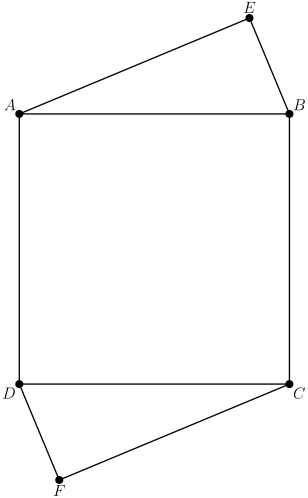
Square has side length and points and are exterior to the square such that and Find
小提示:
因为 ,角 和 都是直角。
Since angles and are right angles
大提示:
将 延长过 ,将 延长过 ,交于 ,并寻找与 全等的直角三角形。
Extend beyond and beyond to meet at and look for right triangles congruent to
解答:
因为 ,三角形 和 分别在 和 处为直角,且它们全等(边长 、、)。将 延长过 ,将 延长过 ,直到两条直线交于 。
于是 这两个角之和为 ,所以 ,三角形 与 全等(角相等且斜边 )。因此 且 。
所以 ,,且它们在 处成直角,因此 。
Since triangles and are right-angled at and and they are congruent (sides ). Extend beyond and beyond until the two lines meet at
Then These two angles sum to so and triangle is congruent to (equal angles and hypotenuse ). Hence and
Therefore and with a right angle between them at so
4.
一家工厂的工人生产小部件和小装置。对每一种产品,生产时间是固定的,并且对所有工人相同,但两种产品的生产时间不一定相等。在一小时内, 名工人可以生产 个小部件和 个小装置。在两小时内, 名工人可以生产 个小部件和 个小装置。在三小时内, 名工人可以生产 个小部件和 个小装置。求 。
The workers in a factory produce widgets and whoosits. For each product, production time is constant and identical for all workers, but not necessarily equal for the two products. In one hour, workers can produce widgets and whoosits. In two hours, workers can produce widgets and whoosits. In three hours, workers can produce widgets and whoosits. Find
小提示:
令 和 分别为生产一个小部件和一个小装置所需的工时;每种情形给出一个线性方程。
Let and be the worker-hours needed for one widget and one whoosit; each scenario gives one linear equation
大提示:
前两种情形给出 和 ;第三种情形总共提供 个工时。
The first two scenarios give and the third supplies worker-hours in total
解答:
令 和 分别为生产一个小部件和一个小装置所需的工时。三种情形分别提供 、 和 个工时,所以
前两个方程化简为 和 ,解得 且 。代入第三个方程,,所以 ,。
Let and be the worker-hours required to make one widget and one whoosit. The three scenarios supply and worker-hours, so
The first two equations simplify to and giving and Substituting into the third, so and
5.
方程 的图像画在方格纸上,每个小正方形在两个方向上都表示一个单位。有多少个 乘 的方格纸小正方形,其内部完全位于该图像下方且完全位于第一象限内?
The graph of the equation is drawn on graph paper with each square representing one unit in each direction. How many of the by graph paper squares have interiors lying entirely below the graph and entirely in the first quadrant?
小提示:
线段从 到 ;数一数它穿过 矩形中的 个单位方格中的多少个。
The segment runs from to count how many unit squares it cuts through in the rectangle of squares
大提示:
因为 ,线段不经过内部格点,所以它穿过 个方格;对称性把未被触及的方格平分。
Since the segment hits no interior lattice point, so it crosses squares; symmetry splits the untouched squares evenly
解答:
直线与坐标轴交于 和 ,所以所有符合条件的方格都在 的矩形内,该矩形含有 个单位方格。因为 ,线段不经过内部格点;它穿过 条内部竖直网格线和 条内部水平网格线,每次穿线都进入一个新方格,所以它经过 个方格的内部。
其余 个方格完全位于线段上方或下方。线段的中点 是矩形中心,绕它旋转 会交换这两组方格。因此恰有一半,即 ,位于图像下方。
The line meets the axes at and so all qualifying squares lie inside the rectangle, which contains unit squares. Because the segment passes through no interior lattice point; it crosses interior vertical lines and interior horizontal lines, entering a new square at each crossing, so it passes through the interiors of squares.
The other squares lie entirely above or entirely below the segment. The segment’s midpoint is the center of the rectangle, so rotating by about it swaps the two groups. Hence exactly half of them, lie below the graph.
6.
若一个整数的十进制表示 满足 (当 为奇数时)以及 (当 为偶数时),则称它为奇偶单调。有多少个四位奇偶单调整数?
An integer is called parity-monotonic if its decimal representation satisfies if is odd, and if is even. How many four-digit parity-monotonic integers are there?
小提示:
从右向左构造这个数,数一数某个给定数字前面可以紧挨着放多少个数字。
Build the number from right to left, counting how many digits may immediately precede a given digit
大提示:
对每个数字 ,恰好有 个数字可以在它前面:小于 的奇数,加上大于 的偶数。数字 永远不合格。
For every digit exactly digits can precede it: the odd digits below together with the even digits above The digit never qualifies.
解答:
数字 可以紧挨在 前面,当且仅当 是小于 的奇数,或者是大于 的偶数。逐一检查 从 到 ,总是恰好有 个可选数字:例如 时可选 、、、; 时可选 、、、; 时可选 、、、。(把 增加 时,一些奇数选择会被偶数选择替代,总数仍为 。)注意 永远不能作为前一个数字,因为 是偶数但不大于任何数字。
因此最后一位 有 种选法,然后 、、 各有 种选法;首位自动非零。总数为 。
A digit may immediately precede exactly when is odd and less than or even and greater than Checking each from to this always allows exactly digits: for example, allows allows allows (Raising by trades odd choices for even ones, keeping the total at ) Note that is never an allowed predecessor, since is even but exceeds no digit.
So choose the last digit in ways, then each of in ways; the leading digit is automatically nonzero. The count is
7.
给定实数 ,令 表示小于或等于 的最大整数。对某个整数 ,恰好有 个正整数 、、、 满足 并且 整除 ,对所有满足 的 都成立。求 在 时的最大值。
Given a real number let denote the greatest integer less than or equal to For a certain integer there are exactly positive integers such that and divides for all such that Find the maximum value of for
小提示:
表示 ;数出这个范围内 的倍数。
means count the multiples of in that range
大提示:
这样的倍数有 个,所以解 ,再取最大的倍数。
There are such multiples, so solve then take the largest multiple
解答:
条件 表示 。这个范围内 的倍数为 、、、,所以恰好有 个。
令 ,得 。 的最大值为 。
The condition means The multiples of in this range are so there are exactly of them.
Setting gives The maximum of is
8.
一张长方形纸片的尺寸为 单位乘 单位。若干条线段被画出,并且都平行于纸片的边。由其中一些线段的交点确定的长方形称为基本长方形,如果 (i) 该长方形的四条边都是所画线段的一部分,且 (ii) 没有所画线段的任何一段位于该长方形内部。
已知所有画出的线段总长度恰好为 个单位。令 为能确定的基本长方形个数的最大可能值。求 除以 的余数。
A rectangular piece of paper measures units by units. Several lines are drawn parallel to the edges of the paper. A rectangle determined by the intersections of some of these lines is called basic if (i) all four sides of the rectangle are segments of drawn line segments, and (ii) no segments of drawn lines lie inside the rectangle.
Given that the total length of all lines drawn is exactly units, let be the maximum possible number of basic rectangles determined. Find the remainder when is divided by
小提示:
若有 条长度为 的线段和 条长度为 的线段,则 ,相邻线段对形成 个基本长方形。
With drawn lines of length and of length we get and adjacent pairs form basic rectangles
大提示:
最大化 ,约束为 :取 满足 ,并尽量接近顶点 。
Maximize over take satisfying and as close as possible to the vertex
解答:
设画出的线段中有 条长度为 ,有 条长度为 ,则 。一个基本长方形由每个方向上的两条相邻线段围成,所以这些线段确定 个基本长方形。令 且 ,我们要最大化 ,约束为 。
作为 的函数,乘积 是开口向下的抛物线,顶点在 。为了使 为整数,需要 ,即 。最近的候选是 (此时 ,乘积 )和 (此时 ,乘积 )。
因此 ,除以 的余数为 。
Suppose of the drawn lines have length and have length so A basic rectangle is bounded by two adjacent lines in each direction, so the lines determine basic rectangles. Setting and we must maximize subject to
As a function of the product is a downward parabola with vertex at For to be an integer we need i.e. The nearest candidates are (giving and product ) and (giving and product ).
So and the remainder upon division by is
9.
已知长方形 中 且 。点 和 分别在 和 上,满足 。三角形 的内切圆与 相切于点 ,三角形 的内切圆与 相切于点 。求 。
Rectangle is given with and Points and lie on and respectively, such that The inscribed circle of triangle is tangent to at point and the inscribed circle of triangle is tangent to at point Find
答案:259
小提示:
用勾股定理计算 、、;三角形 与 实际上全等。
Compute and with the Pythagorean theorem; triangles and turn out congruent
大提示:
切点按照切线长分割 : 且 ,其中 是共同的半周长。然后 。
The tangency point splits by tangent lengths: and where is the common semiperimeter. Then
解答:
设 、、、,则 且 。于是 ,,且 。特别地,三角形 与 全等,共同半周长为 。
在任意三角形中,从一个顶点到内切圆在其两边上的切点的距离等于半周长减去对边长。在三角形 中, ;在三角形 中, 。
因此 。
Place so and Then and In particular triangles and are congruent, with common semiperimeter
In any triangle, the distance from a vertex to the incircle’s tangency points on its two sides is the semiperimeter minus the opposite side. In triangle in triangle
Therefore
10.
令 为一个有六个元素的集合。令 为 的所有子集组成的集合。令 和 为 的两个子集,两者可以相同,并从 中相互独立地随机选取。 是 或 中至少一个集合的子集,这一事件的概率为 ,其中 、、 是正整数, 是质数,且 与 互质。求 。(集合 是 中不属于 的所有元素组成的集合。)
Let be a set with six elements. Let be the set of all subsets of Subsets and of not necessarily distinct, are chosen independently and at random from The probability that is contained in at least one of or is where and are positive integers, is prime, and and are relatively prime. Find (The set is the set of all elements of which are not in )
小提示:
按 分类,并数集合 :它满足 或 ;只有空集同时满足两者。
Condition on and count the sets with or only the empty set satisfies both
大提示:
对 求和 ,并使用 。
Sum over the expression using
解答:
固定集合 ,并设 。有 个子集满足 ,有 个子集满足 ,且只有空集被重复计算,所以有 种 成功。因为共有 个集合 ,其大小为 ,且各有 种选择来确定 和 ,所以概率为 这里用到了 。
化简为 。因为 是奇数,所以 、、,因而 。
Fix with There are subsets and subsets and only the empty set is counted twice, so choices of succeed. Since there are sets of size and choices for each of and the probability is using
This simplifies to Since is odd, we take and
11.
两根长度相同但直径不同的长圆柱管彼此平行地放在平面上。较大的圆柱管半径为 ,沿平面向半径为 的较小圆柱管滚动。它滚过较小圆柱管并继续沿平面滚动,直到它以圆周上的同一点着地而停下,已完成一整圈旋转。如果较小圆柱管始终不动,且滚动无滑动,则较大圆柱管最终离起点的距离为 。距离 可表示为 ,其中 、、 为整数,且 不被任何质数的平方整除。求 。
Two long cylindrical tubes of the same length but different diameters lie parallel to each other on a flat surface. The larger tube has radius and rolls along the surface toward the smaller tube, which has radius It rolls over the smaller tube and continues rolling along the flat surface until it comes to rest on the same point of its circumference as it started, having made one complete revolution. If the smaller tube never moves, and the rolling occurs with no slipping, the larger tube ends up a distance from where it starts. The distance can be expressed in the form where and are integers and is not divisible by the square of any prime. Find
小提示:
当两根管相切且都接触地面时,连接它们圆心的线段长为 ,竖直分量为 。
When the tubes touch while both rest on the ground, the segment joining their centers has length and vertical component
大提示:
总转角为 :越过小管时,大管的自转角等于圆心扫过的 加上接触弧所贡献的转角,其余转角来自平地滚动。
Total turning is while crossing the small tube, the big tube’s rotation equals the center’s sweep plus the angular contribution from the contact arc; the rest is flat rolling
解答:
当滚动的大管同时接触地面和小管时,两圆心之间的距离为 ,竖直分量为 ,所以该线段与水平线成 角。大管滚过小管时,它的圆心沿着以小管圆心为圆心、半径 的圆弧运动,从一侧水平线上方 到另一侧 ,扫过 。圆心的水平位移为 。
在这段扫过过程中,小管上的接触弧对应大管圆周的 ,而扫角本身也使大管转过 ,所以越过小管时大管总共转过 。为了恰好完成一整圈,剩下的 转角发生在平地滚动中,此时圆心前进的滚动距离为 。
因此 ,所以 。
When the rolling tube touches both the ground and the small tube, the segment between centers has length and vertical component so it makes a angle with the horizontal. As the big tube rolls over the small one, its center swings along an arc of radius about the small tube’s center, from above the horizontal on one side to on the other: a sweep of advancing the center horizontally by
During that sweep, the contact arc on the small tube is worth of the big tube’s circumference, and the sweep itself also rotates the big tube by so crossing the small tube turns the big tube by in all. To complete exactly one revolution, the remaining of turning happens rolling on flat ground, where the center advances the rolled distance
Hence and
12.
递增的等比数列 、、、 完全由 的整数次幂组成。已知 且 求 。
The increasing geometric sequence consists entirely of integral powers of Given that and find
小提示:
写成 ,其中 为整数,而 ;对数和条件给出 。
Write with integers and the log-sum condition gives
大提示:
和 严格大于 且小于 ,所以该和的以 为底的对数确定了 。
The sum lies strictly between and so its base- log pins down
解答:
每一项都是 的幂,公比也是两个 的幂之商,所以 ,其中 和 为整数;又因为数列递增,。第一个条件给出 即
对第二个条件, 是最大项,并且 所以 严格介于 和 之间。给定界限迫使 。
从 中减去它,得 ,进而 。因此 。
Every term is a power of and the ratio is a quotient of powers of so for integers and with since the sequence increases. The first condition gives i.e.
For the second condition, is the largest term, and so lies strictly between and The given bounds then force
Subtracting from yields then Therefore
13.
一个由正方形组成的三角形阵列,第一行有一个正方形,第二行有两个,依此类推,第 行有 个正方形,其中 。除底行外,每个正方形都放在它正下方一行的两个正方形上,如图所示。在第十一行的每个正方形中填入一个 或 。然后在其他正方形中填数,每个正方形中的数等于它下面两个正方形中的数之和。底行中 和 的初始分布有多少种,使得顶端正方形中的数是 的倍数?
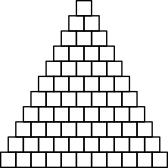
A triangular array of squares has one square in the first row, two in the second, and, in general, squares in the th row for With the exception of the bottom row, each square rests on two squares in the row immediately below, as illustrated in the figure. In each square of the eleventh row, a or a is placed. Numbers are then placed into the other squares, with the entry for each square being the sum of the entries in the two squares below it. For how many initial distributions of ’s and ’s in the bottom row is the number in the top square a multiple of
小提示:
每个条目像帕斯卡三角形一样向上传递:顶端正方形为底行条目 、、 的 。
Each entry feeds upward like Pascal’s triangle: for bottom entries the top square is
大提示:
模 时,除了 、、、 外, 都为零,所以只有 有影响。
Modulo except for the coefficient vanishes, so only matters
解答:
将底行条目标为 、、、。由于每个正方形都是下方两个正方形之和,贡献按帕斯卡三角形的权重累积:顶端正方形等于 。
模 时,直接检查(或对 使用卢卡斯定理)可知,当 时 ,而 ,且 。所以顶端正方形是 的倍数,当且仅当 。
因为这四个条目都是 或 ,所以能被 整除的和只有 或 :要么四个全为 (一种),要么恰好三个为 (四种),共 种选择。其余七个条目 、、 可自由选择,所以总数为 。
Label the bottom-row entries Since each square is the sum of the two below it, the contributions accumulate with Pascal’s-triangle weights: the top square equals
Modulo direct checking (or Lucas’ theorem with ) shows that for while and So the top square is a multiple of exactly when
Because the four entries are or their sum is divisible by only when it is or either all four are (one way) or exactly three are (four ways), for choices. The remaining seven entries are free, so the count is
14.
设 是一个实系数多项式,满足 ,,且对所有 都有 。求 。
Let be a polynomial with real coefficients such that and for all Find
小提示:
若 是一个根,则 也是根;比较首项系数可知 是首一多项式。
If is a root, so is compare leading coefficients to see is monic
大提示:
没有根可以满足 (模长会无限增大,或者根的乘积不可能为 );然后 迫使 。
No root can have (moduli would grow forever, or the root product couldn’t be ); then forces
解答:
题中给出的函数值排除了常数多项式。若 的次数为 ,首项系数为 ,则 两边的首项系数分别为 和 ,所以 。该方程还说明,只要 是根, 也是根。
若某个根满足 ,则 ,反复迭代会产生无限多个不同的根,这是不可能的。由于 是首一多项式且 ,根的乘积模长为 ,所以也没有根的模长能小于 ;每个根都满足 。那么 的模长也必须为 ,因此 。写 ,得 ,化简为 ,所以 。
因此每个根都是 ,且实系数使它们成对出现:。条件 给出 ,所以 。
The given values rule out a constant polynomial. If has degree and leading coefficient the leading coefficients of the two sides of are and so The equation also shows that whenever is a root, is a root as well.
If some root had then and iterating would produce infinitely many distinct roots — impossible. Since is monic with the product of the roots has modulus so no root can have modulus less than either: every root satisfies Then must also have modulus so Writing we get which simplifies to so
Thus every root is and real coefficients pair them up: The condition gives so
15.
画出四个半径相同的圆 、、 和 ,它们位于三角形 内部,使得 与边 和 相切, 与 和 相切, 与 和 相切,并且 与 、、 外切。若三角形 的边长为 、、,则 的半径可表示为 ,其中 和 是互质正整数。求 。
Four circles and with the same radius are drawn in the interior of triangle such that is tangent to sides and to and to and and is externally tangent to and If the sides of triangle are and the radius of can be represented in the form where and are relatively prime positive integers. Find
答案:389
小提示:
、、 的圆心在角平分线上,形成一个与 相似的三角形,它是以内心为中心、按比例 缩小得到的。
The centers of lie on the angle bisectors, forming a triangle similar to shrunk toward the incenter by factor
大提示:
的圆心到这三个圆心距离相等,所以 等于缩小后三角形的外接圆半径,即 。
The center of is equidistant from those three centers, so equals the circumradius of the shrunken triangle, namely
解答:
令 为共同半径,令 、、 分别为 、、 的圆心。每个圆心到三角形的两条边距离为 ,所以每个圆心都在一条角平分线上,且三角形 的边与 的对应边平行,相距 。因此 是 以内心 为中心、按比例 位似得到的图形,其中 是内切圆半径;特别地,它的外接圆半径为 ,其中 是 的外接圆半径。
的圆心到 、、 的距离都为 (等圆外切),所以它是三角形 的外心,并且 对 -- 三角形,,海伦公式给出面积 ,所以 ,且 。
于是 ,得到 ,所以 。因为 与 无公因数,答案为 。
Let be the common radius, and let be the centers of Each is at distance from two sides of the triangle, so each lies on an angle bisector, and the sides of triangle are parallel to those of at distance Hence is the image of under the homothety centered at the incenter with ratio where is the inradius; in particular its circumradius is where is the circumradius of
The center of is at distance from each of (externally tangent equal circles), so it is the circumcenter of and For the -- triangle, and Heron’s formula gives area so and
Then gives so Since shares no factor with the answer is