
Soluciones del 2019 AMC 12A
Desplázate hacia abajo para ver las soluciones preparadas profesionalmente de LIVE by Po-Shen Loh, imprime las soluciones en PDF, consulta la clave de respuestas, o haz el examen cronometrado completo.
Todos los problemas se usan con el permiso legal oficial de la Mathematical Association of America (MAA).
1.
El área de una pizza de radio pulgadas es por ciento mayor que el área de una pizza de radio pulgadas. ¿Cuál es el entero más cercano a ?
The area of a pizza with radius inches is percent larger than the area of a pizza with radius inches. What is the integer closest to
Pista pequeña:
Las áreas están en la razón .
The areas are in the ratio
Pista grande:
El aumento porcentual es
The percent increase is
Solución:
Las áreas son proporcionales a los cuadrados de los radios, así que la razón del área mayor a la menor es
El aumento porcentual es El entero más cercano es
Por lo tanto, la respuesta correcta es E.
The areas are proportional to the squares of the radii, so the ratio of the larger area to the smaller is
The percent increase is The closest integer is
Thus, the correct answer is E.
2.
Supongamos que es el de ¿Qué porcentaje de es ?
Suppose is of What percent of is
Pista pequeña:
Escribe .
Write
Pista grande:
Calcula y conviértelo a un porcentaje
Compute and convert to a percentage
Solución:
Como tenemos
Como porcentaje, es el de
Por lo tanto, la respuesta correcta es D.
Since we have
As a percentage, is of
Thus, the correct answer is D.
3.
Una caja contiene bolas rojas, bolas verdes, bolas amarillas, bolas azules, bolas blancas y bolas negras. ¿Cuál es el número mínimo de bolas que se deben sacar de la caja sin reemplazo para garantizar que se saquen al menos bolas de un mismo color?
A box contains red balls, green balls, yellow balls, blue balls, white balls, and black balls. What is the minimum number of balls that must be drawn from the box without replacement to guarantee that at least balls of a single color will be drawn?
Pista pequeña:
Considera el peor caso: saca tantas como sea posible sin llegar nunca a de un solo color
Consider the worst case: draw as many as possible without ever reaching of one color
Pista grande:
Toma de cada color que tenga al menos y todas las bolas de los colores con menos
Take of each color that has at least and all balls of the smaller colors
Solución:
En el peor caso, sacamos de rojas, verdes y amarillas, más todas las azules blancas y negras sin llegar a de ningún color.
Eso da bolas.
La siguiente bola debe completar un conjunto de así que se necesitan bolas.
Por lo tanto, la respuesta correcta es B.
In the worst case, we draw each of red, green, and yellow, plus all of the blue white and black without reaching of any color.
That is balls.
The next ball must complete a set of so balls are needed.
Thus, the correct answer is B.
4.
¿Cuál es la mayor cantidad de enteros consecutivos cuya suma es ?
What is the greatest number of consecutive integers whose sum is
Pista pequeña:
Se permite que los enteros sean negativos
The integers are allowed to be negative
Pista grande:
Sumar aporta así que extiende la sucesión justo más allá de .
Adding contributes so extend the run just past
Solución:
Se permiten enteros negativos. Los enteros de a suman así que los enteros de a suman
Esta sucesión tiene enteros. Recíprocamente, si enteros consecutivos suman entonces el doble de su suma es por un entero, así que es múltiplo de Por tanto, lo que demuestra que esta sucesión es la más larga.
Por lo tanto, la respuesta correcta es D.
Negative integers are allowed. The integers from to sum to so the integers from to sum to
This run has integers. Conversely, if consecutive integers have sum then twice their sum is times an integer, so is a multiple of Hence proving that this run is longest.
Thus, the correct answer is D.
5.
Dos rectas de pendientes y se cortan en ¿Cuál es el área del triángulo encerrado por estas dos rectas y la recta ?
Two lines with slopes and intersect at What is the area of the triangle enclosed by these two lines and the line
Pista pequeña:
Halla dónde se cruza cada recta con
Find where each line meets
Pista grande:
Los tres vértices son y usa la fórmula del cordón
The three vertices are and use the shoelace formula
Solución:
Las dos rectas son y Al intersecar cada una con se obtienen los puntos y
El triángulo tiene vértices y Por la fórmula del cordón,
Por lo tanto, la respuesta correcta es C.
The two lines are and Intersecting each with gives the points and
The triangle has vertices and By the shoelace formula,
Thus, the correct answer is C.
6.
La figura de abajo muestra la recta con un patrón regular, infinito y recurrente de cuadrados y segmentos.
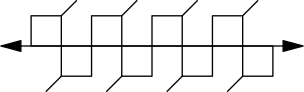
¿Cuántos de los siguientes cuatro tipos de transformaciones de movimiento rígido del plano en el que está dibujada esta figura, distintas de la transformación identidad, llevan esta figura sobre sí misma?
• alguna rotación alrededor de un punto de la recta
• alguna traslación en la dirección paralela a la recta
• la reflexión respecto a la recta
• alguna reflexión respecto a una recta perpendicular a la recta
The figure below shows line with a regular, infinite, recurring pattern of squares and line segments.
How many of the following four kinds of rigid motion transformations of the plane in which this figure is drawn, other than the identity transformation, will transform this figure into itself?
• some rotation around a point of line
• some translation in the direction parallel to line
• the reflection across line
• some reflection across a line perpendicular to line
Pista pequeña:
Una traslación de un período claramente funciona
A translation by one period clearly works
Pista grande:
Prueba una rotación de alrededor de un punto sobre y verifica que ninguna de las dos reflexiones lleva correctamente los segmentos diagonales
Test a rotation about a point on and check that neither reflection maps the diagonal segments correctly
Solución:
Una traslación de un período completo lleva la figura sobre sí misma, así que la traslación funciona.
Una rotación de alrededor de un punto adecuado sobre envía cada cuadrado por encima de la recta al cuadrado por debajo de ella, y los segmentos diagonales coinciden, así que esta rotación funciona.
La reflexión respecto a envía las diagonales de arriba a la derecha a diagonales de arriba a la derecha por debajo de la recta, pero las diagonales reales por debajo de la recta apuntan hacia abajo a la izquierda, así que falla. Una reflexión respecto a una recta perpendicular falla por la misma razón. Solo de las cuatro transformaciones funcionan.
Por lo tanto, la respuesta correcta es C.
A translation by one full period maps the figure to itself, so translation works.
A rotation about a suitable point on sends each square above the line to the square below it, with the diagonal segments matching, so this rotation works.
Reflection across sends the top-right diagonals to top-right diagonals below the line, but the actual below-line diagonals point to the bottom-left, so it fails. A reflection across a perpendicular line fails for the same reason. Only of the four transformations work.
Thus, the correct answer is C.
7.
Melanie calcula la media la mediana y las modas de los valores que son las fechas de los meses de Así, sus datos consisten en números , números , números , números , números y números . Sea la mediana de las modas. ¿Cuál de las siguientes afirmaciones es verdadera?
Melanie computes the mean the median and the modes of the values that are the dates in the months of Thus her data consist of s, s, s, s, s, and s. Let be the median of the modes. Which of the following statements is true?
Pista pequeña:
Las modas son hasta cada una apareciendo veces, así que es su mediana
The modes are through each appearing times, so is their median
Pista grande:
La mediana es el -ésimo valor; calcula directamente a partir de los totales
The median is the rd value; compute directly from the totals
Solución:
Los valores hasta aparecen cada uno veces y son las modas, así que
El -ésimo de los valores ordenados es la mediana. Los valores hasta ocupan las primeras posiciones, así que la posición es por lo tanto
El total de todos los valores es así que
Por lo tanto
Por lo tanto, la respuesta correcta es E.
The values through each appear times and are the modes, so
The rd of the ordered values is the median. Values through fill the first positions, so position is thus
The total of all values is so
Therefore
Thus, the correct answer is E.
8.
Para un conjunto de cuatro rectas distintas en un plano, hay exactamente puntos distintos que están sobre dos o más de las rectas. ¿Cuál es la suma de todos los valores posibles de ?
For a set of four distinct lines in a plane, there are exactly distinct points that lie on two or more of the lines. What is the sum of all possible values of
Pista pequeña:
El máximo es cuando las rectas están en posición general.
The maximum is when the lines are in general position
Pista grande:
Enumera las configuraciones usando clases de paralelismo y concurrencias; verifica cuáles recuentos desde hasta son alcanzables
Enumerate configurations using parallel classes and concurrences; check which counts from to are achievable
Solución:
Los valores y ocurren cuando las cuatro rectas son paralelas o concurrentes, respectivamente. Tres rectas paralelas cortadas por una cuarta dan puntos. Tres rectas concurrentes junto con una cuarta que no pasa por su punto común dan Un par paralelo sin tres rectas concurrentes da y cuatro rectas en posición general dan
El valor es imposible. Una vez que dos rectas se cortan en una tercera que no pasa por crea al menos una intersección nueva; una cuarta recta distinta debe crear entonces otro punto nuevo. Si todas las rectas restantes pasan por hay solo un punto de intersección. Así, los valores posibles son cuya suma es
Por lo tanto, la respuesta correcta es D.
The values and occur when all four lines are parallel or all four are concurrent. Three parallel lines crossed by a fourth give points. Three concurrent lines together with a fourth line not through their common point give One parallel pair with no three concurrent gives and four lines in general position give
The value is impossible. Once two lines meet at a third line not through creates at least one new intersection; a fourth distinct line must then create another new point. If every remaining line passes through there is only one intersection point instead. Thus the achievable values are whose sum is
Thus, the correct answer is D.
9.
Una sucesión de números se define recursivamente por y
para todo Entonces puede escribirse como donde y son enteros positivos primos entre sí. ¿Cuánto vale ?
A sequence of numbers is defined recursively by and
for all Then can be written as where and are relatively prime positive integers. What is
Pista pequeña:
Toma los recíprocos de ambos lados
Take reciprocals of both sides
Pista grande:
Al poner se obtiene una sucesión aritmética
Setting gives an arithmetic sequence
Solución:
Tomando recíprocos,
Sea Entonces así que es aritmética con y diferencia común
Por lo tanto así que Como son primos entre sí,
Por lo tanto, la respuesta correcta es E.
Taking reciprocals,
Let Then so is arithmetic with and common difference
Thus so Since these are relatively prime,
Thus, the correct answer is E.
10.
La figura de abajo muestra círculos de radio dentro de un círculo más grande. Todas las intersecciones ocurren en puntos de tangencia. ¿Cuál es el área de la región, sombreada en la figura, dentro del círculo más grande pero fuera de todos los círculos de radio ?
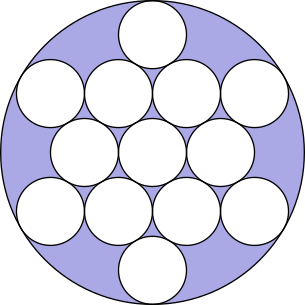
The figure below shows circles of radius within a larger circle. All the intersections occur at points of tangency. What is the area of the region, shaded in the figure, inside the larger circle but outside all the circles of radius
Pista pequeña:
Un círculo central está rodeado por seis círculos, y luego otros seis se ubican en los huecos exteriores
A central circle is ringed by six circles, then six more sit in the outer notches
Pista grande:
Los centros más externos están a distancia del centro, así que el radio grande es
The outermost centers are at distance from the center, so the big radius is
Solución:
Coloca un círculo unitario en el centro, seis a su alrededor con centros a distancia (un hexágono), y seis más con centros a distancia en los huecos exteriores. Eso da círculos.
Los círculos más externos son tangentes al círculo grande, cuyo radio es por lo tanto Su área es
Restando los círculos unitarios queda
Por lo tanto, la respuesta correcta es A.
Place a unit circle at the center, six around it with centers at distance (a hexagon), and six more with centers at distance in the outer gaps. That is circles.
The outermost circles are tangent to the big circle, whose radius is therefore Its area is
Subtracting the unit circles leaves
Thus, the correct answer is A.
11.
Para cierto entero positivo la representación periódica en base de la fracción (en base diez) es ¿Cuánto vale ?
For some positive integer the repeating base- representation of the (base-ten) fraction is What is
Pista pequeña:
Un bloque periódico de dos dígitos en base es igual a .
A two-digit repeating block in base equals
Pista grande:
Iguala y elimina los denominadores
Set and clear denominators
Solución:
El bloque periódico da
Multiplicando en cruz, así que
La fórmula cuadrática da
Por lo tanto, la respuesta correcta es D.
The repeating block gives
Cross-multiplying, so
The quadratic formula gives
Thus, the correct answer is D.
12.
Los números reales positivos y satisfacen y ¿Cuánto vale ?
Positive real numbers and satisfy and What is
Pista pequeña:
Sea y entonces .
Let and then
Pista grande:
Obtienes y observa que
You get and note
Solución:
Sea y Entonces así que lo que da
Como tenemos
Por lo tanto
Por lo tanto, la respuesta correcta es B.
Let and Then so giving
Since we have
Therefore
Thus, the correct answer is B.
13.
¿De cuántas maneras se puede pintar cada uno de los enteros de rojo, verde o azul de modo que cada número tenga un color distinto al de cada uno de sus divisores propios?
How many ways are there to paint each of the integers either red, green, or blue so that each number has a different color from each of its proper divisors?
Pista pequeña:
Los números y no tienen restricción; trata la cadena y las restricciones sobre
Numbers and are unconstrained; handle the chain and the constraints on
Pista grande:
El color de debe evitar tanto como así que el recuento depende de si y comparten color
The color of must avoid both and so count depends on whether and share a color
Solución:
Los primos y no tienen divisores propios aquí, dando opciones cada uno.
A lo largo de la cadena hay coloraciones. El número debe diferir de dando opciones una vez fijado .
El número debe diferir tanto de como de Sumando sobre los colores de y (iguales en pares, distintos en pares), el factor combinado para suma
Multiplicando por las maneras para y se obtiene
Por lo tanto, la respuesta correcta es E.
The primes and have no proper divisors here, giving choices each.
Along the chain there are colorings. Number must differ from giving choices once is set.
Number must differ from both and Summing over the colors of and (equal in pairs, unequal in pairs), the combined factor for totals
Multiplying by the ways for and gives
Thus, the correct answer is E.
14.
Para cierto número complejo el polinomio
tiene exactamente raíces distintas. ¿Cuánto vale ?
For a certain complex number the polynomial
has exactly distinct roots. What is
Pista pequeña:
El primer y el tercer factor dan las raíces y .
The first and third factors give roots and
Pista grande:
Para tener solo raíces distintas, debe reutilizar dos de estas; sus raíces se multiplican para dar .
For only distinct roots, must reuse two of these; its roots multiply to
Solución:
Los factores y tienen raíces y que son valores distintos.
Para que tenga exactamente raíces distintas, las raíces de deben estar entre estas. Su producto debe ser igual a y el único par así es una raíz de cada factor, por ejemplo
Entonces así que
Por lo tanto, la respuesta correcta es E.
The factors and have roots and which are distinct values.
For to have exactly distinct roots, the roots of must lie among these. Their product must equal and the only such pair is one root from each factor, for example
Then so
Thus, the correct answer is E.
15.
Los números reales positivos y tienen la propiedad de que
y los cuatro términos de la izquierda son enteros positivos, donde denota el logaritmo en base . ¿Cuánto vale ?
Positive real numbers and have the property that
and all four terms on the left are positive integers, where denotes the base logarithm. What is
Pista pequeña:
Sea y entonces debe ser un entero
Let and then must be an integer
Pista grande:
Con la ecuación se convierte en
With the equation becomes
Solución:
Sea y así que y Para que esto sea un entero, es par; igualmente
Escribiendo la ecuación se convierte en
La única solución es dando
Por lo tanto
Por lo tanto, la respuesta correcta es D.
Let and so and For this to be an integer, is even; likewise
Writing the equation becomes
The only solution is giving
Therefore
Thus, the correct answer is D.
16.
Los números se colocan al azar en las casillas de una cuadrícula . Cada casilla recibe un número, y cada número se usa una vez. ¿Cuál es la probabilidad de que la suma de los números en cada fila y en cada columna sea impar?
The numbers are randomly placed into the squares of a grid. Each square gets one number, and each of the numbers is used once. What is the probability that the sum of the numbers in each row and each column is odd?
Pista pequeña:
Hay números impares y pares; cada fila y columna necesita una cantidad impar de números impares
There are odd and even numbers; each row and column needs an odd count of odd numbers
Pista grande:
Las entradas impares deben llenar una fila entera y una columna entera, formando una figura de cruz de casillas
The odd entries must fill one entire row and one entire column, forming a plus shape of cells
Solución:
Hay números impares y pares. Cada fila y columna debe contener un número impar de entradas impares.
La única forma de colocar entradas impares con cada fila y columna impar es llenar una fila completa y una columna completa (una cruz de casillas). Hay de tales patrones.
Cada patrón admite colocaciones de los números impares y de los pares, así que la probabilidad es
Por lo tanto, la respuesta correcta es B.
There are odd and even numbers. Each row and column must contain an odd number of odd entries.
The only way to place odd entries with every row and column odd is to fill one complete row and one complete column (a plus shape of cells). There are such patterns.
Each pattern admits placements of the odd numbers and of the even numbers, so the probability is
Thus, the correct answer is B.
17.
Sea la suma de las -ésimas potencias de las raíces del polinomio En particular, y Sean y números reales tales que para ¿Cuánto vale ?
Let denote the sum of the th powers of the roots of the polynomial In particular, and Let and be real numbers such that for What is
Pista pequeña:
Cada raíz satisface .
Each root satisfies
Pista grande:
Multiplica por y suma sobre las raíces para leer .
Multiply by and sum over the roots to read off
Solución:
Cada raíz satisface así que
Sumando sobre las tres raíces se obtiene así que
Por lo tanto
Por lo tanto, la respuesta correcta es D.
Every root satisfies so
Summing over the three roots gives so
Therefore
Thus, the correct answer is D.
18.
Una esfera con centro tiene radio Un triángulo con lados de longitud y está situado en el espacio de modo que cada uno de sus lados es tangente a la esfera. ¿Cuál es la distancia entre y el plano determinado por el triángulo?
A sphere with center has radius A triangle with sides of length and is situated in space so that each of its sides is tangent to the sphere. What is the distance between and the plane determined by the triangle?
Pista pequeña:
La esfera corta el plano en un círculo tangente a los tres lados, así que ese círculo es el incírculo
The sphere meets the plane in a circle tangent to all three sides, so that circle is the incircle
Pista grande:
Si es la distancia, el círculo de corte tiene radio que es igual al inradio
If is the distance, the cross-circle has radius which equals the inradius
Solución:
La esfera interseca el plano del triángulo en un círculo de radio donde es la distancia de al plano. Como cada lado es tangente a la esfera, este círculo es el incírculo del triángulo.
El triángulo tiene área y semiperímetro así que su inradio es
Así lo que da y
Por lo tanto, la respuesta correcta es D.
The sphere intersects the triangle’s plane in a circle of radius where is the distance from to the plane. Since each side is tangent to the sphere, this circle is the triangle’s incircle.
The triangle has area and semiperimeter so its inradius is
Thus giving and
Thus, the correct answer is D.
19.
En con longitudes de lados enteras,
¿Cuál es el menor perímetro posible para ?
In with integer side lengths,
What is the least possible perimeter for
Pista pequeña:
Halla a partir de los cosenos dados.
Find from the given cosines
Pista grande:
Por la ley de los senos, los lados son proporcionales a .
By the Law of Sines the sides are proportional to
Solución:
Cada seno es
Por la ley de los senos, los lados están en razón Los menores lados enteros son que satisfacen la desigualdad triangular.
El menor perímetro es
Por lo tanto, la respuesta correcta es A.
Each sine is
By the Law of Sines the sides are in ratio The smallest integer sides are which satisfy the triangle inequality.
The least perimeter is
Thus, the correct answer is A.
20.
Se eligen números reales entre y inclusive, de la siguiente manera. Se lanza una moneda justa. Si sale cara, se lanza de nuevo y el número elegido es si el segundo lanzamiento es cara y si el segundo lanzamiento es cruz. Por otro lado, si el primer lanzamiento es cruz, entonces el número se elige uniformemente al azar del intervalo cerrado Dos números aleatorios y se eligen independientemente de esta manera. ¿Cuál es la probabilidad de que ?
Real numbers between and inclusive, are chosen in the following manner. A fair coin is flipped. If it lands heads, then it is flipped again and the chosen number is if the second flip is heads and if the second flip is tails. On the other hand, if the first coin flip is tails, then the number is chosen uniformly at random from the closed interval Two random numbers and are chosen independently in this manner. What is the probability that
Pista pequeña:
Cada número es con probabilidad con probabilidad y uniforme en con probabilidad
Each number is with probability with probability and uniform on with probability
Pista grande:
Divide en las nueve combinaciones de tipos; para dos uniformes,
Split into the nine type-combinations; for two uniforms,
Solución:
Cada variable es igual a con probabilidad es igual a con probabilidad y es uniforme en con probabilidad
Considerando las nueve combinaciones de tipos: los pares y contribuyen cada uno Cada uno de los cuatro casos de punto contra uniforme contribuye El caso de uniforme contra uniforme contribuye
El total es
Por lo tanto, la respuesta correcta es B.
Each variable equals with probability equals with probability and is uniform on with probability
Considering the nine combinations of types: the pairs and each contribute Each of the four point-versus-uniform cases contributes The uniform-versus-uniform case contributes
The total is
Thus, the correct answer is B.
21.
Sea ¿Cuánto vale
Let What is
Pista pequeña:
así que depende solo de .
so depends only on
Pista grande:
Para el exponente es seis veces, tres veces, y tres veces
Over the exponent is six times, three times, and three times
Solución:
Como tenemos que depende solo de
Para hasta el residuo es (dando ) seis veces, (dando ) tres veces, y (dando ) tres veces. Así que la primera suma es
La segunda suma es análogamente Su producto es
Por lo tanto, la respuesta correcta es C.
Since we have depending only on
For to the residue is (giving ) six times, (giving ) three times, and (giving ) three times. So the first sum is
The second sum is likewise Their product is
Thus, the correct answer is C.
22.
Los círculos y ambos con centro en tienen radios y respectivamente. El triángulo equilátero cuyo interior está dentro de pero fuera de tiene el vértice sobre y la recta que contiene el lado es tangente a Los segmentos y se cortan en y Entonces puede escribirse en la forma para enteros positivos con ¿Cuánto vale ?
Circles and both centered at have radii and respectively. Equilateral triangle whose interior lies in the interior of but in the exterior of has vertex on and the line containing side is tangent to Segments and intersect at and Then can be written in the form for positive integers with What is
Pista pequeña:
Sea Como tenemos y .
Let Since we have and
Pista grande:
Coloca en el origen con horizontal; está sobre la recta a distancia de y de .
Place at the origin with horizontal; lies on line at distance from and from
Solución:
Sea Como tenemos y Pon en el origen con sobre el eje , y el ápice
Los puntos son colineales, así que para algún escalar Dos condiciones lo determinan: está a distancia de la recta lo que da y está sobre lo que da ya que
Resolviendo, y La configuración válida tiene y en lados opuestos de así que Por lo tanto
Entonces
Por lo tanto, la respuesta correcta es E.
Let Since we have and Put at the origin with on the -axis, and apex
Points are collinear, so for some scalar Two conditions pin it down: is at distance from line giving and is on giving since
Solving, and The valid configuration has and on opposite sides of so Therefore
Then
Thus, the correct answer is E.
23.
Define las operaciones binarias y por
y
para todos los números reales y para los que estas expresiones están definidas. La sucesión se define recursivamente por y para todos los enteros Al entero más cercano, ¿cuánto vale ?
Define binary operations and by
and
for all real numbers and for which these expressions are defined. The sequence is defined recursively by and for all integers To the nearest integer, what is
Pista pequeña:
Aplica entonces
Apply then
Pista grande:
Escribiendo la recurrencia se convierte en
Writing the recurrence becomes
Solución:
Sea Entonces y
Así y El producto se telescopa:
Por lo tanto que se redondea a
Por lo tanto, la respuesta correcta es D.
Let Then and
So and The product telescopes:
Hence which rounds to
Thus, the correct answer is D.
24.
¿Para cuántos enteros entre y inclusive, es un entero? (Recuerda que )
For how many integers between and inclusive, is an integer? (Recall that )
Pista pequeña:
Compara el exponente de un primo en el numerador y el denominador usando
Compare the exponent of a prime in numerator and denominator using
Pista grande:
El fracaso requiere que sea una potencia de primo con
Failure requires to be a prime power with
Solución:
Fijemos un primo Por la fórmula de Legendre, la diferencia entre el exponente de en el numerador y en el denominador es Si es el residuo de módulo el -ésimo sumando es
Sea Los primeros sumandos son Si no es potencia de escribamos con Cuando el siguiente sumando es al menos y todos los posteriores son no negativos; cuando todos los sumandos ya son no negativos. Por tanto, salvo que sea potencia de
Para la fórmula de Legendre reduce la condición a Entre las potencias de primo no mayores que esto falla exactamente cuando (es decir, cuando es primo) y cuando Hay primos no mayores que más para un total de fallos. Por tanto, funcionan valores de .
Por lo tanto, la respuesta correcta es D.
Fix a prime By Legendre’s formula, the difference between the exponent of in the numerator and its exponent in the denominator is If is the remainder of modulo the th summand is
Let The first summands are If is not a power of write with When the next summand is at least and all later summands are nonnegative; when every summand is already nonnegative. Thus unless is a power of
For Legendre’s formula reduces the requirement to Among prime powers at most this fails exactly when (so is prime) and when There are primes at most plus giving failures. Hence values of work.
Thus, the correct answer is D.
25.
Sea un triángulo cuyas medidas angulares son exactamente y Para cada entero positivo define como el pie de la altura desde a la recta Del mismo modo, define como el pie de la altura desde a la recta y como el pie de la altura desde a la recta ¿Cuál es el menor entero positivo para el cual es obtuso?
Let be a triangle whose angle measures are exactly and For each positive integer define to be the foot of the altitude from to line Likewise, define to be the foot of the altitude from to line and to be the foot of the altitude from to line What is the least positive integer for which is obtuse?
Pista pequeña:
Para un triángulo acutángulo, el triángulo órtico tiene ángulos .
For an acute triangle, the orthic triangle has angles
Pista grande:
Rastrea la desviación respecto a cada paso la multiplica por y el triángulo se vuelve obtuso cuando una desviación supera
Track the deviation from each step multiplies it by and the triangle turns obtuse when a deviation exceeds
Solución:
Para un triángulo acutángulo, el triángulo órtico (pies de las alturas) tiene ángulos para cada ángulo original
Escribiendo un ángulo como el nuevo ángulo es así que cada desviación respecto a se multiplica por Las desviaciones iniciales son
Después de pasos, una desviación tiene magnitud grados. El triángulo se vuelve obtuso por primera vez cuando esto supera es decir Como y el menor tal es
Por lo tanto, la respuesta correcta es E.
For an acute triangle, the orthic triangle (feet of the altitudes) has angles for each original angle
Writing an angle as the new angle is so each deviation from is multiplied by The initial deviations are
After steps a deviation has magnitude degrees. The triangle first becomes obtuse when this exceeds i.e. Since and the least such is
Thus, the correct answer is E.