
Soluciones del 2016 AMC 12B
Desplázate hacia abajo para ver las soluciones preparadas profesionalmente de LIVE by Po-Shen Loh, imprime las soluciones en PDF, consulta la clave de respuestas, o haz el examen cronometrado completo.
Todos los problemas se usan con el permiso legal oficial de la Mathematical Association of America (MAA).
1.
¿Cuál es el valor de
cuando ?
What is the value of
when
Pista pequeña:
así que cuando .
so when
Pista grande:
El numerador es luego se divide entre .
The numerator is then divide by
Solución:
Con tenemos El numerador es y al dividir entre se obtiene
Por lo tanto, la respuesta correcta es D.
With we have The numerator is and dividing by gives
Thus, the correct answer is D.
2.
La media armónica de dos números puede calcularse como el doble de su producto dividido entre su suma. ¿A qué entero se aproxima más la media armónica de y ?
The harmonic mean of two numbers can be computed as twice their product divided by their sum. The harmonic mean of and is closest to which integer?
Pista pequeña:
El doble del producto dividido entre la suma: .
Twice the product over the sum:
Pista grande:
está apenas por debajo de un número entero; redondéalo.
is just a hair under a whole number; round it
Solución:
La media armónica es Como está muy cerca de este valor está justo por debajo de así que el entero más cercano es
Por lo tanto, la respuesta correcta es A.
The harmonic mean is Since is very close to this is just under so the closest integer is
Thus, the correct answer is A.
3.
Sea ¿Cuál es el valor de
Let What is the value of
Pista pequeña:
y la parte más interna es .
and the innermost part is
Pista grande:
Simplifica de dentro hacia afuera: luego después el valor absoluto exterior y, por último, .
Simplify outward: then then the outer absolute value, and finally
Solución:
Como La expresión más interna es Luego y el valor absoluto exterior deja Por último, al restar se obtiene
Por lo tanto, la respuesta correcta es D.
Since The innermost expression is Then and the outer absolute value leaves Finally subtracting gives
Thus, the correct answer is D.
4.
La razón entre las medidas de dos ángulos agudos es y el complemento de uno de estos dos ángulos es el doble del complemento del otro. ¿Cuál es la suma de las medidas, en grados, de los dos ángulos?
The ratio of the measures of two acute angles is and the complement of one of these two angles is twice as large as the complement of the other. What is the sum of the degree measures of the two angles?
Pista pequeña:
Sean los ángulos con .
Let the angles be with
Pista grande:
Los complementos son y plantea .
The complements are and set
Solución:
Sean los ángulos con El complemento mayor corresponde al ángulo menor, así que Esto da por lo que y La suma es
Por lo tanto, la respuesta correcta es C.
Let the angles be with The larger complement belongs to the smaller angle, so This gives so and The sum is
Thus, the correct answer is C.
5.
La Guerra de comenzó con una declaración de guerra el jueves de junio de El tratado de paz que puso fin a la guerra se firmó días después, el de diciembre de ¿En qué día de la semana se firmó el tratado?
The War of started with a declaration of war on Thursday, June The peace treaty to end the war was signed days later, on December On what day of the week was the treaty signed?
viernes
Friday
sábado
Saturday
domingo
Sunday
lunes
Monday
martes
Tuesday
Pista pequeña:
Los días de la semana se repiten cada días, así que reduce módulo .
Days of the week repeat every days, so reduce modulo
Pista grande:
así que cuenta días hacia adelante desde el jueves.
so count days forward from Thursday
Solución:
Como el tratado se firmó semanas completas más días después del jueves.
Dos días después del jueves es sábado. Por lo tanto, la respuesta correcta es B.
Because the treaty was signed full weeks plus days after Thursday. Two days beyond Thursday is Saturday.
Thus, the correct answer is B.
6.
Los tres vértices del están sobre la parábola definida por con en el origen y paralelo al eje . El área del triángulo es ¿Cuál es la longitud de ?
All three vertices of lie on the parabola defined by with at the origin and parallel to the -axis. The area of the triangle is What is the length of
Pista pequeña:
Sea un vértice superior por simetría, el otro es .
Let a top vertex be by symmetry the other is
Pista grande:
La base es y la altura es así que .
The base is and the height is so
Solución:
Sea el vértice del primer cuadrante Por simetría, la base es y la altura es así que Por lo tanto, y
Por lo tanto, la respuesta correcta es C.
Let the vertex in the first quadrant be By symmetry the base is and the height is so Thus and
Thus, the correct answer is C.
7.
Josh escribe los números Tacha salta el siguiente número tacha y sigue saltando y tachando el siguiente número hasta el final de su lista. Luego vuelve al principio de su lista, tacha el primer número que queda salta el siguiente número tacha salta tacha y así sucesivamente hasta el final. Josh continúa de esta manera hasta que solo queda un número. ¿Cuál es ese número?
Josh writes the numbers He marks out skips the next number marks out and continues skipping and marking out the next number to the end of his list. Then he goes back to the start of his list, marks out the first remaining number skips the next number marks out skips marks out and so on to the end. Josh continues in this manner until only one number remains. What is that number?
Pista pequeña:
Después de la primera pasada solo quedan los múltiplos de ; después de la siguiente, solo los múltiplos de .
After the first pass only the multiples of remain; after the next, only the multiples of
Pista grande:
Cada pasada conserva los múltiplos de la siguiente potencia de halla la mayor potencia de que sea a lo sumo .
Each pass keeps the multiples of the next power of find the highest power of that is at most
Solución:
La primera pasada elimina los números impares y deja los múltiplos de La segunda pasada elimina dejando los múltiplos de En general, después de la -ésima pasada solo quedan los múltiplos de . El número que sobrevive es la mayor potencia de que no excede que es
Por lo tanto, la respuesta correcta es D.
The first pass removes the odd numbers, leaving the multiples of The second pass removes leaving the multiples of In general, after the th pass only the multiples of remain. The surviving number is the highest power of not exceeding which is
Thus, the correct answer is D.
8.
Una lámina delgada de madera de densidad uniforme con forma de triángulo equilátero de lado pulgadas pesa onzas. Una segunda lámina del mismo tipo de madera, con el mismo grosor y también con forma de triángulo equilátero, tiene lado pulgadas. ¿Cuál de las siguientes opciones se aproxima más al peso, en onzas, de la segunda lámina?
A thin piece of wood of uniform density in the shape of an equilateral triangle with side length inches weighs ounces. A second piece of the same type of wood, with the same thickness, also in the shape of an equilateral triangle, has side length inches. Which of the following is closest to the weight, in ounces, of the second piece?
Pista pequeña:
El peso es proporcional al área, que escala con el cuadrado de la longitud del lado.
The weight is proportional to the area, which scales with the square of the side length
Pista grande:
Multiplica por .
Multiply by
Solución:
El peso es proporcional al área, y el área escala con el cuadrado de la longitud del lado. El segundo lado es veces el primero, así que su peso es onzas.
Por lo tanto, la respuesta correcta es D.
Weight is proportional to area, and area scales with the square of the side length. The second side is times the first, so its weight is ounces.
Thus, the correct answer is D.
9.
Carl decidió cercar su jardín rectangular. Compró postes de cerca, colocó uno en cada una de las cuatro esquinas y distribuyó el resto uniformemente a lo largo de los bordes del jardín, dejando exactamente yardas entre postes vecinos. El lado más largo de su jardín, incluidas las esquinas, tiene el doble de postes que el lado más corto, incluidas las esquinas. ¿Cuál es el área, en yardas cuadradas, del jardín de Carl?
Carl decided to fence in his rectangular garden. He bought fence posts, placed one on each of the four corners, and spaced out the rest evenly along the edges of the garden, leaving exactly yards between neighboring posts. The longer side of his garden, including the corners, has twice as many posts as the shorter side, including the corners. What is the area, in square yards, of Carl’s garden?
Pista pequeña:
Supón que el lado más corto tiene postes y el más largo postes; los cuatro postes de las esquinas se comparten.
Let the shorter side have posts and the longer side posts; the four corner posts are shared
Pista grande:
Total de postes un lado con postes abarca yardas.
Total posts a side with posts spans yards
Solución:
Supón que el lado más corto tiene postes, así que el más largo tiene Contando todos los postes y restando las cuatro esquinas contadas dos veces, lo que da El lado más corto tiene postes, es decir yardas, y el más largo tiene postes, es decir yardas. El área es
Por lo tanto, la respuesta correcta es B.
Let the shorter side have posts, so the longer side has Counting all posts and subtracting the four corners counted twice, giving The shorter side has posts, or yards, and the longer side has posts, or yards. The area is
Thus, the correct answer is B.
10.
Un cuadrilátero tiene vértices y donde y son enteros con El área de es ¿Cuánto vale ?
A quadrilateral has vertices and where and are integers with The area of is What is
Pista pequeña:
Revisa las pendientes: y tienen pendiente mientras que y tienen pendiente así que es un rectángulo.
Check the slopes: and have slope while and have slope so is a rectangle
Pista grande:
Sus lados son y así que el área es .
Its sides are and so the area is
Solución:
Los lados y tienen pendiente y y tienen pendiente así que es un rectángulo con lados y Su área es así que Los únicos cuadrados perfectos que difieren en son y lo que da y
Por lo tanto, la respuesta correcta es A.
The sides and have slope and and have slope so is a rectangle with sides and Its area is so The only perfect squares differing by are and giving and
Thus, the correct answer is A.
11.
¿Cuántos cuadrados cuyos lados son paralelos a los ejes y cuyos vértices tienen coordenadas enteras están contenidos por completo en la región limitada por la recta la recta y la recta ?
How many squares whose sides are parallel to the axes and whose vertices have coordinates that are integers lie entirely within the region bounded by the line the line and the line
Pista pequeña:
La región está debajo de observa que y .
The region sits below note and
Pista grande:
En cada franja vertical cuenta los cuadrados y que caben debajo de la recta, y luego súmalos.
In each vertical strip count the and squares that fit below the line, then add them up
Solución:
Un cuadrado cuyo borde izquierdo es debe caber bajo el punto más bajo de a lo largo de su anchura, que es Para lado los posibles bordes izquierdos aportan cuadrados. Para lado los bordes aportan y para lado los bordes aportan Un cuadrado de lado al menos no cabe, así que el total es
Por lo tanto, la respuesta correcta es D.
A square whose left edge is must fit below the lowest point of over its width, namely For side length the possible left edges contribute squares. For side length the left edges contribute and for side length the left edges contribute A square of side at least cannot fit, so the total is
Thus, the correct answer is D.
12.
Todos los números se escriben en un arreglo de casillas , uno en cada casilla, de modo que si dos números son consecutivos entonces ocupan casillas que comparten un lado. Los números de las cuatro esquinas suman ¿Qué número está en el centro?
All the numbers are written in a array of squares, one number in each square, in such a way that if two numbers are consecutive then they occupy squares that share an edge. The numbers in the four corners add up to What number is in the center?
Pista pequeña:
Colorea la cuadrícula como un tablero de ajedrez; los números consecutivos deben quedar en colores opuestos, así que se alternan.
Color the grid like a checkerboard; consecutive numbers must lie on opposite colors, so they alternate
Pista grande:
Las cinco casillas del mismo color (las cuatro esquinas más el centro) deben contener los cinco números impares, que suman .
The five same-colored cells (four corners plus center) must hold the five odd numbers, which sum to
Solución:
Colorea la cuadrícula como un tablero de ajedrez de modo que las cuatro esquinas y el centro compartan un color. Como los números consecutivos ocupan casillas adyacentes (de color opuesto), los números alternan su paridad a lo largo de la cadena, así que las cinco casillas del mismo color contienen los cinco números impares que suman Las cuatro esquinas suman así que el centro es
Por lo tanto, la respuesta correcta es C.
Color the grid like a checkerboard so the four corners and the center share one color. Since consecutive numbers occupy adjacent (opposite colored) squares, the numbers alternate parity along the chain, so the five same-colored cells contain the five odd numbers which sum to The four corners add to so the center is
Thus, the correct answer is C.
13.
Alice y Bob viven a millas de distancia. Un día, Alice mira hacia el norte desde su casa y ve un avión. Al mismo tiempo, Bob mira hacia el oeste desde su casa y ve el mismo avión. El ángulo de elevación del avión es desde la posición de Alice y desde la posición de Bob. ¿Cuál de las siguientes opciones se aproxima más a la altura del avión, en millas?
Alice and Bob live miles apart. One day Alice looks due north from her house and sees an airplane. At the same time Bob looks due west from his house and sees the same airplane. The angle of elevation of the airplane is from Alice’s position and from Bob’s position. Which of the following is closest to the airplane’s altitude, in miles?
Pista pequeña:
Supón que el avión está sobre el punto del suelo a una altura Los triángulos y son triángulos rectángulos --.
Let the plane be above point on the ground at height Triangles and are -- right triangles
Pista grande:
y entonces .
and then
Solución:
Supón que el avión está en directamente sobre el punto del suelo, a una altura Los triángulos y son triángulos rectángulos --, así que y Como Alice mira al norte y Bob mira al oeste, así que Entonces lo que da el más cercano a
Por lo tanto, la respuesta correcta es E.
Let the airplane be at directly above point on the ground at altitude Triangles and are -- right triangles, so and Since Alice looks north and Bob looks west, so Then giving closest to
Thus, the correct answer is E.
14.
La suma de una serie geométrica infinita es un número positivo y el segundo término de la serie es ¿Cuál es el menor valor posible de ?
The sum of an infinite geometric series is a positive number and the second term in the series is What is the smallest possible value of
Pista pequeña:
Con razón y segundo término el primer término es así que .
With ratio and second term the first term is so
Pista grande:
es mínimo cuando es máximo; maximiza la parábola que abre hacia abajo.
is smallest when is largest; maximize the downward parabola
Solución:
Sea la razón común. Como el segundo término es el primero es así que La convergencia exige y obliga entonces a Por tanto, es mínimo cuando es máximo. La parábola alcanza su máximo en donde vale así que el menor valor de es
Por lo tanto, la respuesta correcta es E.
Let be the common ratio. Since the second term is the first term is so Convergence requires and then forces Therefore is smallest when is largest. The parabola peaks at where it equals so the smallest value of is
Thus, the correct answer is E.
15.
Todos los números se asignan a las seis caras de un cubo, un número a cada cara. Para cada uno de los ocho vértices del cubo se calcula un producto de tres números, donde los tres números son los asignados a las tres caras que contienen ese vértice. ¿Cuál es el mayor valor posible de la suma de estos ocho productos?
All the numbers are assigned to the six faces of a cube, one number to each face. For each of the eight vertices of the cube, a product of three numbers is computed, where the three numbers are the numbers assigned to the three faces that include that vertex. What is the greatest possible value of the sum of these eight products?
Pista pequeña:
Agrupa los tres pares de caras opuestas como .
Group the three pairs of opposite faces as
Pista grande:
La suma de los ocho productos de los vértices se factoriza como con una suma total fija, un producto es máximo cuando los factores son iguales.
The sum of the eight vertex products factors as with a fixed total, a product is largest when the factors are equal
Solución:
Empareja las caras opuestas como Cada producto de vértice usa una cara de cada par, así que la suma de los ocho productos se factoriza como Los tres factores tienen suma total fija y un producto con suma fija es máximo cuando los factores son iguales, con cada uno. Este equilibrio se logra con lo que da
Por lo tanto, la respuesta correcta es D.
Pair the opposite faces as Each vertex product uses one face from each pair, so the sum of all eight products factors as The three factors have fixed total and a product with fixed sum is largest when the factors are equal, at each. This balance is achievable with giving
Thus, the correct answer is D.
16.
¿De cuántas maneras se puede escribir como la suma de una sucesión creciente de dos o más enteros positivos consecutivos?
In how many ways can be written as the sum of an increasing sequence of two or more consecutive positive integers?
Pista pequeña:
Una serie de enteros consecutivos es igual a por su mediana, y .
A run of consecutive integers equals times its median, and
Pista grande:
Para valores impares de la mediana es un factor entero; para valores pares de la mediana es un semientero. Cuenta ambos casos manteniendo todos los términos positivos.
For odd the median is an integer factor; for even the median is a half-integer. Count both while keeping all terms positive
Solución:
La suma de enteros consecutivos es igual a la cantidad de términos por la mediana. Para un número impar de términos, la mediana es un divisor entero de lo que da series de (mediana ), (mediana ), (mediana ), y (mediana ) términos. Para un número par de términos, la mediana es un semientero; las posibilidades positivas tienen longitudes con medianas respectivas Series más largas basadas en divisores obligarían a que el primer término no fuera positivo. Esto da maneras.
Por lo tanto, la respuesta correcta es E.
A sum of consecutive integers equals the count times the median. For an odd number of terms, the median is an integer divisor of giving runs of (median ), (median ), (median ), and (median ) terms. For an even number of terms the median is a half-integer. The positive possibilities have lengths with respective medians Longer divisor-based runs would force a nonpositive first term. This gives ways.
Thus, the correct answer is E.
17.
En el que se muestra en la figura, y es una altura. Los puntos y están sobre los lados y respectivamente, de modo que y son bisectrices, que cortan a en y respectivamente. ¿Cuánto vale ?
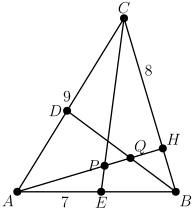
In shown in the figure, and is an altitude. Points and lie on sides and respectively, so that and are angle bisectors, intersecting at and respectively. What is
Pista pequeña:
Sea Entonces lo que da y .
Let Then which gives and
Pista grande:
Por el teorema de la bisectriz, y entonces .
By the angle bisector theorem, and then
Solución:
Sea Entonces y a partir de los dos triángulos rectángulos Esto da y Por el teorema de la bisectriz en así que De manera similar, en así que Entonces
Por lo tanto, la respuesta correcta es D.
Let Then and from the two right triangles This gives and By the angle bisector theorem in so Similarly in so Then
Thus, the correct answer is D.
18.
¿Cuál es el área de la región encerrada por la gráfica de la ecuación ?
What is the area of the region enclosed by the graph of the equation
Pista pequeña:
La gráfica es simétrica respecto a ambos ejes; en el primer cuadrante la ecuación es .
The graph is symmetric about both axes; in the first quadrant the equation is
Pista grande:
Completa el cuadrado para obtener en ese cuadrante la región es un triángulo rectángulo más un semicírculo.
Complete the square to in that quadrant the region is a right triangle plus a semicircle
Solución:
Por simetría, considera el primer cuadrante, donde la ecuación es o Esta es una circunferencia centrada en que pasa por y como el centro es el punto medio de esa cuerda, la región encerrada en el primer cuadrante es el triángulo rectángulo con catetos hacia y (área ) más un semicírculo de radio (área ). Multiplicando por para todos los cuadrantes se obtiene
Por lo tanto, la respuesta correcta es B.
By symmetry, consider the first quadrant, where the equation is or This is a circle centered at passing through and since the center is the midpoint of that chord, the enclosed first-quadrant region is the right triangle with legs to and (area ) plus a semicircle of radius (area ). Multiplying by for all quadrants gives
Thus, the correct answer is B.
19.
Tom, Dick y Harry están jugando un juego. Comenzando al mismo tiempo, cada uno lanza repetidamente una moneda equilibrada hasta que sale su primera cara, momento en el que se detiene. ¿Cuál es la probabilidad de que los tres lancen sus monedas el mismo número de veces?
Tom, Dick, and Harry are playing a game. Starting at the same time, each of them flips a fair coin repeatedly until he gets his first head, at which point he stops. What is the probability that all three flip their coins the same number of times?
Pista pequeña:
Un jugador obtiene su primera cara en el lanzamiento con probabilidad .
A single player gets his first head on flip with probability
Pista grande:
Los tres se detienen en el lanzamiento con probabilidad suma esta serie geométrica para .
All three stop on flip with probability sum this geometric series over
Solución:
La primera cara de un jugador sale en el lanzamiento con probabilidad Que los tres se detengan en el mismo lanzamiento tiene probabilidad Sumando para
Por lo tanto, la respuesta correcta es B.
A player’s first head comes on flip with probability All three stopping on the same flip has probability Summing over
Thus, the correct answer is B.
20.
Un conjunto de equipos disputó un torneo de todos contra todos en el que cada equipo jugó exactamente una vez contra cada uno de los demás. Cada equipo ganó partidos y perdió partidos; no hubo empates. ¿Cuántos conjuntos de tres equipos había en los que venció a venció a y venció a ?
A set of teams held a round-robin tournament in which every team played every other team exactly once. Every team won games and lost games; there were no ties. How many sets of three teams were there in which beat beat and beat
Pista pequeña:
Cada equipo juega contra rivales, así que hay equipos y tríos en total.
Each team plays others, so there are teams and triples in all
Pista grande:
Un trío no cíclico tiene exactamente un equipo que vence a los otros dos; cuéntalos y réstalos del total.
A non-cyclic triple has exactly one team that beats the other two; count those and subtract from the total
Solución:
Como cada equipo ganó y perdió hay equipos y tríos. Un trío no es cíclico exactamente cuando un equipo vence a los otros dos. Elegir ese equipo ( maneras) y de los equipos que venció da tríos no cíclicos. Por lo tanto, los tríos cíclicos son
Por lo tanto, la respuesta correcta es A.
Since each team won and lost there are teams and triples. A triple is not cyclic exactly when one team beats both others. Choosing that team ( ways) and of the teams it beat gives non-cyclic triples. Thus the cyclic triples number
Thus, the correct answer is A.
21.
Sea un cuadrado unitario. Sea el punto medio de Para sea la intersección de y y sea el pie de la perpendicular desde hasta ¿Cuánto vale
Let be a unit square. Let be the midpoint of For let be the intersection of and and let be the foot of the perpendicular from to What is
Pista pequeña:
Los triángulos semejantes dan la recursión y lleva a .
Similar triangles give the recursion and leads to
Pista grande:
El área de es la suma es telescópica.
The area of is the sum telescopes
Solución:
Coloca y sea Al intersecar la recta con (la recta ) se obtiene con ambas coordenadas así que A partir de esto da La base de es y su altura es la coordenada de que es Entonces La suma telescópica da
Por lo tanto, la respuesta correcta es B.
Place and let Intersecting line with (the line ) gives with both coordinates so From this yields The base of is and its height is the -coordinate of which is Then Summing telescopes to
Thus, the correct answer is B.
22.
Para cierto entero positivo menor que el equivalente decimal de es un decimal periódico de período y el equivalente decimal de es un decimal periódico de período ¿En qué intervalo se encuentra ?
For a certain positive integer less than the decimal equivalent of is a repeating decimal of period and the decimal equivalent of is a repeating decimal of period In which interval does lie?
Pista pequeña:
Período significa que es divisible por período significa que es divisible por .
Period means is divisible by period means is divisible by
Pista grande:
debe dividir a pero no a lo que obliga a prueba cada para ver si es divisible por .
must divide but not forcing test each to see whether is divisible by
Solución:
El período exige que sea divisible por El período exige que sea divisible por mientras que no es divisible por (pues de otro modo el período sería o ). Por tanto, es múltiplo de Como también divide a y es menor que las únicas posibilidades son que dan Solo divide a así que
Finalmente, mientras que y de modo que su período es exactamente Además, divide a pero no a por lo que el período de es exactamente Así, pertenece a
Por lo tanto, la respuesta correcta es B.
Period requires to be divisible by Period requires to be divisible by while is not divisible by (else the period would be or ). Hence is a multiple of Since also divides and is less than the only possibilities are giving Only divides so
Finally, while and so its period is exactly Also divides but not so the period of is exactly Thus lies in
Thus, the correct answer is B.
23.
¿Cuál es el volumen de la región del espacio tridimensional definida por las desigualdades y ?
What is the volume of the region in three-dimensional space defined by the inequalities and
Pista pequeña:
El conjunto es un octaedro regular con diagonales de longitud y volumen .
The set is a regular octahedron with diagonals of length and volume
Pista grande:
La segunda desigualdad es ese octaedro trasladado hacia arriba en su intersección es un octaedro semejante con la mitad del tamaño lineal.
The second inequality is that octahedron translated up by their overlap is a similar octahedron with half the linear size
Solución:
La región es un octaedro regular con vértices en cuyo volumen es La segunda región es el mismo octaedro desplazado hacia arriba en Su intersección está limitada por otro octaedro regular con diagonales de longitud la mitad de las dimensiones lineales del primero, así que su volumen es
Por lo tanto, la respuesta correcta es A.
The region is a regular octahedron with vertices at whose volume is The second region is the same octahedron shifted up by Their intersection is bounded by another regular octahedron with diagonals of length half the linear dimensions of the first, so its volume is
Thus, the correct answer is A.
24.
Hay exactamente cuádruplas ordenadas tales que y ¿Cuál es el menor valor posible de ?
There are exactly ordered quadruples such that and What is the smallest possible value of
Pista pequeña:
Divide todo entre Con necesitas cuádruplas reducidas de mcd y mcm analizadas primo por primo.
Divide everything by With you need reduced quadruples of gcd and lcm analyzed one prime at a time
Pista grande:
Para un primo con exponente máximo la cantidad de cuádruplas de exponentes es Usa la factorización de para determinar cuántos primos dividen a y qué valores puede tomar
For a prime with maximum exponent the count of exponent quadruples is Use the factorization of to determine how many primes divide and which values of can occur
Solución:
Al escribir cada entrada como por un valor reducido, necesitamos y Para cada primo que divide a con exponente máximo la cantidad de cuádruplas de exponentes válidas es El producto sobre todos los primos debe ser Como vale y para y los exponentes dan una factorización candidata.
Cada primo aporta exactamente un factor así que exactamente tres primos dividen a Sus factores impares deben dividir a Al revisar los divisores se obtiene con factores impares La opción deja solo como producto de los otros dos factores impares, pero cada uno es al menos lo cual es imposible. Por tanto, los exponentes máximos son exactamente Para minimizar asignamos el exponente mayor al primo menor: así que
Por lo tanto, la respuesta correcta es D.
Writing each entry as times a reduced value, we need and For each prime dividing with maximum exponent the number of valid exponent quadruples is The total over all primes must equal Since equals and for and the exponents give one candidate factorization.
Every prime contributes exactly one factor of so exactly three primes divide Their odd factors must divide Checking the divisors gives with odd factors The choice leaves only for the product of the other two odd factors, but each is at least so this is impossible. Therefore the maximum exponents are exactly To minimize assign the largest exponent to the smallest prime: so
Thus, the correct answer is D.
25.
La sucesión se define recursivamente por y para ¿Cuál es el menor entero positivo tal que el producto es un entero?
The sequence is defined recursively by and for What is the smallest positive integer such that the product is an integer?
Pista pequeña:
Escribe Entonces y .
Write Then and
Pista grande:
El producto es un entero exactamente cuando es divisible por resuelve y usa el orden de módulo .
The product is an integer exactly when is divisible by solve and use the order of modulo
Solución:
Escribamos La recurrencia se convierte en cuya solución es El producto es entero exactamente cuando es divisible por Al sumar la fórmula para , obtenemos cuando es impar, y cuando es par.
El orden de módulo es porque y Para impar, la divisibilidad exige que sea divisible por lo que ocurre por primera vez en Para par, exige que sea divisible por lo que ocurre por primera vez en Por tanto, el menor positivo es
Por lo tanto, la respuesta correcta es A.
Write The recursion becomes solved by The product is an integer exactly when is divisible by Summing the formula for gives when is odd, and when is even.
The order of modulo is because and For odd divisibility therefore requires to be divisible by first occurring at For even it requires to be divisible by first occurring at Hence the smallest positive is
Thus, the correct answer is A.