
Soluciones del 2014 AMC 12B
Desplázate hacia abajo para ver las soluciones preparadas profesionalmente de LIVE by Po-Shen Loh, imprime las soluciones en PDF, consulta la clave de respuestas, o haz el examen cronometrado completo.
Todos los problemas se usan con el permiso legal oficial de la Mathematical Association of America (MAA).
1.
Leah tiene monedas, todas de un centavo (pennies) y de cinco centavos (nickels). Si tuviera un nickel más de los que tiene ahora, entonces tendría la misma cantidad de pennies y de nickels. En centavos, ¿cuánto valen las monedas de Leah?
Leah has coins, all of which are pennies and nickels. If she had one more nickel than she has now, then she would have the same number of pennies and nickels. In cents, how much are Leah’s coins worth?
Pista pequeña:
Sea el número de nickels, de modo que hay pennies.
Let be the number of nickels, so there are pennies
Pista grande:
Agregar un nickel da nickels, que debe ser igual a los pennies.
Adding one nickel gives nickels, which must equal the pennies
Solución:
Sea el número de nickels, así que Leah tiene pennies. Un nickel más le daría nickels, y esto es igual al número de pennies: Al resolver se obtiene por lo que hay nickels y pennies.
El valor total es centavos.
Por lo tanto, la respuesta correcta es C.
Let be the number of nickels, so Leah has pennies. One more nickel would give her nickels, and this equals the number of pennies: Solving gives so there are nickels and pennies.
The total value is cents.
Thus, the correct answer is C.
2.
Orvin fue a la tienda con dinero justo para comprar globos. Al llegar descubrió que la tienda tenía una oferta especial en globos: compra globo al precio regular y obtén un segundo con de descuento sobre el precio regular. ¿Cuál es el mayor número de globos que Orvin podría comprar?
Orvin went to the store with just enough money to buy balloons. When he arrived he discovered that the store had a special sale on balloons: buy balloon at the regular price and get a second at off the regular price. What is the greatest number of balloons Orvin could buy?
Pista pequeña:
Agrupa los globos en parejas, uno a precio completo y otro a del precio.
Group the balloons into pairs, one at full price and one at of the price
Pista grande:
Cada pareja cuesta del precio de un globo regular.
Each pair costs of a regular balloon’s price
Solución:
Con la oferta, una pareja de globos cuesta veces el precio regular de un globo.
El dinero de Orvin compra globos al precio regular, así que puede pagar parejas, es decir globos.
Por lo tanto, la respuesta correcta es C.
Under the sale, a pair of balloons costs times the regular price of one balloon.
Orvin’s money buys balloons at the regular price, so he can afford pairs, which is balloons.
Thus, the correct answer is C.
3.
Randy condujo el primer tercio de su viaje por un camino de grava, las siguientes millas por pavimento, y el quinto restante por un camino de tierra. En millas, ¿qué tan largo fue el viaje de Randy?
Randy drove the first third of his trip on a gravel road, the next miles on pavement, and the remaining one-fifth on a dirt road. In miles, how long was Randy’s trip?
Pista pequeña:
El tramo pavimentado es la fracción del viaje que no está en grava ni en tierra.
The paved stretch is the fraction of the trip not on gravel or dirt
Pista grande:
Esa fracción pavimentada es igual a millas.
That paved fraction equals miles
Solución:
La fracción del viaje sobre pavimento es
Como esto es igual a millas, el viaje completo mide millas.
Por lo tanto, la respuesta correcta es E.
The fraction of the trip on pavement is
Since this equals miles, the whole trip is miles.
Thus, the correct answer is E.
4.
Susie paga muffins y plátanos. Calvin gasta el doble pagando muffins y plátanos. ¿Cuántas veces más caro es un muffin que un plátano?
Susie pays for muffins and bananas. Calvin spends twice as much paying for muffins and bananas. A muffin is how many times as expensive as a banana?
Pista pequeña:
Sea el precio de un muffin y el de un plátano.
Let a muffin cost and a banana cost
Pista grande:
Que Calvin gaste el doble significa .
Calvin spending twice as much means
Solución:
El precio de un muffin es y el de un plátano es Entonces
Al desarrollar se obtiene así que y
Por lo tanto, la respuesta correcta es B.
Let a muffin cost and a banana cost Then
Expanding gives so and
Thus, the correct answer is B.
5.
Doug construye una ventana cuadrada usando paneles de vidrio del mismo tamaño, como se muestra. La razón entre la altura y el ancho de cada panel es y los bordes alrededor y entre los paneles tienen pulgadas de ancho. En pulgadas, ¿cuál es la longitud del lado de la ventana cuadrada?

Doug constructs a square window using equal-size panes of glass, as shown. The ratio of the height to width for each pane is and the borders around and between the panes are inches wide. In inches, what is the side length of the square window?
Pista pequeña:
Sea cada panel de de ancho y de alto.
Let each pane be wide and tall
Pista grande:
El ancho de la ventana es igual a su altura .
The window’s width equals its height
Solución:
Sea cada panel de ancho y de altura La ventana tiene paneles de ancho con bordes verticales, así que su ancho es
Tiene paneles de alto con bordes horizontales, así que su altura es
Igualar el ancho con la altura da así que y la longitud del lado es
Por lo tanto, la respuesta correcta es A.
Let each pane have width and height The window is panes wide with vertical borders, so its width is
It is panes tall with horizontal borders, so its height is
Setting width equal to height gives so and the side length is
Thus, the correct answer is A.
6.
Ed y Ann toman limonada con su almuerzo. Ed pide el tamaño regular. Ann pide la limonada grande, que es más que la regular. Después de que ambos consumen de sus bebidas, Ann le da a Ed un tercio de lo que le queda, y onzas adicionales. Cuando terminan sus limonadas se dan cuenta de que ambos bebieron la misma cantidad. ¿Cuántas onzas de limonada bebieron entre los dos?
Ed and Ann both have lemonade with their lunch. Ed orders the regular size. Ann gets the large lemonade, which is more than the regular. After both consume of their drinks, Ann gives Ed a third of what she has left, and additional ounces. When they finish their lemonades they realize that they both drank the same amount. How many ounces of lemonade did they drink together?
Pista pequeña:
Sea una limonada regular de onzas, de modo que la grande es .
Let a regular lemonade be ounces, so the large is
Pista grande:
Después de beber a Ann le quedan y le entrega a Ed de eso más .
After drinking Ann has left and hands Ed of that plus
Solución:
Sea una limonada regular de onzas, de modo que la grande de Ann contiene Después de que cada uno bebe a Ann le quedan , y le da a Ed onzas.
Ed bebe sus onzas completas más ese regalo, y Ann bebe sus menos el regalo. Igualando ambos, lo que da así que
Entonces Ed bebió onzas y Ann bebió onzas, para un total de onzas.
Por lo tanto, la respuesta correcta es D.
Let a regular lemonade hold ounces, so Ann’s large holds After each drinks Ann has left, and she gives Ed ounces.
Ed drinks his full ounces plus that gift, and Ann drinks her minus the gift. Setting these equal, which gives so
Then Ed drank ounces and Ann drank ounces, for a total of ounces.
Thus, the correct answer is D.
7.
¿Para cuántos enteros positivos el valor también es un entero positivo?
For how many positive integers is also a positive integer?
Pista pequeña:
Reescribe .
Rewrite
Pista grande:
Así que debe ser un divisor positivo de y el cociente debe ser al menos .
So must be a positive divisor of and the quotient must be at least
Solución:
Escribe
Para que esto sea un entero positivo, debe ser un divisor positivo de con es decir
Los divisores de que son a lo sumo son lo que da valores de (a saber ).
Por lo tanto, la respuesta correcta es D.
Write
For this to be a positive integer, must be a positive divisor of with i.e.
The divisors of that are at most are giving values of (namely ).
Thus, the correct answer is D.
8.
En la suma que se muestra a continuación, y son dígitos distintos. ¿Cuántos valores diferentes son posibles para ?
In the addition shown below and are distinct digits. How many different values are possible for
Pista pequeña:
La columna más a la izquierda da sin acarreo, así que .
The leftmost column gives with no carry, so
Pista grande:
La segunda y la cuarta columna obligan a que y a que no haya acarreos en ningún lugar.
The second and fourth columns force and no carries anywhere
Solución:
La columna más a la izquierda muestra sin acarreo de salida, así que Examinar las columnas de las decenas y de los millares (cada una de la forma que produce el mismo dígito) obliga a y elimina todos los acarreos.
Cada columna se reduce entonces a con distintos. Como y son dígitos positivos distintos, puede tomar cualquier valor desde hasta lo que da posibilidades, por ejemplo
Por lo tanto, la respuesta correcta es C.
The leftmost column shows with no carry out, so Examining the tens and thousands columns (each of the form producing the same digit) forces and eliminates all carries.
Every column then reduces to with distinct. Since and are distinct positive digits, can be any value from up to giving possibilities, for example
Thus, the correct answer is C.
9.
El cuadrilátero convexo tiene y como se muestra. ¿Cuál es el área del cuadrilátero?

Convex quadrilateral has and as shown. What is the area of the quadrilateral?
Pista pequeña:
Usa el triángulo rectángulo para hallar la diagonal .
Use right triangle to find diagonal
Pista grande:
Comprueba si satisfacen .
Check whether satisfy
Solución:
Por el Teorema de Pitágoras en el triángulo rectángulo
Como el recíproco del Teorema de Pitágoras muestra que por lo que es rectángulo.
El área de es y el área de es El cuadrilátero tiene área
Por lo tanto, la respuesta correcta es B.
By the Pythagorean Theorem in right triangle
Since the converse of the Pythagorean Theorem shows so is right.
The area of is and the area of is The quadrilateral has area
Thus, the correct answer is B.
10.
Danica condujo su coche nuevo en un viaje durante un número entero de horas, con un promedio de millas por hora. Al comienzo del viaje, el odómetro mostraba millas, donde es un número de cifras con y Al final del viaje, el odómetro mostraba millas. ¿Cuánto vale ?
Danica drove her new car on a trip for a whole number of hours, averaging miles per hour. At the beginning of the trip, miles was displayed on the odometer, where is a -digit number with and At the end of the trip, the odometer showed miles. What is
Pista pequeña:
La distancia recorrida es .
The distance driven is
Pista grande:
También es un múltiplo de así que es un múltiplo de .
It is also a multiple of so it is a multiple of
Solución:
La distancia recorrida es un múltiplo de Conducir un número entero de horas a mph también la hace un múltiplo de , y por tanto un múltiplo de
Como la diferencia del odómetro es a lo sumo un número de cifras y la distancia debe ser así que
Con y la única opción es Entonces
Por lo tanto, la respuesta correcta es D.
The distance driven is a multiple of Driving a whole number of hours at mph makes it a multiple of too, hence a multiple of
Since the odometer difference is at most a -digit number and the distance must be so
With and the only choice is Then
Thus, the correct answer is D.
11.
Una lista de enteros positivos tiene una media de una mediana de y una única moda de ¿Cuál es el mayor valor posible de un entero de la lista?
A list of positive integers has a mean of a median of and a unique mode of What is the largest possible value of an integer in the list?
Pista pequeña:
Los números suman .
The numbers sum to
Pista grande:
Maximiza un número minimizando los otros diez, manteniendo el valor número en y a como la única moda.
Maximize one number by minimizing the other ten, keeping the th value and the unique mode
Solución:
La lista suma Para maximizar una entrada, minimiza la suma de las otras diez.
Ordenados, el sexto número debe ser (la mediana), y debe aparecer más veces que cualquier otro valor. Probando tres veces, los diez números más pequeños posibles son que suman y mantienen a como la única moda.
La entrada más grande es entonces
Por lo tanto, la respuesta correcta es E.
The list sums to To maximize one entry, minimize the sum of the other ten.
Sorted, the sixth number must be (the median), and must appear more often than any other value. Trying three times, the smallest possible ten numbers are which sum to and keep the unique mode.
The largest entry is then
Thus, the correct answer is E.
12.
Un conjunto está formado por triángulos cuyos lados tienen longitudes enteras menores que y no hay dos elementos de que sean congruentes o semejantes. ¿Cuál es el mayor número de elementos que puede tener?
A set consists of triangles whose sides have integer lengths less than and no two elements of are congruent or similar. What is the largest number of elements that can have?
Pista pequeña:
Lista cada triángulo por sus lados en orden no creciente usando valores de .
List each triangle by its sides in nonincreasing order using values from
Pista grande:
Descarta los que no cumplen la desigualdad triangular, y cuenta y solo una vez, ya que son semejantes.
Drop those failing the triangle inequality, and count and only once since they are similar
Solución:
Escribe cada triángulo por sus longitudes de lado en orden no creciente. Solo se permite un triángulo equilátero (todos son semejantes), y del par semejante y solo uno puede aparecer.
Los triángulos válidos restantes, no semejantes entre sí, son siete en total. Junto con uno equilátero y uno del par semejante, tiene a lo sumo elementos.
Por lo tanto, la respuesta correcta es B.
Write each triangle by its side lengths in nonincreasing order. Only one equilateral triangle is allowed (all are similar), and of the similar pair and only one may appear.
The remaining valid, pairwise non-similar triangles are seven in all. Together with one equilateral and one of the similar pair, has at most elements.
Thus, the correct answer is B.
13.
Se eligen números reales y con de modo que ningún triángulo de área positiva tenga longitudes de lado y o y ¿Cuál es el menor valor posible de ?
Real numbers and are chosen with such that no triangle with positive area has side lengths and or and What is the smallest possible value of
Pista pequeña:
Con que no exista un triángulo significa .
With no triangle means
Pista grande:
Que no exista un triángulo significa es decir .
No triangle means i.e.
Solución:
Como es el mayor de no existe tal triángulo exactamente cuando Como es el mayor de no existe tal triángulo exactamente cuando es decir
Ambas condiciones se cumplen con mínimo cuando y coinciden, lo que da o sea
La raíz mayor que es
Por lo tanto, la respuesta correcta es C.
Since is the largest of no such triangle exists exactly when Since is the largest of no such triangle exists exactly when that is
Both conditions hold with smallest when and meet, giving or
The root larger than is
Thus, the correct answer is C.
14.
Una caja rectangular tiene un área superficial total de pulgadas cuadradas. La suma de las longitudes de todas sus aristas es pulgadas. ¿Cuál es la suma, en pulgadas, de las longitudes de todas sus diagonales interiores?
A rectangular box has a total surface area of square inches. The sum of the lengths of all its edges is inches. What is the sum of the lengths in inches of all of its interior diagonals?
Pista pequeña:
Sean las aristas de modo que y .
Let the edges be so and
Pista grande:
Usa para hallar cada diagonal .
Use to find each diagonal
Solución:
Sean las aristas Entonces y Por lo tanto
Cada una de las diagonales interiores tiene longitud así que su longitud total es
Por lo tanto, la respuesta correcta es D.
Let the edges be Then and Therefore
Each of the interior diagonals has length so their total length is
Thus, the correct answer is D.
15.
Cuando el número es un entero. ¿Cuál es la mayor potencia de que es factor de ?
When the number is an integer. What is the largest power of that is a factor of
Pista pequeña:
así que .
so
Pista grande:
Solo y aportan factores de .
Only and contribute factors of
Solución:
Como la suma da así que
Los factores de provienen de (que aporta ), (que aporta ), y (que aporta ). En total el exponente de es
Por lo tanto, la respuesta correcta es C.
Since the sum gives so
The factors of come from (giving ), (giving ), and (giving ). In total the exponent of is
Thus, the correct answer is C.
16.
Sea un polinomio cúbico con y ¿Cuánto vale ?
Let be a cubic polynomial with and What is
Pista pequeña:
Escribe usando .
Write using
Pista grande:
Sumar y despeja y .
Adding and isolates and
Solución:
Como escribe
Entonces y Sumando estas se obtiene así que
Los términos de potencia impar se cancelan en la suma: Como esto es igual a
Por lo tanto, la respuesta correcta es E.
Since write
Then and Adding these gives so
The odd-power terms cancel in the sum: Since this equals
Thus, the correct answer is E.
17.
Sea la parábola con ecuación y sea Existen números reales y tales que la recta que pasa por con pendiente no interseca a si y solo si ¿Cuánto vale ?
Let be the parabola with equation and let There are real numbers and such that the line through with slope does not intersect if and only if What is
Pista pequeña:
La recta es iguálala a .
The line is set it equal to
Pista grande:
Que no haya intersección significa que el discriminante usa la suma de las raíces .
No intersection means the discriminant use the sum of the roots
Solución:
La recta que pasa por es Al sustituir en se obtiene
No hay intersección exactamente cuando esto no tiene raíz real, es decir cuando el discriminante es negativo. Eso ocurre entre las dos raíces y de
Por las fórmulas de Vieta,
Por lo tanto, la respuesta correcta es E.
The line through is Substituting into gives
There is no intersection exactly when this has no real root, i.e. when the discriminant is negative. That happens between the two roots and of
By Vieta’s formulas,
Thus, the correct answer is E.
18.
Los números se van a acomodar en un círculo. Un arreglo es malo si no es cierto que para cada desde hasta se pueda encontrar un subconjunto de los números que aparecen consecutivamente en el círculo cuya suma sea Los arreglos que difieren solo por una rotación o una reflexión se consideran iguales. ¿Cuántos arreglos malos diferentes hay?
The numbers are to be arranged in a circle. An arrangement is bad if it is not true that for every from to one can find a subset of the numbers that appear consecutively on the circle that sum to Arrangements that differ only by a rotation or a reflection are considered the same. How many different bad arrangements are there?
Pista pequeña:
Las sumas hasta siempre se pueden lograr con un solo número.
Sums through are always achievable with a single number
Pista grande:
Si un bloque consecutivo suma su complemento suma así que solo y pueden fallar.
If a consecutive block sums to its complement sums to so only and can fail
Solución:
Cualquier número por sí solo cubre las sumas de a Si un bloque consecutivo suma los números restantes forman un bloque consecutivo que suma así que también quedan cubiertas automáticamente las sumas de a . Por tanto, un arreglo es malo solo si no produce o
Si no se puede formar , podemos rotar y reflejar para que el orden sea El par no puede ser ni así que evitar el bloque obliga entonces a Si no se puede formar , escribimos el orden como Ahora no puede ser ni así que y evitar obliga a
Estos son los únicos dos arreglos malos salvo rotación y reflexión.
Por lo tanto, la respuesta correcta es B.
Any single number covers sums through If a consecutive block sums to the remaining numbers form a consecutive block summing to so sums through are automatically covered as well. Thus an arrangement is bad only if it fails to produce or
If cannot be formed, rotate and reflect so the order is The pair cannot be or so avoiding the block then forces If cannot be formed, write the order as Now cannot be or so and avoiding forces
These are the only two bad arrangements up to rotation and reflection.
Thus, the correct answer is B.
19.
Una esfera está inscrita en un cono circular recto truncado, como se muestra. El volumen del cono truncado es el doble que el de la esfera. ¿Cuál es la razón entre el radio de la base inferior del cono truncado y el radio de la base superior del cono truncado?

A sphere is inscribed in a truncated right circular cone as shown. The volume of the truncated cone is twice that of the sphere. What is the ratio of the radius of the bottom base of the truncated cone to the radius of the top base of the truncated cone?
Pista pequeña:
Toma una sección axial, normaliza el radio superior a y llama y a los radios de la base inferior y de la esfera.
Take an axial cross-section, normalize the top radius to and call the bottom and sphere radii and
Pista grande:
Usa la distancia del centro de la esfera a un lado inclinado para relacionar y y luego compara los volúmenes del tronco y de la esfera
Use the distance from the sphere center to a slanted side to relate and then compare the frustum and sphere volumes
Solución:
Sea el radio superior el radio inferior y el radio de la esfera La esfera toca ambas bases, así que la altura del tronco es En una sección axial, coloca el centro de la esfera en ; el lado inclinado derecho que pasa por y tiene ecuación Su distancia a es así que lo que da
El volumen del tronco es Igualarlo al doble del volumen de la esfera y usar da es decir
La raíz positiva es
Por lo tanto, la respuesta correcta es E.
Let the top radius be the bottom radius and the sphere radius The sphere touches both bases, so the frustum height is In an axial cross-section put the sphere center at ; the right slanted side through and has equation Its distance from is so giving
The frustum volume is Setting it equal to twice the sphere volume and using yields that is
The positive root is
Thus, the correct answer is E.
20.
¿Para cuántos enteros positivos se cumple ?
For how many positive integers is
infinitos
infinitely many
Pista pequeña:
Ambos logaritmos requieren .
Both logarithms require
Pista grande:
Combinando se obtiene que equivale a .
Combining gives which is
Solución:
Los logaritmos están definidos solo cuando y así que
Dentro de este rango la desigualdad se convierte en que se desarrolla como es decir Esto se cumple para todo
Los enteros estrictamente entre y excepto son y lo que son valores.
Por lo tanto, la respuesta correcta es B.
The logarithms are defined only when and so
Within this range the inequality becomes which expands to i.e. This holds for every
The integers strictly between and except are and which is values.
Thus, the correct answer is B.
21.
En la figura, es un cuadrado de lado Los rectángulos y son congruentes. ¿Cuánto vale ?
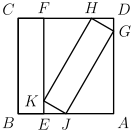
In the figure, is a square of side length The rectangles and are congruent. What is
Pista pequeña:
Sea en el triángulo rectángulo .
Let in right triangle
Pista grande:
A lo largo del lado superior, se simplifica a .
Along the top side, simplifies to
Solución:
Sea y con En el triángulo rectángulo así que
A lo largo del lado Sustituyendo se obtiene
Por lo tanto así que y
Por lo tanto, la respuesta correcta es C.
Let and with In right triangle so
Along side Substituting for gives
Hence so and
Thus, the correct answer is C.
22.
En un pequeño estanque hay once nenúfares en fila, numerados de a Una rana está sentada en el nenúfar Cuando la rana está en el nenúfar saltará al nenúfar con probabilidad y al nenúfar con probabilidad Cada salto es independiente de los saltos anteriores. Si la rana llega al nenúfar será comida por una serpiente que espera pacientemente. Si la rana llega al nenúfar saldrá del estanque para no volver. ¿Cuál es la probabilidad de que la rana escape de ser comida por la serpiente?
In a small pond there are eleven lily pads in a row labeled through A frog is sitting on pad When the frog is on pad it will jump to pad with probability and to pad with probability Each jump is independent of the previous jumps. If the frog reaches pad it will be eaten by a patiently waiting snake. If the frog reaches pad it will exit the pond, never to return. What is the probability that the frog will escape being eaten by the snake?
Pista pequeña:
Por simetría, la probabilidad de escape desde el nenúfar es .
By symmetry the escape probability from pad is
Pista grande:
Sea la probabilidad de escape desde el nenúfar y escribe cada en términos de sus vecinos.
Let be the escape probability from pad and write each in terms of its neighbors
Solución:
Sea la probabilidad de llegar finalmente al nenúfar partiendo del nenúfar Por la simetría de la regla de salto en el centro,
Cada nenúfar interior satisface lo que da
Sea La recurrencia equivale a así que Como y Por lo tanto,
Por lo tanto, la respuesta correcta es C.
Let be the probability of eventually reaching pad starting from pad By the symmetry of the jump rule at the center,
Each interior pad satisfies which gives
Put The recurrence is equivalent to so Since and Therefore
Thus, the correct answer is C.
23.
El número es primo. Sea ¿Cuál es el residuo cuando se divide entre ?
The number is prime. Let What is the remainder when is divided by
Pista pequeña:
Módulo reduce usando y así sucesivamente.
Modulo reduce using and so on
Pista grande:
Esto da y la suma alternada se telescopa.
This gives and the alternating sum telescopes
Solución:
Trabajando módulo la identidad junto con lleva a así que
Entonces
La suma restante es así que
Por lo tanto, la respuesta correcta es C.
Working modulo the identity together with leads to so
Then
The remaining sum is so
Thus, the correct answer is C.
24.
Sea un pentágono inscrito en un círculo tal que y La suma de las longitudes de todas las diagonales de es igual a donde y son enteros positivos primos entre sí. ¿Cuánto vale ?
Let be a pentagon inscribed in a circle such that and The sum of the lengths of all diagonals of is equal to where and are relatively prime positive integers. What is
Pista pequeña:
Cuerdas iguales subtienden arcos iguales, así que llama a esto .
Equal chords subtend equal arcs, so call this
Pista grande:
Aplica el teorema de Ptolomeo a y para obtener ecuaciones en .
Apply Ptolemy’s theorem to and to get equations in
Solución:
Como los arcos son iguales y los arcos son iguales, las cuerdas son todas iguales; sean y
El teorema de Ptolomeo en y da Resolver las dos primeras para y y sustituir en la tercera da
Así que y Las cinco diagonales son que suman
Por lo tanto y la respuesta correcta es D.
Because arcs are equal and arcs are equal, the chords are all equal; let and
Ptolemy’s theorem on and gives Solving the first two for and and substituting into the third yields
So and The five diagonals are summing to
Thus and the correct answer is D.
25.
¿Cuál es la suma de todas las soluciones reales positivas de la ecuación
What is the sum of all positive real solutions to the equation
Pista pequeña:
Sustituye y usa .
Substitute and use
Pista grande:
La ecuación se reduce a lo que obliga a que y sean enteros de la misma paridad.
The equation reduces to forcing and to be integers of the same parity
Solución:
Sea Dividiendo entre y usando la ecuación se simplifica a
Ambos cosenos deben ser iguales a o ambos iguales a así que y son enteros de la misma paridad. Como es par, ambos deben ser pares, así que con un divisor positivo impar de lo que da
Cada uno de esos da así que la suma de las soluciones es
Por lo tanto, la respuesta correcta es D.
Let Dividing by and using the equation simplifies to
Both cosines must equal or both equal so and are integers of the same parity. Since is even, both must be even, so with a positive odd divisor of giving
Each such gives so the sum of solutions is
Thus, the correct answer is D.