
Soluciones del 1971 AMC 12
Desplázate hacia abajo para ver las soluciones preparadas profesionalmente de LIVE by Po-Shen Loh, imprime las soluciones en PDF, consulta la clave de respuestas, o haz el examen cronometrado completo.
Todos los problemas se usan con el permiso legal oficial de la Mathematical Association of America (MAA).
1.
El número de cifras del número es:
The number of digits in the number is:
Pista pequeña:
Empareja tantos factores y como sea posible
Pair as many factors of and as possible
Pista grande:
Reescribe el número como
Rewrite the number as
Solución:
Tenemos y que tiene cifras.
Por lo tanto, la respuesta correcta es B.
We have and which has digits.
Therefore, the correct answer is B.
2.
Si hombres tardan días en colocar ladrillos, entonces el número de días que tardarán hombres, trabajando al mismo ritmo, en colocar ladrillos es:
If men take days to lay bricks, then the number of days it will take men working at the same rate to lay bricks is:
Pista pequeña:
Calcula cuántos ladrillos coloca un hombre en un día
Find the number of bricks laid by one man in one day
Pista grande:
El ritmo es de ladrillos por hombre-día
The rate is bricks per man-day
Solución:
El ritmo es de ladrillos por hombre-día. Por tanto, hombres colocan ladrillos al día, así que colocar ladrillos requiere días.
Por lo tanto, la respuesta correcta es D.
The rate is bricks per man-day. Thus men lay bricks per day, so laying bricks takes days.
Therefore, the correct answer is D.
3.
Si el punto está en la recta que une los puntos y en el plano , entonces es igual a:
If the point lies on the straight line joining the points and in the -plane, then is equal to:
Pista pequeña:
Calcula la pendiente de la recta que pasa por los dos puntos fijos dados
Find the slope through the two given fixed points
Pista grande:
La recta tiene ecuación
The line has equation
Solución:
La pendiente de la recta que pasa por y es así que su ecuación es Al sustituir , se obtiene de donde
Por lo tanto, la respuesta correcta es E.
The slope through and is so the line is Substituting gives hence
Therefore, the correct answer is E.
4.
Después de abonar el interés simple de dos meses a una tasa anual del , una tropa de exploradores tenía un total de en la tesorería del consejo. El interés abonado constaba de cierta cantidad de dólares más el siguiente número de centavos:
After simple interest for two months at per annum was credited, a Boy Scout Troop had a total of in the Council Treasury. The interest credited was a number of dollars plus the following number of cents:
Pista pequeña:
Dos meses son la sexta parte de un año
Two months is one-sixth of a year
Pista grande:
Si es el capital, resuelve
If is the principal, solve
Solución:
Si es el capital, entonces Por tanto, así que el interés es y su parte en centavos es
Por lo tanto, la respuesta correcta es A.
If is the principal, then Hence so the interest is and its cents part is
Therefore, the correct answer is A.
5.
Los puntos y están en la circunferencia mostrada, y las medidas de los arcos y son y respectivamente. La suma de las medidas de los ángulos y es:
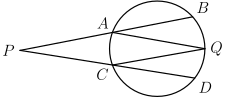
Points and lie on the circle shown, and the measures of arcs and are and respectively. The sum of the measures of angles and is:
Ninguna de estas
None of these
Pista pequeña:
Usa la fórmula del ángulo exterior formado por dos secantes para el ángulo
Use the external-secant formula for angle
Pista grande:
Al sumar el ángulo , se cancela el arco interceptado desconocido
Adding angle cancels the unknown intercepted arc
Solución:
Sea La fórmula del ángulo exterior formado por dos secantes da mientras que el teorema del ángulo inscrito da Por lo tanto,
Por lo tanto, la respuesta correcta es C.
Let The external-secant formula gives while the inscribed-angle theorem gives Therefore
Therefore, the correct answer is C.
6.
Sea un símbolo que denota la siguiente operación binaria en el conjunto de todos los números reales no nulos: para cualesquiera se define ¿Cuál afirmación no es verdadera?
Let be a symbol denoting the binary operation on the set of all nonzero real numbers as follows: for any Which statement is not true?
es conmutativa en
is commutative over
es asociativa en
is associative over
es un elemento identidad para en
is an identity element for in
Todo elemento de tiene un inverso respecto de
Every element of has an inverse for
es un inverso respecto de del elemento de
is an inverse for of the element of
Pista pequeña:
Determina primero la identidad a partir de
First determine the identity from
Pista grande:
Un inverso de debe satisfacer
An inverse of must satisfy
Solución:
La operación es conmutativa y por lo que también es asociativa. Su identidad es El inverso de debe satisfacer así que es no
Por lo tanto, la respuesta correcta es E.
The operation is commutative, and so it is associative. Its identity is The inverse of must satisfy so it is not
Therefore, the correct answer is E.
7.
es igual a:
is equal to:
Pista pequeña:
Factoriza el término con la menor potencia de
Factor out the term with the smallest power of
Pista grande:
Usa
Use
Solución:
Al factorizar se obtiene
Por lo tanto, la respuesta correcta es C.
Factoring gives
Therefore, the correct answer is C.
8.
El conjunto solución de es el conjunto de todos los valores de tales que:
The solution set of is the set of all values of such that:
o
or
o
or
Pista pequeña:
Pasa al lado izquierdo y factoriza
Move to the left and factor
Pista grande:
El producto es negativo entre sus raíces
The product is negative between its roots
Solución:
La desigualdad equivale a Las raíces son y y la cuadrática, que abre hacia arriba, es negativa entre ellas.
Por lo tanto, la respuesta correcta es B.
The inequality is The roots are and and the upward-opening quadratic is negative between them.
Therefore, the correct answer is B.
9.
Una correa sin cruzar se ajusta sin holgura alrededor de dos poleas circulares de radios pulgadas y pulgadas. Si la distancia entre los puntos de contacto de la correa con las poleas es de pulgadas, entonces la distancia, en pulgadas, entre los centros de las poleas es:
An uncrossed belt is fitted without slack around two circular pulleys with radii of inches and inches. If the distance between the points of contact of the belt with the pulleys is inches, then the distance between the centers of the pulleys in inches is:
Pista pequeña:
Une los centros y usa la diferencia de los radios
Join the centers and use the difference of the radii
Pista grande:
La distancia entre los centros es la hipotenusa de un triángulo rectángulo cuyos catetos miden y
The center distance is the hypotenuse of a right triangle with legs and
Solución:
La tangente exterior común y los radios trazados a sus puntos de contacto forman un triángulo rectángulo cuyos catetos miden y Por tanto, la distancia entre los centros es
Por lo tanto, la respuesta correcta es D.
The common external tangent and the radii to its contact points form a right triangle whose legs are and Thus the center distance is
Therefore, the correct answer is D.
10.
Cada una de las chicas de un grupo es rubia o morena y tiene ojos azules o marrones. Si son rubias de ojos azules, son morenas y tienen ojos marrones, entonces el número de morenas de ojos marrones es:
Each of a group of girls is blonde or brunette and is blue-eyed or brown-eyed. If are blue-eyed blondes, are brunettes, and are brown-eyed, then the number of brown-eyed brunettes is:
Pista pequeña:
Calcula primero el número total de rubias
First find the total number of blondes
Pista grande:
Resta las rubias de ojos marrones del total de chicas de ojos marrones
Subtract the brown-eyed blondes from all brown-eyed girls
Solución:
Hay rubias, de las cuales tienen ojos marrones. Por tanto, el número de morenas de ojos marrones es
Por lo tanto, la respuesta correcta es E.
There are blondes, of whom are brown-eyed. Hence the number of brown-eyed brunettes is
Therefore, the correct answer is E.
11.
El numeral en base representa el mismo número que en base Suponiendo que ambas bases son enteros positivos, el menor valor posible de escrito como número romano, es:
The numeral in base represents the same number as in base Assuming both bases are positive integers, the least possible value of written as a Roman numeral, is:
Pista pequeña:
Traduce los numerales a la ecuación
Translate the numerals into
Pista grande:
Ambas bases son mayores que ; resuelve para hallar el menor par válido
Both bases exceed ; solve for the least valid pair
Solución:
La igualdad es o bien Como ambas cifras deben ser válidas, Al reducir módulo , se obtiene El primer valor válido es que da Por tanto, que se escribe
Por lo tanto, la respuesta correcta es D.
The equality is or Since both digits must be valid, Reducing modulo gives The first valid value is which gives Thus written
Therefore, the correct answer is D.
12.
Para cada entero se define que dos enteros positivos son congruentes si dejan el mismo residuo no negativo al dividirlos entre Si y son congruentes en uno de estos sistemas, entonces, en ese mismo sistema, es congruente con:
For each integer define positive integers to be congruent if they leave the same nonnegative remainder when divided by If and are congruent in one such system, then in that same system, is congruent to:
Pista pequeña:
El módulo divide la diferencia de cualesquiera dos enteros congruentes
The modulus divides the difference of any two congruent integers
Pista grande:
Usa las diferencias y
Use the differences and
Solución:
El módulo divide tanto como Como esto obliga a que Entonces
Por lo tanto, la respuesta correcta es B.
The modulus divides both and Since this forces Then
Therefore, the correct answer is B.
13.
Si se evalúa correctamente hasta cifras decimales, entonces la cifra en la quinta posición decimal es:
If is evaluated correct to decimal places, then the digit in the fifth decimal place is:
Pista pequeña:
Escribe
Write
Pista grande:
En el desarrollo binomial, conserva los términos suficientemente grandes para afectar la quinta cifra decimal
In the binomial expansion, retain terms large enough to affect the fifth decimal place
Solución:
El desarrollo binomial da que se redondea a La quinta cifra decimal es
Por lo tanto, la respuesta correcta es E.
The binomial expansion gives which rounds to The fifth decimal digit is
Therefore, the correct answer is E.
14.
El número es divisible exactamente por dos números comprendidos entre y Estos números son:
The number is exactly divisible by two numbers between and These numbers are:
Pista pequeña:
Usa que divide a siempre que sea divisible por
Use the fact that divides whenever is divisible by
Pista grande:
Reconoce que y que es divisible por
Recognize and that is divisible by
Solución:
Como es divisible por el número es divisible por Además, y es divisible por por lo que es divisible por Así, los dos números son y
Por lo tanto, la respuesta correcta es C.
Because is divisible by the number is divisible by Also and is divisible by so is divisible by Thus the two numbers are and
Therefore, the correct answer is C.
15.
Un acuario sobre una mesa horizontal tiene caras rectangulares, mide pulgadas de ancho y pulgadas de alto. Al inclinarlo, el agua cubría exactamente un extremo de pulgadas por pulgadas, pero solo tres cuartos del fondo rectangular. La profundidad del agua cuando el fondo volvió a quedar horizontal era:
An aquarium on a level table has rectangular faces and is inches wide and inches high. When it was tilted, the water in it just covered an -inch by -inch end but only three-fourths of the rectangular bottom. The depth of the water when the bottom was again made level was:
pulgadas
inches
pulgadas
inches
pulgadas
inches
pulgadas
inches
pulgadas
inches
Pista pequeña:
Compara el volumen de agua en las posiciones inclinada y horizontal
Compare the water volume in the tilted and level positions
Pista grande:
La sección lateral inclinada es un triángulo de altura y base igual a tres cuartos de la longitud del acuario
The tilted side view is a triangle with height and base three-fourths of the aquarium length
Solución:
Sea la longitud del acuario y la profundidad del agua cuando está horizontal. En la posición inclinada, la sección longitudinal del agua es un triángulo de base y altura Por tanto, de modo que pulgadas.
Por lo tanto, la respuesta correcta es B.
Let the aquarium length be and the level-water depth be In the tilted position the longitudinal cross-section of the water is a triangle with base and height Therefore so inches.
Therefore, the correct answer is B.
16.
Después de calcular el promedio de puntuaciones, un estudiante incluyó por descuido ese promedio junto con las puntuaciones y calculó el promedio de estos números. La razón del segundo promedio al promedio verdadero era:
After finding the average of scores, a student carelessly included the average with the scores and found the average of these numbers. The ratio of the second average to the true average was:
Ninguna de estas
None of these
Pista pequeña:
Llama al promedio original
Call the original average
Pista grande:
La suma original es , y el número añadido también es
The original sum is , and the extra number is also
Solución:
Si el promedio verdadero es entonces la suma original es Al incluir el propio , se obtiene una suma de entre números, de modo que el nuevo promedio sigue siendo La razón es
Por lo tanto, la respuesta correcta es A.
If the true average is then the original sum is Including itself gives a sum of over numbers, so the new average is still The ratio is
Therefore, the correct answer is A.
17.
Un disco circular se divide mediante radios igualmente espaciados y una recta secante. El número máximo de regiones no superpuestas en que puede dividirse el disco es:
A circular disk is divided by equally spaced radii and one secant line. The maximum number of nonoverlapping areas into which the disk can be divided is:
Pista pequeña:
Comienza con los sectores formados por los radios
Begin with the sectors made by the radii
Pista grande:
Una secante puede cortar como máximo radios; cuenta después los segmentos de la cuerda secante
A secant can cross at most of the radii, so count the pieces of the secant chord
Solución:
Los radios forman primero sectores. Una secante que no pase por el centro puede cortar como máximo un radio de cada uno de los pares opuestos, y por tanto como máximo radios. Esas intersecciones dividen la cuerda secante en segmentos, cada uno de los cuales añade una región. El máximo es, por tanto,
Por lo tanto, la respuesta correcta es E.
The radii first make sectors. A secant not through the center can meet at most one radius in each of opposite pairs, hence at most radii. Those intersections divide the secant chord into pieces, each of which adds one region. The maximum is therefore
Therefore, the correct answer is E.
18.
La corriente de un río fluye uniformemente a millas por hora. Una lancha que viaja a velocidad constante en aguas quietas recorre millas río abajo y luego regresa al punto de partida. El viaje dura una hora, sin contar el tiempo de giro. La razón entre la velocidad río abajo y la velocidad río arriba es:
The current in a river flows steadily at miles per hour. A motorboat traveling at a constant rate in still water goes downstream miles and then returns to its starting point. The trip takes one hour, excluding turning time. The ratio of the downstream rate to the upstream rate is:
Pista pequeña:
Sea la velocidad de la lancha en aguas quietas
Let be the boat’s still-water speed
Pista grande:
Resuelve
Solve
Solución:
Si es la velocidad en aguas quietas, entonces Esto se simplifica a cuya solución positiva admisible es Las velocidades río abajo y río arriba son y cuya razón es
Por lo tanto, la respuesta correcta es D.
If is the still-water speed, then This simplifies to so the positive admissible solution is The downstream and upstream rates are and whose ratio is
Therefore, the correct answer is D.
19.
Si la recta corta a la elipse exactamente una vez, entonces el valor de es:
If the line intersects the ellipse exactly once, then the value of is:
Pista pequeña:
Sustituye la ecuación de la recta en la de la elipse
Substitute the line equation into the ellipse
Pista grande:
Una sola intersección significa que el discriminante de la cuadrática resultante es cero
Exactly one intersection means the resulting quadratic has discriminant zero
Solución:
La sustitución da La tangencia exige que el discriminante sea cero: Por tanto, y así
Por lo tanto, la respuesta correcta es C.
Substitution gives Tangency requires its discriminant to vanish: Thus so
Therefore, the correct answer is C.
20.
La suma de los cuadrados de las raíces de la ecuación es El valor absoluto de es igual a:
The sum of the squares of the roots of the equation is The absolute value of is equal to:
Ninguna de estas
None of these
Pista pequeña:
Usa la suma y el producto de las dos raíces
Use the sum and product of the two roots
Pista grande:
Si las raíces son entonces y
If the roots are then and
Solución:
Para las raíces las fórmulas de Vieta dan y Por tanto, Así, que no aparece entre las opciones A-D porque la opción A es
Por lo tanto, la respuesta correcta es E.
For roots Vieta’s formulas give and Hence Therefore which is not among choices A-D because choice A is
Therefore, the correct answer is E.
21.
Si entonces es igual a:
If then is equal to:
Pista pequeña:
Deshaz cada logaritmo desde el exterior hacia el interior
Undo each logarithm from the outside inward
Pista grande:
Para la primera cadena, los valores interiores sucesivos son y luego
For the first chain, the successive inner values are and then
Solución:
Al deshacer los logaritmos desde el exterior hacia el interior se obtiene Por tanto,
Por lo tanto, la respuesta correcta es C.
Undoing the logarithms from the outside inward gives Therefore
Therefore, the correct answer is C.
22.
Si es una de las raíces imaginarias de entonces es igual a:
If is one of the imaginary roots of then is equal to:
Pista pequeña:
Usa
Use
Pista grande:
Sustituye por y por
Replace by and by
Solución:
Como y tenemos Por tanto, Su producto es
Por lo tanto, la respuesta correcta es A.
Because and we have Thus Their product is
Therefore, the correct answer is A.
23.
Los equipos y disputan una serie de partidos. Si ambos equipos tienen la misma probabilidad de ganar cada partido, y el equipo debe ganar dos partidos mientras que el equipo debe ganar tres para llevarse la serie, entonces las probabilidades a favor de que el equipo gane la serie son:
Teams and are playing a series of games. If either team has an equal chance to win any game, and Team must win two games while Team must win three games to win the series, then the odds favoring Team to win the series are:
a
to
a
to
a
to
a
to
a
to
Pista pequeña:
Es más breve enumerar las maneras en que el equipo puede perder
It is shorter to enumerate the ways Team can lose
Pista grande:
Antes de la segunda victoria de , puede terminar con BBB, ABBB, BABB o BBAB
Before ’s second win, can finish as BBB, ABBB, BABB, or BBAB
Solución:
El equipo pierde en las secuencias BBB, ABBB, BABB y BBAB. Su probabilidad total es Por tanto, el equipo gana con probabilidad así que las probabilidades a su favor son
Por lo tanto, la respuesta correcta es A.
Team loses in the sequences BBB, ABBB, BABB, and BBAB. Their total probability is Thus Team wins with probability so the odds in its favor are
Therefore, the correct answer is A.
24.
El triángulo de Pascal es un arreglo de enteros positivos, mostrado abajo, en el que la primera fila es la segunda fila contiene dos , cada fila comienza y termina con y cada otra entrada es la suma de las dos entradas situadas encima.
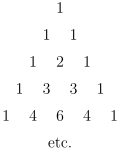
El cociente entre el número de entradas de las primeras filas que no son y el número de entradas que sí son es:
Pascal’s triangle is an array of positive integers, shown below, in which the first row is the second row is two ’s, each row begins and ends with and each other entry is the sum of the two entries above it.
The quotient of the number of entries in the first rows which are not ’s and the number of ’s is:
Ninguna de estas
None of these
Pista pequeña:
Cuenta todas las entradas y resta después los de la frontera
Count all entries and then subtract the boundary ’s
Pista grande:
Las primeras filas contienen entradas y valores en la frontera
The first rows contain entries and boundary ’s
Solución:
Las primeras filas contienen entradas. Hay valores en la frontera, así que el número de las demás entradas es Al dividir entre , se obtiene
Por lo tanto, la respuesta correcta es D.
The first rows contain entries. There are boundary ’s, so the number of other entries is Dividing by gives
Therefore, the correct answer is D.
25.
Un adolescente escribió su edad después de la de su padre. De este nuevo número de cuatro cifras restó el valor absoluto de la diferencia entre sus edades y obtuvo La suma de sus edades era:
A teenage boy wrote his own age after his father’s. From this new four-place number, he subtracted the absolute value of the difference of their ages to get The sum of their ages was:
Pista pequeña:
Sea la edad del padre y la del muchacho
Let the father’s age be and the boy’s age be
Pista grande:
El número concatenado es , así que usa
The concatenated number is , so use
Solución:
Sean y las edades del padre y del muchacho. Como El muchacho es adolescente, así que Al reducir módulo , se obtiene de donde Entonces y
Por lo tanto, la respuesta correcta es D.
Let the father and boy be and years old. Since The boy is a teenager, so Reducing modulo gives hence Then and
Therefore, the correct answer is D.
26.
En el triángulo el punto divide el lado en la razón Sea el punto donde el lado corta a siendo el punto medio de Entonces divide en la razón:
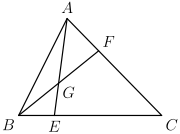
In triangle point divides side in the ratio Let be the point where side meets where is the midpoint of Then divides in the ratio:
Pista pequeña:
Asigna masas a los extremos de modo que
Assign endpoint masses so that
Pista grande:
La condición de punto medio hace iguales las masas en y
The midpoint condition makes the masses at and equal
Solución:
Usa puntos de masa. Como asigna masas y a y de modo que la masa en sea Puesto que es el punto medio de la masa en también es Por tanto,
Por lo tanto, la respuesta correcta es B.
Use mass points. Since assign masses and to and so the mass at is Because is the midpoint of the mass at is also Therefore
Therefore, the correct answer is B.
27.
Una caja contiene fichas, cada una de las cuales es roja, blanca o azul. El número de fichas azules es al menos la mitad del número de fichas blancas y como máximo un tercio del número de fichas rojas. El número de fichas blancas o azules es al menos El número mínimo de fichas rojas es:
A box contains chips, each of which is red, white, or blue. The number of blue chips is at least half the number of white chips and at most one-third the number of red chips. The number which are white or blue is at least The minimum number of red chips is:
Pista pequeña:
Sean las cantidades y traduce cada condición a una desigualdad
Let the counts be and translate every condition into an inequality
Pista grande:
A partir de y , halla el menor entero posible
From and , find the least possible integer
Solución:
Sean las cantidades. Las condiciones dan Por tanto, así que y La igualdad es posible con por lo que el mínimo es
Por lo tanto, la respuesta correcta es E.
Let the counts be The conditions give Hence so and Equality is possible with so the minimum is
Therefore, the correct answer is E.
28.
Nueve rectas paralelas a la base de un triángulo dividen cada uno de los otros lados en segmentos iguales y el área en partes distintas. Si el área de la mayor de estas partes es entonces el área del triángulo original es:
Nine lines parallel to the base of a triangle divide the other sides each into equal segments and the area into distinct parts. If the area of the largest of these parts is then the area of the original triangle is:
Pista pequeña:
La parte mayor es la franja inferior
The largest part is the bottom strip
Pista grande:
El triángulo menor situado sobre esa franja tiene factor de escala lineal
The smaller triangle above that strip has linear scale
Solución:
Si el área total es el triángulo situado sobre la franja inferior es semejante al original con factor de escala por lo que su área es Así, la franja mayor tiene área lo que da
Por lo tanto, la respuesta correcta es C.
If the whole area is the triangle above the bottom strip is similar to the original with scale so its area is Thus the largest strip has area giving
Therefore, the correct answer is C.
29.
Dada la progresión el menor entero positivo tal que el producto de los primeros términos excede es:
Given the progression the least positive integer such that the product of the first terms exceeds is:
Pista pequeña:
Suma los exponentes al multiplicar los términos
Add the exponents when multiplying the terms
Pista grande:
Exige , teniendo en cuenta que la igualdad no basta
Require , noting that equality is not enough
Solución:
El producto es Excede exactamente cuando Para hay igualdad, mientras que sí funciona.
Por lo tanto, la respuesta correcta es E.
The product is It exceeds exactly when For there is equality, while works.
Therefore, the correct answer is E.
30.
Dada la transformación fraccionaria lineal define para Suponiendo que se deduce que es igual a:
Given the linear fractional transformation define for Assuming it follows that is equal to:
Ninguna de estas
None of these
Pista pequeña:
Cancela cinco iteraciones componiendo con la transformación inversa
Cancel five iterates by composing with the inverse transformation
Pista grande:
Si , entonces una vez que es la identidad
If , then once is the identity
Solución:
La transformación es invertible. A partir de al componer con se ve que es la identidad. Al despejar en , se obtiene Como las iteraciones tienen período La composición directa da
Por lo tanto, la respuesta correcta es D.
The transformation is invertible. From composing with shows that is the identity. Solving for gives Since iterates have period Direct composition gives
Therefore, the correct answer is D.
31.
El cuadrilátero está inscrito en una circunferencia y el lado es un diámetro de longitud Si los lados y tienen longitud entonces el lado tiene longitud:
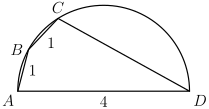
Quadrilateral is inscribed in a circle with side a diameter of length If sides and each have length then side has length:
Pista pequeña:
Las cuerdas iguales y subtienden ángulos centrales iguales
Equal chords and subtend equal central angles
Pista grande:
Si la mitad de cualquiera de esos ángulos centrales es , entonces y
If half of either central angle is , then and
Solución:
La circunferencia tiene radio Sean los ángulos centrales subtendidos por las cuerdas iguales y . Entonces por lo que El ángulo central restante desde hasta a lo largo del semicírculo es y por tanto
Por lo tanto, la respuesta correcta es A.
The circle has radius Let the central angles subtending the equal chords and each be Then so The remaining central angle from to along the semicircle is hence
Therefore, the correct answer is A.
32.
Si entonces es igual a:
If then is equal to:
Pista pequeña:
Sea
Set
Pista grande:
Aplica repetidamente la identidad de diferencia de cuadrados hasta el factor
Apply the difference-of-squares identity repeatedly through the factor
Solución:
Sea Entonces Por tanto,
Por lo tanto, la respuesta correcta es A.
Let Then Therefore
Therefore, the correct answer is A.
33.
Si es el producto de cantidades en progresión geométrica, es su suma y es la suma de sus recíprocos, entonces , en términos de y , es:
If is the product of quantities in geometric progression, their sum, and the sum of their reciprocals, then in terms of and is:
Pista pequeña:
Escribe la progresión como
Write the progression as
Pista grande:
Demuestra que , cuya potencia es el producto
Show that , whose power is the product
Solución:
Escribe los términos como Al invertir el orden de la suma de los recíprocos se obtiene de modo que Por otra parte,
Por lo tanto, la respuesta correcta es B.
Write the terms as Reversing the reciprocal sum gives so Meanwhile
Therefore, the correct answer is B.
34.
Un reloj común de una fábrica se atrasa de tal modo que el minutero alcanza a la manecilla de las horas en las posiciones habituales de la esfera (las , etc.), pero solo cada minutos. Con pago de tiempo y medio por horas extra, el pago adicional que le corresponde a un trabajador que gana por hora después de completar una jornada normal de horas según ese reloj atrasado es:
An ordinary clock in a factory is running slow so that the minute hand passes the hour hand at the usual dial positions ( o’clock, etc.) but only every minutes. At time and one-half for overtime, the extra pay to which a -per-hour worker should be entitled after working a normal -hour day by that slow-running clock is:
Pista pequeña:
Las manecillas de un reloj normal se superponen cada minutos
A normal clock’s hands pass every minutes
Pista grande:
Once intervalos del reloj atrasado suman horas indicadas, pero horas y minutos de tiempo real
Eleven slow-clock intervals total displayed hours but hours minutes of real time
Solución:
Las superposiciones sucesivas de las manecillas están separadas por minutos reales, mientras que este reloj atrasado indica minutos entre ellas. Así, horas indicadas corresponden a minutos reales, pues Por tanto, ocho horas indicadas duran horas y minutos, de modo que hay minutos de tiempo extra. A por hora, corresponden
Por lo tanto, la respuesta correcta es B.
Successive hand-overlaps are real minutes apart, while this slow clock displays minutes between them. Thus displayed hours correspond to real minutes, since Eight displayed hours therefore take hours minutes, so the overtime is minutes. At per hour, that pays
Therefore, the correct answer is B.
35.
Cada círculo de una sucesión infinita de radios decrecientes es tangente exteriormente al círculo siguiente y a ambos lados de un ángulo recto dado. La razón del área del primer círculo a la suma de las áreas de todos los demás círculos de la sucesión es:
Each circle in an infinite sequence with decreasing radii is tangent externally to the one following it and to both sides of a given right angle. The ratio of the area of the first circle to the sum of the areas of all the other circles in the sequence is:
Pista pequeña:
Los centros están en la bisectriz del ángulo; halla la razón entre radios consecutivos
The centers lie on the angle bisector; find the ratio of consecutive radii
Pista grande:
La razón de radios es , así que la razón de áreas es su cuadrado
The radius ratio is , so the area ratio is its square
Solución:
Si los radios consecutivos son sus centros están en la bisectriz del ángulo a distancias y del vértice. La tangencia exterior da por lo que La razón de áreas consecutivas es Por tanto, el área del primer círculo dividida entre la suma de todas las áreas posteriores es
Por lo tanto, la respuesta correcta es C.
If consecutive radii are their centers lie on the angle bisector at distances and from the vertex. External tangency gives so The ratio of successive areas is Therefore the first area divided by the sum of all later areas is
Therefore, the correct answer is C.