
Soluciones del 2009 AIME II
Desplázate hacia abajo para ver las soluciones preparadas profesionalmente de LIVE by Po-Shen Loh, imprime las soluciones en PDF, consulta la clave de respuestas, o haz el examen cronometrado completo.
Todos los problemas se usan con el permiso legal oficial de la Mathematical Association of America (MAA).
1.
Antes de empezar a pintar, Bill tenía onzas de pintura azul, onzas de pintura roja y onzas de pintura blanca. Bill pintó cuatro franjas del mismo tamaño en una pared: una franja azul, una roja, una blanca y una rosada. El rosado es una mezcla de rojo y blanco, no necesariamente en cantidades iguales. Cuando Bill terminó, le quedaban cantidades iguales de pintura azul, roja y blanca. Halla el número total de onzas de pintura que le quedaron a Bill.
Before starting to paint, Bill had ounces of blue paint, ounces of red paint, and ounces of white paint. Bill painted four equally sized stripes on a wall, making a blue stripe, a red stripe, a white stripe, and a pink stripe. Pink is a mixture of red and white, not necessarily in equal amounts. When Bill finished, he had equal amounts of blue, red, and white paint left. Find the total number of ounces of paint Bill had left.
Pista pequeña:
Que sobren cantidades iguales significa que la pintura roja usada supera a la azul en y de forma similar para la blanca
Equal leftovers mean the red used exceeds the blue used by and similarly for white
Pista grande:
Todos esos excesos fueron a parar a la franja rosada, así que la pintura de una franja es onzas
Those excesses all went into the pink stripe, so one stripe’s worth of paint is ounces
Solución:
Supongamos que cada franja usó onzas de pintura. El azul se usó solo en la franja azul, así que se usaron onzas de azul. Como las tres cantidades sobrantes son iguales y los colores partían con y onzas de diferencia, el uso de rojo superó al de azul en onzas y el uso de blanco superó al de azul en onzas. Ese rojo y blanco adicionales se usaron exactamente en la franja rosada, así que
Por lo tanto, a Bill le quedaron onzas de cada color, para un total de onzas.
Say each stripe used ounces of paint. Blue was used only on the blue stripe, so ounces of blue were used. Since the three leftovers are equal and the colors started and ounces apart, red use exceeded blue use by ounces and white use exceeded blue use by ounces. That extra red and white is exactly the pink stripe, so
Bill therefore had ounces of each color left, for a total of ounces.
2.
Supongamos que y son números reales positivos tales que y Halla
Suppose that and are positive real numbers such that and Find
Pista pequeña:
Escribe como
Write as
Pista grande:
Trata los otros dos términos de la misma manera.
Handle the other two terms the same way.
Solución:
Por la regla de la potencia de una potencia,
De la misma manera, y
La suma es
By the power rule for exponents,
In the same way, and
The sum is
3.
En el rectángulo Sea el punto medio de Dado que la recta y la recta son perpendiculares, halla el mayor entero menor que
In rectangle Let be the midpoint of Given that line and line are perpendicular, find the greatest integer less than
Pista pequeña:
Coloca coordenadas: de modo que y
Place coordinates: so and
Pista grande:
Las rectas perpendiculares tienen pendientes cuyo producto es
Perpendicular lines have slopes whose product is
Solución:
Sea y coloca de modo que La recta tiene pendiente y la recta tiene pendiente La perpendicularidad da así que y
El mayor entero menor que es
Let and place so Line has slope and line has slope Perpendicularity gives so and
The greatest integer less than is
4.
Un grupo de niños celebró un concurso de comer uvas. Cuando terminó el concurso, el ganador había comido uvas, y el niño en el -ésimo lugar había comido uvas. El número total de uvas comidas en el concurso fue Halla el menor valor posible de
A group of children held a grape-eating contest. When the contest was over, the winner had eaten grapes, and the child in th place had eaten grapes. The total number of grapes eaten in the contest was Find the smallest possible value of
Pista pequeña:
Con niños, las cantidades de uvas forman una progresión aritmética, y el total es
With children the grape counts are an arithmetic sequence, and the total is
Pista grande:
El niño en último lugar comió uvas; comprueba qué divisores de sobreviven a esa condición
The last-place child ate grapes; check which divisors of survive that condition
Solución:
Sea el número de niños. Las cantidades de uvas forman una progresión aritmética, así que el total es por el promedio del primer y último término: Por lo tanto es divisible por y
El niño en último lugar comió uvas, lo que obliga a descartando y Los divisores restantes dan para para y para
El menor valor posible es
Let be the number of children. The grape counts form an arithmetic sequence, so the total is times the average of the first and last terms: Thus is divisible by and
The last-place child ate grapes, which forces ruling out and The remaining divisors give for for and for
The smallest possible value is
5.
El triángulo equilátero está inscrito en el círculo que tiene radio El círculo de radio es tangente interiormente al círculo en un vértice de Los círculos y ambos de radio son tangentes interiormente al círculo en los otros dos vértices de Los círculos y son todos tangentes exteriormente al círculo que tiene radio donde y son enteros positivos primos entre sí. Halla
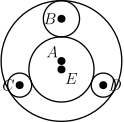
Equilateral triangle is inscribed in circle which has radius Circle with radius is internally tangent to circle at one vertex of Circles and both with radius are internally tangent to circle at the other two vertices of Circles and are all externally tangent to circle which has radius where and are relatively prime positive integers. Find
Pista pequeña:
Los centros de los círculos tangentes interiormente están sobre los radios del círculo coloca el centro de en el origen con el vértice del radio arriba
Centers of internally tangent circles lie along radii of circle put the center of at the origin with the radius- vertex on top
Pista grande:
Por simetría, el centro de está sobre el eje vertical. La tangencia con lo coloca a la altura luego la tangencia con da una ecuación en
By symmetry ’s center is on the vertical axis. Tangency to puts it at height then tangency to gives an equation in
Solución:
Coloca el centro del círculo en el origen con los vértices del triángulo en y Un círculo tangente interiormente a en un vértice tiene su centro sobre el radio hacia ese vértice, así que el círculo tiene centro y los círculos y tienen centros (a distancia del origen).
Por simetría, el centro del círculo de radio está sobre el eje en La tangencia exterior con da así que La tangencia exterior con da es decir, que se simplifica a así que
Entonces
Place the center of circle at the origin with the triangle’s vertices at and A circle internally tangent to at a vertex has its center on the radius to that vertex, so circle has center and circles and have centers (at distance from the origin).
By symmetry the center of circle of radius lies on the -axis at External tangency to gives so External tangency to gives that is, which simplifies to so
Then
6.
Sea el número de subconjuntos de cinco elementos que se pueden elegir del conjunto de los primeros números naturales de modo que al menos dos de los cinco números sean consecutivos. Halla el residuo cuando se divide entre
Let be the number of five-element subsets that can be chosen from the set of the first natural numbers so that at least two of the five numbers are consecutive. Find the remainder when is divided by
Pista pequeña:
Cuenta el complemento: los subconjuntos de cinco elementos sin dos números consecutivos
Count the complement: five-element subsets with no two consecutive numbers
Pista grande:
Restar a los cinco números en orden creciente hace corresponder los subconjuntos sin dos consecutivos de con subconjuntos arbitrarios de
Subtracting from the five numbers in increasing order matches no-two-consecutive subsets of with arbitrary subsets of
Solución:
Cuenta el complemento: subconjuntos sin dos consecutivos. Al poner cada subconjunto de este tipo se convierte en cinco números distintos en y esta correspondencia es reversible, así que hay subconjuntos sin dos números consecutivos.
Por lo tanto y el residuo al dividir entre es
Count the complement: subsets with no two consecutive. Setting turns each such subset into five distinct numbers in and this map is reversible, so there are subsets with no two consecutive numbers.
Therefore and the remainder upon division by is
7.
Define como para impar y para par. Cuando se expresa como una fracción en su mínima expresión, su denominador es con impar. Halla
Define to be for odd and for even. When is expressed as a fraction in lowest terms, its denominator is with odd. Find
Pista pequeña:
y como es un entero, todos los factores impares de se cancelan dentro de
and since is an integer, all odd factors of cancel into
Pista grande:
El término en su mínima expresión tiene denominador siendo el exponente de en Estos crecen estrictamente, así que el último término manda.
Term in lowest terms has denominator the exponent of in These strictly increase, so the last term controls.
Solución:
El -ésimo término es con numerador impar, y Como es un entero, toda potencia de primo impar que divide a también divide a Por lo tanto, en su mínima expresión el -ésimo término tiene denominador exactamente donde y es el exponente de en Los crecen estrictamente, así que sobre el común denominador todo término salvo el último aporta un numerador par mientras que el último aporta uno impar. La suma en su mínima expresión tiene por lo tanto denominador exactamente así que
Por la fórmula de Legendre, así que Entonces
The th term is with odd numerator, and Because is an integer, every odd prime power dividing also divides Hence in lowest terms the th term has denominator exactly where and is the exponent of in The strictly increase, so over the common denominator every term except the last contributes an even numerator while the last contributes an odd one. The sum in lowest terms therefore has denominator exactly so
By Legendre’s formula, so Then
8.
Dave lanza un dado justo de seis caras hasta que aparece un seis por primera vez. De forma independiente, Linda lanza un dado justo de seis caras hasta que aparece un seis por primera vez. Sean y enteros positivos primos entre sí tales que es la probabilidad de que el número de veces que Dave lanza su dado sea igual al número de veces que Linda lanza el suyo o difiera de él a lo sumo en uno. Halla
Dave rolls a fair six-sided die until a six appears for the first time. Independently, Linda rolls a fair six-sided die until a six appears for the first time. Let and be relatively prime positive integers such that is the probability that the number of times Dave rolls his die is equal to or within one of the number of times Linda rolls her die. Find
Pista pequeña:
La probabilidad de que el primer seis aparezca en el lanzamiento es
The chance the first six appears on roll is
Pista grande:
Calcula para un empate y para una diferencia de uno; ambas son series geométricas de razón
Compute for a tie and for a difference of one; both are geometric series with ratio
Solución:
La probabilidad de que el primer seis de un jugador aparezca en el lanzamiento es La probabilidad de un empate es
La probabilidad de que Linda necesite exactamente un lanzamiento más que Dave es y por simetría lo mismo vale intercambiando los jugadores.
La probabilidad total es así que
The probability that a player’s first six appears on roll is The probability of a tie is
The probability that Linda needs exactly one more roll than Dave is and by symmetry the same holds with the players swapped.
The total probability is so
9.
Sea el número de soluciones en enteros positivos de la ecuación y sea el número de soluciones en enteros positivos de la ecuación Halla el residuo cuando se divide entre
Let be the number of solutions in positive integers to the equation and let be the number of solutions in positive integers to the equation Find the remainder when is divided by
Pista pequeña:
Restar a cada variable hace corresponder las soluciones positivas de la ecuación con las soluciones no negativas de la ecuación , ya que
Subtracting from each variable matches positive solutions of the equation with nonnegative solutions of the equation, since
Pista grande:
Así que cuenta las soluciones no negativas de en las que alguna variable es Cuenta los tres casos y corrige el doble conteo.
So counts nonnegative solutions of in which some variable is Count the three cases and correct for double counting.
Solución:
Si es una solución positiva de entonces es una solución no negativa de y recíprocamente, ya que Así que es igual al número de soluciones no negativas de y cuenta las soluciones no negativas de esa ecuación en las que al menos una variable es
Si obliga a que sea par, dando soluciones. Si con da Si obliga a dando Las soluciones y se cuentan dos veces cada una, así que
El residuo al dividir entre es
If is a positive solution of then is a nonnegative solution of and conversely, since So equals the number of nonnegative solutions of and counts the nonnegative solutions of that equation in which at least one variable is
If forces even, giving solutions. If with gives If forces giving The solutions and are each counted twice, so
The remainder upon division by is
10.
Cuatro faros están ubicados en los puntos y El faro en está a kilómetros del faro en el faro en está a kilómetros del faro en y el faro en está a kilómetros del faro en Para un observador en el ángulo determinado por las luces en y y el ángulo determinado por las luces en y son iguales. Para un observador en el ángulo determinado por las luces en y y el ángulo determinado por las luces en y son iguales. El número de kilómetros de a está dado por donde y son enteros positivos primos entre sí, y no es divisible por el cuadrado de ningún primo. Halla
Four lighthouses are located at points and The lighthouse at is kilometers from the lighthouse at the lighthouse at is kilometers from the lighthouse at and the lighthouse at is kilometers from the lighthouse at To an observer at the angle determined by the lights at and and the angle determined by the lights at and are equal. To an observer at the angle determined by the lights at and and the angle determined by the lights at and are equal. The number of kilometers from to is given by where and are relatively prime positive integers, and is not divisible by the square of any prime. Find
Pista pequeña:
El triángulo tiene un ángulo recto en Las condiciones dicen que biseca el ángulo y que biseca el ángulo
The triangle is right-angled at The conditions say bisects angle and bisects angle
Pista grande:
Con el rayo es el reflejo del rayo respecto a la recta vertical así que llega a y
With ray is the mirror of ray over the vertical line so it hits and
Solución:
Como el ángulo es recto. Coloca La condición en dice que así que está sobre la bisectriz del ángulo Usando la fórmula del ángulo mitad con así que está sobre la recta
La condición en dice que biseca el ángulo así que el rayo es la reflexión del rayo respecto a la recta que es la recta vertical La reflexión de es así que está sobre la recta que pasa por y a saber,
Resolviendo y se obtiene Entonces así que
Since angle is right. Place The condition at says so lies on the bisector of angle Using the half-angle formula with so lies on the line
The condition at says bisects angle so ray is the reflection of ray over line which is the vertical line The reflection of is so lies on the line through and namely
Solving and gives Then so
11.
Para ciertos pares de enteros positivos con hay exactamente enteros positivos distintos tales que Halla la suma de todos los valores posibles del producto
For certain pairs of positive integers with there are exactly distinct positive integers such that Find the sum of all possible values of the product
Pista pequeña:
La desigualdad dice exactamente que
The inequality says exactly that
Pista grande:
Escribe con la cantidad de tales es así que deja solo unos pocos casos
Write with the count of such is so leaves only a few cases
Solución:
La desigualdad es equivalente a Escribe con como (para ningún funciona), Los enteros en el intervalo son así que hay de ellos, es decir, o
Para el lado izquierdo es al menos así que Comprobando cada caso, solo funcionan (así que ) y (así que ). Estos dan y en efecto, y contienen cada uno exactamente enteros.
La suma de todos los valores posibles de es
The inequality is equivalent to Write with since (for no works), The integers in the interval are so there are of them, that is, or
For the left side is at least so Checking each case, only (so ) and (so ) work. These give and indeed and each contain exactly integers.
The sum of all possible values of is
12.
Del conjunto de enteros elige pares con de modo que no haya dos pares con un elemento común. Supón que todas las sumas son distintas y menores o iguales que Halla el máximo valor posible de
From the set of integers choose pairs with so that no two pairs have a common element. Suppose that all the sums are distinct and less than or equal to Find the maximum possible value of
Pista pequeña:
Suma las sumas de dos maneras: los elementos son distintos, así que el total es al menos
Add up all sums in two ways: the elements are distinct, so the total is at least
Pista grande:
Las sumas son enteros distintos a lo sumo así que el total es a lo sumo Compara las cotas y luego construye un emparejamiento que alcance el resultante.
The sums are distinct integers at most so the total is at most Compare the bounds, then build a pairing that achieves the resulting
Solución:
Sea Los elementos elegidos son enteros positivos distintos, así que Las sumas son enteros distintos a lo sumo así que Combinando, así que
Para alcanzar toma los pares para cuyas sumas son los números pares junto con los pares para cuyas sumas son los números impares Los elementos usados son del al y del al , sin repeticiones, y las sumas son todas distintas y a lo sumo
El máximo es
Let The chosen elements are distinct positive integers, so The sums are distinct integers at most so Combining, so
To achieve take the pairs for whose sums are the even numbers together with the pairs for whose sums are the odd numbers The elements used are – – with no repeats, and all sums are distinct and at most
The maximum is
13.
Sean y los extremos de un arco semicircular de radio El arco se divide en siete arcos congruentes por seis puntos igualmente espaciados Se dibujan todas las cuerdas de la forma o . Sea el producto de las longitudes de estas doce cuerdas. Halla el residuo cuando se divide entre
Let and be the endpoints of a semicircular arc of radius The arc is divided into seven congruent arcs by six equally spaced points All chords of the form or are drawn. Let be the product of the lengths of these twelve chords. Find the remainder when is divided by
Pista pequeña:
Modela el círculo en el plano complejo con y donde
Model the circle in the complex plane with and where
Pista grande:
y los son exactamente las raíces -ésimas no triviales de la unidad, cuyo producto de distancias a es
and the are exactly the nontrivial th roots of unity, whose product of distances to is
Solución:
Coloca el círculo en el plano complejo con centro y para donde Entonces y así que
A medida que recorre los números recorren las seis raíces -ésimas no triviales de la unidad. Sea Como al sustituir se obtiene Por lo tanto
El residuo cuando se divide entre es
Put the circle in the complex plane with center and for where Then and so
As runs over the numbers run over all six nontrivial th roots of unity. Let Since plugging in gives Therefore
The remainder when is divided by is
14.
La sucesión satisface y para Halla el mayor entero menor o igual que
The sequence satisfies and for Find the greatest integer less than or equal to
Pista pequeña:
Prueba entonces y la recursión es la suma de ángulos con
Try then and the recursion is angle addition with
Pista grande:
Como el ángulo sube hasta cuyo coseno es negativo, y luego oscila entre y
Since the angle climbs to whose cosine is negative, and then oscillates between and
Solución:
Escribe con así que Sea de modo que La recursión se convierte en con el signo más cuando y el signo menos cuando
Como tenemos Los ángulos tienen coseno positivo, así que la sucesión de ángulos avanza Pero tiene coseno negativo, así que y de ahí en adelante el ángulo alterna entre y En particular para todo entero par
Como así que la respuesta es
Write with so Let so The recursion becomes with the plus sign when and the minus sign when
Since we have The angles have positive cosine, so the sequence of angles runs But has negative cosine, so and from then on the angle alternates between and In particular for every even
With so the answer is
15.
Sea un diámetro de un círculo de diámetro Sean y puntos en uno de los arcos semicirculares determinados por tales que es el punto medio del arco semicircular y El punto está en el otro arco semicircular. Sea la longitud del segmento cuyos extremos son las intersecciones del diámetro con las cuerdas y El mayor valor posible de se puede escribir en la forma donde y son enteros positivos y no es divisible por el cuadrado de ningún primo. Halla
Let be a diameter of a circle with diameter Let and be points on one of the semicircular arcs determined by such that is the midpoint of the semicircle and Point lies on the other semicircular arc. Let be the length of the line segment whose endpoints are the intersections of diameter with the chords and The largest possible value of can be written in the form where and are positive integers and is not divisible by the square of any prime. Find
Pista pequeña:
Si la cuerda corta a en entonces ya que los ángulos y son suplementarios
If chord meets at then since angles and are supplementary
Pista grande:
Con la longitud resulta ser minimiza por AM-GM
With the length works out to minimize by AM-GM
Solución:
Supón que las cuerdas y cortan a en y respectivamente, y pon Como (ángulo inscrito en un semicírculo) y obtenemos además Como está tanto en como en la razón es igual a la razón de las distancias de y a la recta es decir, En el cuadrilátero cíclico los ángulos y son suplementarios, así que sus senos son iguales y
Como estas dan y así que
A medida que recorre el semicírculo opuesto, toma todos los valores positivos. Por AM-GM, con igualdad en Por lo tanto, el mayor valor de es ya que Entonces
Let chords and meet at and and set Since (angle in a semicircle) and we get also Because lies on both and the ratio equals the ratio of the distances from and to line i.e. In cyclic quadrilateral the angles and are supplementary, so their sines are equal and
Since these give and so
As ranges over the far semicircle, takes every positive value. By AM-GM, with equality at Hence the largest value of is since Then