
2025 AIME II 真题
计时
3:00:00
1.
六个点 、、、、、 按这个顺序位于同一直线上。设 是不在这条直线上的一点,且 、、、、、、。求 的面积。
Six points and lie in a straight line in that order. Suppose that is a point not on the line and that and Find the area of
小提示:
把这条直线放在数轴上,并令 ;距离 、、、、 会确定每个点的位置
Put the line on a number line with the distances determine every point
大提示:
得到 后,利用 和 求出 到直线的高度; 是底边
With use and to find how high sits above the line; is the base
解答:
把直线放在数轴上,并令 。于是 、、、、。
写 。由 和 ,可得 两式相减得 ,所以 ,进而 ,因此 到直线的高度为 。
因为 和 都在这条直线上, 可作底边,高为 ,所以面积为 。
Place the line on a number line with Then and
Write From and Subtracting gives so and then so is at height above the line.
Since and both lie on the line, is a base with height so the area is
2.
求所有满足 整除 的正整数 的和。
Find the sum of all positive integers such that divides the product
小提示:
在模 下,乘积 同余于一个常数:代入
Modulo the product is congruent to a constant: substitute
大提示:
你需要 整除 ,且
You need to divide with
解答:
在模 下计算,此时 。于是 所以 整除 当且仅当 整除 。
中至少为 的正因数是 、、,对应 、、。它们的和为 。
Work modulo where Then so divides exactly when divides
The divisors of that are at least are and giving and The sum is
3.
四个单位正方形组成一个 方格。构成这些正方形边的 条单位线段分别被涂成红色或蓝色,并且每个单位正方形都有 条红边和 条蓝边。下面给出一个例子(红色为实线,蓝色为虚线)。求这样的涂色方法数。

Four unit squares form a grid. Each of the unit line segments forming the sides of the squares is colored either red or blue in such a way that each unit square has red sides and blue sides. One example is shown below (red is solid, blue is dashed). Find the number of such colorings.
小提示:
先给四条内部线段(中心的十字)涂色,再统计每个正方形的两条外边有多少种补全方式
Color the four interior segments (the central cross) first, then count completions of each square’s two boundary sides
大提示:
若一个正方形已有 条红色内边,则它的外边有 种合法涂法;按哪些十字臂为红色将 种十字涂色分组
A square with red interior sides has valid boundary colorings; group the cross colorings by which arms are red
解答:
这 条线段分成组成中心十字的 条内部线段和 条边界线段;每个单位正方形恰有两条内边和两条外边。先给十字涂色。一个正方形如果已有 条红色内边,就还需要 条红色外边,可用 种方式选择:当 或 时有 种,当 时有 种。
按红色十字臂的集合给 种十字涂色分组。若四臂同色( 种涂色),每个正方形都有 或 ,各贡献 种,总共 种。若恰有一臂为红或恰有一臂为蓝( 种涂色),接触这条特殊臂的两个正方形有 ,另外两个没有,各贡献 种,总共 种。若两条相邻臂为红( 种涂色),四个正方形的相应数值为 ,每种十字涂色各有 种补全方式,总共 种。若两条相对臂为红( 种涂色),四个正方形都有 ,各贡献 种,总共 种。
涂色方法数为 。
The segments split into the interior segments forming the central cross and boundary segments, and each unit square has exactly two interior sides (its two cross arms) and two boundary sides. Color the cross first. A square that already has red interior sides needs red boundary sides, which can be chosen in ways: way if or and ways if
Group the cross colorings by the set of red arms. If all four arms have the same color ( colorings), every square has or contributing each: total If exactly one arm is red or exactly one is blue ( colorings), the two squares touching the odd arm have and the others do not, contributing each: total If two adjacent arms are red ( colorings), the squares have contributing each: total If two opposite arms are red ( colorings), all four squares have contributing each: total
The number of colorings is
4.
乘积 等于 ,其中 和 是互质正整数。求 。
The product is equal to where and are relatively prime positive integers. Find
小提示:
由换底公式,每个因子等于
By change of base, each factor equals
大提示:
分解 和 ;所有部分都会裂项相消
Factor and everything telescopes
解答:
由换底公式,,所以乘积的每个因子等于
三个部分在 上都会裂项相消:
该乘积为 ,已经是最简分数,所以 。
By the change-of-base formula, so each factor of the product equals
All three pieces telescope over
The product is which is in lowest terms, so
5.
设 的三个角为 、 和 。令 、 和 分别为边 、 和 的中点。 的外接圆分别与 、 和 交于点 、 和 。点 、、、、 和 如图所示将 的外接圆分成六段小弧。求 ,其中弧度数以度为单位。
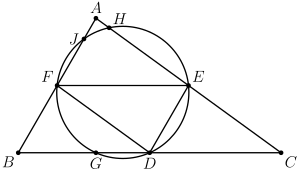
Suppose has angles and Let and be the midpoints of sides and respectively. The circumcircle of intersects and at points and respectively. The points and divide the circumcircle of into six minor arcs, as shown. Find where the arcs are measured in degrees.
小提示:
经过三边中点的圆是九点圆,所以 、、 是三条高的垂足,并且 与 有相同的角
The circle through the midpoints is the nine-point circle, so are the feet of the altitudes, and has the same angles as
大提示:
因为 ,点 到 、、、 的距离相等;利用等腰三角形可将这些弧的度数转化为 的角度
Since is equidistant from isosceles triangles turn the arcs into angles of
解答:
中点三角形 的边分别平行于 的边,所以 、,且 。它的外接圆是九点圆,与 的边第二次相交于各高的垂足: 是从 所作高的垂足, 是从 所作高的垂足, 是从 所作高的垂足。由圆周角定理,。
对于 :因为 ,且 在射线 上,所以 等于直线 与 的夹角,也就是 ,因此 。对于 :因为 ,所以 和 都在以 为直径、以 为圆心的圆上,因此 且 。等腰三角形 给出 ,等腰三角形 给出 。于是 ,所以 。
因此 。
The medial triangle has sides parallel to those of so and Its circumcircle is the nine-point circle, whose second intersections with the sides of are the feet of the altitudes: is the foot from the foot from and the foot from By the inscribed angle theorem,
For since and lies on ray the angle equals the angle between lines and which is so For because both and lie on the circle with diameter centered at so and Isosceles triangle gives and isosceles triangle gives Hence and
Therefore
6.
半径为 、圆心为点 的圆 在点 处与半径为 的圆 内切。点 和 在 上,且 是 的直径,并且 。矩形 内接于 ,满足 , 比起 ,更靠近 ,且 比起 ,更靠近 ,如图所示。三角形 和 面积相等。矩形 的面积为 ,其中 和 是互质正整数。求 。
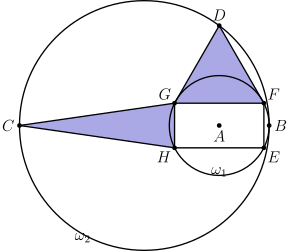
Circle with radius centered at point is internally tangent at point to circle with radius Points and lie on such that is a diameter of and The rectangle is inscribed in such that is closer to than to and is closer to than to as shown. Triangles and have equal areas. The area of rectangle is where and are relatively prime positive integers. Find
小提示:
使用坐标:令 的圆心为原点,、、,并设矩形顶点为 ,其中
Use coordinates: center of at the origin, and rectangle vertices with
大提示:
两个三角形的面积分别是 和 ;令它们相等时, 项会抵消
The two triangle areas are and setting them equal makes the terms cancel
解答:
令 的圆心为原点,并取 。在 处内切可得 ,且 。因为 且 在 上,所以 (取图中在线上方的 )。由于 ,矩形有竖直边,因此顶点为 ,其中 。关于 和 的条件说明 是左边, 是上边:、、、。
三角形 的底边 ,高为 ,所以面积为 。三角形 的底边 ,高为 ,所以面积为 。令二者相等,,故 ,再由 。
矩形面积为 ,所以 。
Center at the origin with Internal tangency at puts and Since and is on we get (taking above the line). Because the rectangle has vertical sides, so its vertices are with The conditions on and make the left side and the top side:
Triangle has base and height so its area is Triangle has base and height so its area is Setting these equal, so and then
The area of the rectangle is so
7.
令 为 的正整数因数集合。令 为从 中随机选取的一个子集。 是非空集合且其元素的最小公倍数为 的概率为 ,其中 和 是互质正整数。求 。
Let be the set of positive integer divisors of Let be a randomly selected subset of The probability that is a nonempty set with the property that the least common multiple of its elements is is where and are relatively prime positive integers. Find
小提示:
有 个因数;最小公倍数为 当且仅当该子集含有一个 的倍数和一个 的倍数
has divisors; the lcm is exactly when the subset contains a multiple of and a multiple of
大提示:
使用容斥:有 个子集避开全部三个 的倍数,有 个子集避开全部五个 的倍数
Use inclusion-exclusion: subsets avoid all three multiples of and avoid all five multiples of
解答:
因为 ,集合 有 个元素,所以共有 个子集。一个子集的最小公倍数为 当且仅当它至少含有一个可被 整除的因数,并且至少含有一个可被 整除的因数(这样的子集自动非空)。不被 整除的因数有 个,不被 整除的因数有 个,二者都不整除的有 个。
由容斥,符合条件的子集数为 因为 ,概率为 ,所以 。
Since the set has elements, and there are subsets. A subset has least common multiple exactly when it contains at least one divisor divisible by and at least one divisible by (such a subset is automatically nonempty). There are divisors not divisible by not divisible by and divisible by neither.
By inclusion-exclusion, the number of good subsets is Since the probability is and
8.
Silas 有无限多枚 分硬币、 分硬币和 分硬币。他想找出若干硬币,使总价值为 分,其中 是正整数。他使用所谓的 贪心算法:每一步都选择不会使当前总价值超过 的最大面值硬币。例如,为了凑 分,Silas 会选择一枚 分硬币、一枚 分硬币,然后选择 枚 分硬币。然而,这组 枚硬币比必要数量更多;事实上,选择 枚 分硬币和 枚 分硬币也能得到同样总价值 分,且只用 枚硬币。
一般来说,若不存在另一组 分、 分和 分硬币,能用严格更少的硬币数凑出 分,则称贪心算法对该 成功。求 到 (含端点)之间使贪心算法成功的 的个数。
From an unlimited supply of -cent coins, -cent coins, and -cent coins, Silas wants to find a collection of coins that has a total value of cents, where is a positive integer. He uses the so-called greedy algorithm, successively choosing the coin of greatest value that does not cause the value of his collection to exceed For example, to get cents, Silas will choose a -cent coin, then a -cent coin, then -cent coins. However, this collection of coins uses more coins than necessary to get a total of cents; indeed, choosing -cent coins and -cent coins achieves the same total value with only coins.
In general, the greedy algorithm succeeds for a given if no other collection of -cent, -cent, and -cent coins gives a total value of cents using strictly fewer coins than the collection given by the greedy algorithm. Find the number of values of between and inclusive for which the greedy algorithm succeeds.
小提示:
在最优组合中,最多有 枚一分硬币,最多有 枚十分硬币,所以它使用 枚二十五分硬币或少一枚
In an optimal collection there are at most pennies and at most dimes, so it uses quarters or one fewer
大提示:
比较 和 所需的十分硬币与一分硬币数量,其中 ;贪心算法会在两段连续五个余数上失败
Compare dime-and-penny coin counts for and where greedy fails on two runs of five consecutive residues
解答:
在任意最优组合中,最多有 枚一分硬币(十枚一分可换成一枚十分),最多有 枚十分硬币(五枚十分可换成两枚二十五分),所以十分和一分硬币的总价值最多为 分。因此一个最优组合使用 枚二十五分硬币,和贪心算法一样,或使用 枚二十五分硬币。对于只由十分和一分硬币组成的金额 ,最佳硬币数为 ,这正是贪心算法处理余数的方式。
令 。贪心算法使用 枚硬币,唯一的竞争方案使用 枚硬币(当 时可行),所以贪心算法失败当且仅当 。列表计算:对 ,;对 ,;对 ,;对 ,;对 ,。所以贪心算法失败恰好发生在 且 时。
在 中,每个模 的余数类都有 个 ,所以上述 个余数给出 个值,其中小于 的 个值不计入失败(此时 )。因而贪心算法失败于 个值,成功于 个值。
In any optimal collection there are at most pennies (ten pennies could become a dime) and at most dimes (five dimes could become two quarters), so its dimes and pennies are worth at most cents. Hence an optimal collection uses either quarters, like greedy, or quarters. For an amount made only of dimes and pennies, the best count is which is what greedy does on the remainder.
Let Greedy uses coins, and the only rival uses coins (possible when ), so greedy fails exactly when Tabulating: for for for for for So greedy fails exactly when and
Each residue class mod contains values of in so these residues give values, of which the values less than do not count (there ). Greedy fails for values and succeeds for
9.
区间 中有 个 的值满足 。在这些 个 中,有 个使得 的图像与 轴相切。求 。
There are values of in the interval where For of these values of the graph of is tangent to the -axis. Find
小提示:
当且仅当 ,其中所取整数满足 ;在 的五个周期内分别统计每个 的解数
exactly when for an integer count solutions for each over five periods of
大提示:
与 轴相切还需要 ,这迫使 ,也就是
Tangency to the -axis also needs which forces i.e.
解答:
当且仅当 是 的整数倍,也就是 ,其中整数 满足 。当 遍历 时, 遍历 ,也就是五个完整周期。对于 ,解为 :共有 个。对于 的 个取值,每个周期贡献 个解,共 个解。对于 ,需要 ,各出现 次。所以 。
图像在零点处与 轴相切当且仅当 。在任何零点处, ,所以相切要求 ,也就是 :这正是 的那 个零点(此时 取极值,因此 只接触而不穿过)。所以 ,。
exactly when is a multiple of that is, for an integer with As runs over the quantity runs over five full periods. For the solutions are values. For each of the values each period contributes solutions: values each. For we need which happens times each. So
The graph is tangent to the -axis at a zero exactly when there. At any zero, so tangency requires which means exactly the zeros with (there has an extremum, so touches without crossing). Thus and
10.
十六把椅子排成一排。八个人各选择一把椅子坐下,并且没有人同时紧挨着另外两个人。令 为可能被选中的 把椅子的子集数量。求 除以 的余数。
Sixteen chairs are arranged in a row. Eight people each select a chair in which to sit so that no person sits next to two other people. Let be the number of subsets of chairs that could be selected. Find the remainder when is divided by
小提示:
没有人同时紧挨着另外两个人,等价于没有 把连续椅子都被占用:这 个人形成大小为 或 的区块
No one sitting next to two others means no consecutive occupied chairs: the people form blocks of size or
大提示:
若有 个区块,用 种方式选择哪些区块是二连座,并用 种方式把这些区块放入 把空椅子形成的 个空隙中
With blocks, pick which are pairs in ways and place the blocks in the gaps around the empty chairs in ways
解答:
一个人同时紧挨着另外两个人,恰好等价于三把连续椅子都被占用,所以我们要数没有三把连续椅子被选中的 把椅子的 元子集。被占用的椅子于是形成大小为 或 的极大区块。若有 个区块,则其中 个是二连座, 个是单座,所以 ,二连座的位置可用 种方式选择。 把空椅子形成 个空隙(包括两端), 个区块占据 个不同空隙:有 种方式。
因此
除以 的余数为 。
A person sits next to two others exactly when three consecutive chairs are all occupied, so we count -element subsets of the chairs with no three consecutive chairs chosen. The occupied chairs then form maximal blocks of size or If there are blocks, then of them are pairs and are singles, so and the pair positions can be chosen in ways. The empty chairs create gaps (including the ends), and the blocks occupy distinct gaps: ways.
Therefore
The remainder when is divided by is
11.
令 为正 边形的顶点集合。求画出 条等长线段的方法数,使得 中每个顶点都恰好是这 条线段之一的端点。
Let be the set of vertices of a regular -gon. Find the number of ways to draw segments of equal lengths so that each vertex in is an endpoint of exactly one of the segments.
小提示:
等长意味着每条线段都沿圆周跨过相同数量 个顶点,其中
Equal lengths means every segment steps the same number of vertices around the circle, for some
大提示:
对于步长 ,这些弦形成 个长度为 的环;一个偶长度环恰有 个完美匹配
For step the chords form cycles of length an even cycle has exactly perfect matchings
解答:
圆上等间距点形成的两条弦等长,当且仅当它们跨过相同数量的顶点,所以所有 条线段都连接相距 个顶点的一对顶点,其中共同的步长为 。固定 在 个顶点上连接每个 与 :我们需要这个图中的一个完美匹配。若 ,该图是 个长度为 的环的不交并;若 ,它是 条互不相交的直径。
一个偶长度环恰有 个完美匹配(交替取边),奇长度环没有。因此每个 且环长为偶数的情形贡献 : 各给 ; 各给 ; 各给 ; 给 ; 给 。对于 ,环长为奇数 ,贡献 。对于 ,匹配被迫确定: 种。
总数为 。
Two chords of a circle through equally spaced points have equal length exactly when they skip the same number of vertices, so all segments join pairs of vertices exactly apart for one common For fixed form the graph on the vertices joining each to we need a perfect matching in this graph. For the graph is a disjoint union of cycles of length while for it is disjoint diameters.
A cycle of even length has exactly perfect matchings (alternate edges), and a cycle of odd length has none. So each with even cycle length contributes give each; give each; give each; gives gives For the cycles have odd length giving For the matching is forced: way.
The total is
12.
令 为一个非凸简单 边形,满足以下性质:
• 对每个整数 , 的面积为 。
• 对每个整数 ,。
• 边形 的周长等于 。
那么 可表示为 ,其中 、、、 是正整数, 不被任何质数的平方整除,且没有质数同时整除 、、。求 。
Let be an -sided non-convex simple polygon with the following properties:
• For every integer the area of is
• For every integer
• The perimeter of the -gon is equal to
Then can be expressed as where and are positive integers, is not divisible by the square of any prime, and no prime divides all of and Find
小提示:
令 。相等面积迫使 ,所以 在两个值 和 之间交替
Let The equal areas force so the alternate between two values and
大提示:
每条边 有相同长度 ,且 ;周长给出
Each side has the same length with the perimeter gives
解答:
令 ,其中 ,并令公共角为 ,满足 且 。每个面积条件说明 ,所以对 有 。连续乘积相等迫使 在两个值之间交替:设 ,,且 ;特别地,。
由余弦定理,对每个 ,边 都有相同长度 ,且 令 ,周长条件为 。将 两边平方,得到 ,化简为 ,所以 (正根;且 符合要求)。
因此 ,其中 无平方因子,且没有质数同时整除 、、。答案为 。
Let for and let be the common angle, with and Each area condition says so for Consecutive products being equal forces the to alternate between two values and with in particular
By the law of cosines, every side with has the same length where Writing the perimeter condition is Squaring gives which simplifies to so (the positive root; then as required).
Thus with squarefree and no prime dividing all of The answer is
13.
定义有理数列 、、,其中 ,且 对所有 成立。则 可表示为 ,其中 和 是互质正整数。求 除以 的余数。
Let the sequence of rationals be defined such that and for all Then can be expressed as for relatively prime positive integers and Find the remainder when is divided by
小提示:
代换 会把递推变成 ,且
The substitution turns the recurrence into with
大提示:
写 ,证明 已经是最简分数,所以
Writing show is already in lowest terms, so
解答:
令 。由递推式,,并且 ,所以 因为 。这里 。归纳可得 ,其中 且 ;由于 可被 整除,每个 都与 互质。
反解代换,,其中 且 。所有 都为正(当 时,),所以 ,使得 和 均为正。 与 的任何公因数都整除它们的线性组合 和 ;由于 ,它只可能整除 ,但 是 的倍数,而 不是,所以 不是 的倍数。因此该分数已经最简,且 。
模 时,。模 时, 的乘法阶整除 ,且 (它模 为 ,并且 模 ,而 模 ),所以 。中国剩余定理给出 ,因此 。
Let From the recurrence, and so since Here By induction where and since is divisible by every stays coprime to
Inverting the substitution, with and All are positive (for ), so making both and positive. Any common divisor of and divides their combinations and as it divides but is divisible by while is not, so is not divisible by Hence the fraction is in lowest terms and
Modulo Modulo the multiplicative order of divides and (it is mod and mod with mod ), so The Chinese remainder theorem gives so
14.
令 为直角三角形,,且 。三角形内部存在点 和 ,满足 四边形 的面积可表示为 ,其中 是正整数。求 。
Let be a right triangle with and There exist points and inside the triangle such that The area of the quadrilateral can be expressed as for some positive integer Find
小提示:
三角形 是等边三角形,所以 ,且 ;同时
Triangle is equilateral, so and also
大提示:
在 下,关系 会确定 ;从 中减去三角形 、、
With the relation determines subtract triangles from
解答:
因为 ,三角形 是等边三角形,且 。令 ,,所以 。因为 ,点 在 的垂直平分线上,所以 ;同理 。于是 给出 ,即 。由和化积, ,所以 。
分解面积: 。首先, 接着, 到 的高为 ,所以 ,同理 ;二者之和为 。最后 。
因此 ,所以 。
Since triangle is equilateral and Let and so Because point lies on the perpendicular bisector of so similarly Then gives i.e. By sum-to-product, so
Decompose First, Next, has height over so and likewise their sum is Finally
Therefore so
15.
正好有三个正实数 ,使得定义在正实数上的函数 恰好在两个正实数 处取得最小值。求这三个 的和。
There are exactly three positive real numbers such that the function defined over the positive real numbers achieves its minimum value at exactly two positive real numbers Find the sum of these three values of
小提示:
最小值 被取到两次,当且仅当 是一个完全平方
The minimum value is attained twice exactly when is a perfect square
大提示:
比较系数: 且 ;代入 会得到一个有三个正根的四次方程
Match coefficients: and substituting yields a quartic in with three positive roots
解答:
对 ,当 时 (分子趋向 ),且当 时也趋于正无穷,所以 在 上取得全局最小值 。它恰在两个点取得,当且仅当 且有两个不同的正二重根,即 其中 的根为正且不同(所以 )。
比较 、 和常数项的系数( 项只决定 ),得到 代入 ,其中 ,则 ,且 。中间的方程变为 ,即 它可分解为 。
正根 给出 (每个确实满足 ,与题目保证的正好三个值相符)。它们的和为 。
For both as (the numerator tends to ) and as so attains a global minimum value on It is attained at exactly two points precisely when with two distinct positive double roots, i.e. where the roots of are positive and distinct (so ).
Matching coefficients of and the constant (the -coefficient just determines ): Substitute with then and The middle equation becomes i.e. which factors as
The positive roots give (each indeed yields matching the problem’s promise of exactly three values). The sum is