
Soluciones del 2013 AMC 12B
Desplázate hacia abajo para ver las soluciones preparadas profesionalmente de LIVE by Po-Shen Loh, imprime las soluciones en PDF, consulta la clave de respuestas, o haz el examen cronometrado completo.
Todos los problemas se usan con el permiso legal oficial de la Mathematical Association of America (MAA).
1.
En cierto día de enero, la temperatura máxima en Lincoln, Nebraska, fue grados mayor que la temperatura mínima, y el promedio de las temperaturas máxima y mínima fue En grados, ¿cuál fue la temperatura mínima en Lincoln ese día?
On a particular January day, the high temperature in Lincoln, Nebraska, was degrees higher than the low temperature, and the average of the high and low temperatures was In degrees, what was the low temperature in Lincoln that day?
Pista pequeña:
La máxima y la mínima difieren en por lo que cada una está a de su promedio.
The high and low differ by so each is away from their average
Pista grande:
La temperatura mínima está por debajo del promedio de .
The low temperature is below the average of
Solución:
La máxima supera a la mínima en así que la mínima está por debajo del promedio. Como el promedio es la temperatura mínima es Por lo tanto, la respuesta correcta es C.
The high exceeds the low by so the low is below the average. Since the average is the low temperature is Thus, the correct answer is C.
2.
El Sr. Green mide su jardín rectangular caminando dos de los lados y encuentra que mide pasos por pasos. Cada paso del Sr. Green mide pies de largo. El Sr. Green espera media libra de papas por pie cuadrado de su jardín. ¿Cuántas libras de papas espera el Sr. Green de su jardín?
Mr. Green measures his rectangular garden by walking two of the sides and finds that it is steps by steps. Each of Mr. Green’s steps is feet long. Mr. Green expects a half a pound of potatoes per square foot from his garden. How many pounds of potatoes does Mr. Green expect from his garden?
Pista pequeña:
Primero convierte los pasos a pies: cada paso mide pies.
Convert steps to feet first: each step is feet
Pista grande:
Multiplica el área en pies cuadrados por libra por pie cuadrado.
Multiply the area in square feet by pound per square foot
Solución:
El jardín mide pies por pies, un área de pies cuadrados. A media libra por pie cuadrado, el Sr. Green espera libras. Por lo tanto, la respuesta correcta es A.
The garden is feet by feet, an area of square feet. At half a pound per square foot, Mr. Green expects pounds. Thus, the correct answer is A.
3.
Al contar desde hasta es el -ésimo número contado. Al contar hacia atrás desde hasta es el -ésimo número contado. ¿Cuánto vale ?
When counting from to is the st number counted. When counting backwards from to is the th number counted. What is
Pista pequeña:
Al contar hacia atrás, es el -er número, es el -do, y así sucesivamente.
Counting backwards, is the st number, is the nd, and so on
Pista grande:
El valor es el -ésimo número contado.
The value is the th number counted
Solución:
Contando hacia abajo desde el valor es el -ésimo número. Así que es el -ésimo número. Por lo tanto, la respuesta correcta es D.
Counting down from the value is the th number. So is the th number. Thus, the correct answer is D.
4.
El auto de Ray promedia millas por galón de gasolina, y el auto de Tom promedia millas por galón de gasolina. Ray y Tom conducen cada uno la misma cantidad de millas. ¿Cuál es la tasa combinada de millas por galón de gasolina de los dos autos?
Ray’s car averages miles per gallon of gasoline, and Tom’s car averages miles per gallon of gasoline. Ray and Tom each drive the same number of miles. What is the cars’ combined rate of miles per gallon of gasoline?
Pista pequeña:
El rendimiento combinado es el total de millas dividido entre el total de galones, no el promedio de las dos tasas.
Combined mileage is total miles divided by total gallons, not the average of the two rates
Pista grande:
Si cada uno conduce millas, los galones usados son y .
If each drives miles, the gallons used are and
Solución:
Si cada uno conduce millas, juntos recorren millas usando galones. La tasa combinada es millas por galón. Por lo tanto, la respuesta correcta es B.
If each drives miles, together they cover miles using gallons. The combined rate is miles per gallon. Thus, the correct answer is B.
5.
La edad promedio de estudiantes de quinto grado es La edad promedio de de sus padres es ¿Cuál es la edad promedio de todos estos padres y estudiantes de quinto grado?
The average age of fifth-graders is The average age of of their parents is What is the average age of all of these parents and fifth-graders?
Pista pequeña:
El promedio general es la suma de todas las edades dividida entre el número total de personas.
The overall average is the total of all ages divided by the total number of people
Pista grande:
La edad total es repartida entre personas.
The total age is spread over people
Solución:
Las edades de los padres suman y las de los estudiantes de quinto grado suman un total de Al dividir entre personas se obtiene Por lo tanto, la respuesta correcta es C.
The parents’ ages sum to and the fifth-graders’ to a total of Dividing by people gives Thus, the correct answer is C.
6.
Los números reales e satisfacen la ecuación ¿Cuánto vale ?
Real numbers and satisfy the equation What is
Pista pequeña:
Mueve todos los términos a un lado y completa el cuadrado tanto en como en .
Move every term to one side and complete the square in both and
Pista grande:
Una suma de dos cuadrados igual a obliga a que cada cuadrado sea .
A sum of two squares equal to forces each square to be
Solución:
Reordenando se obtiene es decir Por lo tanto y así que Por lo tanto, la respuesta correcta es B.
Rearranging gives that is Hence and so Thus, the correct answer is B.
7.
Jo y Blair se turnan para contar desde hasta uno más que el último número dicho por la otra persona. Jo empieza diciendo “”, así que Blair sigue diciendo “ ”. Luego Jo dice “ ”, y así sucesivamente. ¿Cuál es el -ésimo número dicho?
Jo and Blair take turns counting from to one more than the last number said by the other person. Jo starts by saying “”, so Blair follows by saying “ ”. Jo then says “ ”, and so on. What is the rd number said?
Pista pequeña:
El turno que termina en consiste en que alguien dice .
The turn that ends at consists of someone saying
Pista grande:
Después del turno que termina en se han dicho un total de números.
After the turn ending at a total of numbers have been said
Solución:
Después del turno que cuenta hasta se han dicho exactamente números. Para eso es El siguiente turno empieza así que el -ésimo número es el º número de ese turno, es decir Por lo tanto, la respuesta correcta es E.
After the turn that counts up to exactly numbers have been said. For that is The next turn starts so the rd number is the th number of that turn, namely Thus, the correct answer is E.
8.
La recta tiene ecuación y pasa por La recta tiene ecuación y corta a la recta en el punto La recta tiene pendiente positiva, pasa por el punto y corta a en el punto El área del es ¿Cuál es la pendiente de ?
Line has equation and goes through Line has equation and meets line at point Line has positive slope, goes through point and meets at point The area of is What is the slope of
Pista pequeña:
Halla resolviendo junto con .
Find by solving together with
Pista grande:
La distancia de a la recta es así que da .
The distance from to line is so gives
Solución:
Al resolver con se obtiene La distancia de a la recta es así que da Entonces o esta última hace que sea vertical, así que y la pendiente es Por lo tanto, la respuesta correcta es B.
Solving with gives The distance from to the line is so gives Then or the latter makes vertical, so and the slope is Thus, the correct answer is B.
9.
¿Cuál es la suma de los exponentes de los factores primos de la raíz cuadrada del mayor cuadrado perfecto que divide a ?
What is the sum of the exponents of the prime factors of the square root of the largest perfect square that divides ?
Pista pequeña:
Factoriza .
Factor
Pista grande:
El mayor divisor cuadrado conserva solo los exponentes pares; al dividirlos entre dos se obtiene la raíz cuadrada.
The largest square divisor keeps only even exponents; halving them gives the square root
Solución:
Como el mayor cuadrado perfecto que lo divide es cuya raíz cuadrada es Los exponentes suman Por lo tanto, la respuesta correcta es C.
Since the largest perfect square dividing it is whose square root is The exponents sum to Thus, the correct answer is C.
10.
Alex tiene fichas rojas y fichas azules. Hay un puesto donde Alex puede entregar dos fichas rojas y recibir a cambio una ficha plateada y una ficha azul, y otro puesto donde Alex puede entregar tres fichas azules y recibir a cambio una ficha plateada y una ficha roja. Alex sigue intercambiando fichas hasta que ya no sea posible ningún intercambio. ¿Cuántas fichas plateadas tendrá Alex al final?
Alex has red tokens and blue tokens. There is a booth where Alex can give two red tokens and receive in return a silver token and a blue token, and another booth where Alex can give three blue tokens and receive in return a silver token and a red token. Alex continues to exchange tokens until no more exchanges are possible. How many silver tokens will Alex have at the end?
Pista pequeña:
Después de intercambios en el primer puesto y en el segundo, Alex tiene fichas rojas y fichas azules.
After exchanges at the first booth and at the second, Alex has red and blue tokens
Pista grande:
Los intercambios se detienen cuando quedan menos de rojas y menos de azules; el número de plateadas es .
Exchanges stop when fewer than red and fewer than blue remain; the silver count is
Solución:
Después de intercambios en el puesto rojo y en el azul, Alex tiene fichas rojas, fichas azules y fichas plateadas. Al terminar, la cantidad roja es o y la azul es o Resolver las ecuaciones en estos seis casos deja solo con estado final o con estado final Este último es inalcanzable: su intercambio final tendría que comenzar en o Por tanto, Alex termina con fichas plateadas. Por lo tanto, la respuesta correcta es E.
After red-booth and blue-booth exchanges, Alex has red tokens, blue tokens, and silver tokens. At termination the red count is or and the blue count is or Solving the token equations over these six cases leaves only ending at or ending at The latter is unreachable: its final exchange would have to start at either or Hence Alex finishes with silver tokens. Thus, the correct answer is E.
11.
Dos abejas parten del mismo lugar y vuelan a la misma velocidad en las siguientes direcciones. La abeja viaja pie al norte, luego pie al este, luego pie hacia arriba, y después sigue repitiendo este patrón. La abeja viaja pie al sur, luego pie al oeste, y después sigue repitiendo este patrón. ¿En qué direcciones viajan las abejas cuando están exactamente a pies una de otra?
Two bees start at the same spot and fly at the same rate in the following directions. Bee travels foot north, then foot east, then foot upwards, and then continues to repeat this pattern. Bee travels foot south, then foot west, and then continues to repeat this pattern. In what directions are the bees traveling when they are exactly feet away from each other?
al este, al oeste
east, west
al norte, al sur
north, south
al norte, al oeste
north, west
hacia arriba, al sur
up, south
hacia arriba, al oeste
up, west
Pista pequeña:
Usa coordenadas con este, norte y arriba como las abejas solo se alejan más con el tiempo.
Use coordinates with east, north, up as the bees only get farther apart over time
Pista grande:
Calcula la distancia justo antes y justo después de cada pie para encontrar dónde cruza .
Compute the distance right before and right after each foot to find where it crosses
Solución:
Toma este, norte y arriba como Después de pies la abeja está en y la abeja está en a una distancia En el siguiente pie la abeja se mueve al este hasta y la abeja se mueve al oeste hasta a una distancia Así que pasan por una separación de pies mientras va al este y va al oeste. Por lo tanto, la respuesta correcta es A.
Take east, north, up as After feet bee is at and bee is at a distance On the next foot bee moves east to and bee moves west to a distance So they pass through feet apart while heads east and heads west. Thus, the correct answer is A.
12.
Las ciudades y están conectadas por los caminos y ¿Cuántas rutas diferentes hay desde hasta que usan cada camino exactamente una vez? (Tal ruta necesariamente visitará algunas ciudades más de una vez.)
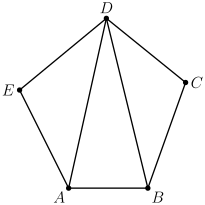
Cities and are connected by roads and How many different routes are there from to that use each road exactly once? (Such a route will necessarily visit some cities more than once.)
Pista pequeña:
Las ciudades y tocan cada una solo dos caminos, así que se comportan como desvíos en las conexiones - y -.
Cities and each touch only two roads, so they behave like detours on the – and – connections
Pista grande:
Cuenta los recorridos desde hasta en el grafo reducido, luego multiplica por las opciones independientes de desvío.
Count the trails from to on the reduced graph, then multiply by the independent detour choices
Solución:
La ciudad (caminos ) es un desvío en un trayecto -, y la ciudad (caminos ) es un desvío en un trayecto -. Al reemplazarlas se obtiene un grafo sobre con dos conexiones -, dos conexiones -, y un camino -. Los recorridos desde hasta que usan cada uno una vez son de tipos: y Cada desvío (por por ) puede tomarse en cualquiera de los dos pasos, así que cada tipo da rutas reales, para rutas. Por lo tanto, la respuesta correcta es D.
City (roads ) is a detour on an – trip, and city (roads ) is a detour on a – trip. Replace them to get a graph on with two – connections, two – connections, and one – road. The trails from to using each once are of types: and Each detour (through through ) can be taken on either passage, so each type gives actual routes, for routes. Thus, the correct answer is D.
13.
Los ángulos internos del cuadrilátero forman una progresión aritmética. Los triángulos y son semejantes, con y Además, los ángulos de cada uno de estos dos triángulos también forman una progresión aritmética. En grados, ¿cuál es la mayor suma posible de los dos ángulos más grandes de ?
The internal angles of quadrilateral form an arithmetic progression. Triangles and are similar with and Moreover, the angles in each of these two triangles also form an arithmetic progression. In degrees, what is the largest possible sum of the two largest angles of
Pista pequeña:
Los ángulos de un triángulo forman una progresión aritmética exactamente cuando su ángulo del medio es .
A triangle’s angles form an arithmetic progression exactly when its middle angle is
Pista grande:
Sea y los cuatro ángulos de resultan que deben formar una progresión aritmética con un ángulo del triángulo igual a .
Let and the four angles of become which must be an arithmetic progression with one triangle angle equal to
Solución:
Los ángulos de un triángulo forman una progresión aritmética exactamente cuando el ángulo medio es Con y los cuatro ángulos de son y también deben formar una progresión aritmética. En orden creciente son o lo que da o Uno de los ángulos del triángulo es Al sustituir quedan los conjuntos de ángulos y Los dos ángulos mayores suman como máximo Así, la respuesta correcta es D.
The angles of a triangle form an arithmetic progression exactly when the middle one is With and the four angles of are which must itself be an arithmetic progression. In increasing order they are either or giving or One of the triangle angles is Substitution leaves the angle sets and The two largest angles sum to at most Thus, the correct answer is D.
14.
Dos sucesiones no decrecientes de enteros no negativos tienen primeros términos diferentes. Cada sucesión tiene la propiedad de que cada término a partir del tercero es la suma de los dos términos anteriores, y el séptimo término de cada sucesión es ¿Cuál es el menor valor posible de ?
Two non-decreasing sequences of nonnegative integers have different first terms. Each sequence has the property that each term beginning with the third is the sum of the previous two terms, and the seventh term of each sequence is What is the smallest possible value of
Pista pequeña:
En términos de los dos primeros términos el séptimo término es igual a .
In terms of the first two terms the seventh term equals
Pista grande:
Igualar los dos séptimos términos da como y son coprimos, se obliga a que sea múltiplo de .
Setting the two seventh terms equal gives coprimality of and forces to be a multiple of
Solución:
Una sucesión que empieza con tiene séptimo término Para las dos sucesiones, así que Como necesitamos que sea múltiplo de y que sea múltiplo de Tomando con términos no decrecientes se obtiene Eligiendo resulta Por lo tanto, la respuesta correcta es C.
A sequence starting has seventh term For the two sequences, so Since we need to be a multiple of and to be a multiple of Taking with nondecreasing terms gives Choosing yields Thus, the correct answer is C.
15.
El número se expresa en la forma
donde y son enteros positivos y es lo más pequeño posible. ¿Cuánto vale ?
The number is expressed in the form
where and are positive integers and is as small as possible. What is
Pista pequeña:
Factoriza su mayor primo es .
Factor its largest prime is
Pista grande:
Algún debe alcanzar así que pero también contiene el primo que debe cancelarse del denominador.
Some must reach so but also contains the prime which must be cancelled from the denominator
Solución:
Como el numerador necesita un factorial de al menos para aportar el primo así que Pero también tiene un factor que no tiene, así que el denominador necesita Por lo tanto alcanzado con mediante Entonces Por lo tanto, la respuesta correcta es B.
Since the numerator needs a factorial at least to supply the prime so But also has a factor of which does not, so the denominator needs Thus attained by via Then Thus, the correct answer is B.
16.
Sea un pentágono convexo equiángulo de perímetro Las intersecciones por pares de las rectas que prolongan los lados del pentágono determinan un polígono en forma de estrella de cinco puntas. Sea el perímetro de esta estrella. ¿Cuál es la diferencia entre el máximo y el mínimo valor posible de ?
Let be an equiangular convex pentagon of perimeter The pairwise intersections of the lines that extend the sides of the pentagon determine a five-pointed star polygon. Let be the perimeter of this star. What is the difference between the maximum and the minimum possible values of
Pista pequeña:
Cada ángulo interior de un pentágono equiángulo es así que cada punta de la estrella es un triángulo isósceles con vértice de .
Each interior angle of an equiangular pentagon is so every point of the star is an isosceles triangle with a apex
Pista grande:
Los dos lados iguales de cada punta de la estrella son el mismo múltiplo fijo del lado del pentágono sobre el que se apoya, así que el perímetro de la estrella es veces el perímetro del pentágono.
Each star point’s two equal sides are the same fixed multiple of the pentagon side it sits on, so the star perimeter is times the pentagon perimeter
Solución:
Un pentágono equiángulo tiene todos sus ángulos interiores así que cada punta de la estrella es un triángulo isósceles con ángulos de la base y vértice Por la igualdad de los ángulos de la base, cada punta aporta dos lados que son el mismo múltiplo fijo del lado del pentágono sobre el que se apoya. Sumando sobre las cinco puntas, el perímetro de la estrella es igual a independiente de las longitudes individuales de los lados. Así que es constante, y la diferencia entre su valor máximo y su valor mínimo es Por lo tanto, la respuesta correcta es A.
An equiangular pentagon has all interior angles so each point of the star is an isosceles triangle with base angles and apex By the equal base angles, each point contributes two sides that are the same fixed multiple of the pentagon side it rests on. Summing over the five points, the star perimeter equals independent of the individual side lengths. So is constant, and the difference between its maximum and minimum values is Thus, the correct answer is A.
17.
Sean y números reales tales que
y
¿Cuál es la diferencia entre el máximo y el mínimo valor posible de ?
Let and be real numbers such that
and
What is the difference between the maximum and minimum possible values of
Pista pequeña:
Escribe y .
Write and
Pista grande:
Existen reales con una suma y una suma de cuadrados dadas si y solo si .
Real with a given sum and sum of squares exist iff
Solución:
De las ecuaciones, y Existen números reales con una suma y una suma de cuadrados dadas si y solo si es decir Esto se simplifica a así que La diferencia es Por lo tanto, la respuesta correcta es D.
From the equations, and Real numbers with a given sum and sum of squares exist iff i.e. This simplifies to so The difference is Thus, the correct answer is D.
18.
Barbara y Jenna juegan el siguiente juego, en el que se turnan. Sobre una mesa hay cierta cantidad de monedas. Cuando es el turno de Barbara, debe quitar o monedas, a menos que quede una sola moneda, en cuyo caso pierde su turno. Cuando es el turno de Jenna, debe quitar o monedas. Un lanzamiento de moneda determina quién empieza. Quien quite la última moneda gana el juego. Supón que ambas jugadoras usan su mejor estrategia. ¿Quién ganará cuando el juego empieza con monedas y cuando el juego empieza con monedas?
Barbara and Jenna play the following game, in which they take turns. A number of coins lie on a table. When it is Barbara’s turn, she must remove or coins, unless only one coin remains, in which case she loses her turn. When it is Jenna’s turn, she must remove or coins. A coin flip determines who goes first. Whoever removes the last coin wins the game. Assume both players use their best strategy. Who will win when the game starts with coins and when the game starts with coins?
Barbara ganará con monedas, y Jenna ganará con
monedas.
Barbara will win with coins, and Jenna will win with
coins.
Jenna ganará con monedas, y quien
empiece ganará con monedas.
Jenna will win with coins, and whoever
goes first will win with coins.
Barbara ganará con monedas, y quien vaya en segundo
lugar ganará con monedas.
Barbara will win with coins, and whoever goes second
will win with coins.
Jenna ganará con monedas, y Barbara ganará con
monedas.
Jenna will win with coins, and Barbara will win with
coins.
Quien empiece ganará con monedas, y quien vaya en
segundo lugar ganará con monedas.
Whoever goes first will win with coins, and whoever
goes second will win with coins.
Pista pequeña:
Sigue el número de monedas módulo .
Track the number of coins modulo
Pista grande:
Jenna siempre puede restaurar un múltiplo de después de su jugada, respondiendo al de Barbara con y a su con decide quién puede mantener el invariante para cada cantidad inicial.
Jenna can always restore a multiple of after her move, answering Barbara’s with and her with decide who can maintain the invariant for each starting count
Solución:
Trabaja módulo Con monedas, Jenna gana de cualquier manera: si empieza, quita para dejar un múltiplo de luego responde al de Barbara con y al con para conservar múltiplos de y finalmente toma la última moneda; si va en segundo lugar, mantiene la cantidad hasta que Barbara queda atascada en monedas, debe quitar y le deja a Jenna la última moneda. Con monedas, gana quien empiece: Jenna, si empieza, reduce al caso de , mientras que Barbara, si empieza, quita y luego conserva múltiplos de Esta es la opción B. Por lo tanto, la respuesta correcta es B.
Work modulo With coins, Jenna wins either way: going first she takes to leave a multiple of then answers Barbara’s with and with to keep multiples of eventually taking the last coin; going second she keeps the count until Barbara is stuck at coins, must remove and leaves Jenna the last coin. With coins, whoever goes first wins: Jenna first reduces to the case, while Barbara first takes and then keeps multiples of This is choice B. Thus, the correct answer is B.
19.
En el triángulo y Los puntos distintos y están sobre los segmentos y respectivamente, de modo que y La longitud del segmento se puede escribir como donde y son enteros positivos primos entre sí. ¿Cuánto vale ?
In triangle and Distinct points and lie on segments and respectively, such that and The length of segment can be written as where and are relatively prime positive integers. What is
Pista pequeña:
La altura en el triángulo -- da .
The altitude in the -- triangle gives
Pista grande:
Como los puntos son concíclicos; usa triángulos rectángulos semejantes para hallar y luego .
Since points are concyclic; use similar right triangles to find then
Solución:
La altura desde hasta da Como el triángulo lo que da y Como el cuadrilátero es cíclico, así que haciendo semejantes los triángulos rectángulos y : así que Por lo tanto y Por lo tanto, la respuesta correcta es B.
The altitude from to gives Because triangle giving and Since quadrilateral is cyclic, so making right triangles and similar: so Hence and Thus, the correct answer is B.
20.
Para los puntos y son los vértices de un trapecio. ¿Cuánto vale ?
For points and are the vertices of a trapezoid. What is
Pista pequeña:
Los cuatro puntos están en la parábola la pendiente de la cuerda que une los parámetros y es .
All four points lie on the parabola the slope of the chord joining parameters and is
Pista grande:
En este rango los lados paralelos deben ser y así que .
On this range the parallel sides must be and so
Solución:
Cada punto está en y la cuerda que pasa por los parámetros tiene pendiente Para tanto como están entre y así que y quedan entre y y los lados paralelos son y La igualdad de pendientes da Multiplicando por y simplificando se obtiene Elevando al cuadrado y usando se obtiene cuya única raíz en es Por lo tanto, la respuesta correcta es A.
Each point lies on and the chord through parameters has slope For both and lie between and so and sit between and and the parallel sides are and Equal slopes give Multiplying by and simplifying yields Squaring and using gives whose only root in is Thus, the correct answer is A.
21.
Considera el conjunto de parábolas definidas como sigue: todas las parábolas tienen como foco el punto y las rectas directrices tienen la forma con y enteros tales que y Ninguna terna de estas parábolas tiene un punto común. ¿Cuántos puntos del plano están en dos de estas parábolas?
Consider the set of parabolas defined as follows: all parabolas have as focus the point and the directrix lines have the form with and integers such that and No three of these parabolas have a common point. How many points in the plane are on two of these parabolas?
Pista pequeña:
Dos parábolas que comparten un foco se cortan en puntos, salvo que sus directrices sean paralelas y el foco no esté entre ellas.
Two parabolas sharing a focus meet in points unless their directrices are parallel with the focus not between them
Pista grande:
De todos los pares, resta los que no se cortan: pendiente igual e interceptos en del mismo signo.
From all pairs, subtract the non-intersecting ones: equal slope and same-sign -intercepts
Solución:
Dos parábolas con foco común se cortan en exactamente puntos, salvo cuando sus directrices son paralelas y queda fuera de la franja entre ellas, en cuyo caso no se cortan. Los pares que no se cortan tienen directrices de igual pendiente e interceptos en del mismo signo. Hay pendientes, y para cada una, pares de interceptos del mismo signo. Como cada par que se corta lo hace en puntos y ningún punto está en tres parábolas, el total es Por lo tanto, la respuesta correcta es C.
Two parabolas with common focus meet in exactly points, except when their directrices are parallel and lies outside the strip between them, in which case they do not meet. The non-intersecting pairs have directrices of equal slope and -intercepts of the same sign. There are slopes, and for each, same-sign intercept pairs. Since every intersecting pair meets in points and no point lies on three parabolas, the total is Thus, the correct answer is C.
22.
Sean y enteros. Supón que el producto de las soluciones en de la ecuación
es el menor entero posible. ¿Cuánto vale ?
Let and be integers. Suppose that the product of the solutions for of the equation
is the smallest possible integer. What is
Pista pequeña:
Usa para convertir la ecuación en una cuadrática en .
Use to turn the equation into a quadratic in
Pista grande:
El producto de las raíces satisface así que minimiza este entero.
The product of the roots satisfies so minimize this integer
Solución:
Al escribir y la ecuación se convierte en una cuadrática en cuyas raíces suman Por tanto, donde Para cada primo que divide a sean sus exponentes en respectivamente. Entonces Es imposible que sea impar. Si entonces es múltiplo de y este primo aporta al menos un factor pero algún otro primo debe dividir a Si es positivo, su aporte a es al menos si entonces y el menor aporte es Cualquier otro valor positivo y par de produce un aporte mayor. Así, el mínimo usa únicamente con lo que da y Por tanto, Así, la respuesta correcta es A.
Writing and the equation becomes a quadratic in whose roots sum to Hence where For each prime dividing let its exponents in be Then An odd is impossible. If then is a multiple of and this prime contributes at least but some other prime must divide If is positive, its contribution to is at least if then and the least contribution is Every other positive even gives more. Thus the minimum uses only with giving and So Thus, the correct answer is A.
23.
Bernardo elige un entero positivo de tres dígitos y escribe en un pizarrón tanto su representación en base como en base . Más tarde LeRoy ve los dos números que Bernardo ha escrito. Tratando los dos números como enteros en base , los suma para obtener un entero Por ejemplo, si Bernardo escribe los números y y LeRoy obtiene la suma ¿Para cuántas elecciones de los dos dígitos más a la derecha de en orden, son los mismos que los de ?
Bernardo chooses a three-digit positive integer and writes both its base- and base- representations on a blackboard. Later LeRoy sees the two numbers Bernardo has written. Treating the two numbers as base- integers, he adds them to obtain an integer For example, if Bernardo writes the numbers and and LeRoy obtains the sum For how many choices of are the two rightmost digits of in order, the same as those of
Pista pequeña:
Como la condición depende solo de así que deja que varíe de a .
Since the condition depends only on so let range from to
Pista grande:
Igualar los últimos dígitos obliga a que los dígitos de las unidades en base y en base sean iguales; trabajando módulo se determinan los pares permitidos de los dos últimos dígitos.
Matching last digits forces the base- and base- units digits equal; working modulo pins down the allowed last-two-digit pairs
Solución:
Como la condición sobre depende solo de así que consideramos Sean los dos últimos dígitos en base , y sean los dos últimos dígitos en base Módulo la igualdad deseada y obligan a que El teorema chino del resto, aplicado módulo y , da entonces Al comparar el doble de este residuo módulo con el número decimal , se obtiene Por tanto, los pares válidos son exactamente Cada uno se combina con valores de lo que da valores de Así, la respuesta correcta es E.
Because the condition on depends only on so consider Let the last two base- digits be and the last two base- digits be Modulo the desired equality and force The Chinese Remainder Theorem applied modulo and then gives Comparing twice this residue modulo with the decimal number reduces to Hence the valid pairs are exactly Each combines with choices of giving values of Thus, the correct answer is E.
24.
Sea un triángulo donde es el punto medio de y es la bisectriz del con sobre Sea la intersección de la mediana y la bisectriz Además es equilátero y ¿Cuánto vale ?
Let be a triangle where is the midpoint of and is the angle bisector of with on Let be the intersection of the median and the bisector In addition is equilateral and What is
Pista pequeña:
Sea y el triángulo equilátero da .
Let and the equilateral triangle gives
Pista grande:
Los triángulos semejantes dan y luego aplica la Ley de Cosenos en .
Similar triangles yield and then apply the Law of Cosines in
Solución:
Sea y Como es equilátero, lo que da y De la primera, con obtenemos así que De la segunda, La Ley de Cosenos en con da Por lo tanto Por lo tanto, la respuesta correcta es A.
Let and Since is equilateral, which gives and From the first, with we get so From the second, The Law of Cosines in with gives Hence Thus, the correct answer is A.
25.
Sea el conjunto de polinomios de la forma
donde son enteros y tiene raíces distintas de la forma con y enteros. ¿Cuántos polinomios hay en ?
Let be the set of polynomials of the form
where are integers and has distinct roots of the form with and integers. How many polynomials are in
Pista pequeña:
Los coeficientes reales emparejan las raíces no reales como conjugadas, así que se factoriza en piezas lineales y cuadráticas , cada una con término constante que divide a .
Real coefficients pair nonreal roots as conjugates, so factors into linear and quadratic pieces, each with constant term dividing
Pista grande:
Para cada divisor de cuenta los factores básicos de magnitud (soluciones de más ), luego multiplica las opciones para que los términos constantes multipliquen a .
For each divisor of count the basic factors of magnitude (solutions of plus ), then multiply choices so the constant terms multiply to
Solución:
Como los coeficientes son reales, las raíces no reales aparecen en pares conjugados, así que se factoriza en factores lineales distintos con y cuadráticos El término constante de cada factor divide a Para las cantidades de pares conjugados con y son respectivamente. Al añadir las dos opciones lineales se obtiene y Las particiones de en magnitudes de factores mayores que son y Que las raíces sean distintas obliga, en el último caso, a elegir dos factores diferentes de . Por último, al tener en cuenta la presencia libre de y (con forzado por el signo del producto restante), se obtiene Por lo tanto, la respuesta correcta es B.
Since the coefficients are real, nonreal roots occur in conjugate pairs, so factors into distinct linear factors with and quadratics Each factor’s constant term divides For the numbers of conjugate pairs with and are respectively. Adding the two linear choices gives and The factor-magnitude partitions of using values greater than are and Distinct roots require choosing two different factors in the last case. Finally, account for the free presence of and (with forced by the sign of the remaining product), gives Thus, the correct answer is B.