
Soluciones del 2013 AMC 12A
Desplázate hacia abajo para ver las soluciones preparadas profesionalmente de LIVE by Po-Shen Loh, imprime las soluciones en PDF, consulta la clave de respuestas, o haz el examen cronometrado completo.
Todos los problemas se usan con el permiso legal oficial de la Mathematical Association of America (MAA).
1.
El cuadrado tiene lado El punto está en y el área del es ¿Cuánto vale ?
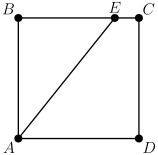
Square has side length Point is on and the area of is What is
Pista pequeña:
Los catetos del triángulo rectángulo son y .
The legs of right triangle are and
Pista grande:
Plantea con .
Set with
Solución:
Los catetos del triángulo rectángulo son y De obtenemos
Por lo tanto, la respuesta correcta es E.
The legs of right triangle are and From we get
Thus, the correct answer is E.
2.
Un equipo de softball jugó diez partidos, anotando y carreras. Perdieron por una carrera en exactamente cinco partidos. En cada uno de sus otros partidos, anotaron el doble de carreras que su oponente. ¿Cuántas carreras anotaron en total sus oponentes?
A softball team played ten games, scoring and runs. They lost by one run in exactly five games. In each of their other games, they scored twice as many runs as their opponent. How many total runs did their opponents score?
Pista pequeña:
Anotar el doble que el oponente solo es posible cuando la propia puntuación del equipo es par
Scoring twice the opponent is only possible when the team’s own score is even
Pista grande:
Las cinco derrotas por una carrera son los partidos con puntuación impar; cada oponente anotó una más.
The five one-run losses are the odd-scored games; each opponent scored one more
Solución:
El equipo solo puede anotar el doble de carreras que su oponente cuando su propia puntuación es par. Esos partidos tienen puntuaciones así que sus oponentes anotaron
Los otros cinco partidos tuvieron puntuaciones y fueron derrotas por una carrera, así que sus oponentes anotaron El total es
Por lo tanto, la respuesta correcta es C.
The team can only score twice as many runs as its opponent when its own score is even. Those games have scores so their opponents scored
The other five games had scores and were one-run losses, so their opponents scored The total is
Thus, the correct answer is C.
3.
Un ramo de flores contiene rosas rosadas, rosas rojas, claveles rosados y claveles rojos. Un tercio de las flores rosadas son rosas, tres cuartos de las flores rojas son claveles, y seis décimos de las flores son rosadas. ¿Qué porcentaje de las flores son claveles?
A flower bouquet contains pink roses, red roses, pink carnations, and red carnations. One third of the pink flowers are roses, three fourths of the red flowers are carnations, and six tenths of the flowers are pink. What percent of the flowers are carnations?
Pista pequeña:
Seis décimos de las flores son rosadas y cuatro décimos son rojas
Six tenths of the flowers are pink and four tenths are red
Pista grande:
Dos tercios de las rosadas y tres cuartos de las rojas son claveles; suma las dos cantidades
Two thirds of the pink and three fourths of the red are carnations; add the two amounts
Solución:
Seis décimos de las flores son rosadas y cuatro décimos son rojas. Como dos tercios de las flores rosadas son claveles, los claveles rosados constituyen de las flores.
Como tres cuartos de las flores rojas son claveles, los claveles rojos constituyen de las flores. En conjunto, los claveles son
Por lo tanto, la respuesta correcta es E.
Six tenths of the flowers are pink and four tenths are red. Since two thirds of the pink flowers are carnations, pink carnations make up of the flowers.
Since three fourths of the red flowers are carnations, red carnations make up of the flowers. Together the carnations are
Thus, the correct answer is E.
4.
¿Cuál es el valor de
What is the value of
Pista pequeña:
Saca como factor común tanto en el numerador como en el denominador.
Factor out of both the numerator and the denominator
Pista grande:
La razón se reduce a .
The ratio reduces to
Solución:
Sacando como factor de cada término se obtiene
Por lo tanto, la respuesta correcta es C.
Factoring from each term gives
Thus, the correct answer is C.
5.
Tom, Dorothy y Sammy se fueron de vacaciones y acordaron repartir los gastos por igual. Durante el viaje Tom pagó Dorothy pagó y Sammy pagó Para compartir los gastos por igual, Tom le dio a Sammy dólares, y Dorothy le dio a Sammy dólares. ¿Cuánto vale ?
Tom, Dorothy, and Sammy went on a vacation and agreed to split the costs evenly. During their trip Tom paid Dorothy paid and Sammy paid In order to share the costs equally, Tom gave Sammy dollars, and Dorothy gave Sammy dollars. What is
Pista pequeña:
La parte justa de cada persona es un tercio del total gastado
Each person’s fair share is one third of the total spent
Pista grande:
y miden cuánto le falta a Tom y a Dorothy, respectivamente, para alcanzar su parte justa
and measure how much Tom and Dorothy each fall short of their fair share
Solución:
El total gastado fue así que la parte justa de cada uno es dólares.
Entonces y así que
Por lo tanto, la respuesta correcta es B.
The total spent was so each fair share is dollars.
Then and so
Thus, the correct answer is B.
6.
En un partido de baloncesto reciente, Shenille solo intentó tiros de tres puntos y tiros de dos puntos. Acertó el de sus tiros de tres puntos y el de sus tiros de dos puntos. Shenille intentó tiros. ¿Cuántos puntos anotó?
In a recent basketball game, Shenille attempted only three-point shots and two-point shots. She was successful on of her three-point shots and of her two-point shots. Shenille attempted shots. How many points did she score?
Pista pequeña:
Sea el número de intentos de tres puntos, de modo que son intentos de dos puntos
Let be the number of three-point attempts, so are two-point attempts
Pista grande:
Su puntuación es los términos con se cancelan
Her score is the terms cancel
Solución:
Si Shenille intentó tiros de tres puntos y tiros de dos puntos, anotó puntos.
Por lo tanto, la respuesta correcta es B.
If Shenille attempted three-point shots and two-point shots, she scored points.
Thus, the correct answer is B.
7.
La sucesión tiene la propiedad de que cada término a partir del tercero es la suma de los dos anteriores. Es decir, Supongamos que y ¿Cuánto vale ?
The sequence has the property that every term beginning with the third is the sum of the previous two. That is, Suppose that and What is
Pista pequeña:
Reescribe la regla como y desciende paso a paso
Rearrange the rule to and step downward
Pista grande:
A partir de halla luego desciende hasta .
From find then work down to
Solución:
Como obtenemos Luego y
Por lo tanto, la respuesta correcta es C.
Since we get Then and
Thus, the correct answer is C.
8.
Dado que e son números reales distintos y no nulos tales que ¿cuánto vale ?
Given that and are distinct nonzero real numbers such that what is
Pista pequeña:
Multiplica ambos lados por para eliminar las fracciones
Multiply both sides by to clear the fractions
Pista grande:
El resultado se factoriza como
The result factors as
Solución:
Multiplicando por se obtiene así que
Como se sigue que
Por lo tanto, la respuesta correcta es D.
Multiplying by gives so
Since it follows that
Thus, the correct answer is D.
9.
En el y Los puntos y están en los lados y respectivamente, de modo que y son paralelos a y respectivamente. ¿Cuál es el perímetro del paralelogramo ?
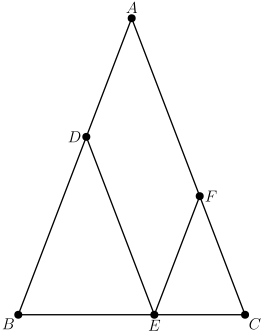
In and Points and are on sides and respectively, such that and are parallel to and respectively. What is the perimeter of parallelogram
Pista pequeña:
Como el triángulo es semejante a y por tanto isósceles con .
Since triangle is similar to and hence isosceles with
Pista grande:
La mitad del perímetro es igual a .
Half the perimeter equals
Solución:
Como el triángulo es semejante al triángulo que es isósceles, así que
La mitad del perímetro del paralelogramo es El perímetro completo es
Por lo tanto, la respuesta correcta es C.
Because triangle is similar to triangle which is isosceles, so
Half the perimeter of parallelogram is The entire perimeter is
Thus, the correct answer is C.
10.
Sea el conjunto de los enteros positivos para los cuales tiene la representación decimal periódica con y dígitos distintos. ¿Cuál es la suma de los elementos de ?
Let be the set of positive integers for which has the repeating decimal representation with and different digits. What is the sum of the elements of
Pista pequeña:
Un bloque periódico de dos dígitos significa que .
A two-digit repeating block means
Pista grande:
Así que es el número de dos dígitos revisa los divisores de
So is the two-digit number check the divisors of
Solución:
Si entonces un número de dos dígitos. Los divisores positivos de son
Solo hacen que sea igual a que tienen dos dígitos distintos. La suma pedida es
Por lo tanto, la respuesta correcta es D.
If then a two-digit number. The positive divisors of are
Only make equal to which have two different digits. The requested sum is
Thus, the correct answer is D.
11.
El triángulo es equilátero con Los puntos y están en y los puntos y están en , de modo que tanto como son paralelos a Además, el triángulo y los trapecios y tienen todos el mismo perímetro. ¿Cuánto vale ?
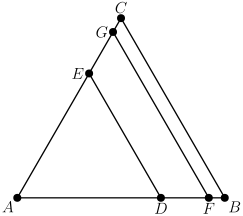
Triangle is equilateral with Points and are on and points and are on such that both and are parallel to Furthermore, triangle and trapezoids and all have the same perimeter. What is
Pista pequeña:
Sean e y escribe cada uno de los tres perímetros en términos de e
Let and and write each of the three perimeters in terms of and
Pista grande:
Los tres perímetros iguales dan .
The three equal perimeters give
Solución:
Sean e Los cortes paralelos hacen que las regiones pequeñas sean triángulos equiláteros o trapecios isósceles, así que los perímetros son
Igualándolos, da y Resolviendo se obtiene e así que
Por lo tanto, la respuesta correcta es C.
Let and The parallel cuts make the small regions equilateral or isosceles trapezoids, so the perimeters are
Setting them equal, gives and Solving yields and so
Thus, the correct answer is C.
12.
Los ángulos de cierto triángulo están en progresión aritmética, y las longitudes de los lados son y La suma de los posibles valores de es igual a donde y son enteros positivos. ¿Cuánto vale ?
The angles in a particular triangle are in arithmetic progression, and the side lengths are and The sum of the possible values of equals where and are positive integers. What is
Pista pequeña:
Los ángulos en progresión aritmética que suman obligan a que el ángulo del medio sea .
Angles in arithmetic progression summing to force the middle angle to be
Pista grande:
Aplica la Ley de Cosenos en cada caso según qué lado se opone al ángulo de
Apply the Law of Cosines in each case for which side is opposite the angle
Solución:
Si los ángulos son , su suma da , así que uno de los ángulos es .
Si se opone al ángulo de , la Ley de Cosenos da así que .
Si se opone al ángulo de , entonces , cuya solución positiva es . Si se opone a dicho ángulo, entonces no tiene solución real.
La suma de los posibles valores es , así que .
Por lo tanto, la respuesta correcta es A.
If the angles are their sum gives so one angle is
If is opposite the angle, the Law of Cosines gives so
If is opposite the angle, then whose positive solution is If is opposite, then has no real solution.
The sum of the possible values is so
Thus, the correct answer is A.
13.
Sean los puntos y El cuadrilátero se corta en piezas de igual área mediante una recta que pasa por Esta recta corta a en el punto donde estas fracciones están en su forma más simple. ¿Cuánto vale ?
Let points and Quadrilateral is cut into equal area pieces by a line passing through This line intersects at point where these fractions are in lowest terms. What is
Pista pequeña:
Halla el área de la recta de corte forma un triángulo sobre la base con la mitad de esa área
Find the area of the cutting line makes a triangle on base with half that area
Pista grande:
Con base la altura del triángulo es la coordenada del punto sobre
With base the triangle’s height is the -coordinate of the point on
Solución:
Por la fórmula del cordón, el área de es Sea el punto donde la recta corta a El triángulo debe tener área
Como está sobre el eje , la ecuación da La recta es así que
Entonces
Por tanto, la respuesta correcta es B.
By the shoelace formula, the area of is Let the line meet at Triangle must have area
Since lies on the -axis, gives Line is so
Then
Thus, the correct answer is B.
14.
La sucesión es una progresión aritmética. ¿Cuánto vale ?
The sequence is an arithmetic progression. What is
Pista pequeña:
Diferencias iguales de logaritmos significan que es una sucesión geométrica
Equal differences of logs mean is a geometric sequence
Pista grande:
Halla la razón común a partir de .
Find the common ratio from
Solución:
Como los logaritmos están en progresión aritmética, es una sucesión geométrica. Su razón común satisface así que y
Por consiguiente
Por lo tanto, la respuesta correcta es B.
Because the logarithms are in arithmetic progression, is a geometric sequence. Its common ratio satisfies so and
Therefore
Thus, the correct answer is B.
15.
Los conejos Peter y Pauline tienen tres crías: Flopsie, Mopsie y Cottontail. Estos cinco conejos se van a distribuir en cuatro tiendas de mascotas distintas de modo que ninguna tienda reciba a la vez a un padre y a una cría. No se exige que cada tienda reciba un conejo. ¿De cuántas maneras distintas se puede hacer esto?
Rabbits Peter and Pauline have three offspring—Flopsie, Mopsie, and Cottontail. These five rabbits are to be distributed to four different pet stores so that no store gets both a parent and a child. It is not required that every store gets a rabbit. In how many different ways can this be done?
Pista pequeña:
Divide en casos según si los dos padres van a la misma tienda
Split into cases by whether the two parents go to the same store
Pista grande:
Misma tienda: opciones para los padres y asignaciones de las crías; tiendas distintas: y
Same store: parent choices and child assignments; different stores: and
Solución:
Si los dos padres comparten tienda, hay opciones para ella, y cada cría debe ir a una de las otras tres tiendas: maneras.
Si los padres van a tiendas distintas, hay opciones, y cada cría debe ir a una de las dos tiendas restantes: maneras.
El total es
Por lo tanto, la respuesta correcta es D.
If the two parents share a store, there are choices for it, and each child must go to one of the other three stores: ways.
If the parents go to different stores, there are choices, and each child must go to one of the two remaining stores: ways.
The total is
Thus, the correct answer is D.
16.
y son tres montones de piedras. El peso medio de las piedras en es libras, el peso medio de las piedras en es libras, el peso medio de las piedras en los montones combinados y es libras, y el peso medio de las piedras en los montones combinados y es libras. ¿Cuál es el mayor valor entero posible para el peso medio, en libras, de las piedras en los montones combinados y ?
and are three piles of rocks. The mean weight of the rocks in is pounds, the mean weight of the rocks in is pounds, the mean weight of the rocks in the combined piles and is pounds, and the mean weight of the rocks in the combined piles and is pounds. What is the greatest possible integer value for the mean in pounds of the rocks in the combined piles and
Pista pequeña:
Sean las cantidades; la media de da .
Let be the counts; the mean gives
Pista grande:
Escribe la media de en términos de y usando y la media de
Write the mean in terms of and using and the mean
Solución:
Sean las cantidades de piedras de los montones. De obtenemos así que y
Sea la media de y Usando la media de para expresar hallamos y por tanto
Como es más pesado que la media de y supera lo que obliga a es decir, El valor se alcanza tomando entonces el montón tiene media y la fórmula anterior da Por tanto, la mayor media entera es
Por lo tanto, la respuesta correcta es E.
Let be the numbers of rocks in the piles. From we get so and
Let be the mean of and Using the mean to express we find so
Since is heavier than the mean of and exceeds forcing i.e. The value is attainable by taking then pile has mean and the displayed formula gives Thus the greatest integer mean is
Thus, the correct answer is E.
17.
Un grupo de piratas acuerda repartirse un cofre del tesoro lleno de monedas de oro de la siguiente manera. El -ésimo pirata en tomar su parte se lleva de las monedas que quedan en el cofre. El número de monedas que hay inicialmente en el cofre es el menor número para el cual este arreglo permite que cada pirata reciba un número entero positivo de monedas. ¿Cuántas monedas recibe el -ésimo pirata?
A group of pirates agree to divide a treasure chest of gold coins among themselves as follows. The th pirate to take a share takes of the coins that remain in the chest. The number of coins initially in the chest is the smallest number for which this arrangement will allow each pirate to receive a positive whole number of coins. How many coins does the th pirate receive?
Pista pequeña:
Antes de que el -ésimo pirata tome su parte, el cofre contiene veces lo que queda después
Before the th pirate takes a share, the chest holds times what remains after
Pista grande:
Si quedan monedas para el último pirata, el conteo inicial es hazlo entero con el menor
If coins remain for the last pirate, the initial count is make it an integer with smallest
Solución:
Para el número de monedas antes de que el -ésimo pirata tome su parte es veces el número posterior. Por tanto, si quedan monedas para el -ésimo pirata, el número inicial es
El menor que hace que esta cantidad sea un entero positivo es Antes del pirata el número restante es el número inicial multiplicado por al sustituir este valor de , se comprueba que es entero para todo Por lo tanto, todas las partes son enteras y el -ésimo pirata recibe monedas.
Así, la respuesta correcta es D.
For the number of coins before the th pirate takes a share is times the number afterward. So if coins are left for the th pirate, the initial count is
The smallest making this a positive integer is Before pirate the remaining count is the initial count multiplied by substituting this shows it is an integer for every Hence all shares are integral, and the th pirate receives coins.
Thus, the correct answer is D.
18.
Seis esferas de radio se colocan de modo que sus centros están en los vértices de un hexágono regular de lado Las seis esferas son tangentes internamente a una esfera mayor cuyo centro es el centro del hexágono. Una octava esfera es tangente externamente a las seis esferas más pequeñas y tangente internamente a la esfera mayor. ¿Cuál es el radio de esta octava esfera?
Six spheres of radius are positioned so that their centers are at the vertices of a regular hexagon of side length The six spheres are internally tangent to a larger sphere whose center is the center of the hexagon. An eighth sphere is externally tangent to the six smaller spheres and internally tangent to the larger sphere. What is the radius of this eighth sphere?
Pista pequeña:
La esfera grande tiene radio sea el radio de la octava esfera y su centro a distancia del centro, con .
The large sphere has radius let the eighth sphere have radius and center at distance from the center, with
Pista grande:
El centro de una esfera pequeña, el centro y el centro de la octava forman un triángulo rectángulo:
A center of a small sphere, the center and the eighth center form a right triangle:
Solución:
Cada centro pequeño está a del centro y las esferas pequeñas tienen radio así que la esfera grande tiene radio Sea el radio de la octava esfera y su centro, a distancia de entonces
Como es equidistante de dos vértices opuestos del hexágono, es perpendicular a la recta que va a un vértice, y el Teorema de Pitágoras da
Esto se simplifica a así que
Por lo tanto, la respuesta correcta es B.
Each small center is from the center and the small spheres have radius so the large sphere has radius Let the eighth sphere have radius and center at distance from then
Since is equidistant from two opposite hexagon vertices, is perpendicular to the line to a vertex, and the Pythagorean Theorem gives
This simplifies to so
Thus, the correct answer is B.
19.
En el y Una circunferencia con centro y radio corta a en los puntos y Además, y tienen longitudes enteras. ¿Cuánto vale ?
In and A circle with center and radius intersects at points and Moreover and have integer lengths. What is
Pista pequeña:
La potencia de un punto desde da .
Power of a Point from gives
Pista grande:
factoriza con
factor with
Solución:
Por el teorema de la potencia de un punto, , donde es el radio. Así que
Como y son enteros, son factores complementarios de Dado que la única posibilidad es y
Por lo tanto, la respuesta correcta es D.
By the Power of a Point Theorem, where is the radius. Thus
Since and are integers, they are complementary factors of As the only possibility is and
Thus, the correct answer is D.
20.
Sea el conjunto Para define para indicar que o ¿Cuántas ternas ordenadas de elementos de tienen la propiedad de que y ?
Let be the set For define to mean that either or How many ordered triples of elements of have the property that and
Pista pequeña:
Trabaja módulo entonces significa
Work modulo then means
Pista grande:
Fija ( formas); sea con entonces tiene opciones
Fix ( ways); let with then has options
Solución:
Leyendo los elementos módulo la relación se cumple exactamente cuando
Hay opciones para Una vez fijado , toma para algún Entonces debe satisfacer lo que da opciones.
El total es
Por lo tanto, la respuesta correcta es B.
Reading the elements modulo the relation holds exactly when
There are choices for Once is fixed, take for some Then must satisfy giving choices.
The total is
Thus, the correct answer is B.
21.
Considera
¿Cuál de los siguientes intervalos contiene a ?
Consider
Which of the following intervals contains
Pista pequeña:
Rastrea dónde se sitúa el valor anidado: para pequeño, luego etc.
Track where the nested value sits: for small then etc.
Pista grande:
Para el valor satisface así que estima .
For the value satisfies so estimate
Solución:
Sea Se comprueba que para luego para luego para y para
Por consiguiente así que y en consecuencia
Por lo tanto, la respuesta correcta es A.
Let One checks for then for then for and for
Hence so and therefore
Thus, the correct answer is A.
22.
Un palíndromo es un número entero no negativo que se lee igual de izquierda a derecha que de derecha a izquierda cuando se escribe en base sin ceros a la izquierda. Se elige uniformemente al azar un palíndromo de dígitos. ¿Cuál es la probabilidad de que sea también un palíndromo?
A palindrome is a nonnegative integer number that reads the same forwards and backwards when written in base with no leading zeros. A -digit palindrome is chosen uniformly at random. What is the probability that is also a palindrome?
Pista pequeña:
Muestra que debe ser un palíndromo de dígitos .
Show must be a -digit palindrome
Pista grande:
El producto es un palíndromo exactamente cuando y cuenta esos casos
The product is a palindrome exactly when and count those
Solución:
Sea Si tuviera cuatro dígitos, entonces así que el primer y el último dígito del palíndromo de seis dígitos serían ambos Esto obliga a que el primer y el último dígito del palíndromo también sean de donde y una contradicción. Por tanto, es un palíndromo de cinco dígitos
Al escribir no hay acarreos exactamente cuando y los dígitos resultantes son Si los dígitos inicial y final difieren; si solo difiere el siguiente par. Así, las condiciones también son necesarias. La cantidad de válidos es
Hay palíndromos de seis dígitos, por lo que la probabilidad es
Por lo tanto, la respuesta correcta es E.
Let If had four digits, then so the first and last digits of the six-digit palindrome would both be This forces the first and last digits of the palindromic to be hence and a contradiction. Therefore is a five-digit palindrome
Writing no carries occur exactly when and the resulting digits are If the leading and trailing digits differ; if only the next pair differs. Thus the conditions are also necessary. The number of valid is
There are six-digit palindromes, so the probability is
Thus, the correct answer is E.
23.
es un cuadrado de lado El punto está en tal que La región cuadrada delimitada por se rota en sentido antihorario con centro barriendo una región cuya área es donde y son enteros positivos y ¿Cuánto vale ?
is a square of side length Point is on such that The square region bounded by is rotated counterclockwise with center sweeping out a region whose area is where and are positive integers and What is
Pista pequeña:
Rastrea las imágenes la región barrida son cuatro sectores circulares más cuatro triángulos
Track the images the swept region is four circular sectors plus four triangles
Pista grande:
y dan los radios de los sectores, y es un triángulo de ––
and give the sector radii, and is a –– triangle
Solución:
Sean las imágenes de los vértices bajo la rotación. La región barrida se descompone en cuatro sectores circulares y cuatro triángulos.
Como y los sectores en y tienen áreas y Si es el punto medio de entonces y así que es un triángulo -- y Por tanto, los dos sectores de a lo largo de tienen área cada uno. Los dos triángulos de altura aportan y el otro par congruente tiene altura y aporta Así, los cuatro triángulos aportan
El área total es por lo que
Por lo tanto, la respuesta correcta es C.
Let be the images of the vertices under the rotation. The swept region decomposes into four circular sectors and four triangles.
Since and the sectors at and have areas and If is the midpoint of then and so is a -- triangle and Hence the two sectors along each have area The two triangles with altitude contribute and the other congruent pair has altitude and contributes Thus the four triangles contribute
The total area is so
Thus, the correct answer is C.
24.
Se eligen al azar tres segmentos distintos entre los segmentos cuyos extremos son los vértices de un -ágono regular. ¿Cuál es la probabilidad de que las longitudes de estos tres segmentos sean las tres longitudes de los lados de un triángulo con área positiva?
Three distinct segments are chosen at random among the segments whose endpoints are the vertices of a regular -gon. What is the probability that the lengths of these three segments are the three side lengths of a triangle with positive area?
Pista pequeña:
Hay longitudes posibles cuenta cuántos segmentos tienen cada longitud
There are possible lengths count how many segments have each length
Pista grande:
Usa el conteo complementario: resta las ternas cuya longitud más larga es al menos la suma de las otras dos
Use complementary counting: subtract the triples whose longest length is at least the sum of the other two
Solución:
Inscribamos el -ágono en un círculo unitario. Las longitudes son para con segmentos de cada longitud y de longitud
Al comparar sumas, las ternas prohibidas con y son
Las tres primeras ternas que terminan en aportan las dos ternas con longitud repetida que terminan en aportan las tres ternas de longitudes distintas sin diámetro aportan y las otras dos ternas con diámetro aportan Al dividir su suma entre , se obtiene probabilidad de fracaso y la respuesta es
Por lo tanto, la respuesta correcta es E.
Inscribe the -gon in a unit circle. The segment lengths are for with segments of each length and of length
Comparing sums, the forbidden index triples with and are
The first three triples ending in contribute the two repeated-length triples ending in contribute the three triples of distinct non-diameter lengths contribute and the two remaining diameter triples contribute Dividing their sum by gives failure probability so the answer is
Thus, the correct answer is E.
25.
Sea definida por ¿Cuántos números complejos hay tales que y tanto la parte real como la parte imaginaria de son enteros con valor absoluto a lo sumo ?
Let be defined by How many complex numbers are there such that and both the real and the imaginary parts of are integers with absolute value at most
Pista pequeña:
Muestra que es inyectiva en el semiplano superior, así que contar equivale a contar los válidos
Show is one-to-one on the upper half-plane, so counting equals counting valid
Pista grande:
La imagen es cuenta los puntos reticulares con
The image is count lattice points with
Solución:
En el semiplano superior si , entonces como el factor así que es inyectiva en
Para real, los valores fronterizos trazan la parábola Como queda a su izquierda y es continua e inyectiva en su imagen consta exactamente de los valores que satisfacen Por tanto, contamos con y
Así, la respuesta correcta es A.
On the upper half-plane if then since the factor so is one-to-one on
For real the boundary values trace the parabola Since lies to its left and is continuous and one-to-one on its image consists precisely of the values satisfying Thus we count with and
Thus, the correct answer is A.