
Soluciones del 2005 AMC 12A
Desplázate hacia abajo para ver las soluciones preparadas profesionalmente de LIVE by Po-Shen Loh, imprime las soluciones en PDF, consulta la clave de respuestas, o haz el examen cronometrado completo.
Todos los problemas se usan con el permiso legal oficial de la Mathematical Association of America (MAA).
1.
Dos es el de y el de ¿Cuánto vale ?
Two is of and of What is
Pista pequeña:
El de significa .
of means
Pista grande:
Resuelve y por separado.
Solve and separately
Solución:
De obtenemos y de obtenemos
Por lo tanto
Así, la respuesta correcta es D.
From we get and from we get
Therefore
Thus, the correct answer is D.
2.
Las ecuaciones y tienen la misma solución para ¿Cuál es el valor de ?
The equations and have the same solution for What is the value of
Pista pequeña:
Primero resuelve para .
First solve for
Pista grande:
Sustituye ese valor de en .
Substitute that value of into
Solución:
Al resolver se obtiene
Al sustituir en la segunda ecuación, así que y
Así, la respuesta correcta es B.
Solving gives
Substituting into the second equation, so and
Thus, the correct answer is B.
3.
Un rectángulo con una diagonal de longitud es dos veces más largo que ancho. ¿Cuál es el área del rectángulo?
A rectangle with a diagonal of length is twice as long as it is wide. What is the area of the rectangle?
Pista pequeña:
Sea el ancho de modo que el largo es .
Let the width be so the length is
Pista grande:
La diagonal satisface .
The diagonal satisfies
Solución:
Sea el ancho Entonces el largo es y la diagonal da
El área es
Así, la respuesta correcta es B.
Let the width be Then the length is and the diagonal gives
The area is
Thus, the correct answer is B.
4.
Una tienda normalmente vende ventanas a cada una. Esta semana la tienda ofrece una ventana gratis por cada compra de cuatro. Dave necesita siete ventanas y Doug necesita ocho ventanas. ¿Cuántos dólares ahorrarán si compran las ventanas juntos en lugar de por separado?
A store normally sells windows at each. This week the store is offering one free window for each purchase of four. Dave needs seven windows and Doug needs eight windows. How many dollars will they save if they purchase the windows together rather than separately?
Pista pequeña:
Por cada ventanas pagadas, la número sale gratis.
For every windows paid for, a th comes free
Pista grande:
Compara el número de ventanas pagadas por separado con el de ventanas juntas.
Compare the number of paid windows separately versus for windows together
Solución:
Comprando por separado, Dave obtiene ventanas pagando (), y Doug obtiene pagando (), para un total de
Comprando juntos, necesitan ventanas: pagando obtienen gratis, con un costo de
El ahorro es
Así, la respuesta correcta es A.
Buying separately, Dave gets windows by paying for (), and Doug gets by paying for (), for a total of
Buying together, they need windows: paying for yields free, for a cost of
The savings are
Thus, the correct answer is A.
5.
El promedio (media) de números es y el promedio de otros números es ¿Cuál es el promedio de los números en total?
The average (mean) of numbers is and the average of other numbers is What is the average of all numbers?
Pista pequeña:
Primero halla la suma total de los números.
Find the total sum of all numbers first
Pista grande:
La suma combinada es .
The combined sum is
Solución:
El total de los números es
El promedio es
Así, la respuesta correcta es B.
The total of all numbers is
The average is
Thus, the correct answer is B.
6.
Josh y Mike viven a millas de distancia. Ayer Josh empezó a andar en bicicleta hacia la casa de Mike. Un poco después Mike empezó a andar en bicicleta hacia la casa de Josh. Cuando se encontraron, Josh había pedaleado el doble de tiempo que Mike y a cuatro quintos de la velocidad de Mike. ¿Cuántas millas había recorrido Mike cuando se encontraron?
Josh and Mike live miles apart. Yesterday Josh started to ride his bicycle toward Mike’s house. A little later Mike started to ride his bicycle toward Josh’s house. When they met, Josh had ridden for twice the length of time as Mike and at four-fifths of Mike’s rate. How many miles had Mike ridden when they met?
Pista pequeña:
Para cada ciclista, la distancia es igual a la velocidad por el tiempo.
Distance equals rate times time for each rider
Pista grande:
La distancia de Josh es de la distancia de Mike.
Josh’s distance is of Mike’s distance
Solución:
Como la distancia es velocidad por tiempo, Josh recorrió de lo que recorrió Mike.
Sea las millas que recorrió Mike. Entonces así que
Así, la respuesta correcta es B.
Since distance is rate times time, Josh rode as far as Mike.
Let be the miles Mike rode. Then so
Thus, the correct answer is B.
7.
El cuadrado está dentro del cuadrado de modo que cada lado de puede extenderse para pasar por un vértice de El cuadrado tiene lado está entre y y ¿Cuál es el área del cuadrado interior ?

Square is inside square so that each side of can be extended to pass through a vertex of Square has side length is between and and What is the area of the inner square
Pista pequeña:
Por simetría, los cuatro triángulos de las esquinas son triángulos rectángulos congruentes.
By symmetry the four corner triangles are congruent right triangles
Pista grande:
En el triángulo rectángulo el cateto .
In right triangle the leg
Solución:
Por la simetría de la figura, los triángulos y son triángulos rectángulos congruentes. Por lo tanto
Como está entre y el lado del cuadrado interior es
Por lo tanto el área de es
Así, la respuesta correcta es C.
By the symmetry of the figure, triangles and are congruent right triangles. Hence
Since lies between and the side of the inner square is
Therefore the area of is
Thus, the correct answer is C.
8.
Sean y dígitos tales que ¿Cuánto vale ?
Let and be digits with What is
Pista pequeña:
Factoriza en primos.
Factor into primes
Pista grande:
La suma de dígitos es a lo sumo lo que determina a qué factor es igual.
The digit sum is at most which pins down which factor it equals
Solución:
Como y la suma de dígitos solo puede ser o No puede ser porque entonces Por lo tanto, debe ser el factor no trivial menor:
Leyendo los dígitos, y
Así, la respuesta correcta es D.
Since and the digit sum can only be or It cannot be because then Thus it must be the smaller nontrivial factor:
Reading off the digits, and
Thus, the correct answer is D.
9.
Hay dos valores de para los cuales la ecuación tiene una sola solución para ¿Cuál es la suma de esos valores de ?
There are two values of for which the equation has only one solution for What is the sum of those values of
Pista pequeña:
Una ecuación cuadrática tiene una sola solución exactamente cuando su discriminante es .
A quadratic has one solution exactly when its discriminant is
Pista grande:
Escribe el coeficiente lineal como e iguala .
Write the linear coefficient as and set
Solución:
La ecuación es Tiene una sola solución cuando el discriminante se anula: así que y
Por lo tanto o y su suma es
Así, la respuesta correcta es A.
The equation is It has one solution when the discriminant vanishes: so and
Thus or and their sum is
Thus, the correct answer is A.
10.
Un cubo de madera de unidades de lado se pinta de rojo en las seis caras y luego se corta en cubos unitarios. Exactamente una cuarta parte del número total de caras de los cubos unitarios es roja. ¿Cuánto vale ?
A wooden cube units on a side is painted red on all six faces and then cut into unit cubes. Exactly one-fourth of the total number of faces of the unit cubes are red. What is
Pista pequeña:
Cuenta el número total de caras de los cubos pequeños y cuántas de ellas son rojas.
Count the total number of small-cube faces and the number that are red
Pista grande:
En total hay caras y rojas.
There are faces in all and red ones
Solución:
Los cubos unitarios tienen caras en total. Las caras rojas son exactamente la superficie del cubo original, de ellas.
Igualando la fracción roja a un cuarto, así que
Así, la respuesta correcta es B.
The unit cubes have faces total. The red faces are exactly the surface of the original cube, of them.
Setting the red fraction to one-fourth, so
Thus, the correct answer is B.
11.
¿Cuántos números de tres dígitos cumplen que el dígito del medio es el promedio del primer y del último dígito?
How many three-digit numbers satisfy the property that the middle digit is the average of the first and the last digits?
Pista pequeña:
El dígito del medio es entero solo cuando el primer y el último dígito tienen la misma paridad.
The middle digit is an integer only when the first and last digits have the same parity
Pista grande:
Cuenta por separado los pares impar-impar y los pares par-par, recordando que el primer dígito no es cero.
Count the odd-odd pairs and the even-even pairs separately, remembering the first digit is nonzero
Solución:
El dígito del medio es entero solo cuando el primer y el último dígito son ambos impares o ambos pares. Cada uno de esos pares determina el dígito del medio de forma única.
Hay opciones impar-impar para el primer y el último dígito. Para par-par, el primer dígito no puede ser lo que da opciones.
El total es
Así, la respuesta correcta es E.
The middle digit is an integer only when the first and last digits are both odd or both even. Each such pair determines the middle digit uniquely.
There are odd-odd choices for the first and last digits. For even-even, the first digit cannot be giving choices.
The total is
Thus, the correct answer is E.
12.
Una recta pasa por y ¿Cuántos otros puntos con coordenadas enteras están sobre la recta y estrictamente entre y ?
A line passes through and How many other points with integer coordinates are on the line and strictly between and
Pista pequeña:
Reduce la pendiente a su mínima expresión.
Reduce the slope to lowest terms
Pista grande:
Los puntos de la recta tienen la forma cuenta los enteros estrictamente entre los extremos.
Points on the line take the form count integer strictly between the endpoints
Solución:
La pendiente es
Así, todo punto de la recta tiene la forma que es un punto reticular exactamente cuando es entero. El punto está estrictamente entre y cuando
Hay enteros lo que da puntos reticulares.
Así, la respuesta correcta es D.
The slope is
So every point on the line has the form which is a lattice point exactly when is an integer. The point is strictly between and when
There are such integers giving lattice points.
Thus, the correct answer is D.
13.
En la estrella de cinco puntas mostrada, las letras y se reemplazan por los números y aunque no necesariamente en ese orden. Las sumas de los números en los extremos de los segmentos y forman una progresión aritmética, aunque no necesariamente en ese orden. ¿Cuál es el término central de la progresión aritmética?

In the five-sided star shown, the letters and are replaced by the numbers and although not necessarily in that order. The sums of the numbers at the ends of the line segments and form an arithmetic sequence, although not necessarily in that order. What is the middle term of the arithmetic sequence?
Pista pequeña:
Cada uno de los cinco números es extremo de exactamente dos segmentos.
Each of the five numbers is an endpoint of exactly two segments
Pista grande:
El término central de una progresión aritmética de cinco términos es igual a la media de los cinco términos.
The middle term of a five-term arithmetic sequence equals the mean of all five terms
Solución:
Cada número aparece como extremo de exactamente dos de los cinco segmentos, por lo que el total de las cinco sumas es
El término central de una progresión aritmética de cinco términos es su media, es decir
Así, la respuesta correcta es D.
Every number appears as an endpoint of exactly two of the five segments, so the total of the five sums is
The middle term of a five-term arithmetic sequence is its mean, namely
Thus, the correct answer is D.
14.
En un dado estándar se quita uno de los puntos al azar, siendo cada punto igualmente probable de ser elegido. Luego se lanza el dado. ¿Cuál es la probabilidad de que la cara superior tenga un número impar de puntos?
On a standard die one of the dots is removed at random with each dot equally likely to be chosen. The die is then rolled. What is the probability that the top face has an odd number of dots?
Pista pequeña:
Un dado estándar tiene puntos, así que el punto quitado proviene de la cara con probabilidad .
A standard die has dots, so the removed dot comes from face with probability
Pista grande:
Quitar un punto de una cara par la vuelve impar; quitarlo de una cara impar la vuelve par.
Removing a dot from an even face makes it odd; removing from an odd face makes it even
Solución:
El dado tiene puntos, así que se quita un punto de la cara con puntos con probabilidad
Si se quita un punto de una cara impar, esa cara pasa a ser par y quedan dos caras impares, de modo que la cara superior es impar con probabilidad ; si se quita de una cara par, esa cara pasa a ser impar y quedan cuatro caras impares, de modo que la probabilidad es El punto quitado está en una cara impar con probabilidad y en una cara par con probabilidad
Por lo tanto la respuesta es
Así, la respuesta correcta es D.
The die has dots, so a dot is removed from the face with dots with probability
If a dot is removed from an odd face, that face becomes even, leaving two odd faces and hence probability of an odd top. If a dot is removed from an even face, that face becomes odd, leaving four odd faces and hence probability The removed dot lies on an odd face with probability and on an even face with probability
Hence the answer is
Thus, the correct answer is D.
15.
Sea un diámetro de un círculo y un punto sobre con Sean y puntos del círculo tales que y es un segundo diámetro. ¿Cuál es la razón entre el área de y el área de ?
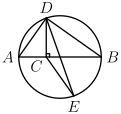
Let be a diameter of a circle and be a point on with Let and be points on the circle such that and is a second diameter. What is the ratio of the area of to the area of
Pista pequeña:
Sea el centro. Como y halla .
Let be the center. Since and find
Pista grande:
y tienen áreas iguales porque es el punto medio de .
and have equal areas because is the midpoint of
Solución:
Sea el centro. Como tenemos y así que
Los triángulos y comparten la misma altura desde hasta la recta así que
Como es el punto medio de los triángulos y tienen áreas iguales, así que
Así, la respuesta correcta es C.
Let be the center. Since we have and so
Triangles and share the same altitude from to line so
Because is the midpoint of triangles and have equal areas, so
Thus, the correct answer is C.
16.
Se dibujan tres círculos de radio en el primer cuadrante del plano . El primer círculo es tangente a ambos ejes, el segundo es tangente al primer círculo y al eje , y el tercero es tangente al primer círculo y al eje . Un círculo de radio es tangente a ambos ejes y al segundo y tercer círculos. ¿Cuánto vale ?
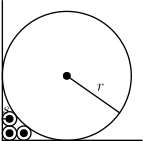
Three circles of radius are drawn in the first quadrant of the -plane. The first circle is tangent to both axes, the second is tangent to the first circle and the -axis, and the third is tangent to the first circle and the -axis. A circle of radius is tangent to both axes and to the second and third circles. What is
Pista pequeña:
Ubica los centros según sus radios: el círculo grande está en y el segundo círculo pequeño en .
Place the centers by their radii: the big circle is at and the second small circle at
Pista grande:
La distancia entre el centro grande y un centro pequeño tangente es igual a aplica el teorema de Pitágoras a las separaciones horizontal y vertical.
The distance between the big center and a tangent small center equals apply the Pythagorean theorem to the horizontal and vertical gaps
Solución:
Coloca el centro del círculo grande en y el centro del segundo círculo pequeño en Son tangentes externamente, así que la distancia entre centros es
Las separaciones horizontal y vertical son y así que
Al desarrollar se obtiene Como obtenemos así que
Así, la respuesta correcta es D.
Put the big circle’s center at and the second small circle’s center at They are externally tangent, so the distance between centers is
The horizontal and vertical gaps are and so
Expanding gives Since we get so
Thus, the correct answer is D.
17.
Un cubo unitario se corta dos veces para formar tres prismas triangulares, dos de los cuales son congruentes, como se muestra en la Figura Luego el cubo se corta de la misma manera a lo largo de las líneas discontinuas mostradas en la Figura Esto crea nueve piezas. ¿Cuál es el volumen de la pieza que contiene el vértice ?
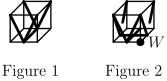
A unit cube is cut twice to form three triangular prisms, two of which are congruent, as shown in Figure The cube is then cut in the same manner along the dashed lines shown in Figure This creates nine pieces. What is the volume of the piece that contains vertex
Pista pequeña:
La pieza en es una pirámide; identifica su base y su ápice.
The piece at is a pyramid; identify its base and apex
Pista grande:
Si el área de su base es y su altura es usa .
If its base area is and height is use
Solución:
Cada uno de los dos conjuntos de cortes va desde una arista superior hasta la línea media de la cara inferior. Cerca de tallan una pirámide cuadrangular. Su base es la cuarta parte de la cara inferior adyacente a y su ápice está a una unidad por encima del centro de la cara inferior.
Su base es un cuadrado de lado (una cuarta parte de la cara inferior) y su altura es la altura completa Por lo tanto el volumen es
Así, la respuesta correcta es A.
The two perpendicular sets of cuts each run from top edges to midlines of the bottom face. Near they carve out a square pyramid. Its base is the quarter of the bottom face adjacent to and its apex lies one unit above the center of the bottom face.
Thus its base is a square of side and its altitude is the full height Therefore the volume is
Thus, the correct answer is A.
18.
Llamamos a un número «de apariencia prima» si es compuesto pero no divisible por o Los tres números de apariencia prima más pequeños son y Hay números primos menores que ¿Cuántos números de apariencia prima hay menores que ?
Call a number “prime-looking” if it is composite but not divisible by or The three smallest prime-looking numbers are and There are prime numbers less than How many prime-looking numbers are there less than
Pista pequeña:
Usa inclusión-exclusión para contar los números menores que divisibles por o .
Use inclusion-exclusion to count the numbers below divisible by or
Pista grande:
De los números coprimos con quita los primos y el número .
From the numbers coprime to remove the primes and the number
Solución:
Entre los números del al la inclusión-exclusión da que son divisibles por o
Eso deja números coprimos con De estos, son primos (los primos menos ), y no es ni primo ni compuesto.
Los números restantes son de apariencia prima.
Así, la respuesta correcta es A.
Among the numbers from to inclusion-exclusion gives that are divisible by or
That leaves numbers coprime to Of these, are primes (the primes minus ), and is neither prime nor composite.
The remaining numbers are prime-looking.
Thus, the correct answer is A.
19.
Un odómetro defectuoso de un auto pasa del dígito al dígito saltándose siempre el dígito sin importar la posición. Por ejemplo, tras recorrer una milla el odómetro cambió de a Si el odómetro ahora marca ¿cuántas millas ha recorrido realmente el auto?
A faulty car odometer proceeds from digit to digit always skipping the digit regardless of position. For example, after traveling one mile the odometer changed from to If the odometer now reads how many miles has the car actually traveled?
Pista pequeña:
El odómetro solo muestra dígitos distintos, así que en realidad cuenta en base .
The odometer only ever shows distinct digits, so it is really counting in base
Pista grande:
Asocia cada dígito mostrado a su valor en base : representan .
Map each shown digit to its base- value: stand for
Solución:
Como el odómetro nunca muestra un usa solo símbolos y cuenta en base donde sus dígitos representan, en base , los dígitos
La lectura corresponde entonces a en base que es igual a
Así, la respuesta correcta es B.
Because the odometer never displays a it uses only symbols and counts in base where its digits represent the base- digits
The reading therefore corresponds to in base which equals
Thus, the correct answer is B.
20.
Para cada en define Sea y para cada entero ¿Para cuántos valores de en se cumple ?
For each in define Let and for each integer For how many values of in is
Pista pequeña:
Sea el número de soluciones de halla una recursión para .
Let be the number of solutions of find a recursion for
Pista grande:
Como aplica cada uno de y sobre todo cada solución se divide en dos, lo que da .
Because maps each of and onto all of each solution splits into two, giving
Solución:
Sea el número de soluciones de en Como aplica cada una de las dos mitades y sobre todo cada solución de proviene de dos valores de (uno en cada mitad).
El valor de frontera satisface así que no se pierde ninguna solución, lo que da
Como concluimos que
Así, la respuesta correcta es E.
Let count the solutions of in Since maps each of the two halves and onto all of every solution of comes from two values of (one in each half).
The boundary value satisfies so no solutions are lost, giving
Since we conclude
Thus, the correct answer is E.
21.
¿Cuántas ternas ordenadas de enteros con y satisfacen a la vez y ?
How many ordered triples of integers with and satisfy both and
Pista pequeña:
Reescribe la primera condición como .
Rewrite the first condition as
Pista grande:
Si entonces es astronómicamente mayor que solo y pueden funcionar.
If then is astronomically larger than only and can work
Solución:
La condición significa
Si entonces lo que supera enormemente a así que es imposible.
Para así que da Para así que da
Hay ternas así.
Así, la respuesta correcta es C.
The condition means
If then which vastly exceeds so is impossible.
For so gives For so gives
There are such triples.
Thus, the correct answer is C.
22.
Una caja rectangular está inscrita en una esfera de radio El área de la superficie de es y la suma de las longitudes de sus aristas es ¿Cuánto vale ?
A rectangular box is inscribed in a sphere of radius The surface area of is and the sum of the lengths of its edges is What is
Pista pequeña:
Sean las dimensiones La suma de aristas da y el área de la superficie da .
Let the dimensions be The edge sum gives and the surface area gives
Pista grande:
El diámetro de la esfera es la diagonal espacial, por lo tanto .
The sphere’s diameter is the space diagonal:
Solución:
Sean las dimensiones Las aristas dan así que y el área de la superficie da
La diagonal espacial es un diámetro de la esfera, así que
Por lo tanto y
Así, la respuesta correcta es B.
Let the dimensions be The edges give so and the surface area gives
The space diagonal is a diameter of the sphere, so
Thus and
Thus, the correct answer is B.
23.
Se eligen al azar dos números distintos y del conjunto ¿Cuál es la probabilidad de que sea un entero?
Two distinct numbers and are chosen randomly from the set What is the probability that is an integer?
Pista pequeña:
Escribe y de modo que .
Write and so
Pista grande:
Para cada cuenta los múltiplos de entre distintos del propio , es decir, .
For each count the multiples of among other than itself, namely
Solución:
Sea y Entonces que es entero exactamente cuando es múltiplo de
Para cada el número de válidos en es Sumando sobre se obtiene pares ordenados
Como hay pares ordenados de elementos distintos, la probabilidad es
Así, la respuesta correcta es B.
Let and Then which is an integer exactly when is a multiple of
For each the number of valid in is Summing over gives ordered pairs
Since there are ordered pairs of distinct elements, the probability is
Thus, the correct answer is B.
24.
Sea ¿Para cuántos polinomios existe un polinomio de grado tal que ?
Let For how many polynomials does there exist a polynomial of degree such that
Pista pequeña:
Compara los grados: tiene grado y tiene grado así que .
Compare degrees: has degree and has degree so
Pista grande:
Para el lado derecho es así que cada uno de está en descarta las ternas que dan grado menor que .
For the right side is so each of lies in discard the triples giving degree less than
Solución:
Como tiene grado y tiene grado necesitamos Un polinomio cuadrático queda determinado por la terna ordenada
En el lado derecho se anula, así que lo que obliga a que cada uno de esté en Eso da ternas.
Cinco de ellas dan un polinomio de grado menor que las constantes de y las lineales de y de Las otras ternas no son colineales y dan polinomios cuadráticos genuinos.
Así, la respuesta correcta es B.
Since has degree and has degree we need A quadratic is determined by the ordered triple
At the right side vanishes, so forcing each of into That gives triples.
Five of them give a polynomial of degree less than the constants from and the linear from and from The other triples are non-collinear and yield genuine quadratics.
Thus, the correct answer is B.
25.
Sea el conjunto de todos los puntos con coordenadas donde y se eligen cada uno del conjunto ¿Cuántos triángulos equiláteros tienen todos sus vértices en ?
Let be the set of all points with coordinates where and are each chosen from the set How many equilateral triangles have all their vertices in
Pista pequeña:
Un triángulo equilátero en esta cuadrícula debe tener los tres lados iguales, así que cada lado es una diagonal de cara o un segmento inclinado específico.
An equilateral triangle in this grid must have all three sides equal, so each side is a face diagonal or a specific slanted segment
Pista grande:
Cuenta por separado los triángulos cuyos lados son diagonales de caras de cubos unitarios, diagonales de caras del cubo grande, y segmentos de punto medio de arista a punto medio de arista de longitud .
Count separately the triangles whose sides are unit-cube face diagonals, big-cube face diagonals, and edge-midpoint-to-edge-midpoint segments of length
Solución:
Los tres lados iguales de un triángulo así deben tener todos la misma longitud. Revisando las posibles longitudes al cuadrado en la cuadrícula , solo aparecen tres familias de lado.
Diagonales de cara de un cubo unitario (longitud ): cada uno de los cubos unitarios aporta triángulos, uno en cada esquina, para
Diagonales de cara del cubo (longitud ): las tres caras que se juntan en un vértice forman un triángulo, lo que da triángulos.
Segmentos entre puntos medios de aristas (longitud que unen los puntos medios de dos aristas): cada uno de los puntos medios de arista es vértice de dos de esos triángulos, para
El total es
Así, la respuesta correcta es C.
The three equal sides of such a triangle must all have the same length. Checking the possible squared lengths in the grid, only three families of side occur.
Face diagonals of a unit cube (length ): each of the unit cubes contributes triangles, one at each corner, for
Face diagonals of the cube (length ): the three faces meeting at a vertex form one triangle, giving triangles.
Edge-midpoint segments (length joining midpoints of two edges): each of the edge midpoints is a vertex of two such triangles, for
The total is
Thus, the correct answer is C.