
Soluciones del 2003 AMC 12A
Desplázate hacia abajo para ver las soluciones preparadas profesionalmente de LIVE by Po-Shen Loh, imprime las soluciones en PDF, consulta la clave de respuestas, o haz el examen cronometrado completo.
Todos los problemas se usan con el permiso legal oficial de la Mathematical Association of America (MAA).
1.
¿Cuál es la diferencia entre la suma de los primeros números pares y la suma de los primeros números impares?
What is the difference between the sum of the first even counting numbers and the sum of the first odd counting numbers?
Pista pequeña:
Empareja cada número par con el número impar justo debajo de él.
Pair each even number with the odd number just below it
Pista grande:
Cada uno de los pares difiere en .
Each of the pairs differs by
Solución:
El -ésimo número par es y el -ésimo número impar es que difieren en
Sumando esta diferencia sobre los pares se obtiene
Por lo tanto, la respuesta correcta es D.
The th even counting number is and the th odd counting number is which differ by
Summing this difference over all pairs gives
Thus, the correct answer is D.
2.
Los miembros de la Liga de Fútbol Rockham compran calcetines y camisetas. Un par de calcetines cuesta y cada camiseta cuesta más que un par de calcetines. Cada miembro necesita un par de calcetines y una camiseta para los partidos en casa, y otro par de calcetines y una camiseta para los partidos de visitante. Si el costo total es ¿cuántos miembros hay en la Liga?
Members of the Rockham Soccer League buy socks and T-shirts. Socks cost per pair and each T-shirt costs more than a pair of socks. Each member needs one pair of socks and a shirt for home games and another pair of socks and a shirt for away games. If the total cost is how many members are in the League?
Pista pequeña:
Una camiseta cuesta .
A T-shirt costs
Pista grande:
Cada miembro compra dos pares de calcetines y dos camisetas.
Each member buys two pairs of socks and two shirts
Solución:
Una camiseta cuesta dólares.
Cada miembro necesita dos pares de calcetines y dos camisetas, con un costo de dólares.
El número de miembros es
Por lo tanto, la respuesta correcta es B.
A T-shirt costs dollars.
Each member needs two pairs of socks and two shirts, costing dollars.
The number of members is
Thus, the correct answer is B.
3.
Una caja sólida mide cm por cm por cm. Se forma un nuevo sólido quitando de cada esquina de esta caja un cubo de cm de lado. ¿Qué porcentaje del volumen original se elimina?
A solid box is cm by cm by cm. A new solid is formed by removing a cube cm on a side from each corner of this box. What percent of the original volume is removed?
Pista pequeña:
La caja tiene esquinas.
The box has corners
Pista grande:
Cada cubo quitado tiene volumen .
Each removed cube has volume
Solución:
El volumen original es
Se quitan ocho cubos de esquina, cada uno de volumen para un total de
La fracción eliminada es que corresponde a
Por lo tanto, la respuesta correcta es D.
The original volume is
Eight corner cubes are removed, each of volume totaling
The fraction removed is which is
Thus, the correct answer is D.
4.
Mary tarda minutos en caminar cuesta arriba km desde su casa hasta la escuela, pero solo tarda minutos en caminar de la escuela a su casa por la misma ruta. ¿Cuál es su rapidez promedio, en km/hr, para el viaje de ida y vuelta?
It takes Mary minutes to walk uphill km from her home to school, but it takes her only minutes to walk from school to home along the same route. What is her average speed, in km/hr, for the round trip?
Pista pequeña:
La rapidez promedio es la distancia total dividida entre el tiempo total.
Average speed is total distance divided by total time
Pista grande:
El tiempo total es minutos, es decir hora.
The total time is minutes hour
Solución:
Mary camina en total km en minutos, que son hora.
Su rapidez promedio es km/hr.
Por lo tanto, la respuesta correcta es A.
Mary walks a total of km in minutes, which is hour.
Her average speed is km/hr.
Thus, the correct answer is A.
5.
La suma de los dos números de cifras y es ¿Cuánto vale ?
The sum of the two -digit numbers and is What is
Pista pequeña:
Nota que .
Pista grande:
Los dos números comparten las mismas tres cifras iniciales .
The two numbers share the same leading three digits
Solución:
Escribe y
Su suma es así que
Entonces
Por lo tanto, la respuesta correcta es E.
Write and
Their sum is so
Then
Thus, the correct answer is E.
6.
Define como para todos los números reales y ¿Cuál de los siguientes enunciados no es verdadero?
Define to be for all real numbers and Which of the following statements is not true?
para todos y
for all and
para todos y
for all and
para todos
for all
para todos
for all
si
if
Pista pequeña:
Nota que .
Pista grande:
Prueba un valor negativo de .
Test a negative value of
Solución:
Como el enunciado (C) afirma que para todo lo cual falla cuando Por ejemplo,
Todos los demás enunciados se deducen directamente de las propiedades del valor absoluto.
Por lo tanto, la respuesta correcta es C.
Since statement (C) claims for all which fails when For example,
Every other statement follows directly from properties of the absolute value.
Thus, the correct answer is C.
7.
¿Cuántos triángulos no congruentes con perímetro tienen lados de longitud entera?
How many non-congruent triangles with perimeter have integer side lengths?
Pista pequeña:
El lado más largo debe ser menor que la mitad del perímetro.
The longest side must be less than half the perimeter
Pista grande:
El lado más largo es a lo sumo .
The longest side is at most
Solución:
Sean los lados con La desigualdad triangular exige así que lo que obliga a
Entonces con lo que da los triángulos y
Por lo tanto, la respuesta correcta es B.
Let the sides be with The triangle inequality requires so forcing
Then with giving the triangles and
Thus, the correct answer is B.
8.
¿Cuál es la probabilidad de que un divisor positivo de elegido al azar sea menor que ?
What is the probability that a randomly drawn positive factor of is less than
Pista pequeña:
tiene divisores.
has factors
Pista grande:
Cuenta los divisores desde hasta .
Count the factors from through
Solución:
El número tiene divisores positivos:
Seis de ellos son menores que a saber así que la probabilidad es
Por lo tanto, la respuesta correcta es E.
The number has positive factors:
Six of them are less than namely so the probability is
Thus, the correct answer is E.
9.
El conjunto de puntos en el plano es simétrico respecto al origen, a ambos ejes coordenados y a la recta Si está en ¿cuál es el menor número de puntos que puede tener ?
A set of points in the -plane is symmetric about the origin, both coordinate axes, and the line If is in what is the smallest number of points in
Pista pequeña:
Reflejar sobre da .
Reflecting over gives
Pista grande:
Las simetrías producen todas las combinaciones de signos y el intercambio de coordenadas.
The symmetries produce every sign choice and coordinate swap
Solución:
Reflejar respecto a da y reflejar respecto a los ejes da todos los puntos y
Hay puntos de este tipo, y este conjunto ya es simétrico respecto al origen, a ambos ejes y a
Por lo tanto, la respuesta correcta es D.
Reflecting across gives and reflecting across the axes gives all points and
There are such points, and this set is already symmetric about the origin, both axes, and
Thus, the correct answer is D.
10.
Al, Bert y Carl son los ganadores de un sorteo escolar de un montón de dulces de Halloween, que deben repartir en una razón de respectivamente. Debido a cierta confusión llegan en momentos distintos a reclamar sus premios, y cada uno supone que es el primero en llegar. Si cada uno toma lo que cree que es su parte correcta de los dulces, ¿qué fracción de los dulces queda sin reclamar?
Al, Bert, and Carl are the winners of a school drawing for a pile of Halloween candy, which they are to divide in a ratio of respectively. Due to some confusion they come at different times to claim their prizes, and each assumes he is the first to arrive. If each takes what he believes to be his correct share of candy, what fraction of the candy goes unclaimed?
Pista pequeña:
Las tres partes son del total.
The three shares are of the whole
Pista grande:
Cada persona deja una fracción fija de los dulces presentes, así que el orden no importa.
Each person leaves a fixed fraction of whatever candy is present, so the order does not matter
Solución:
Las partes son del montón.
Cada persona supone que es el primero, así que Al deja Bert deja y Carl deja de los dulces presentes cuando llega.
La fracción sin reclamar es sin importar el orden.
Por lo tanto, la respuesta correcta es D.
The shares are of the pile.
Each person assumes he is first, so Al leaves Bert leaves and Carl leaves of the candy present when he arrives.
The unclaimed fraction is regardless of the order.
Thus, the correct answer is D.
11.
Un cuadrado y un triángulo equilátero tienen el mismo perímetro. Sea el área del círculo circunscrito al cuadrado y el área del círculo circunscrito al triángulo. Halla
A square and an equilateral triangle have the same perimeter. Let be the area of the circle circumscribed about the square and be the area of the circle circumscribed about the triangle. Find
Pista pequeña:
Elige un perímetro común conveniente, como .
Choose a convenient common perimeter, such as
Pista grande:
El circunradio de un cuadrado es la mitad de su diagonal; el de un triángulo equilátero es .
A square’s circumradius is half its diagonal; an equilateral triangle’s is
Solución:
Sea el perímetro común de modo que el cuadrado tiene lado y el triángulo tiene lado
El circunradio del cuadrado es así que
El circunradio del triángulo es así que
Entonces
Por lo tanto, la respuesta correcta es C.
Let the common perimeter be so the square has side and the triangle has side
The square’s circumradius is so
The triangle’s circumradius is so
Then
Thus, the correct answer is C.
12.
Sally tiene cinco cartas rojas numeradas del al y cuatro cartas azules numeradas del al Apila las cartas de modo que los colores se alternen y que el número de cada carta roja divida exactamente al número de cada carta azul vecina. ¿Cuál es la suma de los números de las tres cartas centrales?
Sally has five red cards numbered through and four blue cards numbered through She stacks the cards so that the colors alternate and so that the number on each red card divides evenly into the number on each neighboring blue card. What is the sum of the numbers on the middle three cards?
Pista pequeña:
Entre los números azules el rojo solo divide a y el rojo solo divide a .
Among the blue numbers the red divides only and the red divides only
Pista grande:
Trabaja hacia el centro desde los extremos forzados y .
Work inward from the forced ends and
Solución:
Como solo divide a y solo divide a entre los dos extremos deben ser
Como solo divide a y la siguiente carta es y como solo divide a y la pila completa es
Las tres cartas centrales son que suman
Por lo tanto, la respuesta correcta es E.
Since divides only and divides only among the two ends must be
Because divides only and the next card is and since divides only and the full stack is
The middle three cards are which sum to
Thus, the correct answer is E.
13.
El polígono encerrado por las líneas continuas de la figura consta de cuadrados congruentes unidos lado con lado. Se une otro cuadrado congruente a una arista en una de las nueve posiciones indicadas. ¿Cuántos de los nueve polígonos resultantes se pueden doblar para formar un cubo al que le falta una cara?
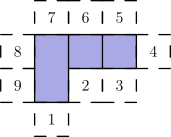
The polygon enclosed by the solid lines in the figure consists of congruent squares joined edge-to-edge. One more congruent square is attached to an edge at one of the nine positions indicated. How many of the nine resulting polygons can be folded to form a cube with one face missing?
Pista pequeña:
Un cubo al que le falta una cara necesita cuadrados.
A cube with one face missing needs squares
Pista grande:
Dobla la pieza de cuatro cuadrados parcialmente alrededor de un cubo, y luego verifica cuál cuadrado añadido cae sobre una cara que aún está abierta.
Fold the four-square piece partway around a cube, then check which attached square lands on a still-open face
Solución:
Un cubo al que le falta una cara tiene caras, así que el quinto cuadrado debe plegarse sobre una cara que la pieza de cuatro cuadrados aún no ocupa. Siguiendo la cara alcanzada por cada unión, las posiciones y se pliegan sobre una cara ya ocupada y se superponen. Cada una de las posiciones y se pliega sobre una cara libre. Por tanto, funcionan de las nueve posiciones.
Así, la respuesta correcta es E.
A cube missing one face has faces, so the fifth square must fold onto a face not already occupied by the four-square piece. Tracing the face reached by each attachment, positions and fold onto a face already occupied and overlap it. Each of positions and folds onto an unoccupied face. Therefore of the nine positions work.
Thus, the correct answer is E.
14.
Los puntos y están en el plano del cuadrado de modo que y son triángulos equiláteros. Si tiene un área de halla el área de
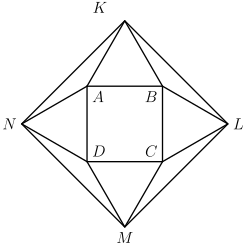
Points and lie in the plane of the square so that and are equilateral triangles. If has an area of find the area of
Pista pequeña:
es un cuadrado por la simetría rotacional de la figura.
is a square by the rotational symmetry of the figure
Pista grande:
Su diagonal es igual al lado del cuadrado más dos veces la altura del triángulo .
Its diagonal equals the square’s side plus twice the triangle height
Solución:
El cuadrado tiene lado Por la simetría rotacional de , también es un cuadrado.
Cada triángulo equilátero sobre un lado de longitud tiene altura así que la diagonal
Un cuadrado con diagonal tiene área así que
Por lo tanto, la respuesta correcta es D.
The square has side By the rotational symmetry, is also a square.
Each equilateral triangle on a side of length has height so the diagonal
A square with diagonal has area so
Thus, the correct answer is D.
15.
Un semicírculo de diámetro se apoya en la parte superior de un semicírculo de diámetro como se muestra. El área sombreada dentro del semicírculo menor y fuera del semicírculo mayor se llama lúnula. Determina el área de esta lúnula.
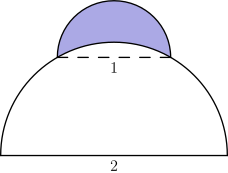
A semicircle of diameter sits at the top of a semicircle of diameter as shown. The shaded area inside the smaller semicircle and outside the larger semicircle is called a lune. Determine the area of this lune.
Pista pequeña:
El diámetro pequeño es una cuerda de longitud en el círculo grande de radio , que abarca un arco de .
The small diameter is a chord of length in the large radius- circle, spanning a arc
Pista grande:
Lúnula (triángulo equilátero semicírculo pequeño) el sector de del círculo grande.
Lune (equilateral triangle small semicircle) the sector of the large circle
Solución:
El diámetro del semicírculo pequeño es una cuerda de longitud en el círculo grande de radio así que subtiende un ángulo de en el centro.
La región limitada por esa cuerda y el arco pequeño es un triángulo equilátero de área coronado por el semicírculo pequeño de área
Restando el sector de del círculo grande, se obtiene el área de la lúnula
Por lo tanto, la respuesta correcta es C.
The small semicircle’s diameter is a chord of length in the large circle of radius so it subtends a angle at the center.
The region bounded by that chord and the small arc is an equilateral triangle of area topped by the small semicircle of area
Subtracting the sector of the large circle, gives the lune area
Thus, the correct answer is C.
16.
Se elige un punto al azar en el interior del triángulo equilátero ¿Cuál es la probabilidad de que tenga mayor área que cada uno de y ?
A point is chosen at random in the interior of equilateral triangle What is the probability that has a greater area than each of and
Pista pequeña:
Los tres triángulos comparten bases iguales, así que sus áreas dependen solo de las distancias de a los lados.
The three triangles share equal bases, so their areas depend only on ’s distances to the sides
Pista grande:
Por la simetría de orden tres, cada lado produce el triángulo más grande con la misma frecuencia.
By the threefold symmetry each side yields the largest triangle equally often
Solución:
Los triángulos y tienen bases iguales (los lados del triángulo equilátero), así que sus áreas son proporcionales a las distancias de a esos lados.
Por la simetría de orden tres del triángulo equilátero, es el más grande con la misma probabilidad que cada uno de los otros dos, así que esa probabilidad es
Por lo tanto, la respuesta correcta es C.
The triangles and have equal bases (the sides of the equilateral triangle), so their areas are proportional to the distances from to those sides.
By the threefold symmetry of the equilateral triangle, is the largest with the same probability as each of the other two, so that probability is
Thus, the correct answer is C.
17.
El cuadrado tiene lados de longitud y es el punto medio de Un círculo de radio y centro corta a un círculo de radio y centro en los puntos y ¿Cuál es la distancia de a ?
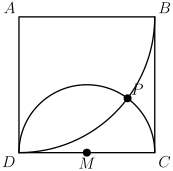
Square has sides of length and is the midpoint of A circle with radius and center intersects a circle with radius and center at points and What is the distance from to
Pista pequeña:
Coloca en el origen con en el eje y en el eje .
Put at the origin with on the -axis and on the -axis
Pista grande:
La distancia de a es la coordenada de .
The distance from to is the -coordinate of
Solución:
Coloca y El círculo centrado en es y el círculo centrado en es
Al resolver estas ecuaciones se obtiene la intersección
Como está sobre el eje , la distancia de a es su coordenada ,
Por lo tanto, la respuesta correcta es B.
Place and The circle centered at is and the circle centered at is
Solving these equations gives the intersection
Since lies on the -axis, the distance from to is its -coordinate,
Thus, the correct answer is B.
18.
Sea un número de cifras, y sean y el cociente y el residuo, respectivamente, cuando se divide entre ¿Para cuántos valores de es divisible entre ?
Let be a -digit number, and let and be the quotient and remainder, respectively, when is divided by For how many values of is divisible by
Pista pequeña:
Observa que .
Pista grande:
Como es múltiplo de .
Since is a multiple of
Solución:
Como y es divisible entre tenemos
Así que es múltiplo de exactamente cuando es múltiplo de
Entre los números de cifras, la cantidad de múltiplos de es
Por lo tanto, la respuesta correcta es B.
Since and is divisible by we have
So is a multiple of exactly when is a multiple of
Among the -digit numbers, the count of multiples of is
Thus, the correct answer is B.
19.
Una parábola con ecuación se refleja respecto al eje . La parábola y su reflexión se trasladan horizontalmente cinco unidades en direcciones opuestas para convertirse en las gráficas de y respectivamente. ¿Cuál de las siguientes opciones describe la gráfica de ?
A parabola with equation is reflected about the -axis. The parabola and its reflection are translated horizontally five units in opposite directions to become the graphs of and respectively. Which of the following describes the graph of
una parábola tangente al eje
a parabola tangent to the -axis
una parábola no tangente al eje
a parabola not tangent to the -axis
una recta horizontal
a horizontal line
una recta no horizontal
a non-horizontal line
la gráfica de una función cúbica
the graph of a cubic function
Pista pequeña:
Escribe la parábola como su reflexión es .
Write the parabola as its reflection is
Pista grande:
Tras los desplazamientos opuestos , suma y y observa cómo se cancelan los términos cuadráticos.
After the opposite shifts, add and and watch the squared terms cancel
Solución:
Escribe la parábola en forma de vértice Su reflexión respecto al eje es
Al desplazar en direcciones opuestas se obtiene y
Al sumar, los términos cuadráticos se cancelan y que es una recta no horizontal ya que
Por lo tanto, la respuesta correcta es D.
Write the parabola in vertex form Its reflection about the -axis is
Shifting in opposite directions gives and
Adding, the squared terms cancel and which is a non-horizontal line since
Thus, the correct answer is D.
20.
¿Cuántos arreglos de letras con A, B y C no tienen ninguna A en las primeras letras, ninguna B en las letras siguientes y ninguna C en las últimas letras?
How many -letter arrangements of A’s, B’s, and C’s have no A’s in the first letters, no B’s in the next letters, and no C’s in the last letters?
Pista pequeña:
En el primer bloque (sin A), supón que hay B y C.
In the first block (no A’s), suppose there are B’s and C’s
Pista grande:
Fijar determina las cantidades de letras en los tres bloques, cada una elegida con colocaciones.
Fixing determines the letter counts in all three blocks, each chosen with placements
Solución:
Supón que el primer bloque contiene B y C. Las C restantes deben ir en el segundo bloque (ya que el tercero no tiene C), lo que obliga a que haya A allí.
Entonces el tercer bloque contiene las A restantes y B.
Para cada las B del primer bloque, las C del segundo y las A del tercero se pueden colocar de maneras, así que el total es
Por lo tanto, la respuesta correcta es A.
Suppose the first block holds B’s and C’s. The remaining C’s must go in the second block (since the third has no C’s), forcing A’s there.
Then the third block contains the remaining A’s and B’s.
For each the B’s in the first block, C’s in the second, and A’s in the third can be placed in ways, so the total is
Thus, the correct answer is A.
21.
La gráfica del polinomio
tiene cinco intersecciones distintas con el eje , una de las cuales está en ¿Cuál de los siguientes coeficientes no puede ser cero?
The graph of the polynomial
has five distinct -intercepts, one of which is at Which of the following coefficients cannot be zero?
Pista pequeña:
obliga a que .
forces
Pista grande:
Factoriza el término constante del cuártico restante es el producto de las cuatro raíces no nulas.
Factor out the constant term of the remaining quartic is the product of the four nonzero roots
Solución:
Como es una intersección, así que
Las cuatro intersecciones restantes son no nulas y distintas, y es igual a su producto, que por lo tanto es no nulo.
Cualquiera de puede ser cero para elecciones adecuadas de esas raíces, pero
Por lo tanto, la respuesta correcta es D.
Since is an intercept, so
The four remaining intercepts are nonzero and distinct, and equals their product, which is therefore nonzero.
Any of can be zero for suitable choices of those roots, but
Thus, the correct answer is D.
22.
Los objetos y se mueven simultáneamente en el plano coordenado mediante una sucesión de pasos, cada uno de longitud uno. El objeto parte de y cada uno de sus pasos es hacia la derecha o hacia arriba, ambos igualmente probables. El objeto parte de y cada uno de sus pasos es hacia la izquierda o hacia abajo, ambos igualmente probables. ¿Cuál de los siguientes valores es el más cercano a la probabilidad de que los objetos se encuentren?
Objects and move simultaneously in the coordinate plane via a sequence of steps, each of length one. Object starts at and each of its steps is either right or up, both equally likely. Object starts at and each of its steps is either left or down, both equally likely. Which of the following is closest to the probability that the objects meet?
Pista pequeña:
Solo pueden encontrarse después de que cada uno haya dado pasos, a lo largo de la recta .
They can meet only after each has taken steps, along the line
Pista grande:
El número de pares de trayectorias que se encuentran es de un total de pares.
The number of meeting path-pairs equals out of total pairs
Solución:
Los objetos están a pasos de distancia, así que solo pueden encontrarse después de que cada uno dé pasos, sobre la antidiagonal
Emparejar la trayectoria de seis pasos de con la trayectoria de seis pasos invertida de pone en correspondencia uno a uno los pares que se encuentran con los caminos monótonos de a
La probabilidad es que es la más cercana a
Por lo tanto, la respuesta correcta es C.
The objects are steps apart, so they can only meet after each takes steps, on the anti-diagonal
Pairing ’s six-step path with ’s reversed six-step path matches meeting pairs one-to-one with the monotone walks from to
The probability is which is closest to
Thus, the correct answer is C.
23.
¿Cuántos cuadrados perfectos son divisores del producto ?
How many perfect squares are divisors of the product
Pista pequeña:
Combina estos factoriales para obtener .
Combine the factorials into
Pista grande:
En un divisor cuadrado, el exponente de cada primo debe ser par.
A square divisor uses an even exponent of each prime
Solución:
El producto es
Un divisor cuadrado tiene la forma con y
El número de elecciones es
Por lo tanto, la respuesta correcta es B.
The product is
A perfect-square divisor has the form with and
The number of choices is
Thus, the correct answer is B.
24.
Si ¿cuál es el mayor valor posible de ?
If what is the largest possible value of
Pista pequeña:
Simplifica a .
Simplify to
Pista grande:
Con usa .
With use
Solución:
Desarrolla:
Sea Como por AM-GM, la expresión es a lo sumo
La igualdad se cumple cuando es decir, cuando así que el mayor valor es
Por lo tanto, la respuesta correcta es B.
Expand:
Let Since by AM-GM, the expression is at most
Equality holds when that is, when so the largest value is
Thus, the correct answer is B.
25.
Sea ¿Para cuántos valores reales de existe al menos un valor positivo de para el cual el dominio de y el rango de son el mismo conjunto?
Let For how many real values of is there at least one positive value of for which the domain of and the range of are the same set?
infinitos
infinitely many
Pista pequeña:
Si para todo , el dominio y el rango son ambos .
If both the domain and range equal for every
Pista grande:
Si , el dominio es y el máximo de es .
For the domain is and the maximum of is
Solución:
Si entonces tiene dominio y rango ambos iguales a así que funciona.
Si el dominio es mientras que el rango es así que no existe tal .
Si el dominio es y el rango es Igualando los extremos derechos se obtiene así que lo que da
Por lo tanto, hay valores de y la respuesta correcta es C.
If then has domain and range both so works.
If the domain is while the range is so no such exists.
If the domain is and the range is Equating the right endpoints gives so giving
Thus there are values of and the correct answer is C.