
Soluciones del 1970 AMC 12
Desplázate hacia abajo para ver las soluciones preparadas profesionalmente de LIVE by Po-Shen Loh, imprime las soluciones en PDF, consulta la clave de respuestas, o haz el examen cronometrado completo.
Todos los problemas se usan con el permiso legal oficial de la Mathematical Association of America (MAA).
1.
La cuarta potencia de es:
The fourth power of is:
Pista pequeña:
Simplifica desde el radical más interno hacia afuera
Simplify from the innermost radical outward
Pista grande:
Después de que el radical más interno se convierte en eleva al cuadrado dos veces
After the innermost radical becomes square twice
Solución:
El radical más interno es así que el número dado es Su cuarta potencia es
Por lo tanto, la respuesta correcta es E.
The innermost radical is so the given number is Its fourth power is
Therefore, the correct answer is E.
2.
Un cuadrado y un círculo tienen perímetros iguales. La razón entre el área del círculo y el área del cuadrado es:
A square and a circle have equal perimeters. The ratio of the area of the circle to the area of the square is:
Pista pequeña:
Sea el perímetro común
Let the common perimeter be
Pista grande:
Expresa el radio del círculo y el lado del cuadrado en función de , y luego divide sus áreas
Express the circle radius and square side in terms of , then divide their areas
Solución:
Si el perímetro común es entonces el círculo tiene radio y el cuadrado tiene lado Por lo tanto,
Por lo tanto, la respuesta correcta es A.
If the common perimeter is then the circle has radius and the square has side Therefore
Therefore, the correct answer is A.
3.
Si y entonces en función de es:
If and then in terms of is:
Pista pequeña:
Despeja en la primera ecuación
Solve the first equation for
Pista grande:
Usa y simplifica
Use and simplify
Solución:
De obtenemos así que
Por lo tanto, la respuesta correcta es C.
From we get so
Therefore, the correct answer is C.
4.
Sea el conjunto de todos los números que son la suma de los cuadrados de tres enteros consecutivos. Entonces podemos afirmar que:
Let be the set of all numbers which are the sum of the squares of three consecutive integers. Then we can say that:
Ningún elemento de es divisible por
No member of is divisible by
Ningún elemento de es divisible por , pero algún elemento es divisible por
No member of is divisible by but some member is divisible by
Ningún elemento de es divisible por ni por
No member of is divisible by or by
Ningún elemento de es divisible por ni por
No member of is divisible by or by
Ninguna de las anteriores
None of these
Pista pequeña:
Escribe los enteros como
Write the integers as
Pista grande:
La suma de sus cuadrados es examínala módulo y prueba un residuo módulo
Their squared sum is examine it modulo and test a residue modulo
Solución:
La suma es Siempre es congruente con así que ningún elemento de es divisible por Por otro lado, al tomar obtenemos que es divisible por
Por lo tanto, la respuesta correcta es B.
The sum is It is always congruent to so no member of is divisible by On the other hand, taking gives which is divisible by
Therefore, the correct answer is B.
5.
Si entonces donde es igual a:
If then where is equal to:
Pista pequeña:
Usa y
Use and
Pista grande:
El numerador se anula, pero el denominador no
The numerator vanishes while the denominator does not
Solución:
Como e
Por lo tanto, la respuesta correcta es D.
Because and
Therefore, the correct answer is D.
6.
El valor mínimo de para valores reales de es:
The smallest value of for real values of is:
Ninguna de las anteriores
None of these
Pista pequeña:
Completa el cuadrado
Complete the square
Pista grande:
Reescribe la expresión como
Rewrite the expression as
Solución:
Al completar el cuadrado obtenemos Como el mínimo se alcanza en y es igual a
Por lo tanto, la respuesta correcta es B.
Completing the square gives Since the minimum occurs at and equals
Therefore, the correct answer is B.
7.
Dentro del cuadrado de lado se trazan arcos de un cuarto de círculo de radio con centros en y Estos arcos se cortan en un punto dentro del cuadrado. ¿A qué distancia está del lado ?
Inside square with side quarter-circle arcs with radii and centers at and are drawn. These arcs intersect at a point inside the square. How far is from side
Pista pequeña:
Los dos radios que llegan a y el lado forman un triángulo equilátero
The two radii to and side form an equilateral triangle
Pista grande:
La altura desde hasta es ; réstala de la altura del cuadrado
The altitude from to is ; subtract it from the square’s height
Solución:
Como el triángulo es equilátero. Por lo tanto, la distancia perpendicular de a es La distancia entre los lados paralelos y es así que la distancia pedida es
Por lo tanto, la respuesta correcta es E.
Since triangle is equilateral. Thus the perpendicular distance from to is The distance between the parallel sides and is so the requested distance is
Therefore, the correct answer is E.
8.
Si y entonces:
If and then:
Pista pequeña:
Reescribe como y como
Rewrite as and as
Pista grande:
Convierte ambos logaritmos a base
Convert both logarithms to base
Solución:
Usando y
Por lo tanto, la respuesta correcta es B.
Using and
Therefore, the correct answer is B.
9.
Los puntos y están en el segmento y ambos se encuentran al mismo lado del punto medio de El punto divide en la razón y divide en la razón Si entonces la longitud del segmento es:
Points and are on line segment and both points are on the same side of the midpoint of Point divides in the ratio and divides in the ratio If then the length of segment is:
Pista pequeña:
Expresa y como fracciones de
Express and as fractions of
Pista grande:
Usa y , y luego resta
Use and , then subtract
Solución:
Las razones de división dan Como los dos puntos están al mismo lado del punto medio, Puesto que obtenemos
Por lo tanto, la respuesta correcta es C.
The division ratios give Because the two points are on the same side of the midpoint, Since we obtain
Therefore, the correct answer is C.
10.
Sea un decimal periódico infinito en el que se repiten los dígitos y Cuando se escribe como fracción irreducible, el denominador excede al numerador en:
Let be an infinite repeating decimal with the digits and repeating. When is written as a fraction in lowest terms, the denominator exceeds the numerator by:
Pista pequeña:
Separa el inicial de la parte periódica
Separate the initial from the repeating tail
Pista grande:
La parte periódica es
The tail is
Solución:
Tenemos El denominador excede al numerador en
Por lo tanto, la respuesta correcta es D.
We have The denominator exceeds the numerator by
Therefore, the correct answer is D.
11.
Si dos factores de son y el valor de es:
If two factors of are and the value of is:
Pista pequeña:
Aplica el teorema del factor en y
Apply the factor theorem at and
Pista grande:
Resuelve y
Solve and
Solución:
El teorema del factor da Al restar la segunda ecuación de la primera obtenemos así que y luego Por tanto,
Por lo tanto, la respuesta correcta es E.
The factor theorem gives Subtracting the second equation from the first gives so and then Hence
Therefore, the correct answer is E.
12.
Un círculo de radio es tangente a los lados y del rectángulo , y pasa por el punto medio de la diagonal El área del rectángulo, en función de es:
A circle with radius is tangent to sides and of rectangle and passes through the midpoint of diagonal The area of the rectangle, in terms of is:
Pista pequeña:
La tangencia a los dos lados opuestos hace que un lado del rectángulo sea igual a
Tangency to the two opposite sides makes one side of the rectangle equal to
Pista grande:
La recta desde el tercer punto de tangencia que pasa por el centro biseca la diagonal, de modo que la cuerda correspondiente es un diámetro
The line from the third tangency point through the center bisects the diagonal, making the corresponding chord a diameter
Solución:
El círculo es tangente a los lados paralelos y La separación entre ellos es su diámetro, así que Sea el punto de tangencia sobre sea el centro y sea el punto medio de
La recta es paralela a y está a mitad de camino entre y así que es el punto medio de y la recta contiene a Como está en el círculo y son colineales, Por tanto, es un segmento medio del triángulo de modo que Entonces el área es
Por lo tanto, la respuesta correcta es C.
Let the circle be tangent to the parallel sides and Their separation is its diameter, so Let be the tangency point on let be the center, and let be the midpoint of
The line is parallel to and halfway between and so is the midpoint of and the line contains Since lies on the circle and are collinear, Thus is a midsegment of triangle so Therefore the area is
Therefore, the correct answer is C.
13.
Se define la operación binaria mediante para todos los números positivos y Entonces, para todos los positivos, se cumple:
Given the binary operation defined by for all positive numbers and Then for all positive we have:
Ninguna de las anteriores
None of these
Pista pequeña:
Sustituye cada según la definición antes de comparar ambos lados
Replace every using the definition before comparing the two sides
Pista grande:
En la opción D, ambos lados se simplifican a una potencia con exponente
For choice D, both sides simplify to a power with exponent
Solución:
Para la opción D, Por lo tanto, esa identidad siempre se cumple. Las otras opciones afirmarían identidades generales falsas, como o
Por lo tanto, la respuesta correcta es D.
For choice D, Thus that identity always holds. The other choices would assert false general identities such as or
Therefore, the correct answer is D.
14.
Considera donde y son números positivos. Si las raíces de esta ecuación difieren en entonces es igual a:
Consider where and are positive numbers. If the roots of this equation differ by then equals:
Pista pequeña:
Usa la fórmula cuadrática para expresar la diferencia entre las raíces
Use the quadratic formula to express the difference of the roots
Pista grande:
La magnitud de la diferencia es
The difference has magnitude
Solución:
El valor absoluto de la diferencia entre las dos raíces es Por tanto, así que Como es positivo,
Por lo tanto, la respuesta correcta es A.
The two roots differ in absolute value by Hence so Since is positive,
Therefore, the correct answer is A.
15.
En el plano se trazan rectas que pasan por el punto y por los puntos de trisección del segmento que une y Una de estas rectas tiene la ecuación:
Lines in the -plane are drawn through the point and the trisection points of the line segment joining the points and One of these lines has the equation:
Pista pequeña:
Halla los dos puntos de trisección avanzando un tercio y dos tercios del vector de desplazamiento
Find the two trisection points by moving one-third and two-thirds of the displacement vector
Pista grande:
Los puntos de trisección son y ; halla la recta que une cualquiera de ellos con
The trisection points are and ; find the line from either one to
Solución:
El desplazamiento de a es Por lo tanto, los puntos de trisección son y La recta que pasa por y tiene pendiente así que o bien
Por lo tanto, la respuesta correcta es E.
The displacement from to is The trisection points are therefore and The line through and has slope so or
Therefore, the correct answer is E.
16.
Si es una función tal que y para entonces es igual a:
If is a function such that and such that for then is equal to:
Pista pequeña:
Calcula los términos uno por uno comenzando con
Compute the terms one at a time beginning with
Pista grande:
Usa la recurrencia sucesivamente para
Use the recurrence successively for
Solución:
Al aplicar la recurrencia sucesivamente, y
Por lo tanto, la respuesta correcta es C.
Applying the recurrence successively, and
Therefore, the correct answer is C.
17.
Si entonces para todos y tales que y se cumple:
If then for all and such that and we have:
Ninguna de las anteriores
None of these
Pista pequeña:
Como la hipótesis solo implica
Because the hypothesis gives only
Pista grande:
Prueba las afirmaciones restantes con valores positivos y negativos de
Test the remaining claims with both positive and negative choices of
Solución:
Como la hipótesis equivale a Entonces así que A es falsa. Al tomar , B y D son falsas. Al tomar , C es falsa porque Por lo tanto, ninguna de A-D se deduce en todos los casos.
Por lo tanto, la respuesta correcta es E.
Since the hypothesis is equivalent to Then so A is false. Taking makes B and D false. Taking makes C false because Thus none of A-D follows in every case.
Therefore, the correct answer is E.
18.
es igual a:
is equal to:
Pista pequeña:
Reconoce cada radicando como el cuadrado de un binomio
Recognize each radicand as a squared binomial
Pista grande:
Usa
Use
Solución:
Como y tanto como son positivos, la diferencia es
Por lo tanto, la respuesta correcta es A.
Since and both and are positive, the difference is
Therefore, the correct answer is A.
19.
La suma de una serie geométrica infinita de razón común , donde es y la suma de los cuadrados de los términos de esta serie es El primer término de la serie es:
The sum of an infinite geometric series with common ratio such that is and the sum of the squares of the terms of this series is The first term of the series is:
Pista pequeña:
Si el primer término es escribe una ecuación para cada suma infinita
If the first term is write one equation for each infinite sum
Pista grande:
Usa y , y luego cancela un factor
Use and , then cancel a factor of
Solución:
Sea el primer término. Entonces Como al dividir la segunda ecuación entre la primera obtenemos Por lo tanto, Al resolver obtenemos y
Por lo tanto, la respuesta correcta es C.
Let the first term be Then Since dividing the second equation by the first gives Thus Solving gives and
Therefore, the correct answer is C.
20.
Las rectas y están en un mismo plano. es el punto medio del segmento y y son perpendiculares a Entonces:
Lines and lie in a plane. is the midpoint of line segment and and are perpendicular to Then we:
siempre se cumple
always have
siempre se cumple
always have
a veces se cumple , pero no siempre
sometimes have but not always
siempre se cumple
always have
siempre se cumple
always have
Pista pequeña:
Coloca sobre el eje
Put on the -axis
Pista grande:
Usa y ; compara los cuadrados de las distancias desde su punto medio
Use and ; compare squared distances from their midpoint
Solución:
Elige las coordenadas Entonces Los desplazamientos horizontales de a y son opuestos, mientras que los desplazamientos verticales son iguales. Por lo tanto, de modo que siempre .
Por lo tanto, la respuesta correcta es A.
Choose coordinates Then The horizontal displacements from to and are opposites, while the vertical displacements are equal. Therefore so always.
Therefore, the correct answer is A.
21.
En un viaje en automóvil, la distancia indicada en el tablero fue de millas. Con neumáticos para nieve en el viaje de regreso por la misma ruta, la lectura fue de millas. Halla, a la centésima de pulgada más cercana, el aumento del radio de las ruedas si el radio original era de pulgadas.
On an auto trip, the distance read from the instrument panel was miles. With snow tires on for the return trip over the same route, the reading was miles. Find, to the nearest hundredth of an inch, the increase in radius of the wheels if the original radius was inches.
Pista pequeña:
Para una distancia real fija, la lectura del odómetro es inversamente proporcional al radio de la rueda
For a fixed true distance, the odometer reading is inversely proportional to wheel radius
Pista grande:
Si los radios son usa
If the radii are use
Solución:
Para una distancia real fija, la lectura del odómetro es proporcional al número de vueltas de la rueda. Por lo tanto, Con el aumento es A la centésima más cercana, esto es pulgadas.
Por lo tanto, la respuesta correcta es B.
For a fixed true distance, the odometer reading is proportional to the number of wheel revolutions. Thus With the increase is To the nearest hundredth this is inch.
Therefore, the correct answer is B.
22.
Si la suma de los primeros enteros positivos es mayor que la suma de los primeros enteros positivos, entonces la suma de los primeros enteros positivos es:
If the sum of the first positive integers is more than the sum of the first positive integers, then the sum of the first positive integers is:
Pista pequeña:
Usa
Use
Pista grande:
La diferencia dada se simplifica a
The given difference simplifies to
Solución:
Sea Entonces Como esto da Por tanto, y la solución positiva es Entonces
Por lo tanto, la respuesta correcta es A.
Let Then Since this gives Hence and the positive solution is Therefore
Therefore, the correct answer is A.
23.
El número ( está escrito en base ), al escribirse en el sistema de base , termina exactamente en ceros. El valor de es:
The number ( is written in base ), when written in the base system, ends in exactly zeros. The value of is:
Pista pequeña:
Un cero final en base aporta un factor
A trailing base- zero contributes one factor of
Pista grande:
Compara los exponentes de y en
Compare the exponents of and in
Solución:
Los exponentes primos en son Cada factor utiliza dos factores de y uno de Por lo tanto, el número de ceros finales en base es
Por lo tanto, la respuesta correcta es D.
The prime exponents in are Each factor of uses two factors of and one of Hence the number of trailing base- zeros is
Therefore, the correct answer is D.
24.
Un triángulo equilátero y un hexágono regular tienen perímetros iguales. Si el área del triángulo es entonces el área del hexágono es:
An equilateral triangle and a regular hexagon have equal perimeters. If the area of the triangle is then the area of the hexagon is:
Pista pequeña:
Sea el lado del hexágono; la igualdad de perímetros hace que el lado del triángulo sea
Let the hexagon side be ; equal perimeters make the triangle side
Pista grande:
El triángulo se divide en cuatro triángulos equiláteros pequeños de lado , mientras que el hexágono se divide en seis
The triangle splits into four small equilateral triangles of side , while the hexagon splits into six
Solución:
Sea el lado del hexágono. Su perímetro es así que el triángulo equilátero tiene lado El triángulo grande consta de triángulos equiláteros de lado mientras que el hexágono consta de Por tanto, la razón entre sus áreas es Como el área del triángulo es el área del hexágono es
Por lo tanto, la respuesta correcta es B.
Let the hexagon side be Its perimeter is so the equilateral triangle has side The large triangle consists of equilateral triangles of side while the hexagon consists of Their area ratio is therefore Since the triangle’s area is the hexagon’s area is
Therefore, the correct answer is B.
25.
Para cada número real sea el mayor entero menor o igual que Si la tarifa postal de primera clase es de seis centavos por cada onza o fracción de onza, entonces el costo en centavos del franqueo de primera clase de una carta que pesa onzas siempre es:
For every real number let be the greatest integer which is less than or equal to If the postal rate for first class mail is six cents for every ounce or portion thereof, then the cost in cents of first-class postage on a letter weighing ounces is always:
Pista pequeña:
El número de onzas cobradas es el menor entero que es al menos
The number of charged ounces is the least integer at least
Pista grande:
Usa la identidad
Use the identity
Solución:
Cobrar por cada onza o fracción de onza significa que el número de onzas cobradas es Las funciones piso y techo satisfacen Por lo tanto, el costo es
Por lo tanto, la respuesta correcta es E.
Charging for every ounce or portion thereof means the number of charged ounces is The floor and ceiling functions satisfy Thus the cost is
Therefore, the correct answer is E.
26.
El número de puntos distintos del plano que son comunes a las gráficas de y es:
The number of distinct points in the -plane common to the graphs of and is:
infinitos
infinite
Pista pequeña:
Cada ecuación producto representa la unión de dos rectas
Each product equation represents a union of two lines
Pista grande:
Comprueba la intersección de las dos rectas de cada par antes de considerar los cuatro emparejamientos
Check the intersection of the two lines in each pair before considering all four pairings
Solución:
La primera gráfica es la unión de y esas dos rectas se cortan en La segunda gráfica es la unión de y estas también se cortan en De hecho, al sustituir se satisfacen las cuatro ecuaciones de las rectas. Como las cuatro rectas tienen pendientes distintas, ningún otro punto puede pertenecer a una recta de cada gráfica. Hay exactamente un punto común.
Por lo tanto, la respuesta correcta es B.
The first graph is the union of and those two lines meet at The second graph is the union of and these also meet at In fact, substituting satisfies all four line equations. Since the four lines have distinct slopes, no other point can belong to a line from each graph. There is exactly one common point.
Therefore, the correct answer is B.
27.
En un triángulo, el área es numéricamente igual al perímetro. ¿Cuál es el radio del círculo inscrito?
In a triangle, the area is numerically equal to the perimeter. What is the radius of the inscribed circle?
Pista pequeña:
Expresa el área en función del inradio y el semiperímetro
Express the area in terms of the inradius and semiperimeter
Pista grande:
Usa y perímetro
Use and perimeter
Solución:
Si es el inradio y el semiperímetro, el área del triángulo es Su perímetro es La igualdad dada produce Como obtenemos
Por lo tanto, la respuesta correcta es A.
If is the inradius and the semiperimeter, the triangle’s area is Its perimeter is The given equality yields Since we obtain
Therefore, the correct answer is A.
28.
En el triángulo la mediana desde el vértice es perpendicular a la mediana desde el vértice Si las longitudes de los lados y son y respectivamente, entonces la longitud del lado es:
In triangle the median from vertex is perpendicular to the median from vertex If the lengths of sides and are and respectively, then the length of side is:
Pista pequeña:
Coloca el centroide en el origen y sean los vectores de posición de los vectores perpendiculares
Place the centroid at the origin and let the position vectors of be perpendicular vectors
Pista grande:
Entonces por lo que y
Then so and
Solución:
Coloca el centroide en el origen. Sean y los vectores de posición de y Las dos medianas tienen las direcciones de y así que Además, la condición del centroide da
Sean y Entonces y Al sumar múltiplos adecuados obtenemos Finalmente, así que
Por lo tanto, la respuesta correcta es A.
Place the centroid at the origin. Let the position vectors of and be and The two medians lie along and so Also the centroid condition gives
Let and Then and Adding appropriate multiples gives Finally, so
Therefore, the correct answer is A.
29.
Ahora es una hora entre las y las , y dentro de seis minutos el minutero de un reloj estará exactamente opuesto al punto donde se encontraba la manecilla horaria hace tres minutos. ¿Qué hora exacta es ahora?
It is now between and o’clock, and six minutes from now, the minute hand of a watch will be exactly opposite the place where the hour hand was three minutes ago. What is the exact time now?
Pista pequeña:
Sea el número de minutos transcurridos desde las
Let be the number of minutes after now
Pista grande:
En unidades de espacios de minuto, el minutero futuro está en , mientras que el punto opuesto a la posición anterior de la manecilla horaria está en
In minute-space units, the future minute hand is at , while the point opposite the past hour hand is at
Solución:
Sea el número de minutos transcurridos desde las . Dentro de seis minutos, el minutero estará a espacios de minuto en sentido horario desde el Hace tres minutos, la manecilla horaria estaba espacios de minuto después de la marca de las por lo que el punto opuesto estaba espacios de minuto después del Por tanto, Al resolver obtenemos así que la hora es
Por lo tanto, la respuesta correcta es D.
Let be the number of minutes after now. Six minutes from now, the minute hand is minute spaces clockwise from Three minutes ago, the hour hand was minute spaces past the so the point opposite it was minute spaces past Hence Solving gives so the time is
Therefore, the correct answer is D.
30.
En la figura adjunta, los segmentos y son paralelos, la medida del ángulo es el doble de la del ángulo y las longitudes de los segmentos y son y respectivamente. Entonces la longitud de es igual a:
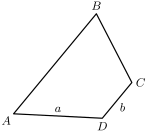
In the accompanying figure, segments and are parallel, the measure of angle is twice that of angle and the measures of segments and are and respectively. Then the measure of is equal to:
Pista pequeña:
Biseca el ángulo y haz que la bisectriz corte a en
Bisect angle and let the bisector meet at
Pista grande:
La persecución de ángulos muestra que es isósceles, mientras que es un paralelogramo
Angle chasing makes isosceles, while is a parallelogram
Solución:
Sea el punto donde la bisectriz de corta a Como cada mitad tiene medida Puesto que el ángulo interior alterno también es igual a Así, el triángulo es isósceles y Además, y por lo que es un paralelogramo. Entonces Por lo tanto,
Por lo tanto, la respuesta correcta es E.
Let the bisector of meet at Because each half has measure Since the alternate interior angle also equals Thus triangle is isosceles and Also and so is a parallelogram. Hence Therefore
Therefore, the correct answer is E.
31.
Si se selecciona al azar un número del conjunto de todos los números de cinco dígitos cuya suma de dígitos es igual a ¿cuál es la probabilidad de que este número sea divisible por ?
If a number is selected at random from the set of all five-digit numbers in which the sum of the digits is equal to what is the probability that this number will be divisible by
Pista pequeña:
Parte de ; una suma de dígitos de significa un déficit total de
Start from ; a digit sum of means a total deficit of
Pista grande:
Las posibilidades son un o dos ; aplica la prueba de divisibilidad por mediante la suma alternada
The possibilities are one or two s; apply the divisibility-by- alternating-sum test
Solución:
La suma máxima de los dígitos de un número de cinco dígitos es así que una suma de tiene un déficit total de con respecto a O bien un dígito es y los demás son , lo que da números, o bien dos dígitos son y los demás son , lo que da números. Así, hay números en total.
Usando la prueba de divisibilidad por exactamente son divisibles por Por lo tanto, la probabilidad es
Por lo tanto, la respuesta correcta es B.
The maximum five-digit digit sum is so a sum of has total deficit from Either one digit is and the others are , giving numbers, or two digits are and the others are , giving numbers. Thus there are numbers total.
Using the divisibility-by- test, exactly are divisible by The probability is therefore
Therefore, the correct answer is B.
32.
y recorren una pista circular a velocidades uniformes en direcciones opuestas, partiendo de puntos diametralmente opuestos. Si comienzan al mismo tiempo, se encuentran por primera vez después de que ha recorrido yardas y se encuentran por segunda vez cuando a le faltan yardas para completar una vuelta, entonces la circunferencia de la pista en yardas es:
and travel around a circular track at uniform speeds in opposite directions, starting from diametrically opposite points. If they start at the same time, meet first after has travelled yards, and meet a second time yards before completes one lap, then the circumference of the track in yards is:
Pista pequeña:
Sea la circunferencia y compara las razones entre las distancias recorridas por los dos corredores en cada encuentro
Let the circumference be and compare the two runners’ traveled-distance ratios at each meeting
Pista grande:
En el primer encuentro sus distancias son y ; en el segundo son y
At the first meeting their distances are and ; at the second they are and
Solución:
Sea la circunferencia. En el primer encuentro, ha recorrido yardas y ha recorrido por lo que la razón entre sus velocidades es En el segundo encuentro, a le faltan yardas para completar una vuelta, así que ha recorrido Para entonces, la distancia combinada que han recorrido es de modo que ha recorrido Por tanto, Al multiplicar en cruz obtenemos así que la circunferencia es yardas.
Por lo tanto, la respuesta correcta es C.
Let the circumference be At the first meeting, has traveled yards and has traveled so their speed ratio is At the second meeting, is yards short of one lap, so it has traveled By then their combined distance is so has traveled Hence Cross-multiplying gives so the circumference is yards.
Therefore, the correct answer is C.
33.
Halla la suma de los dígitos de todos los numerales de la sucesión
Find the sum of the digits of all the numerals in the sequence
Pista pequeña:
Primero suma los dígitos desde hasta
First sum the digits from through
Pista grande:
En cada una de las cuatro posiciones, cada dígito aparece exactamente veces
In each of the four positions, every digit appears exactly times
Solución:
Escribe los enteros desde hasta con cuatro dígitos y ceros iniciales. En cada una de las cuatro posiciones, cada dígito aparece veces. Por lo tanto, la suma total de sus dígitos es Sustituir por añade así que la suma pedida es
Por lo tanto, la respuesta correcta es A.
Write the integers from through using four digits with leading zeros. In each of the four positions, every digit appears times. Thus their total digit sum is Replacing by adds so the requested sum is
Therefore, the correct answer is A.
34.
El mayor entero que divide y y deja el mismo residuo es:
The greatest integer that will divide and and leave the same remainder is:
un múltiplo impar de mayor que
an odd multiple of greater than
un múltiplo par de mayor que
an even multiple of greater than
Pista pequeña:
Un residuo común significa que el divisor divide cada diferencia entre dos números
A common remainder means the divisor divides every pairwise difference
Pista grande:
Halla el MCD de y
Find the GCD of and
Solución:
Un divisor deja el mismo residuo en los tres números exactamente cuando divide sus diferencias. Las dos diferencias sucesivas son Por lo tanto, el mayor divisor posible es
Por lo tanto, la respuesta correcta es C.
A divisor leaves the same remainder on all three numbers exactly when it divides their differences. The two successive differences are Therefore the greatest possible divisor is
Therefore, the correct answer is C.
35.
Un empleado que se jubila recibe una pensión anual proporcional a la raíz cuadrada de su número de años de servicio. Si hubiera trabajado años más, su pensión habría sido dólares mayor; si hubiera trabajado años más (), su pensión habría sido dólares mayor que la pensión anual original. Halla su pensión anual en función de y
A retiring employee receives an annual pension proportional to the square root of the number of years of his service. Had he served years more, his pension would have been dollars greater, whereas, had he served years more (), his pension would have been dollars greater than the original annual pension. Find his annual pension in terms of and
Pista pequeña:
Sea la pensión actual y escribe las dos pensiones hipotéticas
Let the current pension be and write the two hypothetical pensions
Pista grande:
Eleva al cuadrado y , y luego elimina tanto como
Square and , then eliminate both and
Solución:
Sea la pensión actual. Como y al elevar al cuadrado y usar se obtienen las dos primeras ecuaciones de abajo. Al multiplicarlas por y respectivamente, y restar, se obtiene la tercera: Por lo tanto,
Por lo tanto, la respuesta correcta es D.
Let the current pension be Since and squaring and using gives the first line below. Multiplying its equations by and respectively, and subtracting gives the second: Hence
Therefore, the correct answer is D.