
Soluciones del 2024 AMC 10A
Desplázate hacia abajo para ver las soluciones preparadas profesionalmente de LIVE by Po-Shen Loh, imprime las soluciones en PDF, consulta la clave de respuestas, o haz el examen cronometrado completo.
Todos los problemas se usan con el permiso legal oficial de la Mathematical Association of America (MAA).
1.
¿Cuál es el valor de ?
What is the value of
Pista pequeña:
Desarrolla cada producto escribiendo y .
Expand each product by writing and
Pista grande:
Ambos productos están muy cerca de calcula cada uno y réstalos.
Both products are very close to compute each and subtract
Solución:
Simplemente calcula cada parte. Tenemos y Restando, Por lo tanto, A es la respuesta correcta.
Just compute each piece. We have and Subtracting, Thus, A is the correct answer.
2.
Un modelo usado para estimar el tiempo que tomará subir a la cima de una montaña por un sendero tiene la forma donde y son constantes, es el tiempo en minutos, es la longitud del sendero en millas, y es el desnivel de altitud en pies. El modelo estima que tomará minutos subir a la cima si un sendero mide millas de largo y asciende pies, así como si un sendero mide millas de largo y asciende pies. ¿Cuántos minutos estima el modelo que tomará subir a la cima si el sendero mide millas de largo y asciende pies?
A model used to estimate the time it will take to hike to the top of the mountain on a trail is of the form where and are constants, is the time in minutes, is the length of the trail in miles, and is the altitude gain in feet. The model estimates that it will take minutes to hike to the top if a trail is miles long and ascends feet, as well as if a trail is miles long and ascends feet. How many minutes does the model estimate it will take to hike to the top if the trail is miles long and ascends feet?
Pista pequeña:
Escribe los dos recorridos dados como y .
Write the two given trips as and
Pista grande:
Resta las ecuaciones para eliminar la constante y hallar y .
Subtract the equations to eliminate the constant and find and
Solución:
Resta las dos ecuaciones y para eliminar el Queda así que Ahora sustituye: por lo que y Entonces Por lo tanto, la respuesta es B.
Subtract the two equations and to kill the That leaves so Now substitute: so and Then Therefore, the answer is B.
3.
¿Cuál es la suma de los dígitos del menor primo que puede escribirse como suma de primos distintos?
What is the sum of the digits of the smallest prime that can be written as a sum of distinct primes?
Pista pequeña:
Usar hace que la suma sea par y mayor que así que no puede ser primo; usa cinco primos impares.
Using makes the sum even and larger than so it cannot be prime; use five odd primes
Pista grande:
Los cinco primos impares más pequeños suman que no es primo; aumenta hasta la siguiente suma que sea prima.
The five smallest odd primes sum to which is not prime; increase to the next prime sum
Solución:
Supongamos que es uno de los cinco primos. Entonces el total es par y mayor que así que es compuesto. Eso significa que los cinco primos deben ser impares. Los cinco primos impares más pequeños dan que no es primo. La siguiente suma posible se obtiene reemplazando por el siguiente primo, cambiar cualquier término anterior obliga a un aumento al menos igual de grande para mantener los primos distintos. Esto da que es primo. Su suma de dígitos es Por lo tanto, B es la respuesta correcta.
Suppose is one of the five primes. Then the total is even and bigger than so it is composite. Thus all five primes must be odd. The five smallest odd primes give which is not prime. The next possible sum is obtained by replacing with the next prime, changing any earlier term forces at least as large an increase to keep the primes distinct. This gives which is prime. Its digit sum is Thus, B is the correct answer.
4.
El número se escribe como suma de números de dos dígitos no necesariamente distintos. ¿Cuál es la menor cantidad de números de dos dígitos necesarios para escribir esta suma?
The number is written as the sum of not necessarily distinct two-digit numbers. What is the least number of two-digit numbers needed to write this sum?
Pista pequeña:
El mayor número de dos dígitos es así que números suman a lo más .
The largest two-digit number is so numbers sum to at most
Pista grande:
Halla el menor con luego confirma que esa cantidad de números de dos dígitos puede alcanzar .
Find the least with then confirm that many two-digit numbers can reach
Solución:
Cada número de dos dígitos es a lo más así que de ellos suman a lo más Necesitamos lo que obliga a por lo que Y realmente funciona: veinte más un dan Por lo tanto, la respuesta es B.
Each two-digit number is at most so of them sum to at most We need which forces so And really works: twenty s plus one give Therefore, the answer is B.
5.
¿Cuál es el menor valor de tal que sea múltiplo de ?
What is the least value of such that is a multiple of
Pista pequeña:
Factoriza .
Factor
Pista grande:
El mayor factor primo es así que debe aparecer como factor en .
The largest prime factor is so it must appear as a factor in
Solución:
Factoriza El primo es el cuello de botella: para que divida a necesitamos En el producto ya contiene y muchos factores de así que es divisible por El menor valor es Por lo tanto, D es la respuesta correcta.
Factor The prime is the bottleneck: for to divide we need At the product already has and plenty of factors of so is divisible by The least value is Thus, D is the correct answer.
6.
¿Cuál es el mínimo número de intercambios sucesivos de letras adyacentes en la cadena ABCDEF necesarios para cambiar la cadena a FEDCBA?
Por ejemplo, se requieren intercambios para cambiar ABC a CBA; una de esas secuencias de intercambios es ABC BAC BCA CBA.
What is the minimum number of successive swaps of adjacent letters in the string ABCDEF that are needed to change the string to FEDCBA?
(For example, swaps are required to change ABC to CBA; one such sequence of swaps is ABC BAC BCA CBA.)
Pista pequeña:
Cada intercambio de adyacentes cambia el orden relativo de exactamente un par de letras.
Each adjacent swap changes the relative order of exactly one pair of letters
Pista grande:
En la cadena completamente invertida cada par de letras queda desordenado; cuenta los pares con .
In the fully reversed string every pair of letters is out of order; count the pairs with
Solución:
Invertir las seis letras cambia el orden relativo de cada par, así que los pares terminan invertidos. Cada intercambio de adyacentes corrige exactamente una inversión. Así que necesitamos al menos intercambios, y llevar cada letra a su lugar por burbujeo alcanza exactamente . Por lo tanto, la respuesta es D.
Reversing all six letters flips the relative order of every pair, so all pairs end up inverted. Each adjacent swap fixes exactly one inversion. So we need at least swaps, and bubbling each letter into place hits exactly. Therefore, the answer is D.
7.
El producto de tres enteros es ¿Cuál es el menor valor positivo posible de la suma de los tres enteros?
The product of three integers is What is the least possible positive sum of the three integers?
Pista pequeña:
Un producto positivo usa o bien tres factores positivos, o bien uno positivo y dos negativos.
A positive product uses either three positive factors or one positive and two negative factors
Pista grande:
Dos factores negativos permiten que el factor positivo sea grande; minimiza el factor positivo menos la suma de las dos magnitudes.
Two negative factors let the positive factor be large; minimize the positive factor minus the sum of the two magnitudes
Solución:
Un producto positivo proviene de tres enteros positivos o de un entero positivo y dos negativos. Tres enteros positivos tienen suma al menos En el segundo caso, escribimos los números como donde son positivos y Una suma positiva exige así que , y por tanto Los posibles productos que dividen a son Al comprobar sus pares de factores, el menor valor positivo de es Así, y no es posible una suma positiva menor que . Por lo tanto, la respuesta es B.
A positive product comes from three positive integers or one positive and two negative integers. Three positive integers have sum at least In the second case write the numbers as where are positive and A positive sum requires so and hence The possible products that divide are Checking their factor pairs, the smallest positive value of is Thus and no positive sum below is possible. Therefore, the answer is B.
8.
Amy, Bomani, Charlie y Daria trabajan en una fábrica de chocolate. El lunes, Amy, Bomani y Charlie empezaron a trabajar a la PM y podían empaquetar y paquetes, respectivamente, cada minutos. En algún momento posterior, Daria se unió al grupo, y Daria podía empaquetar paquetes cada minutos. Juntos, terminaron de empaquetar paquetes exactamente a las PM. ¿A qué hora se unió Daria al grupo?
Amy, Bomani, Charlie, and Daria work in a chocolate factory. On Monday Amy, Bomani, and Charlie started working at PM and were able to pack and packages, respectively, every minutes. At some later time, Daria joined the group, and Daria was able to pack packages every minutes. Together, they finished packing packages at exactly PM. At what time did Daria join the group?
PM
PM
PM
PM
PM
Pista pequeña:
Amy, Bomani y Charlie juntos empaquetan paquetes cada minutos; de la a las hay minutos.
Amy, Bomani, and Charlie together pack packages every minutes; to is minutes
Pista grande:
Resta lo que empaquetan los primeros tres en minutos de Daria empaqueta el resto a razón de cada minutos.
Subtract what the first three pack in minutes from Daria packs the rest at per minutes
Solución:
De la a las hay minutos. Amy, Bomani y Charlie empaquetan paquetes cada minutos, es decir por minuto, lo que da paquetes. Eso deja para Daria, que empaqueta por minuto y por tanto necesita minutos. Trabajó los últimos minutos, uniéndose minutos después de la Eso es la PM. Por lo tanto, la respuesta es A.
From to is minutes. Amy, Bomani, and Charlie pack packages every minutes, so per minute, which is packages. That leaves for Daria, who packs per minute and so needs minutes. She worked the last minutes, joining minutes after That’s PM. Therefore, the answer is A.
9.
¿De cuántas maneras pueden estudiantes de penúltimo año y de último año formar equipos disjuntos de personas de modo que cada equipo tenga de penúltimo año y de último año?
In how many ways can juniors and seniors form disjoint teams of people so that each team has juniors and seniors?
Pista pequeña:
Divide a los de penúltimo año en tres parejas sin orden y a los de último año en tres parejas sin orden.
Split the juniors into three unordered pairs and the seniors into three unordered pairs
Pista grande:
Hay divisiones de este tipo para cada grupo; luego empareja las parejas de penúltimo año con las de último año de maneras.
There are such splits for each group; then match junior-pairs to senior-pairs in ways
Solución:
Divide a los de penúltimo año en tres parejas sin orden. Hay maneras, y las mismas para los de último año. Cada equipo es una pareja de penúltimo año unida a una pareja de último año, así que emparejamos las tres parejas de penúltimo año con las tres de último año de maneras. Eso da conjuntos de equipos. Por lo tanto, B es la respuesta correcta.
Split the juniors into three unordered pairs. There are ways, and the same for the seniors. Each team is one junior-pair paired with one senior-pair, so we match the three junior-pairs to the three senior-pairs in ways. That’s sets of teams. Thus, B is the correct answer.
10.
Considera la siguiente operación. Dado un entero positivo si es múltiplo de entonces reemplazas por Si no es múltiplo de entonces reemplazas por Luego continúas este proceso. Por ejemplo, comenzando con este procedimiento da
Supón que empiezas con ¿Qué valor resulta si realizas esta operación exactamente veces?
Consider the following operation. Given a positive integer if is a multiple of then you replace by If is not a multiple of then you replace by Then continue this process. For example, beginning with this procedure gives
Suppose you start with What value results if you perform this operation exactly times?
Pista pequeña:
Calcula los primeros términos a partir de los valores pronto empiezan a repetirse.
Compute the first several terms from the values soon start repeating
Pista grande:
Una vez que la sucesión llega a entra en el ciclo con periodo localiza el paso en el ciclo.
Once the sequence reaches it cycles with period locate step in the cycle
Solución:
Simplemente ejecútalo desde Tras el º paso estamos en y desde ahí entra en el ciclo con periodo Así que el paso es la ésima entrada del ciclo. Para el paso y lo que cae en Por lo tanto, la respuesta es C.
Just run it from After the th step we’re at and from there it cycles with period So step is the th entry of the cycle. For step and which lands on Therefore, the answer is C.
11.
¿Cuántos pares ordenados de enteros satisfacen
How many ordered pairs of integers satisfy
Infinitos
Infinitely many
Pista pequeña:
Al elevar al cuadrado se obtiene así que .
Squaring gives so
Pista grande:
tiene pocas factorizaciones; además mientras que puede ser negativo.
has few factorizations; also while may be negative
Solución:
Nota que debe ser un entero, así que lo que significa Las factorizaciones de dan o Así que los pares ordenados son Son de ellos. Por lo tanto, D es la respuesta correcta.
Note has to be an integer, so which means The factorizations of give or So the ordered pairs are That’s of them. Thus, D is the correct answer.
12.
Zelda jugó el juego Adventures of Math el de agosto y obtuvo puntos. Continuó jugando a diario durante los siguientes días. El diagrama de barras de abajo muestra el cambio diario en su puntaje comparado con el día anterior. (Por ejemplo, el puntaje de Zelda el de agosto fue puntos.) ¿Cuál fue el puntaje promedio de Zelda en puntos durante los días?
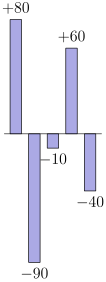
Zelda played the Adventures of Math game on August and scored points. She continued to play daily over the next days. The bar chart below shows the daily change in her score compared to the day before. (For example, Zelda’s score on August was points.) What was Zelda’s average score in points over the days?
Pista pequeña:
Construye el puntaje de cada día sumando el cambio de ese día al puntaje del día anterior.
Build each day’s score by adding that day’s change to the previous day’s score
Pista grande:
Promedia los seis puntajes diarios .
Average the six daily scores
Solución:
Aplica los cambios diarios al valor inicial Los seis puntajes son Suman así que el promedio es Por lo tanto, la respuesta es E.
Apply the daily changes to the starting The six scores are They add to so the average is Therefore, the answer is E.
13.
Se dice que dos transformaciones conmutan si aplicar la primera seguida de la segunda da el mismo resultado que aplicar la segunda seguida de la primera. Considera estas cuatro transformaciones del plano de coordenadas:
• una traslación de unidades a la derecha;
• una rotación de en sentido antihorario alrededor del origen;
• una reflexión respecto al eje ; y
• una dilatación centrada en el origen con factor de escala
De los pares de transformaciones distintas de esta lista, ¿cuántos conmutan?
Two transformations are said to commute if applying the first followed by the second gives the same result as applying the second followed by the first. Consider these four transformations of the coordinate plane:
• a translation units to the right,
• a rotation counterclockwise about the origin,
• a reflection across the -axis, and
• a dilation centered at the origin with scale factor
Of the pairs of distinct transformations from this list, how many commute?
Pista pequeña:
Una dilatación y una rotación, ambas centradas en el origen, siempre conmutan.
A dilation and a rotation, both centered at the origin, always commute
Pista grande:
Revisa cada uno de los pares; una traslación por lo general no conmuta con transformaciones que mueven el origen.
Check each of the pairs; a translation usually fails to commute with maps that move the origin
Solución:
La dilatación solo escala respecto al origen, así que conmuta tanto con la rotación como con la reflexión. Eso da pares. La traslación también conmuta con la reflexión respecto al eje , ya que cualquiera de los dos órdenes envía Los otros tres pares fallan: la traslación choca con la rotación y con la dilatación, y la rotación choca con la reflexión. Así que pares conmutan. Por lo tanto, C es la respuesta correcta.
The dilation just scales about the origin, so it commutes with both the rotation and the reflection. That’s pairs. The translation commutes with the reflection across the -axis too, since either order sends The other three pairs fail: the translation clashes with the rotation and with the dilation, and the rotation clashes with the reflection. So pairs commute. Thus, C is the correct answer.
14.
Un lado de un triángulo equilátero de altura está sobre la recta Un círculo de radio es tangente a y es tangente externamente al triángulo. El área de la región exterior al triángulo y al círculo, acotada por el triángulo, el círculo y la recta , puede escribirse como donde y son enteros positivos y no es divisible por el cuadrado de ningún primo. ¿Cuánto vale ?
One side of an equilateral triangle of height lies on line A circle of radius is tangent to and is externally tangent to the triangle. The area of the region exterior to the triangle and the circle and bounded by the triangle, the circle, and line can be written as where and are positive integers and is not divisible by the square of any prime. What is
Pista pequeña:
La altura da lado coloca sobre el eje , de modo que el centro del círculo está a altura .
Height gives side put on the -axis, so the circle’s center is at height
Pista grande:
Desde el vértice de la base del triángulo, la región está acotada por dos tangentes al círculo y el arco entre ellas; usa la longitud de la tangente y un sector de .
From the triangle’s base vertex the region is bounded by two tangents to the circle and the arc between them; use the tangent length and a sector
Solución:
El triángulo equilátero tiene lado Coloca sobre el eje con vértice de la base ; el lado inclinado está sobre El círculo se apoya en tiene radio y toca ese lado externamente, así que su centro es Sea su punto de tangencia sobre y sea el punto de tangencia sobre el lado inclinado. Las dos longitudes tangentes desde cumplen así que la cometa tiene área El ángulo en es así que el sector eliminado tiene ángulo y área La región tiene área lo que da Por lo tanto, la respuesta es D.
The equilateral triangle has side Put on the -axis with base vertex ; the slanted side lies on The circle sits on has radius and touches that side externally, so its center is Let be its tangency point on and let be the tangency point on the slanted side. The two tangent lengths from satisfy so kite has area The angle at is so the removed sector has angle and area The region has area giving Therefore, the answer is D.
15.
Sea el mayor entero tal que tanto como sean cuadrados perfectos. ¿Cuál es el dígito de las unidades de ?
Let be the greatest integer such that both and are perfect squares. What is the units digit of
Pista pequeña:
Plantea , resta para obtener .
Set and subtract to get
Pista grande:
Ambos factores son pares; el mayor proviene del menor haciendo lo más grande posible.
Both factors are even; the greatest comes from the smallest making as large as possible
Solución:
Plantea , Restando, así que Los dos factores tienen la misma paridad, y su producto es par, así que ambos son pares: escribe con Para hacer lo más grande posible queremos lo más grande posible, así que lo más pequeño posible. Toma lo que da Entonces cuyo dígito de las unidades es Por lo tanto, E es la respuesta correcta.
Set and Subtracting, so The two factors share a parity, and their product is even, so both are even: write with To make as large as possible we want as large as possible, so as small as possible. Take giving Then whose units digit is Thus, E is the correct answer.
16.
Todos los rectángulos de la figura de abajo, que está dibujada a escala, son semejantes al rectángulo que los contiene. Cada número representa el área del rectángulo. ¿Cuál es la longitud ?
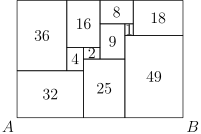
All of the rectangles in the figure below, which is drawn to scale, are similar to the enclosing rectangle. Each number represents the area of the rectangle. What is length
Pista pequeña:
Las piezas tienen área total sea la altura del rectángulo exterior y su anchura
The pieces have total area let the enclosing rectangle have height and width
Pista grande:
En el borde izquierdo, los lados verticales de las piezas de área y miden y
Along the left edge, the vertical sides of the area- and area- pieces have lengths and
Solución:
Las áreas de las once piezas suman Sea la altura del rectángulo que las contiene y sea Las longitudes correspondientes de figuras semejantes están en la razón de las raíces cuadradas de sus áreas. En el diagrama, la pieza de área aporta su lado corto al borde izquierdo, cuya longitud es Encima de ella, la pieza de área aporta su lado largo, cuya longitud es Estos dos segmentos forman la altura completa, así que lo cual se simplifica a Como obtenemos y Por lo tanto, la respuesta es D.
The areas of the eleven pieces sum to Let the enclosing rectangle have height and width Similar figures have corresponding side lengths in the square-root ratio of their areas. From the diagram, the area- piece contributes its short side to the left edge, of length Above it, the area- piece contributes its long side, of length These two segments make the full height, so which simplifies to Since we get and Therefore, the answer is D.
17.
Dos equipos disputan una serie al mejor de tres: los equipos jugarán a lo más partidos, y el ganador de la serie es el primer equipo en ganar partidos. El primer partido se juega en el campo local del Equipo A, y los partidos restantes se juegan en el campo local del Equipo B. El Equipo A tiene una probabilidad de de ganar en casa, y su probabilidad de ganar jugando fuera de casa es Los resultados de los partidos son independientes. La probabilidad de que el Equipo A gane la serie es Entonces puede escribirse en la forma donde y son enteros positivos. ¿Cuánto vale ?
Two teams are in a best-two-out-of-three playoff: the teams will play at most games, and the winner of the playoff is the first team to win games. The first game is played on Team A’s home field, and the remaining games are played on Team B’s home field. Team A has a chance of winning at home, and its probability of winning when playing away from home is Outcomes of the games are independent. The probability that Team A wins the playoff is Then can be written in the form where and are positive integers. What is
Pista pequeña:
Enumera las formas en que el Equipo A gana dos partidos: ganar los partidos y ganar perder ganar perder ganar ganar .
List the ways Team A wins two games: win games and win lose win lose win win
Pista grande:
Iguala la probabilidad total a y resuelve la ecuación cuadrática resultante en .
Set the total probability equal to and solve the resulting quadratic in
Solución:
El Equipo A gana el partido en casa con probabilidad y cada partido de visitante con probabilidad Puede ganar la serie de tres maneras disjuntas: ganar los partidos ganar perder ganar perder ganar Sumando esas, Esto se simplifica a así que Entonces y Por lo tanto, E es la respuesta correcta.
Team A takes game at home with probability and each away game with probability It can win the playoff three disjoint ways: win games win lose win lose win Adding those, This cleans up to so Then and Thus, E is the correct answer.
18.
Hay exactamente enteros positivos con tales que el entero en base es divisible por (donde está en base diez). ¿Cuál es la suma de los dígitos de ?
There are exactly positive integers with such that the base- integer is divisible by (where is in base ten). What is the sum of the digits of
Pista pequeña:
ser divisible por requiere que sea divisible por .
dividing by requires to be divisible by
Pista grande:
Revisa los residuos funcionan, así que cuenta esos en .
Check the residues work, so count those in
Solución:
En base así que es divisible por exactamente cuando es divisible por Prueba los residuos módulo esto se cumple precisamente para Contar los con en esas tres clases da cuya suma de dígitos es Por lo tanto, la respuesta es D.
In base so is divisible by exactly when is divisible by Test the residues modulo this holds precisely for Counting the with in those three classes gives whose digit sum is Therefore, the answer is D.
19.
Los primeros tres términos de una progresión geométrica son los enteros y donde ¿Cuál es la suma de los dígitos del menor valor posible de ?
The first three terms of a geometric sequence are the integers and where What is the sum of the digits of the least possible value of
Pista pequeña:
Por la razón común es racional; escríbela como en su forma más simple con .
so the common ratio is rational; write it as in lowest terms with
Pista grande:
Tanto como deben dividir a minimiza usando la menor razón .
Both and must divide minimize using the smallest ratio
Solución:
Como la razón común es racional. Escribe en su forma más simple con Entonces y son enteros, lo que obliga a que sea divisible por y por Para hacer lo más pequeño posible, queremos la menor razón con divisible por y por que es Eso da (y ). La suma de dígitos es Por lo tanto, E es la respuesta correcta.
Since the common ratio is rational. Write in lowest terms with Then and are integers, which forces to be divisible by and by To make smallest, we want the smallest ratio with divisible by both and which is That gives (and ). The digit sum is Thus, E is the correct answer.
20.
Sea un subconjunto de tal que se cumplan las dos condiciones siguientes:
• Si e son elementos distintos de entonces
• Si e son elementos impares distintos de entonces
¿Cuál es el máximo número posible de elementos en ?
Let be a subset of such that the following two conditions hold:
• If and are distinct elements of then
• If and are distinct odd elements of then
What is the maximum possible number of elements in
Pista pequeña:
Cualesquiera dos números elegidos difieren en al menos y cualesquiera dos números impares elegidos difieren en al menos .
Any two chosen numbers differ by at least and any two chosen odd numbers differ by at least
Pista grande:
Un bloque repetido de puede contener a lo más números elegidos con solo uno impar; prueba los residuos .
A repeating block of can hold at most chosen numbers with only one odd; try residues
Solución:
Las dos condiciones dicen que los números elegidos difieren en al menos , y que los impares elegidos difieren en al menos . Cuatro números en un bloque de necesitarían tres separaciones de al menos así que tendrían que ocupar las posiciones Dos de las posiciones impares diferirían entonces en lo cual está prohibido. Por tanto, cada bloque completo de contiene como máximo números elegidos, y las últimas cuatro posiciones contienen como máximo Esto da la cota superior La cota se alcanza con el patrón (los residuos ), junto con Los valores elegidos adyacentes difieren en al menos y los impares elegidos difieren en . Por lo tanto, la respuesta es C.
The two conditions say chosen numbers are at least apart, and chosen odd numbers at least apart. Any four numbers in a block of would need three gaps of at least so they would have to occupy positions Two of the odd entries would then differ by which is forbidden. Thus each full block of contains at most choices, and the last four positions contain at most This gives the upper bound It is attained by the pattern (residues ), together with Adjacent selected values differ by at least and the selected odd values are apart. Therefore, the answer is C.
21.
Los números, en orden, de cada fila y los números, en orden, de cada columna de un arreglo de enteros forman una progresión aritmética de longitud Los números en las posiciones y son y respectivamente. ¿Qué número está en la posición ?
The numbers, in order, of each row and the numbers, in order, of each column of a array of integers form an arithmetic progression of length The numbers in positions and are and respectively. What number is in position
Pista pequeña:
Una cuadrícula en la que cada fila y columna es aritmética tiene la entrada en la fila columna .
A grid whose every row and column is arithmetic has entry at row column
Pista grande:
Sustituye las cuatro entradas conocidas en esta forma y resuelve para .
Substitute the four known entries into this form and solve for
Solución:
Si cada fila y cada columna es una progresión aritmética, la entrada en la fila columna debe tomar la forma bilineal Sustituye y resuelve: Así que la posición es Por lo tanto, C es la respuesta correcta.
If every row and every column is an arithmetic progression, the entry at row column must take the bilinear form Plug in and solve: So position is Thus, C is the correct answer.
22.
Sea la cometa formada al unir dos triángulos rectángulos con catetos y a lo largo de una hipotenusa común. Se usan ocho copias de para formar el polígono que se muestra abajo. ¿Cuál es el área del triángulo ?
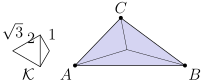
Let be the kite formed by joining two right triangles with legs and along a common hypotenuse. Eight copies of are used to form the polygon shown below. What is the area of
Pista pequeña:
Cada cometa son dos triángulos -- (catetos y hipotenusa ); establece coordenadas a partir de estas longitudes.
Each kite is two -- triangles (legs and hypotenuse ); set up coordinates from these lengths
Pista grande:
Toma y haz horizontal; mide seis unidades, mientras que la frontera de a usa longitudes en ángulos
Take and horizontal; is six unit lengths, while the boundary from to uses lengths at angles
Solución:
Cada mitad de una cometa es un triángulo --, así que sus aristas tienen las longitudes y direcciones mostradas. Tomemos y hagamos horizontal. La extensión horizontal de la figura es de seis unidades, por lo que A lo largo de la frontera exterior de a las tres aristas tienen vectores y Su suma es así que Entonces y la altura desde es lo que da área Por lo tanto, la respuesta es B.
Each half of a kite is a -- triangle, so its edges have the shown lengths and directions. Take and horizontal. The horizontal span in the figure is six unit lengths, so Along the outer boundary from to the three edges have vectors and Their sum is so Thus and the altitude from is giving area Therefore, the answer is B.
23.
Los enteros y satisfacen
¿Cuánto vale ?
Integers and satisfy
What is
Pista pequeña:
Suma las tres ecuaciones para relacionar y .
Add all three equations to relate and
Pista grande:
Resta las dos primeras ecuaciones para obtener enumera los cuatro pares de factores con signo de
Subtract the first two equations to get enumerate the four signed factor pairs of
Solución:
Resta la segunda ecuación de la primera: Pon y Las cuatro posibilidades y dan, tras sustituir en respectivamente y Solo la tercera es una solución entera de las tres ecuaciones originales: (El último candidato es que no cumple ) Al sumar las ecuaciones originales se obtiene Como obtenemos Por lo tanto, D es la respuesta correcta.
Subtract the second equation from the first: Put and The four possibilities and give, after substitution into respectively and Only the third is an integer solution of all three original equations: (The last candidate is which fails ) Adding the original equations gives Since we obtain Thus, D is the correct answer.
24.
Una abeja se mueve en el espacio tridimensional. Se lanza un dado justo de seis caras con caras etiquetadas y . Supón que la abeja ocupa el punto Si el dado muestra entonces la abeja se mueve al punto y si el dado muestra entonces la abeja se mueve al punto Se hacen movimientos análogos con los otros cuatro resultados.
Supón que la abeja parte del punto y el dado se lanza cuatro veces. ¿Cuál es la probabilidad de que la abeja recorra cuatro aristas distintas de algún cubo unitario?
A bee is moving in three-dimensional space. A fair six-sided die with faces labeled and is rolled. Suppose the bee occupies the point If the die shows then the bee moves to the point and if the die shows then the bee moves to the point Analogous moves are made with the other four outcomes.
Suppose the bee starts at the point and the die is rolled four times. What is the probability that the bee traverses four distinct edges of some unit cube?
Pista pequeña:
Hay secuencias de movimientos igualmente probables; los cuatro pasos deben ser cuatro aristas distintas de un mismo cubo unitario.
There are equally likely move sequences; the four steps must be four different edges of one unit cube
Pista grande:
Separa los caminos que usan dos direcciones coordenadas (una cara cuadrada) de los caminos que usan las tres direcciones, donde un eje se repite en pasos no adyacentes.
Separate paths using two coordinate directions (one square face) from paths using all three directions, where one axis repeats in nonadjacent steps
Solución:
Cada lanzamiento mueve a la abeja una unidad a lo largo de o así que hay secuencias igualmente probables. Hay dos tipos de caminos válidos. Un camino alrededor de una cara cuadrada tiene opciones de plano coordenado, opciones de signo, y opciones para la primera dirección, dando En caso contrario se usan las tres direcciones coordenadas, con una repetida: elige esa dirección de maneras, sus dos posiciones no adyacentes de maneras, el orden de las otras direcciones de maneras, y los signos de maneras. Esto da Por lo tanto hay secuencias favorables, y la probabilidad es Por lo tanto, la respuesta es B.
Every roll moves the bee one unit along or so there are equally likely sequences. There are two types of valid paths. A path around one square face has choices of coordinate plane, choices for the signs of its two axes, and choices for which axis is used first, giving Otherwise all three coordinate directions are used, with one repeated: choose that axis in ways, choose its two nonadjacent positions in ways, order the other two axes in ways, and choose their three initial signs in ways. (The second step on the repeated axis must have the opposite sign.) This gives Hence there are favorable sequences, and the probability is Therefore, the answer is B.
25.
La figura de abajo muestra una cuadrícula de puntos de celdas de ancho y celdas de alto formada por cuadrados de . Carl coloca palillos de pulgada a lo largo de algunos de los lados de los cuadrados para crear un lazo cerrado que no se interseca a sí mismo. Los números en las celdas indican cuántos lados de ese cuadrado deben quedar cubiertos por palillos, y se permite cualquier cantidad de palillos si no hay número escrito. ¿De cuántas maneras puede Carl colocar los palillos?
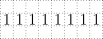
The figure below shows a dotted grid cells wide and cells tall consisting of squares. Carl places -inch toothpicks along some of the sides of the squares to create a closed loop that does not intersect itself. The numbers in the cells indicate the number of sides of that square that are to be covered by toothpicks, and any number of toothpicks are allowed if no number is written. In how many ways can Carl place the toothpicks?
Pista pequeña:
Cada celda de la fila central debe tocar exactamente un palillo; una vez fijadas las dos columnas de retorno, el palillo de cada celda interior está independientemente arriba o abajo de ella.
Each middle-row cell must touch exactly one toothpick; after the two turnaround columns are fixed, each interior cell’s toothpick is independently above or below it
Pista grande:
Un lazo que cruza el centro usa las las primeras las últimas o las columnas centrales; sus columnas interiores se doblan independientemente hacia arriba o hacia abajo
A loop crossing the middle uses all the first the last or the middle columns; its interior columns independently bend above or below
Solución:
Cada celda de la fila central debe tocar exactamente un palillo. Consideremos primero los lazos que pasan de un lado de la franja central al otro. El lazo puede abarcar las columnas, las primeras las últimas o las centrales; una extensión menor dejaría intacta una celda central exterior. Una vez fijados los dos extremos, cada celda central interior elige independientemente si su único palillo está arriba o abajo, y el resto del lazo no autointersecante queda determinado. Los cuatro casos aportan y lazos. También hay exactamente dos lazos que no cruzan la franja central: el rectángulo horizontal que pasa por completo por arriba o por abajo. Así, el total es Por lo tanto, C es la respuesta correcta.
Each middle-row cell must touch exactly one toothpick. First consider loops that pass from one side of the middle strip to the other. The loop can span all columns, the first the last or the middle a narrower span would leave an outer middle cell untouched. Once the two ends are fixed, each interior middle cell independently has its one toothpick on its top or bottom side, and the rest of the non-self-intersecting loop is forced. The four cases therefore contribute and loops. There are also exactly two loops that do not cross the middle strip: the horizontal rectangle running entirely along the top or entirely along the bottom. Hence the total is Thus, C is the correct answer.