
Soluciones del 2006 AMC 10A
Desplázate hacia abajo para ver las soluciones preparadas profesionalmente de LIVE by Po-Shen Loh, imprime las soluciones en PDF, consulta la clave de respuestas, o haz el examen cronometrado completo.
Todos los problemas se usan con el permiso legal oficial de la Mathematical Association of America (MAA).
1.
Los sándwiches en Joe’s Fast Food cuestan cada uno y los refrescos cuestan cada uno. ¿Cuántos dólares costará comprar sándwiches y refrescos?
Sandwiches at Joe’s Fast Food cost each and sodas cost each. How many dollars will it cost to purchase sandwiches and sodas?
Pista pequeña:
Encuentra por separado el total de los sándwiches y el total de los refrescos.
Find the sandwich total and the soda total separately
Pista grande:
Calcula .
Compute
Solución:
Cinco sándwiches cuestan dólares y ocho refrescos cuestan dólares. En total cuestan dólares.
Por lo tanto, la respuesta correcta es A.
Five sandwiches cost dollars and eight sodas cost dollars. Together they cost dollars.
Thus, the correct answer is A.
2.
Se define ¿Cuánto vale ?
Define What is
Pista pequeña:
Primero evalúa la operación interna .
First evaluate the inner
Pista grande:
luego aplica la operación de nuevo.
then apply the operation again
Solución:
La operación interna da Entonces
Por lo tanto, la respuesta correcta es C.
The inner operation gives Then
Thus, the correct answer is C.
3.
La razón entre la edad de Mary y la edad de Alice es Alice tiene años. ¿Cuántos años tiene Mary?
The ratio of Mary’s age to Alice’s age is Alice is years old. How many years old is Mary?
Pista pequeña:
La edad de Mary es de la edad de Alice.
Mary’s age is of Alice’s age
Pista grande:
Calcula .
Compute
Solución:
Como la razón es y Alice tiene Mary tiene años.
Por lo tanto, la respuesta correcta es B.
Since the ratio is and Alice is Mary is years old.
Thus, the correct answer is B.
4.
Un reloj digital muestra horas y minutos con a. m. y p. m. ¿Cuál es la mayor suma posible de los dígitos en la pantalla?
A digital watch displays hours and minutes with am and pm. What is the largest possible sum of the digits in the display?
Pista pequeña:
La pantalla usa un reloj de horas, así que la hora va de a .
The display uses a -hour clock, so the hour is through
Pista grande:
Maximiza por separado la suma de los dígitos de los minutos y la suma de los dígitos de la hora.
Maximize the minutes’ digit sum and the hour’s digit sum separately
Solución:
Los minutos van de a así que la mayor suma de sus dígitos es cuando muestran .
Para la hora, el dígito único supera a de las El mayor total es que ocurre a las
Por lo tanto, la respuesta correcta es E.
The minutes run from to so the largest digit sum for the minutes is at minutes.
For the hour, the single digit beats from The largest total is occurring at
Thus, the correct answer is E.
5.
Doug y Dave compartieron una pizza con porciones del mismo tamaño. Doug quería una pizza simple, pero Dave quería anchoas en la mitad de la pizza. El costo de una pizza simple era y había un costo adicional de por poner anchoas en una mitad. Dave se comió todas las porciones de pizza con anchoas y una porción simple. Doug se comió el resto. Luego cada uno pagó por lo que había comido. ¿Cuántos dólares más pagó Dave que Doug?
Doug and Dave shared a pizza with equally-sized slices. Doug wanted a plain pizza, but Dave wanted anchovies on half of the pizza. The cost of a plain pizza was and there was an additional cost of for putting anchovies on one half. Dave ate all the slices of anchovy pizza and one plain slice. Doug ate the remainder. Each then paid for what he had eaten. How many more dollars did Dave pay than Doug?
Pista pequeña:
Una pizza simple cuesta por porciones, así que cada porción cuesta .
A plain pizza costs for slices, so each slice is
Pista grande:
Dave también paga los completos por las anchoas, además de sus cinco porciones.
Dave also pays the full for the anchovies on top of his five slices
Solución:
Cada una de las porciones cuesta Dave comió porciones y además paga los adicionales por las anchoas, para un total de dólares.
Doug comió porciones, pagando dólares. Así que Dave pagó dólares más.
Por lo tanto, la respuesta correcta es D.
Each of the slices costs Dave ate slices and also pays the extra for the anchovies, for a total of dollars.
Doug ate slices, paying dollars. So Dave paid dollars more.
Thus, the correct answer is D.
6.
¿Qué valor real distinto de cero de satisface ?
What non-zero real value for satisfies
Pista pequeña:
Toma la raíz séptima de ambos lados.
Take the seventh root of both sides
Pista grande:
luego divide entre .
then divide by
Solución:
Tomando la raíz séptima de ambos lados se obtiene así que Como divide entre para obtener de donde
Por lo tanto, la respuesta correcta es B.
Taking the seventh root of both sides gives so Since divide by to get hence
Thus, the correct answer is B.
7.
El rectángulo se corta en dos hexágonos congruentes, como se muestra, de modo que los dos hexágonos pueden reubicarse sin traslape para formar un cuadrado. ¿Cuánto vale ?
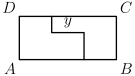
The rectangle is cut into two congruent hexagons, as shown, in such a way that the two hexagons can be repositioned without overlap to form a square. What is
Pista pequeña:
Los dos hexágonos forman un cuadrado con la misma área que el rectángulo.
The two hexagons form a square with the same area as the rectangle
Pista grande:
El rectángulo tiene área así que el cuadrado tiene lado .
The rectangle has area so the square has side
Solución:
El área del rectángulo es así que el cuadrado formado tiene lado
Sean y los extremos superior e inferior del corte escalonado. Para que las dos piezas congruentes formen un cuadrado, los tres segmentos horizontales el segmento central de longitud y deben ser iguales. Juntos abarcan el ancho del rectángulo, por lo que da y En efecto, el cuadrado resultante tiene lado de acuerdo con el cálculo del área.
Por lo tanto, la respuesta correcta es A.
The rectangle’s area is so the square formed has side
Let and be the upper and lower endpoints of the stair-step cut. For the two congruent pieces to fit into a square, the three horizontal segments the middle segment of length and must be equal. Together they span the rectangle’s width, so gives and Indeed, the resulting square has side agreeing with the area calculation.
Thus, the correct answer is A.
8.
Una parábola con ecuación pasa por los puntos y ¿Cuánto vale ?
A parabola with equation passes through the points and What is
Pista pequeña:
Los dos puntos tienen el mismo valor de , así que son simétricos respecto al vértice.
The two points have the same -value, so they are symmetric about the vertex
Pista grande:
El eje de simetría es lo que da .
The axis of symmetry is giving
Solución:
Sustituyendo los puntos se obtiene y Restando resulta así que
Entonces
Por lo tanto, la respuesta correcta es E.
Substituting the points gives and Subtracting yields so
Then
Thus, the correct answer is E.
9.
¿Cuántos conjuntos de dos o más enteros positivos consecutivos tienen suma ?
How many sets of two or more consecutive positive integers have a sum of
Pista pequeña:
La suma de enteros consecutivos es veces el valor central.
The sum of consecutive integers is times the middle value
Pista grande:
Verifica .
Check
Solución:
La suma de enteros consecutivos es igual a veces su mediana. Para una suma de : da da y da
Ningún conjunto de funciona (su suma es par), y o más enteros positivos consecutivos ya superan Hay tales conjuntos.
Por lo tanto, la respuesta correcta es C.
The sum of consecutive integers equals times their median. For a sum of : gives gives and gives
No set of works (their sum is even), and or more consecutive positive integers already exceed There are such sets.
Thus, the correct answer is C.
10.
¿Para cuántos valores reales de es un entero?
For how many real values of is an integer?
Pista pequeña:
Sea y acota .
Let and bound
Pista grande:
es un entero con .
is an integer with
Solución:
Sea Como necesitamos así que lo que da valores.
Cada produce y como es positivo y estrictamente decreciente, los valores resultantes son distintos.
Por lo tanto, la respuesta correcta es E.
Let Since we need so giving values.
Each yields and since is positive and strictly decreasing, the resulting values are distinct.
Thus, the correct answer is E.
11.
¿Cuál de las siguientes opciones describe la gráfica de la ecuación ?
Which of the following describes the graph of the equation
el conjunto vacío
the empty set
un punto
one point
dos rectas
two lines
una circunferencia
a circle
todo el plano
the entire plane
Pista pequeña:
Desarrolla y simplifica.
Expand and simplify
Pista grande:
La ecuación se reduce a .
The equation reduces to
Solución:
Desarrollando, que se reduce a es decir
Esto se cumple exactamente cuando o los dos ejes coordenados, así que la gráfica son dos rectas.
Por lo tanto, la respuesta correcta es C.
Expanding, which reduces to i.e.
This holds exactly when or the two coordinate axes, so the graph is two lines.
Thus, the correct answer is C.
12.
Rolly quiere sujetar a su perro con una cuerda de pies a un cobertizo cuadrado de pies por lado. Se muestran sus dibujos preliminares.
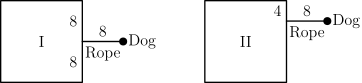
¿Cuál de estas disposiciones da al perro mayor área para moverse, y por cuántos pies cuadrados?
Rolly wishes to secure his dog with an -foot rope to a square shed that is feet on each side. His preliminary drawings are shown.
Which of these arrangements gives the dog the greater area to roam, and by how many square feet?
por
by
por
by
por
by
por
by
por
by
Pista pequeña:
En cada caso el perro barre un semidisco de radio en el lado abierto.
In each case the dog sweeps a half-disk of radius on the open side
Pista grande:
En la disposición II la cuerda también se envuelve alrededor de la esquina cercana.
In arrangement II the rope also wraps around the near corner
Solución:
En la disposición I el perro está atado en el punto medio de un lado y barre un semidisco de radio : área La cuerda llega exactamente a las esquinas, así que nada se envuelve.
En la disposición II el perro está atado a pies de una esquina. Barre el mismo semidisco de , y después de que la cuerda llega a la esquina, quedan pies para barrer un cuarto de disco de radio :
Así que II da superando a I por
Por lo tanto, la respuesta correcta es C.
In arrangement I the dog is tied at the middle of a side and sweeps a half-disk of radius : area The rope reaches exactly to the corners, so nothing wraps.
In arrangement II the dog is tied feet from a corner. It sweeps the same half-disk, and after the rope reaches the corner, feet remain to sweep a quarter-disk of radius :
So II gives exceeding I by
Thus, the correct answer is C.
13.
Un jugador paga para jugar un juego. Se lanza un dado. Si el número del dado es impar, se pierde el juego. Si el número del dado es par, se lanza el dado otra vez. En este caso el jugador gana si el segundo número coincide con el primero y pierde en caso contrario. ¿Cuánto debería ganar el jugador si el juego es justo? (En un juego justo, la probabilidad de ganar multiplicada por la cantidad ganada es lo que el jugador debería pagar.)
A player pays to play a game. A die is rolled. If the number on the die is odd, the game is lost. If the number on the die is even, the die is rolled again. In this case the player wins if the second number matches the first and loses otherwise. How much should the player win if the game is fair? (In a fair game the probability of winning times the amount won is what the player should pay.)
Pista pequeña:
Encuentra la probabilidad de ganar: un lanzamiento par, luego un lanzamiento que coincide.
Find the probability of winning: an even roll, then a matching roll
Pista grande:
La probabilidad de ganar es iguala (probabilidad)(premio) a .
The win probability is set (probability)(prize) equal to
Solución:
El jugador gana solo si el primer lanzamiento es par (probabilidad ) y el segundo lanzamiento coincide con él (probabilidad ), así que la probabilidad de ganar es
Para un juego justo, así que
Por lo tanto, la respuesta correcta es D.
The player wins only if the first roll is even (probability ) and the second roll matches it (probability ), so the win probability is
For a fair game, so
Thus, the correct answer is D.
14.
Varios anillos enlazados, cada uno de cm de grosor, cuelgan de un clavo. El anillo superior tiene un diámetro exterior de cm. El diámetro exterior de cada uno de los otros anillos es cm menor que el del anillo que está encima. El anillo inferior tiene un diámetro exterior de cm. ¿Cuál es la distancia, en cm, desde la parte superior del anillo superior hasta la parte inferior del anillo inferior?
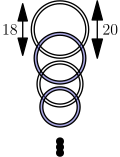
A number of linked rings, each cm thick, are hanging on a peg. The top ring has an outside diameter of cm. The outside diameter of each of the other rings is cm less than that of the ring above it. The bottom ring has an outside diameter of cm. What is the distance, in cm, from the top of the top ring to the bottom of the bottom ring?
Pista pequeña:
La parte expuesta de cada anillo inferior es su diámetro exterior menos los cm de traslape con el anillo de arriba.
The exposed part of each lower ring is its outside diameter minus the cm of overlap with the ring above
Pista grande:
Suma a .
Add to
Solución:
El anillo superior aporta su diámetro exterior completo, cm. Como los anillos tienen cm de grosor, cada anillo cuelga cm por debajo de la parte superior del anillo que está encima, así que cada anillo inferior añade su diámetro exterior menos
Los diámetros exteriores son así que las distancias añadidas son El total es
Por lo tanto, la respuesta correcta es B.
The top ring contributes its full outside diameter, cm. Because the rings are cm thick, each ring hangs cm below the top of the ring above it, so each lower ring adds its outside diameter minus
The outside diameters run so the added distances are The total is
Thus, the correct answer is B.
15.
Odell y Kershaw corren durante minutos en una pista circular. Odell corre en sentido horario a m/min y usa el carril interior con un radio de metros. Kershaw corre en sentido antihorario a m/min y usa el carril exterior con un radio de metros, comenzando en la misma línea radial que Odell. ¿Cuántas veces se cruzan después de la salida?
Odell and Kershaw run for minutes on a circular track. Odell runs clockwise at m/min and uses the inner lane with a radius of meters. Kershaw runs counterclockwise at m/min and uses the outer lane with a radius of meters, starting on the same radial line as Odell. How many times after the start do they pass each other?
Pista pequeña:
Calcula el tiempo de cada corredor para una vuelta; resultan iguales.
Compute each runner’s time for one lap; they turn out equal
Pista grande:
Corriendo en direcciones opuestas, se encuentran dos veces por vuelta; cuenta cuántas vueltas caben en minutos.
Running in opposite directions, they meet twice per lap; count how many laps fit in minutes
Solución:
La vuelta de Odell es m a m/min, tomando min. La vuelta de Kershaw es m a m/min, también min.
Sus períodos son iguales. Corriendo en direcciones opuestas, se encuentran en los instantes para Exigir da así que se cruzan veces.
Por lo tanto, la respuesta correcta es D.
Odell’s lap is m at m/min, taking min. Kershaw’s lap is m at m/min, also min.
Their periods are equal. Running in opposite directions, they meet at times for Requiring gives so they pass times.
Thus, the correct answer is D.
16.
Una circunferencia de radio es tangente a una circunferencia de radio Los lados de son tangentes a las circunferencias como se muestra, y los lados y son congruentes. ¿Cuál es el área de ?

A circle of radius is tangent to a circle of radius The sides of are tangent to the circles as shown, and the sides and are congruent. What is the area of
Pista pequeña:
Sean y los centros; los triángulos rectángulos recortados a lo largo de son semejantes.
Let and be the centers; the right triangles cut off along are similar
Pista grande:
Los centros están a y de y la base está por debajo de .
The centers lie and from and the base is below
Solución:
Sean los centros de la circunferencia pequeña y la grande, y sea el punto donde la circunferencia pequeña toca Los triángulos rectángulos recortados a lo largo de son semejantes, así que lo que da y
La longitud de la tangente es Sea el punto medio de ; entonces
Como obtenemos Por lo tanto y el área es
Por lo tanto, la respuesta correcta es D.
Let be the centers of the small and large circles, and let be the point where the small circle touches The right triangles cut off along are similar, so giving and
The tangent length is Let be the midpoint of ; then
Since we get Thus and the area is
Thus, the correct answer is D.
17.
En el rectángulo los puntos y trisecan y los puntos y trisecan Además, ¿Cuál es el área del cuadrilátero que se muestra en la figura?
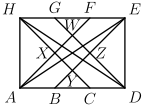
In rectangle points and trisect and points and trisect In addition, What is the area of quadrilateral shown in the figure?
Pista pequeña:
Asigna coordenadas usando y .
Assign coordinates using and
Pista grande:
es un cuadrado; encuentra sus diagonales.
is a square; find its diagonals
Solución:
Toma así que y
Los segmentos dibujados se cortan en y Estos forman un cuadrado cuyas diagonales perpendiculares y tienen cada una longitud
Su área es
Por lo tanto, la respuesta correcta es A.
Set so and
The drawn segments meet at and These form a square whose perpendicular diagonals and each have length
Its area is
Thus, the correct answer is A.
18.
Una placa de matrícula en cierto estado consiste en dígitos, no necesariamente distintos, y letras, también no necesariamente distintas. Estos seis caracteres pueden aparecer en cualquier orden, salvo que las dos letras deben aparecer juntas. ¿Cuántas placas distintas son posibles?
A license plate in a certain state consists of digits, not necessarily distinct, and letters, also not necessarily distinct. These six characters may appear in any order, except that the two letters must appear next to each other. How many distinct license plates are possible?
Pista pequeña:
Pega las dos letras en un solo bloque que se mueve como una unidad.
Glue the two letters into a single block that moves as a unit
Pista grande:
Cuenta las opciones de dígitos, las opciones de letras y las posiciones del bloque.
Count digit choices, letter choices, and positions for the block
Solución:
Como las dos letras deben ser adyacentes, trátalas como un solo bloque. Una placa es entonces dígitos más este bloque, es decir objetos, y el bloque puede ocupar posiciones.
Hay opciones para los dígitos y para las dos letras, así que el total es
Por lo tanto, la respuesta correcta es C.
Since the two letters must be adjacent, treat them as one block. A plate is then digits plus this block— objects—and the block can occupy positions.
There are choices for the digits and for the two letters, so the total is
Thus, the correct answer is C.
19.
¿Cuántos triángulos no semejantes tienen ángulos cuyas medidas en grados son enteros positivos distintos en progresión aritmética?
How many non-similar triangles have angles whose degree measures are distinct positive integers in arithmetic progression?
Pista pequeña:
Si los ángulos están en progresión aritmética, el ángulo central es .
If the angles are in arithmetic progression, the middle angle is
Pista grande:
La diferencia común satisface .
The common difference satisfies
Solución:
Sean los ángulos Su suma es así que
Las medidas son enteros positivos distintos, así que y obliga a Por lo tanto lo que da triángulos no semejantes.
Por lo tanto, la respuesta correcta es C.
Let the angles be Their sum is so
The measures are distinct positive integers, so and forces Thus giving non-similar triangles.
Thus, the correct answer is C.
20.
Se eligen al azar seis enteros positivos distintos entre y inclusive. ¿Cuál es la probabilidad de que algún par de estos enteros tenga una diferencia que sea múltiplo de ?
Six distinct positive integers are randomly chosen between and inclusive. What is the probability that some pair of these integers has a difference that is a multiple of
Pista pequeña:
Considera los residuos cuando los enteros se dividen entre .
Consider the remainders when the integers are divided by
Pista grande:
Solo hay residuos posibles para enteros.
There are only possible remainders for integers
Solución:
Agrupa los enteros por su residuo módulo Solo hay residuos posibles pero enteros, así que por el Principio del Palomar dos comparten un residuo.
Su diferencia es entonces un múltiplo de Esto siempre ocurre, así que la probabilidad es
Por lo tanto, la respuesta correcta es E.
Group the integers by their remainder modulo There are only possible remainders but integers, so by the Pigeonhole Principle two share a remainder.
Their difference is then a multiple of This always happens, so the probability is
Thus, the correct answer is E.
21.
¿Cuántos enteros positivos de cuatro dígitos tienen al menos un dígito que sea un o un ?
How many four-digit positive integers have at least one digit that is a or a
Pista pequeña:
Cuenta el complemento: números de cuatro dígitos sin ningún ni ningún .
Count the complement: four-digit numbers with no and no
Pista grande:
El dígito inicial tiene opciones; cada uno de los otros dígitos tiene .
The leading digit has choices; each other digit has
Solución:
Hay enteros de cuatro dígitos. Para los que evitan el y el el dígito inicial es uno de ( opciones) y cada dígito restante es uno de ( opciones):
Así que tienen al menos un o un
Por lo tanto, la respuesta correcta es E.
There are four-digit integers. For those avoiding and the leading digit is one of ( choices) and each remaining digit is one of ( choices):
So have at least one or
Thus, the correct answer is E.
22.
Dos granjeros acuerdan que los cerdos valen y que las cabras valen Cuando un granjero le debe dinero al otro, paga la deuda con cerdos o cabras, recibiendo “cambio” en forma de cabras o cerdos según sea necesario. (Por ejemplo, una deuda de podría pagarse con dos cerdos, recibiendo una cabra de cambio.) ¿Cuál es el monto de la menor deuda positiva que puede saldarse de esta manera?
Two farmers agree that pigs are worth and that goats are worth When one farmer owes the other money, he pays the debt in pigs or goats, with “change” received in the form of goats or pigs as necessary. (For example, a debt could be paid with two pigs, with one goat received in change.) What is the amount of the smallest positive debt that can be resolved in this way?
Pista pequeña:
Una deuda saldable es para enteros (posiblemente negativos).
A resolvable debt is for integers (possibly negative)
Pista grande:
Esto es igual a y .
This equals and
Solución:
Una deuda saldable es para enteros donde un valor negativo significa cambio recibido. Como y el valor puede ser cualquier entero, así que es cualquier múltiplo de
El menor positivo es logrado con (entregar cabras, recibir cerdos).
Por lo tanto, la respuesta correcta es C.
A resolvable debt is for integers where a negative value means change received. Since and the value can be any integer, so is any multiple of
The smallest positive one is achieved by (give goats, receive pigs).
Thus, the correct answer is C.
23.
Las circunferencias con centros y tienen radios y respectivamente. Una tangente interior común toca las circunferencias en y como se muestra. Las rectas y se cortan en y ¿Cuánto vale ?
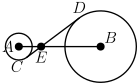
Circles with centers and have radii and respectively. A common internal tangent touches the circles at and as shown. Lines and intersect at and What is
Pista pequeña:
Los radios y son perpendiculares a la tangente .
Radii and are perpendicular to the tangent
Pista grande:
; primero encuentra .
; first find
Solución:
Como tenemos
Como así que
Entonces
Por lo tanto, la respuesta correcta es B.
Since we have
Because so
Then
Thus, the correct answer is B.
24.
Los centros de caras adyacentes de un cubo unitario se unen para formar un octaedro regular. ¿Cuál es el volumen de este octaedro?
Centers of adjacent faces of a unit cube are joined to form a regular octahedron. What is the volume of this octahedron?
Pista pequeña:
El octaedro se compone de dos pirámides de base cuadrada unidas por sus bases.
The octahedron is two square pyramids glued at their bases
Pista grande:
Los centros de caras adyacentes están a de distancia; encuentra el área de la base y la altura.
Adjacent face-centers are apart; find the base area and height
Solución:
Los seis centros de caras forman un octaedro regular, visto como dos pirámides cuadrangulares congruentes que comparten una base. Los centros de caras adyacentes están a de distancia, así que la base cuadrada tiene área
Cada pirámide tiene altura así que su volumen es El octaedro tiene volumen
Por lo tanto, la respuesta correcta es B.
The six face centers form a regular octahedron, viewed as two congruent square pyramids sharing a base. Adjacent face centers are apart, so the square base has area
Each pyramid has height so its volume is The octahedron has volume
Thus, the correct answer is B.
25.
Un insecto parte de un vértice de un cubo y se mueve a lo largo de las aristas del cubo según la siguiente regla. En cada vértice el insecto elige recorrer una de las tres aristas que salen de ese vértice. Cada arista tiene la misma probabilidad de ser elegida, y todas las elecciones son independientes. ¿Cuál es la probabilidad de que después de siete movimientos el insecto haya visitado cada vértice exactamente una vez?
A bug starts at one vertex of a cube and moves along the edges of the cube according to the following rule. At each vertex the bug will choose to travel along one of the three edges emanating from that vertex. Each edge has equal probability of being chosen, and all choices are independent. What is the probability that after seven moves the bug will have visited every vertex exactly once?
Pista pequeña:
El insecto debe trazar un camino que visite los vértices, es decir movimientos sin repetir vértices.
The bug must trace a path visiting all vertices, i.e. moves with no repeated vertices
Pista grande:
Cuenta esos caminos desde el inicio; hay recorridos igualmente probables.
Count such paths from the start; there are equally likely walks
Solución:
Después de movimientos hay recorridos igualmente probables. Un recorrido exitoso visita cada vértice exactamente una vez.
Etiqueta los vértices del cubo con ternas binarias, de modo que los vértices adyacentes difieran en una coordenada. Desde el inicio hay opciones para el primer movimiento y para el segundo si el insecto no regresa al punto de partida. Por simetría, podemos fijar estos primeros movimientos como
Las continuaciones exitosas son exactamente y Por lo tanto, cada par permitido de primeros movimientos tiene continuaciones exitosas, lo que da recorridos exitosos.
La probabilidad es
Por lo tanto, la respuesta correcta es C.
After moves there are equally likely walks. A successful walk visits every vertex exactly once.
Label the cube’s vertices by binary triples, with adjacent vertices differing in one coordinate. There are choices for the first move and for the second move if the bug is not to return to its starting point. By symmetry, fix these first moves as
The successful continuations are exactly and Thus each allowed pair of first moves has successful continuations, giving successful walks.
The probability is
Thus, the correct answer is C.