
2023 AMC 10B 真题
计时
1:15:00
1.
Jones 太太正在把橙汁倒入四个相同的杯子,给她的四个儿子喝。她把前三个杯子都倒满了,但橙汁用完时,第四个杯子只倒了 。Jones 太太需要从前三个杯子中的每个杯子倒出几分之一个杯子的橙汁到第四个杯子里,才能使四个杯子中的橙汁量相同?
Mrs. Jones is pouring orange juice into four identical glasses for her four sons. She fills the first three glasses completely but runs out of juice when the fourth glass is only full. What fraction of a glass must Mrs. Jones pour from each of the first three glasses into the fourth glass so that all four glasses will have the same amount of juice?
答案:C
小提示:
先求橙汁总量,再平均分到四个杯子中。
Find the total amount of juice, then divide it equally among the four glasses
大提示:
每个满杯最终到达公共液面,所以它倒出的量是 减去该液面高度。
Each full glass ends at the common level, so it must pour out minus that level
解答:
总共有 杯橙汁。平均分到四个杯子中,每杯为 。因此每个满杯需要倒出 杯。所以正确答案是 C。
There’s glasses of juice in all. Split four ways, each glass ends up with So a full glass has to pour out Thus, C is the correct answer.
2.
Carlos 去体育用品店买跑鞋。跑鞋正在促销,每双价格降低 。Carlos 还知道,他必须按折后价支付 的销售税。他有 美元。他能买得起的最贵跑鞋的原价(折扣前价格)是多少?
Carlos went to a sports store to buy running shoes. Running shoes were on sale, with prices reduced by on every pair of shoes. Carlos also knew that he had to pay a sales tax on the discounted price. He had dollars. What is the original (before discount) price of the most expensive shoes he could afford to buy?
小提示:
折扣把价格乘以 ; 税把价格乘以 。
A discount multiplies the price by a tax multiplies by
大提示:
令最终花费 等于 ,再解 。
Set the final cost equal to and solve for
解答:
设原价为 。折扣和税后,Carlos 需要支付 。他能负担当且仅当 ,所以 。因此最贵的原价为 。所以正确答案是 B。
Let be the original price. After the discount and tax, Carlos pays He can afford it when which means So the priciest shoes he can swing start at Therefore, the answer is B.
3.
一个 -- 直角三角形内接于圆 ,一个 -- 直角三角形内接于圆 。圆 的面积与圆 的面积之比是多少?
A -- right triangle is inscribed in circle and a -- right triangle is inscribed in circle What is the ratio of the area of circle to the area of circle
答案:D
小提示:
直角三角形的斜边是其外接圆的直径。
The hypotenuse of a right triangle is a diameter of its circumscribed circle
大提示:
两个半径分别为 和 ;面积按半径平方成比例
The radii are and area scales as the square of the radius
解答:
直角三角形的斜边是外接圆的直径。因此圆 的直径为 ,圆 的直径为 。面积之比等于直径平方之比:。所以正确答案是 D。
The hypotenuse of a right triangle is a diameter of the circle around it. So circle has diameter and circle has diameter Areas scale as the square of that, giving Thus, D is the correct answer.
4.
Jackson 的画笔能刷出宽 毫米的窄条。Jackson 的油漆足够刷出 米长的一条。Jackson 能用油漆覆盖多少平方厘米的纸?
Jackson’s paintbrush makes a narrow strip with a width of millimeters. Jackson has enough paint to make a strip meters long. How many square centimeters of paper could Jackson cover with paint?
小提示:
都换算成厘米: 毫米 厘米, 米 厘米。
Convert everything to centimeters: mm cm and m cm
大提示:
单位统一后,面积为宽 长。
Area is width length once both are in the same units
解答:
先换算成厘米。宽度为 毫米 厘米,长度为 米 厘米。面积为 平方厘米。所以正确答案是 C。
Put everything in centimeters first. The strip is mm cm wide and m cm long. Its area is square centimeters. Therefore, the answer is C.
5.
Maddy 和 Lara 看到黑板上写着一列数。Maddy 给列表中的每个数加上 ,发现新数之和为 。Lara 把列表中的每个数乘以 ,发现新数之和也为 。黑板上写了多少个数?
Maddy and Lara see a list of numbers written on a blackboard. Maddy adds to each number in the list and finds that the sum of her new numbers is Lara multiplies each number in the list by and finds that the sum of her new numbers is also How many numbers are written on the blackboard?
小提示:
设个数为 ,原数之和为 ;每个数加 会让总和增加 。
Let the count be and the original sum be adding to each number adds
大提示:
Lara 的条件给出 ,所以 。
Lara’s condition gives so
解答:
设原数之和为 ,数的个数为 。Maddy 每个数加 ,总和为 。Lara 把每个数变为原来的三倍,所以 ,得 。因此 ,所以 。所以正确答案是 A。
Let be the original sum and the number of entries. Maddy adds to each, so her total is Lara triples each, so hers is giving Then so Thus, A is the correct answer.
6.
令 ,,且对 ,。序列 ,,,, 中有多少项是偶数?
Let and for How many terms in the sequence are even?
小提示:
只追踪奇偶性:奇、奇、偶,然后重复。
Track only the parity of the terms: odd, odd, even, and then it repeats
大提示:
偶数项恰好出现在位置为 的倍数处。
Even terms occur exactly at positions that are multiples of
解答:
序列从 可见奇偶性为奇、奇、偶,并以周期 重复。因此 为偶数当且仅当 能被 整除。在 中, 的倍数有 个。所以正确答案是 E。
Track the parities: run odd, odd, even, then repeat with period So is even exactly when is divisible by Among that’s multiples of Therefore, the answer is E.
7.
正方形 绕其中心顺时针旋转 ,得到正方形 ,如下图所示。求 的度数。
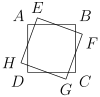
Square is rotated clockwise about its center to obtain square as shown below. What is the degree measure of
小提示:
设 为中心,则 ,且 。
Let be the center; then and
大提示:
三角形 是等腰三角形,而对角线 与 成 角。
Triangle is isosceles, and the diagonal makes a angle with
解答:
设 为共同中心。旋转把 送到 ,所以 ,且 。三角形 是等腰三角形,底角为 。正方形对角线 平分 点的直角,所以 。两角相减,得到 。所以正确答案是 B。
Let be the shared center. The rotation carries to so and That makes triangle isosceles, with base angles The diagonal splits the right angle at so Subtracting, Thus, B is the correct answer.
8.
下列表达式的个位数字是多少?
What is the units digit of
小提示:
的幂的个位数循环为 ; 的幂的个位数循环为 。
Units digits of powers of cycle powers of cycle
大提示:
将每个指数对 取余,再相加个位数。
Reduce each exponent modulo then add the two units digits
解答:
只看个位数。 的幂个位数以 为周期 ,而 ,所以 个位数为 。 的幂个位数按 循环,同样每四项重复一次;又因为 ,所以 个位数为 。相加 ,个位数为 。所以正确答案是 A。
Only the units digits matter. Powers of cycle with period and so ends in Powers of cycle and so ends in Add them: so the units digit is Therefore, the answer is A.
9.
和 是一对连续正完全平方数,它们的差为 。有多少对连续正完全平方数的差小于或等于 ?
The numbers and are a pair of consecutive positive perfect squares whose difference is How many pairs of consecutive positive perfect squares have a difference of less than or equal to
10.
你正在玩一个游戏。一个 矩形覆盖了一个 方格网中两个相邻的小方格,方向可以水平或竖直,但你不知道它覆盖了哪两个小方格。你的目标是找到至少一个被矩形覆盖的小方格。一次“回合”包括你猜一个小方格,随后你会被告知该小方格是否被隐藏矩形覆盖。为了保证至少有一个猜中的小方格,你最少需要多少回合?
You are playing a game. A rectangle covers two adjacent squares (oriented either horizontally or vertically) of a grid of squares, but you are not told which two squares are covered. Your goal is to find at least one square that is covered by the rectangle. A “turn” consists of you guessing a square, after which you are told whether that square is covered by the hidden rectangle. What is the minimum number of turns you need to ensure that at least one of your guessed squares is covered by the rectangle?
小提示:
如果所有猜测都没命中,则被覆盖的两个小方格都在未猜的小方格中。
If none of your guesses is covered, the two covered squares lie among the squares you did not guess
大提示:
未猜的小方格必须没有任何两个相邻; 方格中最多有 个两两不相邻的小方格。
The unguessed squares must have no two adjacent; the most non-adjacent squares in a grid is
解答:
假设每次猜测都没有命中。那么多米诺完全位于未猜的小方格中,所以未猜的小方格中必须含有两个相邻格。要保证命中,需要让未猜格中没有任何两个相邻。把方格黑白相间地染色。两两不相邻的小方格最多有 个,即四个角和中心。因此至少要猜 个格子。 个也足够:猜四个边中点。每个隐藏矩形都会覆盖一个边中点,所以必定命中。正确答案是 C。
Suppose every guess misses. Then the domino lies entirely on unguessed squares, so those squares include two adjacent cells. To force a hit, we need the unguessed squares to have no two adjacent. Color the grid like a checkerboard. The biggest set of pairwise non-adjacent squares has cells, one color’s worth: the four corners and the center. So we must guess at least squares. And is enough: guess the four edge midpoints, since every domino covers one square of each color, hence one edge midpoint. Therefore, the answer is C.
11.
Suzanne 去银行取了 。柜员用 、 和 纸币给她这笔钱,并且每种面额至少有一张。Suzanne 可能收到多少种不同的纸币组合?
Suzanne went to the bank and withdrew The teller gave her this amount using bills, bills, and bills, with at least one of each denomination. How many different collections of bills could Suzanne have received?
小提示:
将 除以 ;奇偶性会迫使 纸币张数为偶数
Divide by parity then forces the number of bills to be even
大提示:
写 ,然后计数满足 的正整数对 。
Writing count positive integer pairs with
解答:
设 分别为 纸币张数。则 ,化为 。因为 和 都是偶数, 也必须为偶数,所以 。此时 条件等价于 ,其中 。这样的正整数对数量为 。所以正确答案是 B。
Let count the bills. Then which divides down to Both and are even, so is too, forcing Now means With the pairs number Thus, B is the correct answer.
12.
将多项式 的根从实数轴上去掉后,剩余部分是 个不相交开区间的并。在其中多少个区间上 为正?
When the roots of the polynomial are removed from the real number line, what remains is the union of disjoint open intervals. On how many of those intervals is positive?
小提示:
当 时,每个因子都为正; 的符号只能在根处改变。
For every factor is positive; the sign of can only change at a root
大提示:
穿过根 时,只有指数 为奇数才会变号。
Crossing the root flips the sign exactly when the exponent is odd
解答:
当 时,每个因子 都为正,所以 。向左移动时,穿过 只有在 为奇数时才变号,即 。因此十一个区间从右到左的符号依次为 ,其中六个区间上为正。所以正确答案是 C。
For every factor is positive, so Now move left. Crossing flips the sign only when is odd, that is at So the eleven intervals, right to left, carry signs Six are positive. Therefore, the answer is C.
13.
坐标平面中由下列不等式定义的区域面积是多少?
What is the area of the region in the coordinate plane defined by the inequality
小提示:
令 、;则 是一个菱形。
Substitute and then is a diamond
大提示:
第一象限中的部分关于两条坐标轴反射,会复制成 份。
Reflecting the first-quadrant piece across both axes copies it times
解答:
令 、。则 是以 为中心、两条对角线长都为 的菱形,面积为 ,且它完全位于 中。映射 对 的点是四对一,所以原区域面积为 。所以正确答案是 B。
Substitute Then is a diamond centered at with diagonals of length so it has area and it sits entirely in The map is four-to-one over so the full region has area Thus, B is the correct answer.
14.
有多少个整数有序对 满足下列方程?
How many ordered pairs of integers satisfy the equation
小提示:
若 ,则 ;否则可假设 。
If then otherwise assume
大提示:
然后 ,迫使 。
Then forces
解答:
若 ,方程迫使 ,得到 。否则两者都非零。不妨假设 。则 ,所以 ,即 。当 时,,得 。当 时,得 。加上 ,共有三个有序对。所以正确答案是 C。
If the equation forces giving Otherwise both are nonzero; assume Then so and Take gives Take That leaves three in all. Therefore, the answer is C.
15.
使 成为完全平方数的最小正整数 是多少?
What is the least positive integer such that is a perfect square?
小提示:
成对组合阶乘: ,是平方数乘以一个奇数。
Pair the factorials: a square times an odd number
大提示:
剩下的奇数因子和 决定哪些质数出现奇数次。
The leftover odd factors and determine which primes appear to an odd power
解答:
将乘积分组为 。因为 ,每一对都是平方数乘以一个奇数。这些奇数 的乘积为 ,平方自由部分为 。同时 的平方自由部分为 。两者相乘后,整个乘积的平方自由部分为 。因此最小的 是 。所以正确答案是 C。
Group the product as Since each pair is a perfect square times an odd number. Those odd numbers multiply to with squarefree part And has squarefree part Multiply the two: the squarefree part of the whole thing is That’s the smallest namely Thus, C is the correct answer.
16.
定义“升数”为一个至少 位的正整数,其数字从左到右严格递增。类似地,定义“降数”为一个至少 位的正整数,其数字从左到右严格递减。例如, 是升数, 是降数。令 为所有升数的总数,令 为所有降数的总数。求 。
Define an upno to be a positive integer of or more digits where the digits are strictly increasing moving left to right. Similarly, define a downno to be a positive integer of or more digits where the digits are strictly decreasing moving left to right. For instance, the number is an upno and is a downno. Let equal the total number of upnos and let equal the total number of downnos. What is
小提示:
每个这样的数只是选择一组数字,再按规定顺序写出。
Each such number is just a choice of its set of digits, written in the required order
大提示:
递增数使用 中的数字;递减数还可以包含末尾的 。
Increasing numbers use digits from decreasing numbers may also include a trailing
解答:
一个“升数”就是选择至少 个数字并按递增顺序写出。数字 不能出现,因为它不能在首位,也不能跟在更小的数字后面。因此数字来自 ,所以 。一个“降数”可以以 结尾,所以可从 中选择 个数字,得到 。因此 。所以正确答案是 E。
An upno is just a choice of at least digits, written in increasing order. A can never appear: it can’t lead and can’t follow a smaller digit. So the digits come from giving A downno can end in so its digits are any subset of of size giving So Therefore, the answer is E.
17.
长方体 的三条不同边长为 、、。 的所有 条边长之和为 , 的所有 个面的面积之和为 , 的体积为 。连接 两个顶点的最长内部对角线长度是多少?
A rectangular box has distinct edge lengths and The sum of the lengths of all edges of is the sum of the areas of all faces of is and the volume of is What is the length of the longest interior diagonal connecting two vertices of
小提示:
边长和给出 ,面面积和给出 。
The edge sum gives and the face-area sum gives
大提示:
对角线为 ;展开 ,即可由两个已知的对称和求出根号内的值。
The diagonal is expand to recover its radicand from the two known symmetric sums
解答:
条边给出 ,所以 。 个面给出 ,所以 。空间对角线长度为 所以正确答案是 D。
The edges give so The faces give so The space diagonal is Thus, D is the correct answer.
18.
假设 、、 为正整数,满足 下列哪些命题必定为真?
I. 如果 或 ,或两者都成立,则 。
II. 如果 ,则 或 ,或两者都成立。
III. 当且仅当 。
Suppose and are positive integers such that Which of the following statements are necessarily true?
I. If or or both, then
II. If then or or both.
III. if and only if
、 和
and
仅
only
仅 和
and only
仅
only
仅 和
and only
小提示:
清除分母得到 ,再模 化简。
Clear denominators to get then reduce modulo
大提示:
会分别限制 在模 意义下以及 在模 意义下的余数。
forces conditions on modulo and on modulo
解答:
清除分母得 。对 的质因数分别取模:,,,。因此 当且仅当 既不是 的倍数也不是 的倍数,且 既不是 的倍数也不是 的倍数,这正是 且 。所以 III 为真,也使 II 为真。I 不一定为真。例如 ,则 ,但 能被 整除。因此只有 II 和 III 为真,正确答案是 E。
Clear denominators to get Reduce modulo the primes of and So iff is divisible by neither nor and is divisible by neither nor which is exactly and That settles III, and it makes II true since the “and” implies the “or.” Statement I fails, though: take Then yet is divisible by So only II and III hold. Therefore, the answer is E.
19.
青蛙 Sonya 在坐标平面中的正方形 内均匀随机选择一个点并跳到该点。然后她从 中均匀随机选择一个距离,并从 中均匀随机选择一个方向。所有选择相互独立。她沿所选方向跳所选距离。她落在正方形外的概率是多少?
Sonya the frog chooses a point uniformly at random lying within the square in the coordinate plane and hops to that point. She then chooses a distance uniformly at random from and a direction uniformly at random from All her choices are independent. She now hops the distance in the chosen direction. What is the probability that she lands outside the square?
小提示:
由对称性,可固定一个方向,例如向东;只需考虑朝该边的坐标。
By symmetry, condition on one direction, say east; only the coordinate toward that edge matters
大提示:
对固定跳跃距离 ,跳出正方形的概率为 ;再对 取平均。
For a fixed hop distance the landing is outside with probability average over
解答:
四个方向由对称性相同。假设她向东跳。她跳出正方形当且仅当原来的 坐标加跳跃距离 超过 。固定 时, 在 上均匀分布,所以横坐标大于 的概率为 。现在对 在 上取平均,得到 。所以正确答案是 B。
The four directions behave the same by symmetry, so say she hops east. She lands outside exactly when her -coordinate plus the hop distance tops Fix Her -coordinate is uniform on so it beats with probability Now average over uniform on Thus, B is the correct answer.
20.
如图,在半径为 的球面上画出四个全等半圆,形成一条闭合曲线,将球面分成两个全等区域。该曲线长度为 。求 。
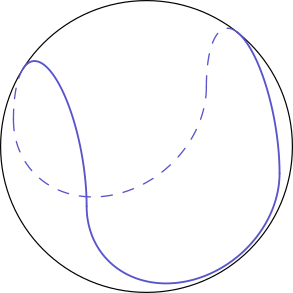
Four congruent semicircles are drawn on the surface of a sphere with radius as shown, creating a closed curve that divides the surface into two congruent regions. The length of the curve is What is
小提示:
闭合曲线由四段全等半圆弧组成,所以长度为一个半圆弧长 的 倍,其中 是弧所在圆的半径。
The closed curve is four congruent semicircular arcs, so its length is times one semicircle’s length where is the arc radius
大提示:
四个弧端点构成一个内接于大圆的正方形,所以每段弧的直径是一条长 的弦,弧半径为 。
The four arc endpoints form a square inscribed in a great circle, so each arc’s diameter is a chord of length making the arc radius
解答:
这条曲线由四段全等的半圆弧组成。若弧所在圆的半径为 ,则总长度是单段半圆弧长 的 倍。四段弧相交于四个点,这四点构成一个内接于球面大圆的正方形;每段弧的直径就是该正方形的一条边。球半径为 ,所以正方形边长为 ,从而 。(也可以这样验证:小圆所在平面到球心的距离为 ,所以小圆半径为 。)因此总长度为 ,所以 。正确答案是 A。
The curve is four congruent semicircular arcs, so its length is times one semicircle, where is the arc radius. The arcs meet at four points that form a square inscribed in a great circle of the radius- sphere, and each arc’s diameter is a side of that square, a chord of length So (Check it another way: the small circle sits in a plane at distance from the center, giving radius ) The total length is so Therefore, the answer is A.
21.
将 个球分别随机放入 个盒子中的一个。下列哪一项最接近每个盒子中球数都是奇数的概率?
Each of balls is randomly placed into one of bins. Which of the following is closest to the probability that each of the bins will contain an odd number of balls?
小提示:
用 符号筛来表示“奇数个”,把奇偶条件写成 。
Encode “odd count” in each bin with a sign filter, replacing oddness by
大提示:
这给出 ;只有 和 给出大项。
This gives only and give large terms
解答:
所有 种放法等可能。用符号筛计数每个盒子都是奇数的放法: 。当 和 时,两项都等于 。对于其余六种符号选择,括号内的和为 或 ,而整项都等于 ,所以这六项合计为 。因此计数为 。除以总数,概率为 ,略小于 。所以正确答案是 E。
All assignments are equally likely. A sign filter counts the ones with every bin odd: For and both terms equal For each other sign choice, the sum in parentheses is or and the full term equals so these six terms total Thus the count is Dividing, the probability is a hair under Thus, E is the correct answer.
22.
有多少个不同的 值满足 其中 表示不超过 的最大整数?
How many distinct values of satisfy where denotes the largest integer less than or equal to
无限多个
an infinite number
小提示:
令 ,则 。
Set then
大提示:
要求 ,并找出满足条件的整数 。
Require and find the integers that work
解答:
令 。方程 给出 。为了与这个定义一致,需要 。左边不等式等价于 ,对整数 均成立。右边不等式等价于 ,只对 成立。这些值给出 ,所以有 个不同的值。正确答案是 B。
Set Then gives For this to be consistent we need The left side, holds for every integer The right side, holds only for Those give so there are distinct values. Therefore, the answer is B.
23.
一个由正整数组成的等差数列有 项,首项为 ,公差为 。Carl 正确写下了这个数列中的所有项,除了有一项相差了 。他写下的各项之和为 。求 。
An arithmetic sequence of positive integers has terms, initial term and common difference Carl wrote down all the terms in this sequence correctly except for one term, which was off by The sum of the terms he wrote down was What is
小提示:
写下的和与真实和 相差 ,所以 或 。
The written sum differs from the true sum by so or
大提示:
因为 ,分解 ,并使用 、、。
Since factor and use
解答:
真实和为 。因为一项相差 ,写下的总和满足 ,所以 或 。又因为 ,所以 整除 。由 、 还可得 ,即 。当 时, 的因数中没有位于 到 之间的数。当 时, 的因数中只有 落在这个范围内。于是 ,即 。由于 、 是正整数且 ,只能有 、。因此 ,正确答案是 B。
The true sum is Since one term is off by the written total satisfies so or Also so divides Since and we have hence For no divisor of lies between and For the only divisor of in this range is Thus or Since and are positive integers with we get Then Thus, B is the correct answer.
24.
由所有可表示为 的点组成的区域边界周长是多少?其中 、、。
What is the perimeter of the boundary of the region consisting of all points which can be expressed as with and
小提示:
固定 时, 扫出一个 的矩形;改变 会沿 平移它。
Fixing the pair sweeps a rectangle; varying slides it along
大提示:
边界是一个六边形,其相对的边长分别为 和 。
The boundary is a hexagon with opposite side lengths and
解答:
固定 。随着 在 中变化,点 填满一个 的轴对齐矩形,其左下角为 。当 从 到 变化时,这个矩形沿向量 平移,该向量长度为 。扫过的区域是一个中心对称的六边形。它的三组对边的长度分别为 和 ,分别来自矩形的两条边以及平移线段。因此它的周长为 。所以,答案是 E。
Fix As sweep the point fills a axis-aligned rectangle with lower-left corner As runs from to this rectangle slides along the vector whose length is The swept region is a centrally symmetric hexagon. Its opposite pairs of sides have lengths and inherited from the two sides of the rectangle and the sliding segment. Therefore its perimeter is Therefore, the answer is E.
25.
一个面积为 的正五边形印在纸上并剪下。将五边形的五个顶点都折到五边形的中心,形成一个较小的五边形。新五边形的面积是多少?
A regular pentagon with area is printed on paper and cut out. All five vertices are folded to the center of the pentagon, creating a smaller pentagon. What is the area of the new pentagon?
小提示:
将一个顶点折到中心时,折痕是该顶点到中心线段的垂直平分线,距离中心为 。
Folding a vertex to the center creases along the perpendicular bisector of the segment from that vertex to the center, a line at distance from the center
大提示:
新内切半径 取代原来的 ,所以面积按 缩放;使用 。
Apothem replaces so the area scales by use
解答:
设原正五边形外接圆半径为 。将一个顶点折到中心时,折痕是中心到该顶点线段的垂直平分线,距离中心 。五条折痕围成新的正五边形,其内切半径为 。原正五边形内切半径为 ,所以新旧正五边形相似比为 ,面积缩放因子为 。代入 :。因此新面积为 。所以正确答案是 B。
Let the original pentagon have circumradius Folding a vertex to the center creases along the perpendicular bisector of the center-to-vertex segment, a line at distance from the center. Those five creases bound the new regular pentagon, whose apothem is (the original apothem was ). So the new pentagon is similar with ratio and its area is the old area times Plug in the factor becomes So the new area is Thus, B is the correct answer.