
2009 AIME I Problem 15
Attempt Problem 15 of the 2009 AIME I below, then check your answer against the professionally curated solution from LIVE by Po-Shen Loh. You can also try the full timed exam, view all 2009 AIME I solutions, or check the answer key.
All problems are used with official legal permission of the Mathematical Association of America (MAA).
15.
In triangle and Let be a point in the interior of Let and denote the incenters of triangles and respectively. The circumcircles of triangles and meet at distinct points and The maximum possible area of can be expressed in the form where and are positive integers and is not divisible by the square of any prime. Find
Answer: 150
Small Hint:
Use and its mirror image, and transfer these angles to via the cyclic quadrilaterals
Big Hint:
is independent of so lies on a fixed arc through and the area is maximized at the arc midpoint
Solution:
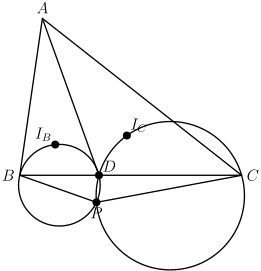
In triangle the incenter satisfies and likewise so these two angles sum to The law of cosines gives so and the sum is
The second intersection point lies on the opposite side of from the incenters (were it on the same side, the two cyclic quadrilaterals would force ). Then and are convex cyclic quadrilaterals, so independent of Hence moves along a fixed circular arc through and
The area of triangle is maximized at the midpoint of the arc, where The law of cosines gives so and the area is Thus
Problem 15 in Other Years
1983 AIME · 1984 AIME · 1985 AIME · 1986 AIME · 1987 AIME · 1988 AIME · 1989 AIME · 1990 AIME · 1991 AIME · 1992 AIME · 1993 AIME · 1994 AIME · 1995 AIME · 1996 AIME · 1997 AIME · 1998 AIME · 1999 AIME · 2000 AIME I · 2000 AIME II · 2001 AIME I · 2001 AIME II · 2002 AIME I · 2002 AIME II · 2003 AIME I · 2003 AIME II · 2004 AIME I · 2004 AIME II · 2005 AIME I · 2005 AIME II · 2006 AIME I · 2006 AIME II · 2007 AIME I · 2007 AIME II · 2008 AIME I · 2008 AIME II · 2009 AIME II · 2010 AIME I · 2010 AIME II · 2011 AIME I · 2011 AIME II · 2012 AIME I · 2012 AIME II · 2013 AIME I · 2013 AIME II · 2014 AIME I · 2014 AIME II · 2015 AIME I · 2015 AIME II · 2016 AIME I · 2016 AIME II · 2017 AIME I · 2017 AIME II · 2018 AIME I · 2018 AIME II · 2019 AIME I · 2019 AIME II · 2020 AIME I · 2020 AIME II · 2021 AIME I · 2021 AIME II · 2022 AIME I · 2022 AIME II · 2023 AIME I · 2023 AIME II · 2024 AIME I · 2024 AIME II · 2025 AIME I · 2025 AIME II · 2026 AIME I · 2026 AIME II