
2026 AIME I Problem 15
Attempt Problem 15 of the 2026 AIME I below, then check your answer against the professionally curated solution from LIVE by Po-Shen Loh. You can also try the full timed exam, view all 2026 AIME I solutions, or check the answer key.
All problems are used with official legal permission of the Mathematical Association of America (MAA).
15.
Let and be positive integers with both and greater than or equal to and less than or equal to Define an cell loop in a grid of cells to be the cells that surround an (possibly empty) rectangle of cells in the grid. For example, the following diagram shows a way to partition a grid of cells into cell loops.
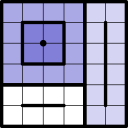
Find the number of ways to partition a grid of cells into cell loops so that every cell of the grid belongs to exactly one cell loop.
Answer: 83
Small Hint:
Every loop’s rectangle must have its inner rectangle exactly filled by other loops, and the loop sizes force Study the rectangles of the outermost loops.
Big Hint:
Area and loop counts force the outermost rectangles to be the full square or parallel full-length slabs of even width each using exactly loops
Solution:
Since the five loops cover cells, Every loop has an even number of cells, so no odd-by-odd rectangle can be exactly filled by loops; and filling a rectangle whose shortest even side is requires at least loops, since peeling off an outermost loop shrinks that side by exactly while splitting a rectangle into smaller ones only adds up such requirements. Now consider the outermost loops of a partition (those whose rectangles lie inside no other loop’s rectangle): their rectangles tile the square. If outermost rectangle has shortest even side it uses loops and covers at most cells. Summing over the tiling, so equality holds throughout: each spans the full in one direction, has even width and is filled with exactly loops. Two full-length slabs in different directions would overlap, so the outermost rectangles are the whole square or parallel slabs, and the same equality argument repeats inside every loop’s inner rectangle.
Let be the number of ways to fill a full-height slab of even width with loops, subject to the slab’s own boundary being one outermost loop. (A split into smaller outermost slabs is counted later instead.) A width- slab is a single loop: A width- slab is a loop around an loop: A width- slab is a loop around an region holding two loops — either nested ( around ) or two slabs — so A width- slab surrounds an region holding three loops: an loop around a region with two loops ( ways as before), or full-height strips of widths ( way), or widths in two orders ( ways), so The same recursion counts the full square: a loop around an region with four loops, where the and regions admit then then fillings (single nested loop, vertical strips, or horizontal strips at each stage).
Finally, tally the outermost structures. The single rectangle gives partitions. For parallel slabs, the widths form a composition of into even parts with at least two parts, and orientations (vertical or horizontal) double the count: gives in orders gives in orders gives in orders gives in orders gives and in orders gives for per orientation. The total is
Problem 15 in Other Years
1983 AIME · 1984 AIME · 1985 AIME · 1986 AIME · 1987 AIME · 1988 AIME · 1989 AIME · 1990 AIME · 1991 AIME · 1992 AIME · 1993 AIME · 1994 AIME · 1995 AIME · 1996 AIME · 1997 AIME · 1998 AIME · 1999 AIME · 2000 AIME I · 2000 AIME II · 2001 AIME I · 2001 AIME II · 2002 AIME I · 2002 AIME II · 2003 AIME I · 2003 AIME II · 2004 AIME I · 2004 AIME II · 2005 AIME I · 2005 AIME II · 2006 AIME I · 2006 AIME II · 2007 AIME I · 2007 AIME II · 2008 AIME I · 2008 AIME II · 2009 AIME I · 2009 AIME II · 2010 AIME I · 2010 AIME II · 2011 AIME I · 2011 AIME II · 2012 AIME I · 2012 AIME II · 2013 AIME I · 2013 AIME II · 2014 AIME I · 2014 AIME II · 2015 AIME I · 2015 AIME II · 2016 AIME I · 2016 AIME II · 2017 AIME I · 2017 AIME II · 2018 AIME I · 2018 AIME II · 2019 AIME I · 2019 AIME II · 2020 AIME I · 2020 AIME II · 2021 AIME I · 2021 AIME II · 2022 AIME I · 2022 AIME II · 2023 AIME I · 2023 AIME II · 2024 AIME I · 2024 AIME II · 2025 AIME I · 2025 AIME II · 2026 AIME II