
2009 AIME I Solutions
Scroll down to view professionally curated solutions from LIVE by Po-Shen Loh, print PDF solutions, view answer key, or take the full timed exam.
All problems are used with official legal permission of the Mathematical Association of America (MAA).
1.
Call a -digit number geometric if it has distinct digits which, when read from left to right, form a geometric sequence. Find the difference between the largest and smallest geometric numbers.
Small Hint:
Write the digits as the ratio may be a fraction as long as all three digits are distinct integers
Big Hint:
For the largest, start with hundreds digit and try ratios with denominator for the smallest, start with and an integer ratio
Solution:
Write the digits as For the largest geometric number, take An integer ratio at least would push the next digit past and repeats digits, so is a fraction whose denominator squares into the choices and give and The largest is
For the smallest, take hundreds digit Then the tens digit must be an integer at least (the digits are distinct), and gives which beats ’s
The difference is
2.
There is a complex number with imaginary part and a positive integer such that Find
Small Hint:
Write and clear the denominator:
Big Hint:
Expand and match real parts, then imaginary parts, to find and then
Solution:
Write Clearing the denominator gives that is,
Real parts give and imaginary parts give so and
3.
A coin that comes up heads with probability and tails with probability independently on each flip is flipped eight times. Suppose the probability of three heads and five tails is equal to of the probability of five heads and three tails. Let where and are relatively prime positive integers. Find
Small Hint:
Set up
Big Hint:
The binomial coefficients cancel, leaving both sides are positive, so take square roots
Solution:
The condition says Since and both and are positive, dividing by leaves so
Hence and
4.
In parallelogram point is on so that and point is on so that Let be the point of intersection of and Find
Small Hint:
Set as the origin and express and in terms of the vectors and
Big Hint:
Points of line have the form also write match coefficients, and add the two resulting equations
Solution:
Place at the origin and let and so that and Since lies on write where since also lies on line write for some
Because and are independent, the coefficients must agree: and Thus and adding gives
Therefore
5.
Triangle has and Points and are located on and respectively so that and is the angle bisector of angle Let be the point of intersection of and and let be the point on line for which is the midpoint of If find
Small Hint:
and the midpoint of mean the diagonals of quadrilateral bisect each other, so is a parallelogram
Big Hint:
makes triangles and similar; get from the angle bisector theorem
Solution:
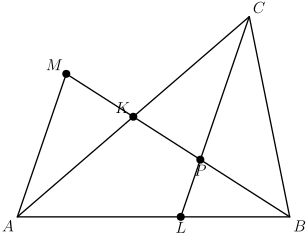
Because and is the midpoint of the diagonals of quadrilateral bisect each other, so is a parallelogram and Since lies on line and all lie on line triangles and are similar.
Thus The angle bisector theorem gives so
Therefore
6.
How many positive integers less than are there such that the equation has a solution for (The notation denotes the greatest integer that is less than or equal to )
Small Hint:
If then as runs over the value covers exactly the integers from to
Big Hint:
Sum the counts for and for the values already exceed
Solution:
Suppose for a positive integer As runs over the value increases continuously from toward so the attainable integers are exactly those with there are of them, and these ranges are disjoint for different If then which is already attained. If then is negative; an odd exponent gives a negative value, while an even exponent gives a value strictly between and Thus no produces a new positive integer.
For and the counts are and and every such is at most For the smallest value is
The total is
7.
The sequence satisfies and for Let be the least integer greater than for which is an integer. Find
Small Hint:
Rewrite the relation as and multiply successive instances to telescope
Big Hint:
The closed form is so you need to be a power of
Solution:
The relation says Multiplying these equations for telescopes: so
Thus is an integer exactly when is a power of Since only odd exponents give numbers of the form The power gives which is excluded, and the next, gives
8.
Let Consider all possible positive differences of pairs of elements of Let be the sum of all of these differences. Find the remainder when is divided by
Small Hint:
In the sum of all positive differences, count how many times each is added and how many times it is subtracted
Big Hint:
evaluate with and a geometric series, then reduce mod
Solution:
In the sum of all positive differences, the element is added once for each smaller element ( times) and subtracted once for each larger element ( times). Hence
The standard sums are and so
The remainder upon division by is
9.
A game show offers a contestant three prizes and each of which is worth a whole number of dollars from to inclusive. The contestant wins the prizes by correctly guessing the price of each prize in the order As a hint, the digits of the three prices are given. On a particular day, the digits given were Find the total number of possible guesses for all three prizes consistent with the hint.
Small Hint:
Concatenating the three prices in order gives an arrangement of the seven digits; count arrangements, then the ways to cut one into three prices
Big Hint:
Each arrangement is cut into three nonempty blocks of at most digits: the block lengths are permutations of or
Solution:
Concatenating the three guessed prices in order produces an arrangement of the seven given digits, and each guess is recovered uniquely from an arrangement together with a way to cut it into three consecutive nonempty blocks of at most four digits each (prices run from to and no price can start with here since every digit is or ). There are arrangements of four s and three s.
The ordered block lengths are the ways to write as an ordered sum of three parts between and the permutations of and giving cuts for each arrangement.
The total is
10.
The Annual Interplanetary Mathematics Examination (AIME) is written by a committee of five Martians, five Venusians, and five Earthlings. At meetings, committee members sit at a round table with chairs numbered from to in clockwise order. Committee rules state that a Martian must occupy chair and an Earthling must occupy chair Furthermore, no Earthling can sit immediately to the left of a Martian, no Martian can sit immediately to the left of a Venusian, and no Venusian can sit immediately to the left of an Earthling. The number of possible seating arrangements for the committee is Find
Small Hint:
Count planet-to-chair patterns first; the rules force blocks of Martians, Venusians, and Earthlings to repeat in that clockwise order
Big Hint:
If the cycle repeats times, each planet’s members split into ordered nonempty groups in ways; cube and sum over
Solution:
First choose which planet sits in each chair; the individuals from each planet can then be assigned to their chairs in ways apiece, so counts the planet patterns. The adjacency rules say exactly that, reading clockwise, each maximal block of Martians must be followed by a block of Venusians and then a block of Earthlings before Martians can appear again. Since chair holds a Martian and chair holds an Earthling, the chairs from to consist of the pattern (Martian block, Venusian block, Earthling block) repeated times, for some
For a given each planet’s five members are distributed into nonempty blocks in order, and the number of ways to write as an ordered sum of positive integers is The three planets’ block sizes are independent, so
11.
Consider the set of all triangles where is the origin and and are distinct points in the plane with nonnegative integer coordinates such that Find the number of such distinct triangles whose area is a positive integer.
Small Hint:
The lattice points on the line are for
Big Hint:
The triangle on points and has area an integer exactly when and have the same parity
Solution:
The points on the line with nonnegative integer coordinates are for — fifty points in all. For and the shoelace formula gives
This is automatically positive for distinct points, and since is odd, it is an integer exactly when is even, that is, when and have the same parity. There are even and odd indices, so the number of triangles is
12.
In right with hypotenuse and is the altitude to Let be the circle having as a diameter. Let be a point outside such that and are both tangent to circle The ratio of the perimeter of to the length can be expressed in the form where and are relatively prime positive integers. Find
Small Hint:
is tangent to at so is the inscribed circle of triangle
Big Hint:
Let be the tangent length from and compute the area of two ways: with and Heron’s formula
Solution:
Because and is an endpoint of the diameter, is tangent to at Together with the tangent lines and this makes the inscribed circle of triangle Write and let be the tangent length from The right-triangle altitude satisfies so the inradius of is
With semiperimeter the tangent lengths are exactly and so the area of equals both and, by Heron’s formula, Equating and squaring, so which gives
The perimeter is so its ratio to is (independent of the given legs), and
13.
The terms of the sequence defined by for are positive integers. Find the minimum possible value of
Small Hint:
Clear denominators: then subtract consecutive instances
Big Hint:
Unless always, the differences strictly decrease forever, which is impossible; the resulting two-periodic case forces
Solution:
Clearing denominators, for all Subtracting each instance from the next gives
If some difference were nonzero, then every later difference would be nonzero as well, and since each the identity would force an infinite strictly decreasing sequence of positive integers — impossible. Hence for all the odd-indexed terms are all equal and the even-indexed terms are all equal.
The recursion then reads so Among the factor pairs of the sum is smallest for giving
14.
For define where If and find the minimum possible value for
Small Hint:
Let count how many equal the given data are linear equations in
Big Hint:
Eliminating and then leaves so is or compare the two resulting values of
Solution:
For let be the number of equal to Then
Subtracting the first equation from the other two gives and subtracting times the former from the latter leaves that is, Hence is a nonnegative multiple of and only and keep everything nonnegative, giving or
These yield and respectively, so the minimum is
15.
In triangle and Let be a point in the interior of Let and denote the incenters of triangles and respectively. The circumcircles of triangles and meet at distinct points and The maximum possible area of can be expressed in the form where and are positive integers and is not divisible by the square of any prime. Find
Small Hint:
Use and its mirror image, and transfer these angles to via the cyclic quadrilaterals
Big Hint:
is independent of so lies on a fixed arc through and the area is maximized at the arc midpoint
Solution:
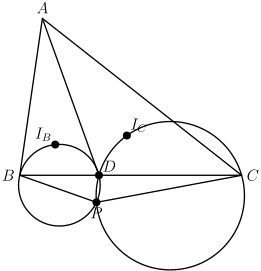
In triangle the incenter satisfies and likewise so these two angles sum to The law of cosines gives so and the sum is
The second intersection point lies on the opposite side of from the incenters (were it on the same side, the two cyclic quadrilaterals would force ). Then and are convex cyclic quadrilaterals, so independent of Hence moves along a fixed circular arc through and
The area of triangle is maximized at the midpoint of the arc, where The law of cosines gives so and the area is Thus