
1997 AIME Problem 15
Attempt Problem 15 of the 1997 AIME below, then check your answer against the professionally curated solution from LIVE by Po-Shen Loh. You can also try the full timed exam, view all 1997 AIME solutions, or check the answer key.
All problems are used with official legal permission of the Mathematical Association of America (MAA).
15.
The sides of rectangle have lengths and An equilateral triangle is drawn so that no point of the triangle lies outside The maximum possible area of such a triangle can be written in the form where and are positive integers, and is not divisible by the square of any prime number. Find
Answer: 554
Small hint:
The largest triangle is tilted, with one vertex at a corner of the rectangle and the other two on the far sides
Big hint:
With side tilted above the length- side, and solve for
Solution:
By reflecting or rotating the configuration, take one side of the equilateral triangle to make an angle with the length- side of the rectangle. A triangle of side in this orientation has horizontal and vertical spans and respectively. Hence The first bound increases with and the second decreases, so their minimum is largest when they are equal. This bound is attainable by putting one vertex at a corner and the other two on the far sides, giving
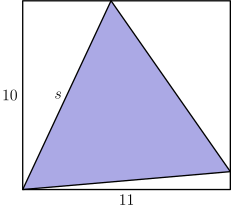
Dividing, and expanding the left side gives so (about a legal tilt). Then
The area is which indeed beats the untilted triangle of side Thus
Problem 15 in other years
- 1983 AIME
- 1984 AIME
- 1985 AIME
- 1986 AIME
- 1987 AIME
- 1988 AIME
- 1989 AIME
- 1990 AIME
- 1991 AIME
- 1992 AIME
- 1993 AIME
- 1994 AIME
- 1995 AIME
- 1996 AIME
- 1998 AIME
- 1999 AIME
- 2000 AIME I
- 2000 AIME II
- 2001 AIME I
- 2001 AIME II
- 2002 AIME I
- 2002 AIME II
- 2003 AIME I
- 2003 AIME II
- 2004 AIME I
- 2004 AIME II
- 2005 AIME I
- 2005 AIME II
- 2006 AIME I
- 2006 AIME II
- 2007 AIME I
- 2007 AIME II
- 2008 AIME I
- 2008 AIME II
- 2009 AIME I
- 2009 AIME II
- 2010 AIME I
- 2010 AIME II
- 2011 AIME I
- 2011 AIME II
- 2012 AIME I
- 2012 AIME II
- 2013 AIME I
- 2013 AIME II
- 2014 AIME I
- 2014 AIME II
- 2015 AIME I
- 2015 AIME II
- 2016 AIME I
- 2016 AIME II
- 2017 AIME I
- 2017 AIME II
- 2018 AIME I
- 2018 AIME II
- 2019 AIME I
- 2019 AIME II
- 2020 AIME I
- 2020 AIME II
- 2021 AIME I
- 2021 AIME II
- 2022 AIME I
- 2022 AIME II
- 2023 AIME I
- 2023 AIME II
- 2024 AIME I
- 2024 AIME II
- 2025 AIME I
- 2025 AIME II
- 2026 AIME I
- 2026 AIME II