
1997 AIME Solutions
Scroll down to view professionally curated solutions from LIVE by Po-Shen Loh, print PDF solutions, view answer key, or take the full timed exam.
All problems are used with official legal permission of the Mathematical Association of America (MAA).
1.
How many of the integers between and inclusive, can be expressed as the difference of the squares of two nonnegative integers?
Small Hint:
Factor and note the two factors always have the same parity
Big Hint:
Odd numbers and multiples of are all achievable; numbers that are more than a multiple of are not
Solution:
Write The factors and differ by the even number so they have the same parity. If both are odd, is odd; if both are even, is divisible by Hence no integer is a difference of two squares.
Conversely, every odd number equals and every multiple of say equals (with since ).
Between and there are odd numbers and multiples of for a total of
2.
The nine horizontal and nine vertical lines on an checkerboard form rectangles, of which are squares. The number can be written in the form where and are relatively prime positive integers. Find
Small Hint:
A rectangle is determined by choosing of the horizontal lines and of the vertical lines
Big Hint:
There are squares of size sum over to
Solution:
A rectangle is determined by choosing two of the nine horizontal lines and two of the nine vertical lines, so
A square can be placed in positions, so
Then which is in lowest terms, so
3.
Sarah intended to multiply a two-digit number and a three-digit number, but she left out the multiplication sign and simply placed the two-digit number to the left of the three-digit number, thereby forming a five-digit number. This number is exactly nine times the product Sarah should have obtained. What is the sum of the two-digit number and the three-digit number?
Small Hint:
If the two-digit number is and the three-digit number is the five-digit number is
Big Hint:
Rewrite as since the factor must divide
Solution:
Let be the two-digit number and the three-digit number. The condition is which rearranges to Since the number must divide
For a two-digit runs from to and The only divisor of in that range congruent to modulo is giving and which is indeed a three-digit number. Check:
The requested sum is
4.
Circles of radii and are mutually externally tangent, where and are relatively prime positive integers. Find
Small Hint:
The two radius- centers are apart, and the other two centers both lie on the perpendicular bisector of that segment
Big Hint:
Right triangles give midpoint distances and rule out opposite sides before subtracting them
Solution:
Let the radius- circles have centers and so and let be the midpoint. The radius- circle’s center satisfies so lies on the perpendicular bisector of at distance from Likewise the fourth circle, of radius has its center on the same perpendicular bisector with so
The centers and cannot lie on opposite sides of that would give hence but squaring would yield contrary to Nor can lie beyond since then would force which is incompatible with Thus lies between and and external tangency to the radius- circle gives Then and squaring yields so and
Thus
5.
The number can be expressed as a four-place decimal where and represent digits, any of which could be zero. It is desired to approximate by a fraction whose numerator is or and whose denominator is an integer. The closest such fraction to is What is the number of possible values for
Small Hint:
Find the fractions with numerator or closest to on each side
Big Hint:
must be closer to than to or count four-place decimals between and
Solution:
Among fractions with numerator or the closest neighbors of are below (note ) and above (note ); no other candidate lies between them. So is the unique closest fraction to exactly when is closer to than to both and i.e. when lies strictly between the midpoints and
The four-place decimals in that interval are and there are of them.
6.
Point is in the exterior of the regular -sided polygon and is an equilateral triangle. What is the largest value of for which and are consecutive vertices of a regular polygon?
Small Hint:
The -gon’s interior angle, the angle, and together fill at
Big Hint:
Setting equal to the interior angle of a regular -gon gives so must divide
Solution:
Since is outside the -gon, the angles at — the interior angle the equilateral angle and — fill a full revolution, so Also since both equal the side of the -gon.
For to be consecutive vertices of a regular -gon, this angle must be the -gon’s interior angle: which simplifies to so
Thus must divide and the largest choice is i.e. (with ).
7.
A car travels due east at mile per minute on a long, straight road. At the same time, a circular storm, whose radius is miles, moves southeast at mile per minute. At time the center of the storm is miles due north of the car. At time minutes, the car enters the storm circle, and at time minutes, the car leaves the storm circle. Find
Small Hint:
Set up coordinates: the car is at and the storm center at
Big Hint:
Entering and leaving happen when the squared distance equals that is a quadratic in so use Vieta’s formulas for
Solution:
Put the car at the origin at with east as the positive -direction and north as the positive -direction. At time the car is at and the storm center, moving southeast at speed (components east and south), is at
The car is on the storm boundary when the squared distance is that is or
The roots are and so by Vieta’s formulas and
8.
How many different arrays whose entries are all ’s and ’s have the property that the sum of the entries in each row is and the sum of the entries in each column is
Small Hint:
Record each row by the pair of columns holding its ’s, and split into cases by how row overlaps row
Big Hint:
When rows and share or columns, count how many ways rows and can finish the columns
Solution:
Each row must contain two ’s and two ’s, so identify each row with the pair of columns holding its ’s; each column must end up chosen by exactly two rows. There are choices for row Classify by how row overlaps row
If row uses the same pair ( way), those two columns are full, so rows and must both use the complementary pair: completion. If row uses the complementary pair ( way), every column has one so far, so rows and need only be a complementary pair themselves: choices for row row forced, giving completions. If row shares exactly one column with row ( ways), one column is full, two have one and one is empty; rows and must each take the empty column together with one of the two half-filled columns, so there are completions.
The total is
9.
Given a nonnegative real number let denote the fractional part of that is, where denotes the greatest integer less than or equal to Suppose that is positive, and Find the value of
Small Hint:
Since and the condition says
Big Hint:
The cubic factors with root use repeatedly to reduce
Solution:
From we get so and while The condition becomes i.e. which factors as Since we get the golden ratio, and indeed lies in
Using repeatedly: and Also from
Therefore
10.
Every card in a deck has a picture of one shape — circle, square, or triangle, which is painted in one of the three colors — red, blue, or green. Furthermore, each color is applied in one of three shades — light, medium, or dark. The deck has cards, with every shape-color-shade combination represented. A set of three cards from the deck is called complementary if all of the following statements are true:
• Either each of the three cards has a different shape or all three of the cards have the same shape.
• Either each of the three cards has a different color or all three of the cards have the same color.
• Either each of the three cards has a different shade or all three of the cards have the same shade.
How many different complementary three-card sets are there?
Small Hint:
Check that any two distinct cards are completed to a complementary set by exactly one third card
Big Hint:
Count pairs of cards, then figure out how many different pairs give rise to the same three-card set
Solution:
Given any two distinct cards, there is exactly one card completing them to a complementary set: in each attribute, if the two cards agree, the third card must share that value, and if they differ, the third must take the one remaining value. The completing card is distinct from both (the two given cards differ somewhere, and in that attribute the third card differs from each).
So the pairs of cards each extend to one complementary set, and each complementary set is produced by of these pairs. The number of sets is
11.
Let What is the greatest integer that does not exceed
Small Hint:
Multiply numerator and denominator by and telescope using product-to-sum identities
Big Hint:
Sum-to-product turns the result into which the half-angle formula evaluates exactly
Solution:
Multiply numerator and denominator by Since and both sums telescope: using the sum-to-product identities in the last step.
By the half-angle formula, Since we have Therefore the greatest integer not exceeding is
12.
The function defined by where and are nonzero real numbers, has the properties and for all values except Find the unique number that is not in the range of
Small Hint:
means is its own inverse; comparing coefficients forces
Big Hint:
and are the roots of and the missing value is the horizontal asymptote
Solution:
Composing, and this equals identically only if Since we get so
A fixed point satisfies i.e. whose roots are and By Vieta’s formulas, so
Finally, is in the range exactly when has a solution, i.e. This solves for unless and when the right side is nonzero (otherwise the fractional-linear expression would be degenerate, contrary to its two distinct fixed points). So the unique number not in the range is
13.
Let be the set of points in the Cartesian plane that satisfy If a model of were built from wire of negligible thickness, then the total length of wire required would be where and are positive integers and is not divisible by the square of any prime number. Find
Small Hint:
For the expression equals and for it equals
Big Hint:
The graph is a union of diamonds count the possible centers and multiply by one diamond’s perimeter
Solution:
Let so the equation is The function is even, and for on so on and for which is too large. So on the relevant range, where is the nearest of those four values to
Therefore is the union of the taxicab circles which meet only at isolated points. Each is a square (diamond) with diagonal hence side and perimeter
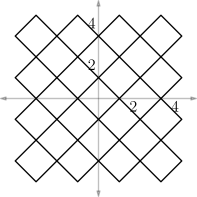
The total length is so
14.
Let and be distinct, randomly chosen roots of the equation Let be the probability that where and are relatively prime positive integers. Find
Small Hint:
Fix if then
Big Hint:
Since count with or
Solution:
By rotational symmetry we may fix and let with uniform in Then Also so the threshold is
The condition holds exactly when is within of or of i.e. or That gives favorable values of
The probability is and is prime, so
15.
The sides of rectangle have lengths and An equilateral triangle is drawn so that no point of the triangle lies outside The maximum possible area of such a triangle can be written in the form where and are positive integers, and is not divisible by the square of any prime number. Find
Small Hint:
The largest triangle is tilted, with one vertex at a corner of the rectangle and the other two on the far sides
Big Hint:
With side tilted above the length- side, and solve for
Solution:
By reflecting or rotating the configuration, take one side of the equilateral triangle to make an angle with the length- side of the rectangle. A triangle of side in this orientation has horizontal and vertical spans and respectively. Hence The first bound increases with and the second decreases, so their minimum is largest when they are equal. This bound is attainable by putting one vertex at a corner and the other two on the far sides, giving
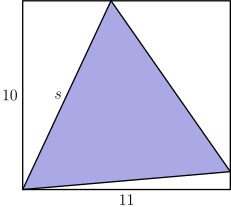
Dividing, and expanding the left side gives so (about a legal tilt). Then
The area is which indeed beats the untilted triangle of side Thus