
1992 AIME Problem 12
Attempt Problem 12 of the 1992 AIME below, then check your answer against the professionally curated solution from LIVE by Po-Shen Loh. You can also try the full timed exam, view all 1992 AIME solutions, or check the answer key.
All problems are used with official legal permission of the Mathematical Association of America (MAA).
12.
In a game of Chomp, two players alternately take bites from a -by- grid of unit squares. To take a bite, a player chooses one of the remaining squares, then removes (“eats”) all squares in the quadrant defined by the left edge (extended upward) and the lower edge (extended rightward) of the chosen square. For example, the bite determined by the shaded square in the diagram would remove the shaded square and the four squares marked by (The squares with two or more dotted edges have been removed from the original board in previous moves.)
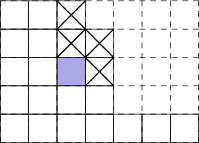
The object of the game is to make one’s opponent take the last bite. The diagram shows one of the many subsets of the set of unit squares that can occur during the game of Chomp. How many different subsets are there in all? Include the full board and empty board in your count.
Answer: 792
Small Hint:
A reachable set is determined by nonincreasing column heights between and
Big Hint:
Encode the boundary of such a set as a lattice path with vertical and horizontal steps
Solution:
After any sequence of bites, the remaining squares form a lower-left order ideal: the seven column heights are nonincreasing integers between and Conversely, every such boundary can be produced and corresponds to a lattice path across a -by- rectangle. Each path consists of vertical and horizontal steps, so the number of states, including full and empty, is
Problem 12 in Other Years
1983 AIME · 1984 AIME · 1985 AIME · 1986 AIME · 1987 AIME · 1988 AIME · 1989 AIME · 1990 AIME · 1991 AIME · 1993 AIME · 1994 AIME · 1995 AIME · 1996 AIME · 1997 AIME · 1998 AIME · 1999 AIME · 2000 AIME I · 2000 AIME II · 2001 AIME I · 2001 AIME II · 2002 AIME I · 2002 AIME II · 2003 AIME I · 2003 AIME II · 2004 AIME I · 2004 AIME II · 2005 AIME I · 2005 AIME II · 2006 AIME I · 2006 AIME II · 2007 AIME I · 2007 AIME II · 2008 AIME I · 2008 AIME II · 2009 AIME I · 2009 AIME II · 2010 AIME I · 2010 AIME II · 2011 AIME I · 2011 AIME II · 2012 AIME I · 2012 AIME II · 2013 AIME I · 2013 AIME II · 2014 AIME I · 2014 AIME II · 2015 AIME I · 2015 AIME II · 2016 AIME I · 2016 AIME II · 2017 AIME I · 2017 AIME II · 2018 AIME I · 2018 AIME II · 2019 AIME I · 2019 AIME II · 2020 AIME I · 2020 AIME II · 2021 AIME I · 2021 AIME II · 2022 AIME I · 2022 AIME II · 2023 AIME I · 2023 AIME II · 2024 AIME I · 2024 AIME II · 2025 AIME I · 2025 AIME II · 2026 AIME I · 2026 AIME II