
1992 AIME Problems
Scroll down and press Start to try the exam! Or, go to the printable PDF, answer key, or professional solutions curated by LIVE by Po-Shen Loh.
All problems are used with official legal permission of the Mathematical Association of America (MAA).
Or jump straight to a single problem with its solution: 1 · 2 · 3 · 4 · 5 · 6 · 7 · 8 · 9 · 10 · 11 · 12 · 13 · 14 · 15
Want to learn professionally through interactive video classes?
Timed
3:00:00
1.
Find the sum of all positive rational numbers that are less than and that have denominator when written in lowest terms.
Answer: 400
Small Hint:
Write every number as and impose the condition
Big Hint:
Group the eligible numerators into ten blocks of length
Solution:
The numbers are for and There are eligible residues in each block of and their sum is Thus the sum of all eligible numerators is Dividing by gives
2.
A positive integer is called ascending if, in its decimal representation, there are at least two digits and each digit is less than any digit to its right. How many ascending positive integers are there?
Answer: 502
Small Hint:
Once a set of nonzero digits is chosen, their order is forced
Big Hint:
Exclude subsets of sizes and from the subsets of
Solution:
The digit cannot occur, because it would have to be the first digit and leading zeroes are not part of a decimal representation. Every subset of at least two digits from gives exactly one ascending integer when written in increasing order. Hence the number is
3.
A tennis player computes her win ratio by dividing the number of matches she has won by the total number of matches she has played. At the start of a weekend, her win ratio is exactly During the weekend, she plays four matches, winning three and losing one. At the end of the weekend, her win ratio is greater than What’s the largest number of matches she could’ve won before the weekend began?
Answer: 164
Small Hint:
If she had wins initially, a ratio means she had played matches
Big Hint:
Translate the final ratio into a strict inequality before taking the largest integer
Solution:
If she initially had wins, then she had played matches. The final condition is Cross-multiplication gives so and The largest possible integer is
4.
In Pascal’s Triangle, each entry is the sum of the two entries above it. The first few rows of the triangle are shown below.
In which row of Pascal’s Triangle do three consecutive entries occur that are in the ratio
Answer: 62
Small Hint:
Represent the three entries as and
Big Hint:
Use the ratios of consecutive binomial coefficients to obtain two linear equations in and
Solution:
For three consecutive entries beginning at position Thus and Solving gives and
5.
Let be the set of all rational numbers that have a repeating decimal expansion in the form where the digits and are not necessarily distinct. To write the elements of as fractions in lowest terms, how many different numerators are required?
Answer: 660
Small Hint:
Every element has the form , and its reduced denominator must divide
Big Hint:
Count numerators coprime to , then check which additional multiples of can occur with denominator
Solution:
Every element is for Any coprime to occurs as a reduced numerator with denominator giving values. If is divisible by but not it can be coprime to a reduced denominator only when that denominator is this adds the multiples of below A numerator divisible by would need a denominator dividing and larger than it, so no further values occur. Therefore the total is
6.
For how many pairs of consecutive integers in is no carrying required when the two integers are added?
Answer: 156
Small Hint:
Write the smaller integer as and separate cases by the number of trailing s
Big Hint:
A digit that is unchanged must be at most , and the digit increased by must also pair without a carry
Solution:
Write the smaller number as If then and the unchanged digits and are each at most giving pairs. If but then and giving pairs. If but there are choices for Finally, also needs no carry. The total is
7.
Faces and of tetrahedron meet at an angle of The area of face is the area of face is and Find the volume of the tetrahedron.
Answer: 320
Small Hint:
Find the altitudes from and to the common edge
Big Hint:
The height from to plane is its face altitude multiplied by
Solution:
The altitudes to in faces and are and respectively. Because the dihedral angle is the perpendicular height from to plane is Using face as the base, the volume is
8.
For any sequence of real numbers define to be the sequence whose th term is Suppose that all of the terms of the sequence are and that Find
Small Hint:
A sequence with constant second difference is given by a quadratic with leading coefficient
Big Hint:
Use the two zero terms to write the quadratic in factored form
Solution:
A quadratic sequence with second difference has leading coefficient Since its values vanish at indices and Therefore
9.
Trapezoid has sides and with parallel to A circle with center on is drawn tangent to and Given that where and are relatively prime positive integers, find
Answer: 164
Small Hint:
Put on the -axis and compare the distances from to the two legs
Big Hint:
The common trapezoid height cancels, leaving an equation involving and divided by the leg lengths
Solution:
Put and let the height of the trapezoid be If its perpendicular distances to legs and are and respectively. Tangency to both legs makes these equal, so Hence and Therefore
10.
Consider the region in the complex plane that consists of all points such that both and have real and imaginary parts between and inclusive. What is the integer that is nearest the area of
Answer: 572
Small Hint:
Write ; the first condition gives a square, and the second gives two circle inequalities
Big Hint:
Subtract from the -by- square the union of two semicircles, accounting for their lens-shaped overlap
Solution:
Write The condition on gives and Since the other condition requires and Thus, within the square, we remove two semicircles of radius
Their overlap is the lens formed by two radius- circles whose centers are apart. Its area is Hence the removed union has area , or Let denote the area of Then The nearest integer is
11.
Lines and both pass through the origin and make first-quadrant angles of and radians, respectively, with the positive -axis. For any line the transformation produces another line as follows: is reflected in and the resulting line is reflected in Let and Given that is the line find the smallest positive integer for which
Answer: 945
Small Hint:
Two reflections in intersecting lines compose to a rotation through twice the angle between the lines
Big Hint:
An unoriented line returns to itself when its accumulated rotation is a multiple of
Solution:
The composition is rotation through A line through the origin is unchanged by a rotation exactly when the rotation angle is a multiple of Thus must satisfy Since the least such is
12.
In a game of Chomp, two players alternately take bites from a -by- grid of unit squares. To take a bite, a player chooses one of the remaining squares, then removes (“eats”) all squares in the quadrant defined by the left edge (extended upward) and the lower edge (extended rightward) of the chosen square. For example, the bite determined by the shaded square in the diagram would remove the shaded square and the four squares marked by (The squares with two or more dotted edges have been removed from the original board in previous moves.)
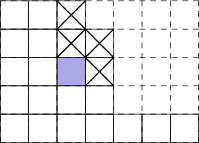
The object of the game is to make one’s opponent take the last bite. The diagram shows one of the many subsets of the set of unit squares that can occur during the game of Chomp. How many different subsets are there in all? Include the full board and empty board in your count.
Answer: 792
Small Hint:
A reachable set is determined by nonincreasing column heights between and
Big Hint:
Encode the boundary of such a set as a lattice path with vertical and horizontal steps
Solution:
After any sequence of bites, the remaining squares form a lower-left order ideal: the seven column heights are nonincreasing integers between and Conversely, every such boundary can be produced and corresponds to a lattice path across a -by- rectangle. Each path consists of vertical and horizontal steps, so the number of states, including full and empty, is
13.
Triangle has and What’s the largest area that this triangle can have?
Answer: 820
Small Hint:
Set and use the Law of Cosines with
Big Hint:
Express the area as a function of and maximize its square
Solution:
Set and The Law of Cosines gives while the area is Hence it equals Differentiating its logarithm shows the maximum occurs at Then and so the maximum area is
14.
In triangle and are on the sides and respectively. Given that and are concurrent at the point and that find
Answer: 94
Small Hint:
Let be normalized barycentric coordinates of
Big Hint:
Write the three ratios as , , and
Solution:
Let be the barycentric coordinates of Then Expanding both sides using gives the standard identity Since the requested product is
15.
Define a positive integer to be a factorial tail if there is some positive integer such that the decimal representation of ends with exactly zeroes. How many positive integers less than are not factorial tails?
Answer: 396
Small Hint:
Let , the number of trailing zeroes in
Big Hint:
Every positive value attained by first appears at a multiple , where
Solution:
The number of trailing zeroes is Its positive distinct values occur at the multiples and is strictly increasing with Now so For the same calculation gives hence Therefore exactly positive values through are factorial tails. Of the positive integers below the number omitted is